You’ll discover Parkland’s haunting legacy along rural Lincoln County roads, where complete abandonment since 2013 left behind rubble-strewn landscapes scarred by mine subsidence and tornado destruction. Visit during April-May or September-October for comfortable exploration, packing recovery gear, camping supplies, and photography equipment for this isolated destination four miles south of Agra. Navigate gravel roads to capture crumbling facades during golden hour, but exercise extreme caution around collapse-prone structures with lead contamination. This guide reveals essential routes, safety protocols, and photographic techniques for documenting Oklahoma’s most desolate ghost town.
Key Takeaways
- Visit during April-May or September-October for comfortable temperatures, clear skies, and fewer crowds at this abandoned settlement.
- Access Parkland via gravel farm roads 4 miles south of Agra, using GPS coordinates due to limited signage.
- Pack recovery gear including tow rope, tools, first aid kit, and camping supplies for this remote, isolated location.
- Photograph crumbling structures during golden hour using f/8-f/11, wearing protective masks and steel-toe boots for safety.
- Note that Parkland was officially unincorporated in 2013 with zero residents due to mine subsidence and contamination.
What Makes Parkland a True Oklahoma Ghost Town
When you stand amid the rubble-strewn landscape of Parkland, Oklahoma, you’re witnessing a textbook example of a true American ghost town—a place where 14,000 souls once carved their livelihoods from zinc-rich earth, now reduced to silence and ruins.
The 1950 Main Street cave-in proved you can’t build prosperity over hollowed ground. Subsidence from abandoned mine shafts created sinkholes that swallowed buildings whole, while mountainous chat piles poisoned the soil.
Then came 2008’s 170-mph tornado, killing seven and obliterating what remained. Today’s hazardous site conditions stem from lead contamination requiring federal superfund designation. Despite ongoing ecological restoration efforts, Parkland earns its ghost town status through complete abandonment—officially unincorporated in 2013, with zero residents where thousands once thrived.
Best Time of Year to Visit Parkland
Planning your visit to Parkland’s haunting remains requires careful consideration of Oklahoma’s dramatic seasonal shifts. April through May and September through October deliver ideal conditions—comfortable temperatures for exploring weathered buildings while seasonal variations in visitor crowds guarantee you’ll wander solitary dirt roads.
Spring and fall offer prime exploration of Parkland’s weathered ruins—comfortable temperatures and sparse crowds deliver authentic solitude among abandoned streets.
Early June offers sweet spots: highs in the 70s, cheaper lodging, and 16 hours of daylight before tourism surges mid-month.
Winter transforms the ghost town into a peaceful retreat where crisp air and golden fields create unforgettable solitude. Weather impact on road conditions remains minimal year-round; 2WD vehicles access Parkland’s grid roads in normal Oklahoma climate.
Avoid peak summer’s Memorial Day through August rush. Instead, choose shoulder seasons when you’ll discover faded structures beneath clear skies, connecting with history on your terms.
Essential Gear and Supplies for Your Trip
Every successful ghost town expedition hinges on what you pack before leaving pavement behind. Your vehicle maintenance checklist starts with recovery essentials—tow rope, kinetic strap, and shackles for extracting yourself from Oklahoma’s red clay.
Pack a basic tool kit with wrenches, socket set, and duct tape for trail-side repairs. Don’t skip the hydraulic jack and puncture repair kit.
Remote camping considerations demand self-sufficiency. You’ll need a sleeping bag rated twenty degrees below expected temps, plus a quality sleeping pad from brands like Nemo.
Bring your camp stove with spare fuel, water filter, and jerry cans. A portable compressor keeps tires properly inflated on rough roads. Add headlamps, first aid supplies, and a fire extinguisher—Parkland’s isolation offers no safety net.
Driving Routes and Road Conditions to Parkland
From Chandler, Oklahoma, your journey to Parkland ghost town begins on rural Lincoln County roads that slice through rolling prairie where red soil meets vast sky. You’ll navigate northeast approximately four miles, following routes that once connected thriving communities but now see sparse traffic.
Expect gravel road conditions along certain stretches—these unpaved surfaces demand careful attention, especially after rain when ruts deepen and dust clouds rise. Limited signage marks your way; modern GPS coordinates (35°50′24″N 96°50′32″W) prove essential since historical markers have long vanished.
The ghost town sits just four miles south of Agra, accessible via local farm roads that wind through open pastureland where Parkland’s streets once bustled. This quiet isolation defines your adventure—freedom found where civilization retreated.
Historical Background of Parkland’s Abandonment

You’ll find Parkland’s story mirrors countless Oklahoma settlements that sprouted during the territory’s town-building frenzy, likely influenced by railroad routes or ambitious promoters seeking fortune. The town’s exact founding remains lost to time, but economic forces—whether shifting rail lines, failed business ventures, or the all-too-familiar boom-and-bust cycle—eventually strangled its lifeline.
As opportunities dried up and hope faded, residents packed their belongings and scattered, leaving behind empty buildings that now stand as weathered monuments to dreams that couldn’t survive.
Early Settlement and Growth
Long before Parkland’s streets fell silent, the region belonged to the Osage tribe until an 1825 treaty stripped away their hunting rights. You’ll find the area’s settlement story begins with displacement—Creek and Seminole tribes replaced the Osage, only to lose their lands through 1866 Reconstruction Treaties. The federal government then resettled Sac and Fox, Potawatomi, Kickapoo, and Iowa tribes here.
The Sac and Fox Agency infrastructure emerged in 1870 as the region’s first settlement, providing law enforcement, education, and government services. A decade later, Wellston Trading Post founding in 1880 marked the first white settlement. When the Jerome Commission negotiated individual allotments in 1890, approximately 20,000 settlers stormed these lands during the September 22, 1891 run, claiming 6,097 homesteads and transforming Native territory into pioneer country.
Economic Decline Triggers
The perfect storm that emptied Parkland’s streets began with dust-choked fields and plummeting crop prices. You’ll understand why families abandoned their homesteads when you consider that Oklahoma lost 18.4% of its population during the 1930s—440,000 people fleeing economic devastation.
Farm prices crashed 30% while taxes remained crushing, creating commodity surpluses that drove values even lower. One Nebraska farm mortgaged at $4,100 sold for just $49.50. Bank failures swept across the state as over 750,000 farms nationwide faced foreclosure between 1930-1935.
The AAA program paradoxically worsened the exodus, letting landlords evict tenant farmers and pocket government payments. What you’ll find in Parkland today reflects this mass displacement—empty buildings standing as monuments to economic collapse.
Final Population Exodus
While economic devastation planted the seeds of Parkland’s demise, the actual exodus unfolded across decades in slow, grinding waves. You’ll trace this demographic shift through census records: 270 souls in 1930 dwindling to just 90 by 2020—a staggering 66% collapse.
The economic realities hit hardest between 1940 and 1970, when population plummeted from 256 to 126. By 1983, the post office shuttered. The school followed in 1984, forcing children onto buses bound for Stroud.
You’re witnessing a pattern mirrored across Oklahoma’s rural counties—Roger Mills lost 75.70% of residents, Seminole 70.41%. While statewide population surged 6.9% between 2010 and 2022, Parkland’s remaining residents packed their belongings and chased opportunities elsewhere.
What Remains: Buildings and Structures to Explore
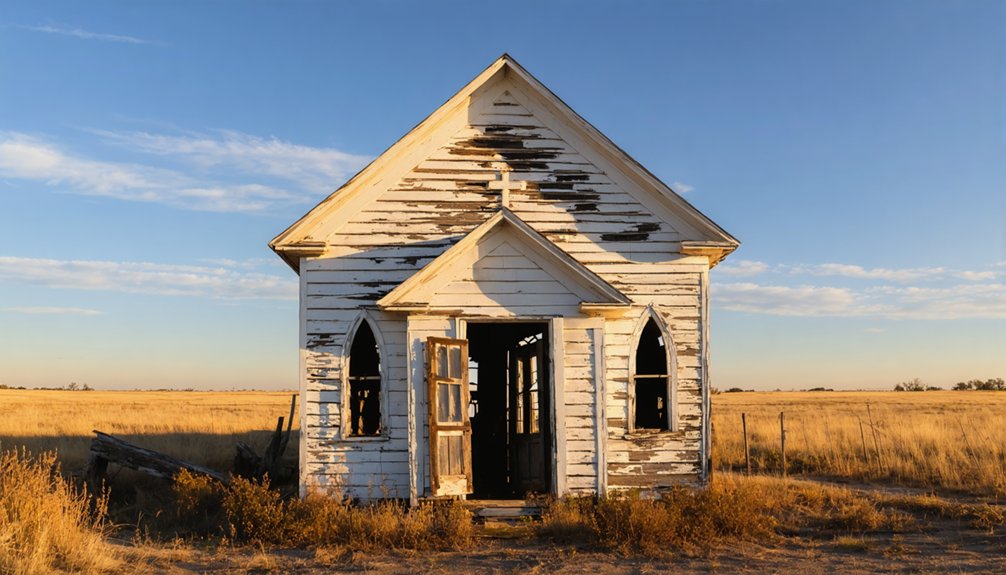
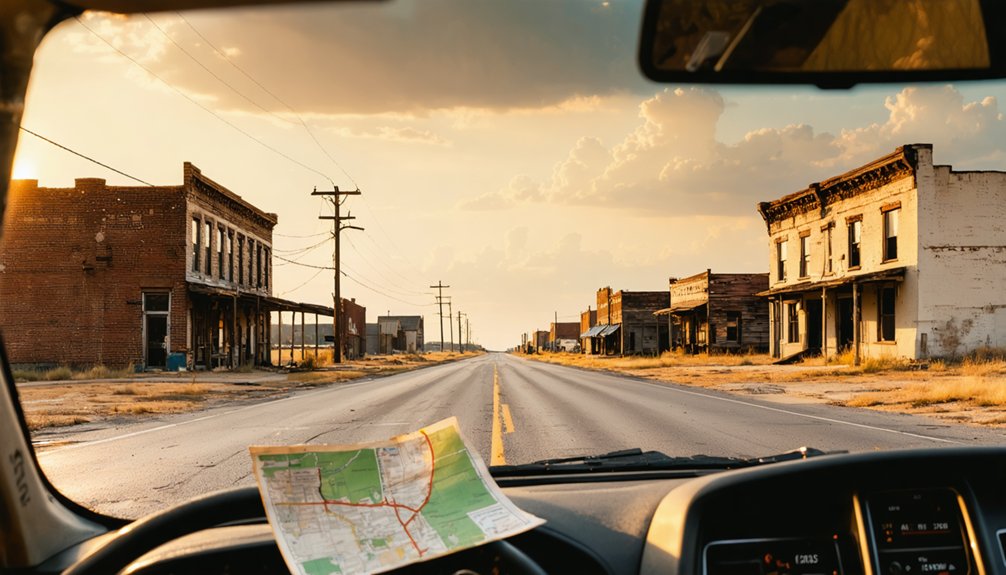
Visitors to Parkland today will find a haunting landscape where nature has reclaimed most of what once stood. Main Street’s empty, overgrown lots sprawl across dozens of blocks, creating an eerie ghost town atmosphere.
You’ll discover clusters of collapsed houses—typically five to eight buildings together—though structural stability assessments reveal they’re far too dangerous to enter. The interiors remain mysteries, as roofs have caved in on these abandoned dwellings.
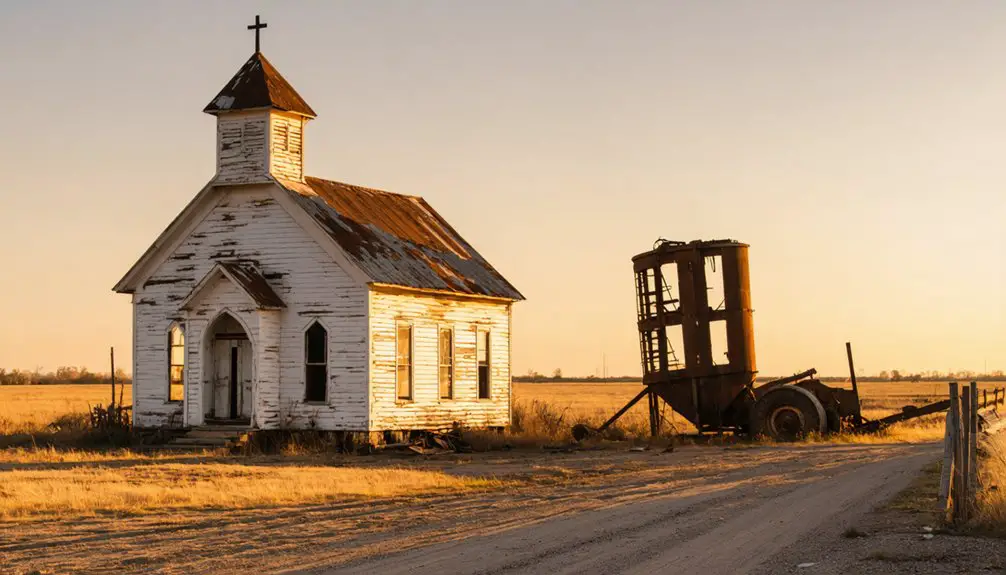
A solitary one-room church stands with its interior completely stripped, while scattered sheds and barn foundations dot the landscape. Factory foundations mark where massive smelters once dominated the skyline, surrounded by towering chat piles.
As of 2011, six defiant homes remained, their owners refusing buyouts despite 86% of structures being undermined and collapse-prone.
Photography Tips for Capturing Parkland’s Ruins
When you’re photographing Parkland’s crumbling facades, skip the harsh midday sun and wait for golden hour—those first and last hours of daylight will paint the weathered wood and rusted metal in warm, dramatic tones that bring out every texture.
Frame your shots through broken windows, collapsed doorways, and fractured walls to create compositions that use the decay itself as a natural border, drawing viewers deeper into the scene.
Before you step inside any structure or climb onto a roof for that perfect angle, test floorboards with your weight, watch for protruding nails and unstable beams, and always keep a clear exit path in sight.
Best Golden Hour Lighting
The crumbling facades of Parkland’s abandoned buildings transform into photographer’s gold during those fleeting moments when the sun hovers near the horizon. You’ll find ideal conditions around 7:00-8:00 AM or 6:00-7:00 PM, when warm 3500-5000K light bathes weathered brickwork in golden-orange hues.
Your careful camera setup matters—shoot at f/8-f/11 with ISO 100-400 to capture crisp details from foreground rubble to distant structures. Complementary lighting angles reveal everything: side-lighting exposes peeling paint, backlighting creates dramatic silhouettes through broken windows, and rim lighting outlines rusted metal against overgrown vegetation.
Position yourself low to harness elongated shadows as leading lines toward key ruins. Winter extends this magic to 75 minutes, giving you more freedom to explore Parkland’s eerie abandonment without rushing your compositions.
Composition Through Decay
Framing your shots through Parkland’s deteriorating doorways and shattered window frames creates natural vignettes that draw viewers into the ghost town’s narrative. You’ll discover stark contrasts between crumbling plaster and weathered wood grain, each texture telling stories of abandonment.
Position yourself to capture peeling paint as foreground interest, leading eyes deeper into collapsed rooms beyond. The moody lighting filtering through broken roofs illuminates dust particles, adding atmospheric depth to your compositions.
Focus on diagonal lines created by sagging beams and tilted structures—they inject dynamic energy into static ruins. Don’t overlook small details: rusted hinges, fractured glass patterns, and nature reclaiming man-made spaces. These elements transform simple documentation into compelling visual storytelling that celebrates both decay and the wild spirit of forgotten places.
Safety While Shooting
Capturing Parkland’s haunting beauty demands more than just a keen photographic eye—it requires treating these decaying structures with the caution they deserve. Before framing that perfect shot, conduct thorough structural stability assessments by checking for roof collapses, compromised flooring, and deteriorating stairs that might betray you mid-shoot. Your P3-rated dust mask isn’t just recommended—it’s essential protection against airborne asbestos and mold spores lurking in these forgotten spaces.
Hazardous material precautions extend beyond breathing protection. Steel-toe boots shield against hidden rusty nails, while heavy-duty gloves let you steady yourself against contaminated surfaces without risk. Never sacrifice safety for the shot by venturing into basements or onto questionable upper floors. Pack your first aid kit, share your location, and remember: the best photographs are ones you live to edit.
Safety Precautions When Exploring Abandoned Sites
While ghost towns like Parkland may seem frozen in time and harmless, abandoned buildings harbor dangers that demand serious respect. You’ll face structural collapse risks, rotted floors, and unstable walls that threaten your safety with every step.
Before exploring, understand that these sites attract unauthorized occupants and criminal activity—drug violations spike 3.2 times in areas with unsecured vacant buildings.
Essential safety precautions include never entering alone, wearing sturdy boots for fall hazards, and carrying a powerful flashlight. Watch for vermin infestations and standing water in basements. Most critically, respect securing access points—if a building’s boarded up, there’s good reason.
The adventure isn’t worth becoming a statistic. Smart explorers photograph exteriors and move on, preserving both history and their wellbeing.
Nearby Attractions and Other Ghost Towns to Visit
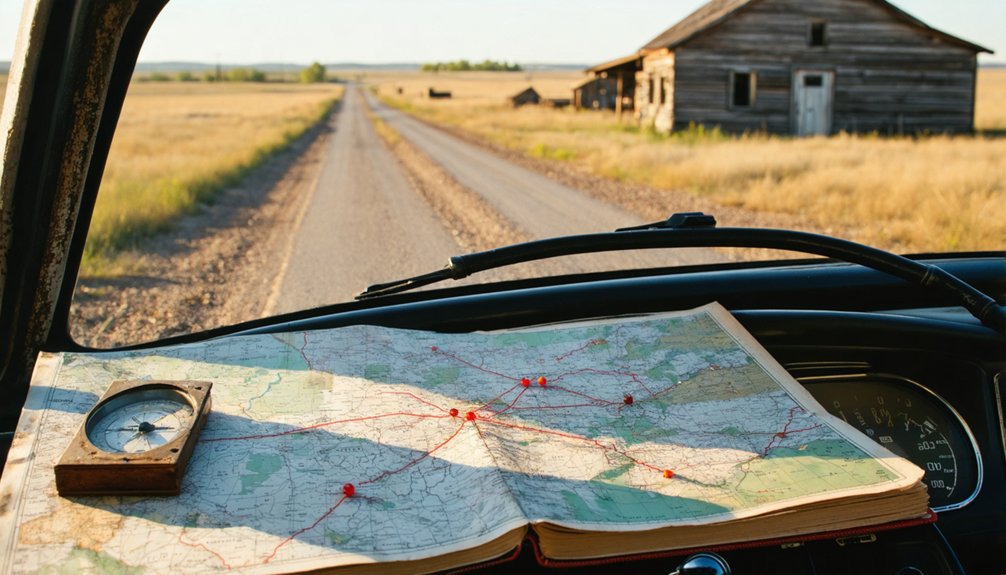
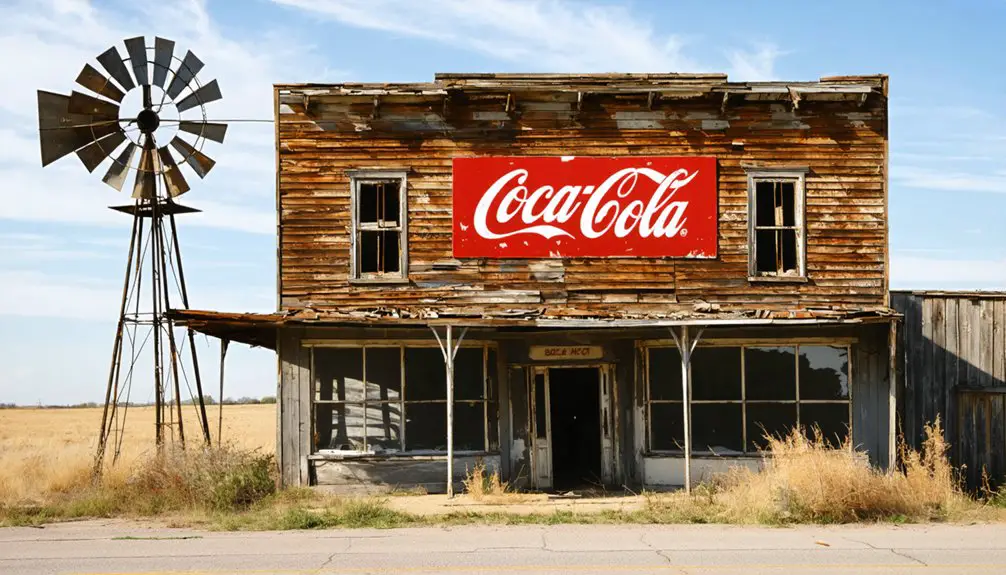
Once you’ve explored Parkland’s solitary general store, Lincoln County reveals a constellation of forgotten settlements that transform a single stop into a full-day adventure.
Ten miles east of Stillwater, Ingalls beckons with crumbling Wild West saloons where outlaws once roamed. Shamrock anchors a multi-county circuit threading through Creek, Payne, and Pawnee territories, while Avery’s Immanuel Lutheran Church stands sentinel over weathered headstones. Near Cushing, Happy Valley School represents ghost town preservation efforts, its classroom frozen in time.
Expand your radius and you’ll discover Skedee’s windswept foundations, Orlando’s stubborn community remnants, and Centralia’s prairie bones on Blue Mound. Unlike nearby communities thriving along modern highways, these settlements surrendered to progress—leaving you free to wander their silent streets and imagine Oklahoma’s untamed past.
Frequently Asked Questions
Are Overnight Camping or RV Parking Allowed Near Parkland Ghost Town?
Breathe in that sweet freedom—you’ll find overnight accommodations and camping facilities near Parkland Ghost Town, where you can park your RV at designated campgrounds. Stay up to 14 days, then roll onward to new adventures.
What Cell Phone Coverage Can Visitors Expect in the Parkland Area?
You’ll find Verizon offers the strongest cell phone signal strength at 90% coverage, while AT&T and T-Mobile reach about 64%. Pack alternative communication options like satellite messengers or two-way radios for true off-grid freedom in remote areas.
Are There Guided Tours Available for Exploring Parkland Ghost Town?
No guided walking tours exist for Parkland ghost town. You’ll explore independently through empty pastures where structures once stood. Consider nearby self-guided audio tours covering regional ghost towns, or venture westward for organized paranormal investigations instead.
What Dining and Lodging Options Exist Closest to Parkland?
You’ll find irony in ghost town dining: Parkland itself offers nothing. Your nearest local restaurants include The Cafe in Fairland, serving all-you-can-eat fried chicken. Nearby accommodation requires traveling to Yukon or Miami, Oklahoma for lodging options.
Do I Need Special Permits to Access Parkland’s Abandoned Buildings?
You’ll need landowner permission since Parkland’s ruins sit on private property concerns. Safety precautions demand caution around unstable structures. There’s no formal permit system—just respect boundaries, verify ownership with Cotton County officials, and tread carefully through history.