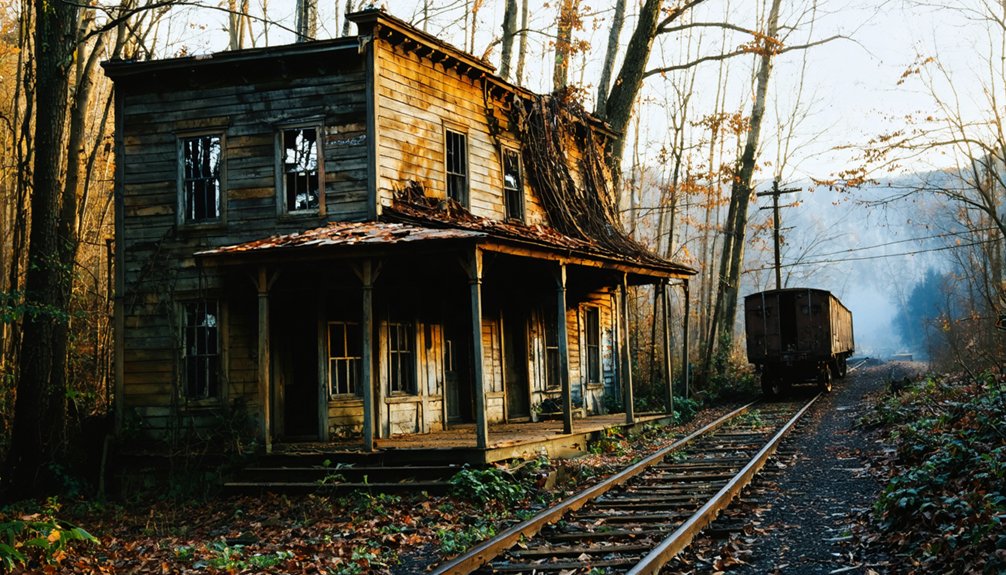
You’ll find Paradise, Kentucky (locally known as Pee Vee) in Muhlenberg County along the Green River, where John Prine’s famous folk song commemorates 800 residents displaced by TVA in 1967. Start at the hilltop cemetery off Highway 176—it’s the only accessible remnant of this coal-mining community buried beneath ash ponds and power plant infrastructure. The actual townsite remains restricted company property, but you can view crumbled foundations and ash-covered landscape from the cemetery overlook, where weathered memorials tell stories of families lost to progress and environmental devastation.
Key Takeaways
- Pee Vee Valley is an incorporated city in Oldham County, Kentucky, not a ghost town available for exploration.
- The ghost town referenced is Paradise, Kentucky, immortalized in John Prine’s 1971 folk song about coal industry devastation.
- Paradise’s townsite remains TVA company property with restricted access, limiting exploration to few publicly accessible areas.
- The hilltop cemetery is the only accessible remnant, offering a small window into Paradise’s vanished community.
- Scattered debris and ash residue mark the former townsite, though most physical remnants remain beyond public reach.
The Rise and Fall of a Kentucky River Town
Tucked along the rolling hills of Oldham County, Pee Vee Valley never actually rose or fell as a river town—because it never was one. You’ll find this incorporated city still thriving since 1870, its story shaped by entirely different forces than river commerce. The settlement earned its quirky name from a pewee bird’s song heard during an early council meeting, establishing its unique character from the start.
Pee Vee Valley’s evolution reflects broader shifts affecting Kentucky communities: agricultural decline transforming rural economies and transportation changes redirecting development patterns. The town persists as a residential community, defying the ghost town narrative while embodying Kentucky’s adaptive spirit through changing times.
When Coal Mining Destroyed a Community
Before coal companies arrived, Pee Vee thrived as a modest river community where families farmed the hillsides and fished the clean waters of Looney Creek.
The Looney Creek Coal Company‘s operations from 1915 to 1934 brought immediate prosperity to 150 residents, but the environmental toll proved catastrophic—polluted waterways, stripped vegetation, and black lung disease ravaged both land and people.
When the Tennessee Valley Authority eventually bought out the decimated town, bulldozers erased what the mines hadn’t already destroyed, leaving only foundations and memories scattered along the creek bed.
Paradise Before the Mines
Long before Wisconsin Steel Company’s agents arrived in Harlan County with land deeds and promises, the hollers around Looney Creek sustained families through a quieter rhythm of subsistence farming, hunting, and modest trade. This quaint mountain setting supported Appalachian communities who controlled their own timber and mineral rights—assets they’d soon surrender for pennies.
Pre industrial daily life centered on self-reliance rather than corporate paychecks. You’ll find that Poor Fork, later renamed Cumberland, operated as a small trading center where neighbors exchanged goods without scrip tokens or company stores dictating terms. The mountaineers lived modestly, yes, but answered to no boss, punched no time clock, and breathed air unsullied by coal dust. Their independence, though materially humble, represented something the coming mining operations would systematically dismantle.
Environmental and Health Devastation
The community health impacts extend far beyond visual blight. Mountaintop removal stripped away nature’s flood protection, contributing over 6 billion gallons of excess water during recent floods.
You’re witnessing the consequences of an industry that prioritized extraction over people, leaving behind contaminated streams, breathing hazards, and multi-billion dollar cleanup costs that bankrupt operators won’t pay.
TVA Buyout and Demolition
When Tennessee Valley Authority executives announced voluntary buyouts for over 600 employees in August 2024, they framed workforce reductions as “Enterprise Transformation”—corporate speak for dismantling the jobs that once sustained communities like Pee Vee. The $40 million severance package, capped at 150 days’ pay, represented TVA’s latest cost-cutting maneuver in its near-billion-dollar efficiency drive.
While CFO Tom Rice boasted that 90-95% of departures would be voluntary, the impact on local economies echoed Pee Vee’s own demise—government priorities shifting without regard for those left behind. The long term community effects mirror what happened when TVA built dams and displaced entire towns: bureaucrats in Knoxville make spreadsheet decisions while real people lose livelihoods. History repeats itself when you’re deemed expendable.
The Song That Made Paradise Unforgettable
In 1971, John Prine transformed a forgotten Kentucky town into an American folk anthem. His debut album featured “Paradise,” a haunting ballad inspired by newspaper reports of Paradise‘s demolition.
You’ll hear Prine’s childhood memories woven through lyrics describing Mr. Peabody’s coal train hauling away both dollars and dreams. The song chronicles the coal industry significance that destroyed an entire community—800 residents bought out by December 1967 so Tennessee Valley Authority could build its fossil plant. Despite cultural preservation efforts, only a hilltop cemetery survived.
Prine’s refrain “sorry Manson but you’re too late” acknowledges failed attempts to save the town. Today, his melody draws you and countless others to this ghost town site, ensuring Paradise’s story resonates beyond the ash-covered landscape where it once thrived.
What Remains of Pee Vee Today
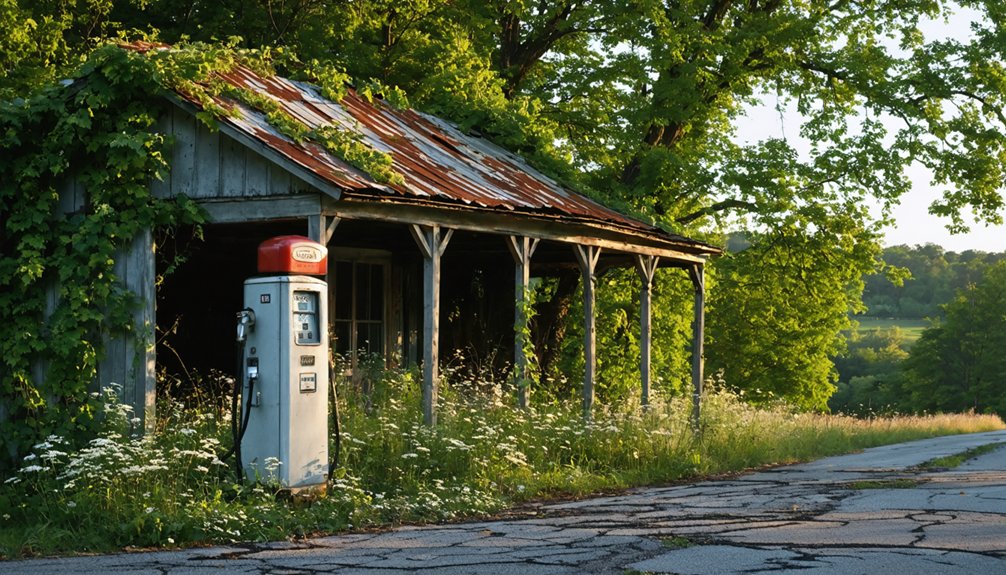
Prine’s melody may have preserved Paradise in memory, but precious little survived in physical form. When you visit Pee Vee today, you’ll find a landscape dominated by TVA’s industrial footprint rather than the community that once thrived here. The small hilltop cemetery stands as your only accessible window into the past, marked by that backwards “Old Town” sign—a poignant reminder of what’s been lost.
Beyond this memorial ground, hidden artifacts are nearly impossible to reach:
- Crumbled wood and brick reduced to gravel
- Disintegrated concrete chunks scattered across restricted land
- Occasional weathered memorials among the debris
- Ash residue from coal plants that drove residents away
- Strip-mined terrain obscuring the original settlement
The old townsite remains company property, keeping most remnant relics forever beyond your reach.
How to Find This Forgotten Settlement
Locating Pee Vee requires traversing unmarked country roads where GPS signals often fail and landmarks matter more than street signs.
You’ll need to watch for the old cemetery that marks the settlement’s heart, positioned roughly a mile from where Green River bends sharply eastward.
Successful ghost town hunters know to study topographical maps beforehand and ask locals at nearby farms for directions, since this Dutch settlement sits well off Kentucky’s beaten path.
While modern GPS might point you toward Hopkins County, finding Pee Vee requires old-school traversing skills and a healthy appreciation for Kentucky’s forgotten places.
You’ll need to master traversing dirt tracks and interpreting contrasting road signage that often contradicts itself. The Kentucky Geological Survey’s Nebo quadrangle map (scale 1:63,360) becomes your essential companion, showing Pee Vee’s position relative to Manitou, Oak Hill, Barnsley, and Richland.
Essential Navigation Tools:
- KGS quadrangle maps at 1:24,000 scale for precision routing
- Lake Pee Wee as your 420-acre landmark reference point
- Population data to gauge settlement activity levels
- River bend awareness for maintaining orientation
- Physical map backup when cellular signals disappear
Empty backroads define this territory—expect abandoned depots, shuttered storefronts, and roads leading nowhere.
Cemetery Location Landmarks
Though no marked cemetery appears on official geological surveys, discovering Pee Vee’s burial grounds means reading the landscape like Hopkins County’s earliest settlers did. You’ll need to venture beyond the 1:24,000 scale USGS quadrangles of Nebo and Nortonville, searching for subtle elevation changes that suggest potential burial mounds.
Look for clusters of native cedars and fieldstone arrangements near the extinct settlement’s original footprint, positioned between Manitou and Oak Hill. These unmarked gravesites often occupy high ground with southern exposure—pioneer practicality meeting reverence.
Navigate using the Dawson Springs SE quadrangle as your reference point, and don’t expect modern signage. Contact the Kentucky Geological Survey at 270.827.3414 for detailed topographic vectors. Your GPS coordinates matter less here than your ability to recognize history’s whispers in forgotten earth.
Green River Access Points
Finding Pee Vee requires abandoning modern expectations of preserved historical sites—this Hopkins County ghost town left behind no welcome signs or interpretive markers. Your exploration connects to the broader Green River watershed, where regional geology shaped settlement patterns and modern recreational access.
Green River Basin Access Points:
- Taylor County’s tailwater below the dam marks navigable sections for fishing launches
- Mammoth Cave National Park offers three river access areas with nearby camping
- Lake Pee Wee provides 420 acres of boating access in the Green/Tradewater Basin
- Liberty to Neatsville route remains popular for upper river paddling
- Greensburg’s Glenview Road ramp features unpaved parking and direct water access
These waterways supported communities like Pee Vee through transportation and resources. Today’s water quality monitoring stations track the same ecological systems that once sustained forgotten settlements.
Building Your Western Kentucky Ghost Town Adventure
Because Paradise exists only as a coal plant and cemetery today, you’ll want to anchor your Western Kentucky ghost town adventure with multiple destinations that reveal the region’s coal mining legacy. Start at Paradise’s hilltop cemetery, then follow the empty backroads connecting Muhlenberg County’s historical demographics—800 displaced residents whose stories echo through abandoned theaters and forgotten settlements.
Blue Heron offers audio recreations of mining life, while Cave Run Lake conceals submerged communities beneath its surface. The region’s regional transportation infrastructure still traces old ferry crossings and coal train routes, including the path of Mr. Peabody’s legendary train.
You’ll find freedom exploring these rural stretches where strip mining transformed entire landscapes, leaving behind ghost towns that testify to energy’s human cost along the Green River tributaries.
Frequently Asked Questions
Are There Any Safety Concerns When Visiting the Cemetery Near the Coal Plant?
You’ll face potential groundwater contamination risks from nearby unlined coal ash ponds leaking toxic chemicals. The environmental impact threatens your health through arsenic and heavy metal exposure, though wildlife preservation efforts don’t mitigate coal plant hazards affecting surrounding areas.
What Is the Best Time of Year to Visit Pee Vee?
Visit Pee Vee during spring or fall for ideal exploration. You’ll enjoy comfortable temperatures between 60-70°F, stunning fall foliage along Green River, and clear skies. Avoid summer’s oppressive heat and winter snowfall that limits your outdoor adventures.
Are There Any Nearby Amenities Like Gas Stations or Restaurants?
You won’t find Wi-Fi hotspots here—Pee Vee’s a true ghost town. You’ll need nearby grocery stores in Pleasureville or Eminence for supplies. Local tourist information’s scarce, so fuel up beforehand and embrace the remote, off-grid adventure awaiting you.
Is Permission Required to Access the Cemetery or Former Town Site?
No formal barriers exist, but you should obtain landowner permission since TVA owns the property. Consult local authorities before visiting to respect any restrictions. The cemetery’s accessible, though it’s technically on federal land requiring courtesy clearance.
How Long Should I Plan to Spend Exploring the Pee Vee Area?
Plan approximately 30-45 minutes for your Pee Vee pursuit. You’ll peruse the peaceful cemetery, photograph historical markers, and appreciate scenic overlooks. Since there’s limited infrastructure, you’re free to explore at your own adventurous pace without strict time constraints.