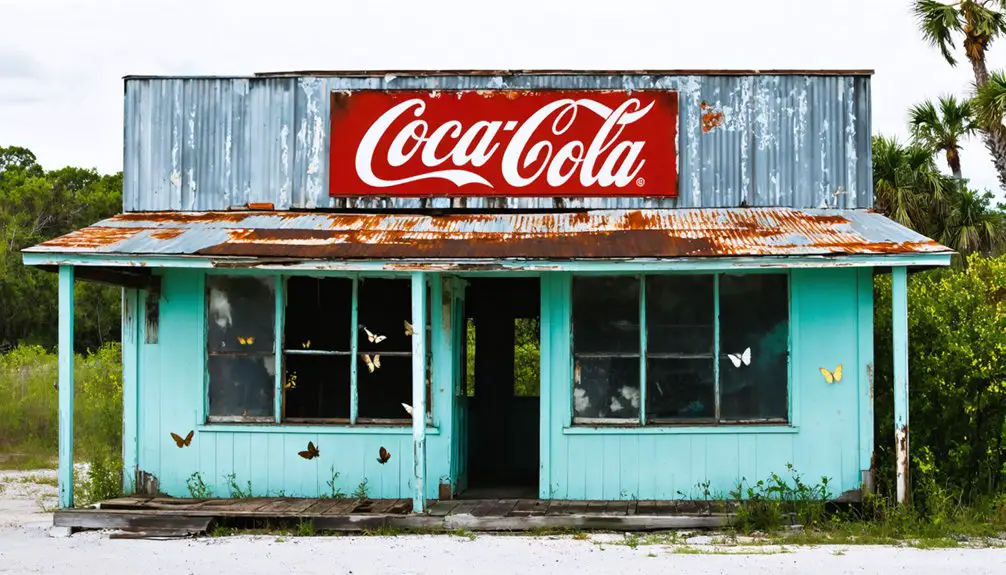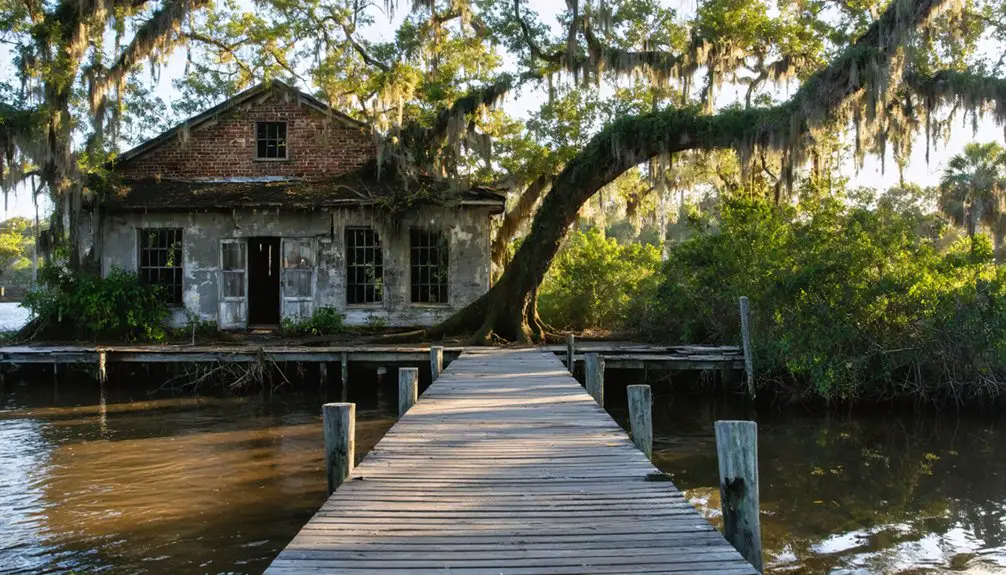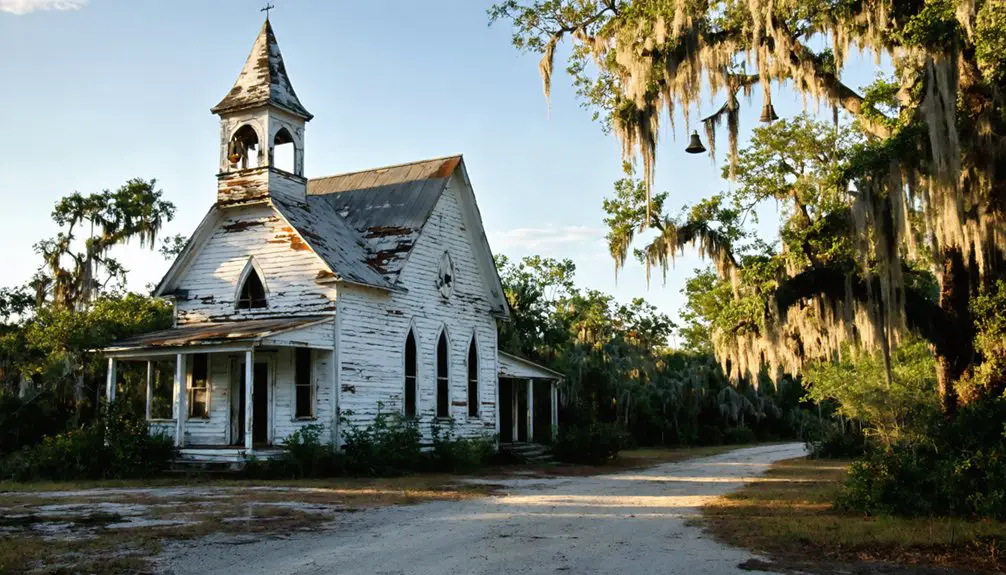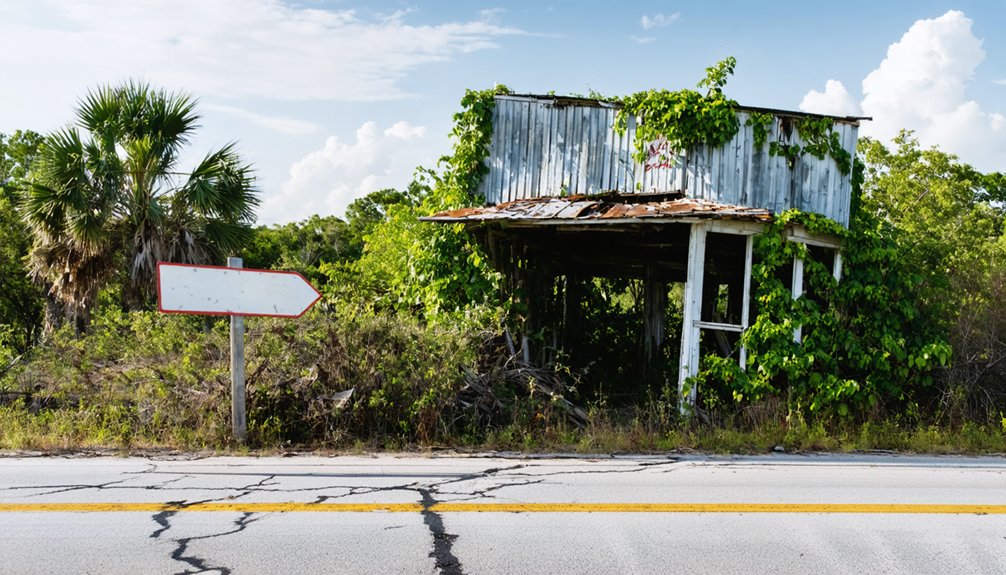
To plan your ghost town road trip to Perky, Florida, head to Mile Marker 17 on the Overseas Highway, situated on Lower Sugarloaf Key about 17 miles northeast of Key West. You’ll find the sun-weathered ruins of Richter Clyde Perky’s ambitious 1929 fishing retreat, including his legendary bat tower experiment gone wrong. Visit between November and April for the best weather. Stick around, and there’s a fascinating story of ambition, failure, and a hurricane’s final verdict waiting for you.
Key Takeaways
- Perky, Florida, is located near Mile Marker 17 on the Overseas Highway on Lower Sugarloaf Key, approximately 17 miles northeast of Key West.
- The town’s main attraction is the ruins of a 1929 bat tower, built for mosquito control but ultimately failed as bats never inhabited it.
- Hurricane Irma in September 2017 collapsed the 30-foot wooden bat tower, which had stood for nearly nine decades before the storm.
- The best time to visit is November through April, with temperatures between 65–80°F; weekday mornings offer quieter, less crowded access.
- Combine your visit with nearby attractions like Key West and Big Pine Key’s National Key Deer Refuge for a fuller road trip experience.
Perky, Florida: The Ghost Town Worth a Road Trip Stop
Tucked away near Mile Marker 17 on the Overseas Highway, Perky, Florida is one of the Lower Keys’ most overlooked ghost towns — and one of its most fascinating stops.
You won’t find crowds here, just open sky, salt air, and layers of forgotten history waiting to be explored.
Once envisioned as a luxurious fishing retreat for wealthy tourists, Perky never quite became what its founder dreamed. That failure, however, is exactly what makes it worth your time.
The town’s ghost town attractions carry real historical significance, rooted in ambitious early 20th-century development and one spectacularly unsuccessful experiment.
Perky’s forgotten past runs deeper than it looks — bold ambitions, stranger experiments, and history worth slowing down for.
If you’re chasing authentic, off-the-beaten-path Florida on your road trip, Perky delivers a raw, unhurried glimpse into a past that most travelers simply drive past.
Where Is Perky, Florida on the Keys Map?
If you’re heading down the Overseas Highway toward Key West, you’ll find Perky tucked into the Lower Keys on Sugarloaf Key, right around Mile Marker 17.
This stretch of Monroe County sits deep in the island chain, where the Gulf of Mexico and Atlantic Ocean squeeze the highway down to a ribbon of asphalt between open water.
Keep your eyes sharp as you approach, because Perky isn’t a town that announces itself — it’s a blink-and-you’ll-miss-it stop with a surprisingly rich history waiting just off US 1.
Lower Keys Location Overview
Perky sits on Lower Sugarloaf Key in Monroe County, Florida, right around Mile Marker 17 on US 1 — the Overseas Highway that strings the Keys together like beads on a chain.
You’re deep in the Lower Keys here, just a short drive from Key West, surrounded by mangroves, open water, and salt air.
Sugarloaf history runs thick in this stretch — from early sponge operations to Richter Perky’s ambitious resort dreams built around a rich fishing legacy.
The elevation’s fundamentally zero, meaning the water feels close because it is.
If you’re road-tripping the Keys, this spot hits differently than the tourist-heavy upper islands.
It’s quieter, rawer, and carries the kind of layered past that rewards curious travelers willing to slow down and look.
Mile Marker 17 Access
Finding Perky on a Keys map is straightforward once you lock onto Mile Marker 17 on US 1, the Overseas Highway.
You’re driving through Monroe County’s Lower Keys, deep in Sugarloaf Key territory, when the ghost town quietly announces itself roadside.
Watch for the bat tower ruins near the highway’s edge — that’s your landmark.
The site sits practically at sea level, flanked by open water and scrubby Florida Keys vegetation, giving the area an isolated, forgotten atmosphere that matches its ghost town status perfectly.
Don’t blink or you’ll miss it.
Perky’s historic significance stretches far beyond its small footprint, but its location remains pleasantly accessible.
Pull off, stretch your legs, and let the Lower Keys silence remind you exactly why you hit the road.
Monroe County Geographic Context
Monroe County stretches across the entire Florida Keys archipelago, and Perky sits near its southwestern end, tucked onto Lower Sugarloaf Key roughly 17 miles northeast of Key West.
Monroe County’s geographic features include mangrove forests, tidal flats, and shallow backcountry waters that define this island chain’s character. You’re traveling through one of America’s most ecologically distinctive corridors when you reach Perky.
The surrounding waters support remarkable wildlife diversity, from tarpon and bonefish to migratory birds traversing the Atlantic flyway. Monroe County also encompasses Everglades National Park and Big Cypress, making it geographically enormous despite feeling intimately connected by a single highway.
Understanding where Perky fits within Monroe County helps you appreciate why Richter Perky chose this remote, wildlife-rich landscape for his ambitious resort vision.
The Strange Story Behind Perky’s Famous Bat Tower
When you pull off near Mile Marker 17, you’ll spot the ruins of one of the strangest mosquito-control experiments in Florida history.
Back in 1929, resort developer Richter Clyde Perky spent nearly $10,000 building a 30-foot bat tower, convinced that a colony of hungry bats would devour the Keys’ relentless mosquito population.
The plan collapsed spectacularly when the bats either flew away immediately or never showed up at all, leaving Perky with an expensive wooden tower and just as many mosquitoes.
Perky’s Mosquito Problem
Few historical follies capture the imagination quite like Richter Clyde Perky‘s ambitious—and spectacularly doomed—attempt to rid Sugarloaf Key of its mosquito problem.
When Perky envisioned his luxurious fishing retreat near Mile Marker 17, relentless swarms of mosquitoes threatened everything he’d built. Effective mosquito control wasn’t optional—it was essential to attracting wealthy tourists who expected comfort alongside adventure.
So Perky hired Dr. Campbell, a self-proclaimed bat expert, believing bats could naturally eliminate the infestation. Campbell designed a 30-foot tower specifically engineered to house thousands of hungry bats.
The historical significance of what followed isn’t the tower’s success—it’s its spectacular failure. You’ll appreciate the irony when you visit: Perky spent nearly $10,000 solving a problem that never actually got solved.
The Bat Tower’s Construction
Construction on Perky’s peculiar bat tower broke ground in March 1929 and wrapped up six months later in September—a swift timeline for something that cost nearly $10,000.
Designed by Dr. Campbell, this 30-foot angular, tapered structure featured four posts and louvered bat entrances, built exactly to his specifications. Perky left it unpainted, trusting Campbell’s belief that bats preferred natural wood.
The bat tower construction reflected serious ambition—this wasn’t a backyard experiment but a calculated investment in making Sugarloaf Key livable and profitable.
Today, its historical significance earns it a spot on the U.S. Register of Historic Places since 1982. When you visit Mile Marker 17, you’re standing beside what was once a bold, unconventional solution to an impossible problem.
Why The Bats Left
After all that investment—the careful construction, the unpainted wood, the proprietary bat bait—the bats simply didn’t stay.
Whether they flew away immediately upon installation or never entered at all remains unclear, but the result was the same: complete failure.
The tower design followed Dr. Campbell’s exact specifications, featuring louvered entrances intended to attract bat behavior naturally.
Yet something went fundamentally wrong.
When Perky sought additional bat bait to try again, he discovered Campbell had died, taking his secret formula to the grave.
Perky’s mosquito problem continued unchecked, and his grand resort dreams quietly unraveled.
It’s a perfect reminder that even the most calculated plans can collapse spectacularly.
When you visit the ruins near Mile Marker 17, you’re standing where ambition met its match.
What Happened to Perky After Richter Perky’s Dream Failed?
Richter Perky’s grand vision quietly unraveled once the bat tower proved useless and the mosquitoes kept swarming. His ambitious resort never fully materialized, leaving a fascinating mark on Perky history that you can still explore today.
Here’s what became of his dream:
- The post office opened in 1929 but shut down by 1942, signaling the town’s quiet fade.
- His fishing lodge and cottages eventually transformed into a modern restaurant and lodge.
- Hurricane Irma destroyed the bat tower in September 2017, erasing its physical presence.
- Despite the collapse, the site’s tourism impact endures through historic designation and curious road-trippers like you.
You’re fundamentally walking through a beautiful failure — a bold entrepreneur’s abandoned paradise that nature and time slowly reclaimed, yet never quite erased.
What Did Hurricane Irma Do to the Perky Bat Tower?
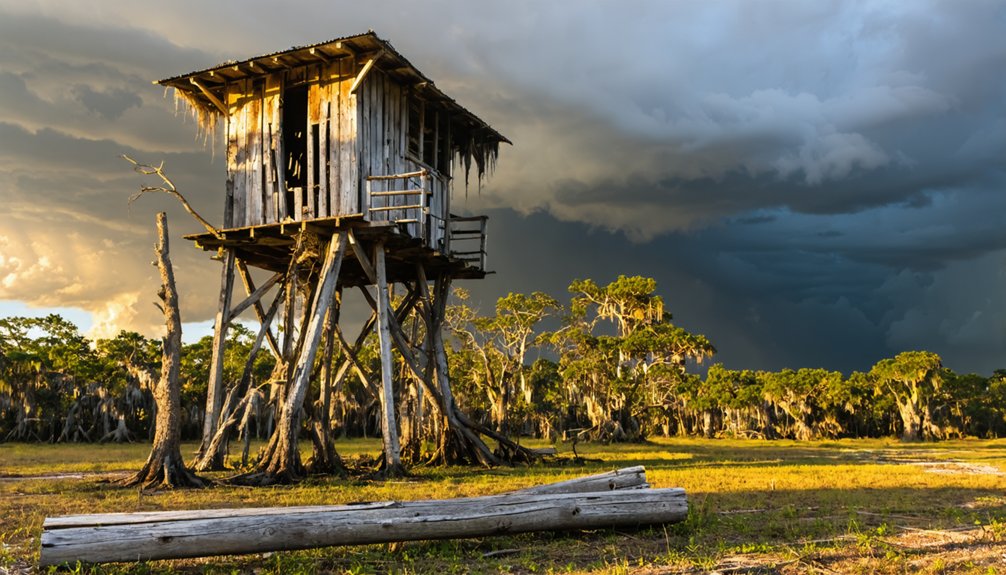
Among the most dramatic chapters in Perky’s slow fade is the story of what Hurricane Irma took when it roared through the Florida Keys in September 2017.
That storm delivered the killing blow to the famous bat tower, a 30-foot wooden structure that had already survived nearly nine decades of salt air, humidity, and neglect. The hurricane damage was decisive and final, collapsing what remained of Richter Perky’s most eccentric legacy.
Nine decades of salt air and neglect couldn’t finish it. Hurricane Irma did the job in hours.
You’ll still find the ruins near Mile Marker 17, a haunting reminder of one man’s mosquito-fighting ambitions.
Before Irma, the bat tower stood on the National Register of Historic Places since 1982. Now you’re visiting a ghost of a ghost, which somehow makes the stop feel even more worth your time.
How to Get to Perky, Florida
Getting to Perky couldn’t be simpler: drive the Overseas Highway south from Miami toward Key West and watch for Mile Marker 17 on Sugarloaf Key in Monroe County.
The open road delivers you straight to this Lower Keys ghost town, where bat conservation history and historical significance collide in one unforgettable stop.
Pack these essentials before you go:
- GPS coordinates: Sugarloaf Key, Mile Marker 17, US 1
- Best time to visit: Early morning or late afternoon for dramatic lighting and cooler temperatures
- Fuel up: Gas stations thin out past Marathon, so fill your tank early
- Combine stops: Pair Perky with nearby Key West for a full Lower Keys adventure
The highway does all the work — you just drive.
What’s Within Driving Distance of the Perky Bat Tower?
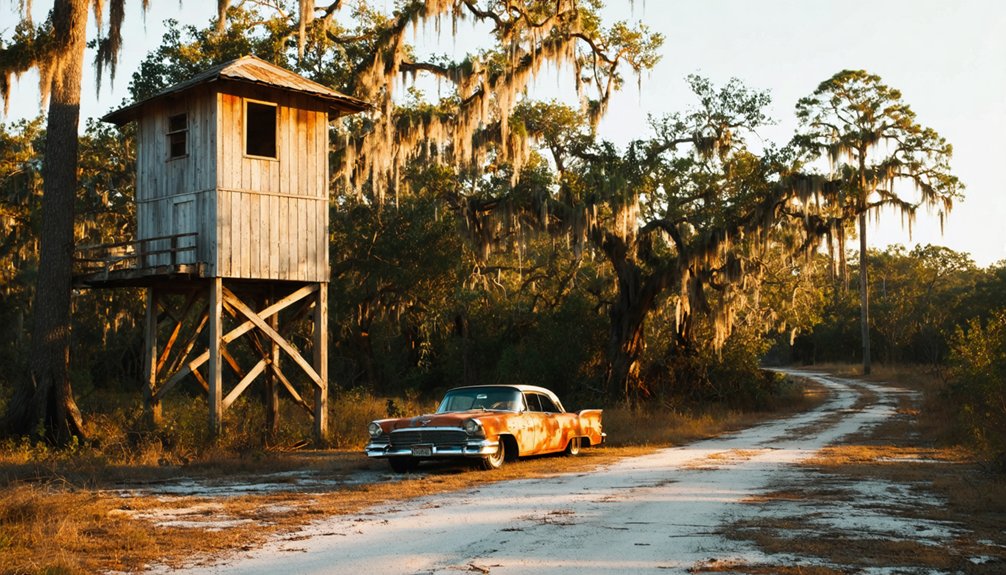
Once you’ve rolled past Mile Marker 17 and soaked in the ghost town atmosphere of Perky, you’ll discover the Overseas Highway puts a surprising number of worthwhile stops within easy striking distance.
Key West sits just 17 miles south, offering in-depth explorations into Florida Keys history that complement the Perky history you’ve just witnessed firsthand.
Key West lies just 17 miles south, where Florida Keys history runs deeper than any single roadside stop can capture.
Head north and you’ll hit Big Pine Key’s National Key Deer Refuge, where wild deer roam freely among the pines.
Between stops, you can unpack bat myths with fellow travelers — like whether bats actually work as mosquito control — because Perky’s failed tower makes that conversation surprisingly rich.
The Lower Keys reward curious road-trippers who refuse itineraries, delivering authentic experiences that crowded tourist traps simply can’t manufacture.
When’s the Best Time to Visit Perky?
Timing your visit to Perky wisely means avoiding the brutal summer humidity that makes outdoor exploration genuinely punishing.
The best seasons run from November through April, when cooler temperatures and lower mosquito activity make outdoor exploration actually enjoyable.
Key visitor tips for planning your trip:
- November to April delivers mild temperatures between 65–80°F, perfect for wandering the historic site.
- December and January offer peak conditions but expect slightly more tourist traffic.
- Weekday mornings give you quieter access before afternoon crowds arrive.
- Hurricane season runs June through November, so check forecasts carefully if you’re visiting during shoulder months.
Pack sunscreen regardless of season — South Florida sun is relentless year-round.
Arrive early, explore freely, and you’ll experience Perky exactly as an adventurous ghost town deserves.
Frequently Asked Questions
Who Owned the Perky Property Before Richter Clyde Perky Purchased It?
You’ll uncover layers of historical significance tracing previous owners: Dr. Harris of Key West held the property first, then the Chase brothers ran their sponge and fruit company before Perky’s ambitious vision transformed it forever.
How Many Acres Did Perky’s Island Holding Company Accumulate by 1924?
By 1924, you’ll discover that Perky’s Island Holding Company had amassed an incredible 25,000 acres across the Florida Keys in its bold land acquisition efforts—a remarkable chapter in Perky history spanning more than 50 islands!
Was the Perky Bat Tower Ever Painted After Its Construction?
No, you’ll find the bat tower’s history fascinating—Dr. Campbell believed bats preferred unpainted structures, so it was never painted. This architectural significance adds to the tower’s unique, adventurous charm you’d have loved exploring firsthand!
How Long Did Perky’s Post Office Remain Operational After Opening?
Perky’s post office history spans just 13 years—it opened in 1929 and closed in 1942. You’ll find this ghost town significance fascinating as you explore the freedom of the open road through the Florida Keys!
Who Did Perky Hire to Manage the Property and Supervise Construction?
Perky hired Fred L. Johnson from Key West for property management and construction supervision. You’d have trusted this capable manager to bring your ambitious Sugarloaf Key retreat boldly to life, transforming a wild Florida Keys vision into reality!
References
- https://keysweekly.com/42/keys-history-lower-keys-bat-tower-was-a-roadside-attraction/
- https://tisqui.github.io/2017/12/28/Perky.html
- https://www.atlasobscura.com/places/sugarloaf-key-bat-tower
- https://kids.kiddle.co/Perky
- https://visitfloridakeys.com/plan-your-trip/plan-book/insiders-guide/strange-saga-of-the-bat-tower
- https://www.ghosttowns.com/states/fl/perky.html
- https://gerrysmarina.net/abandoned-towns-along-florida-waterways/