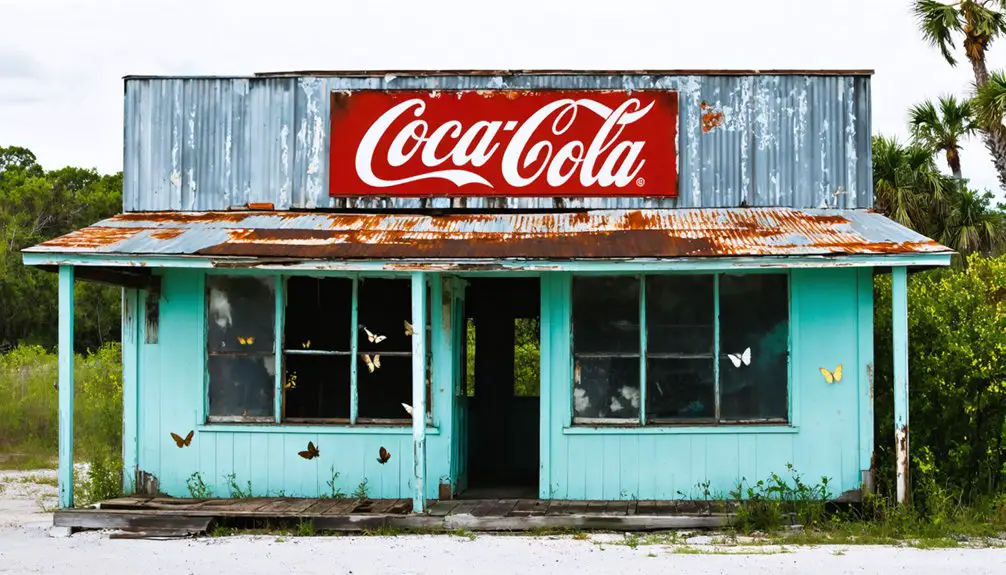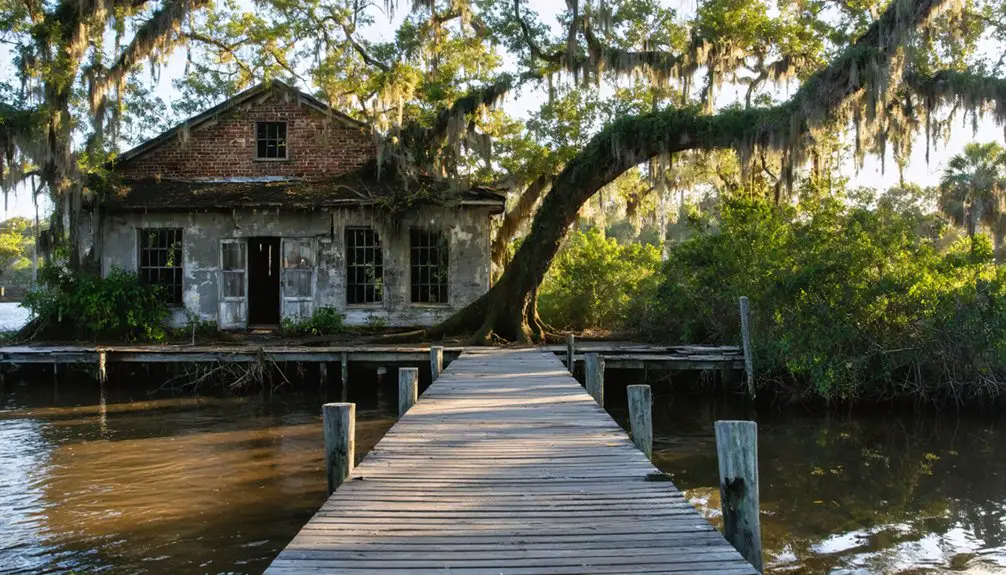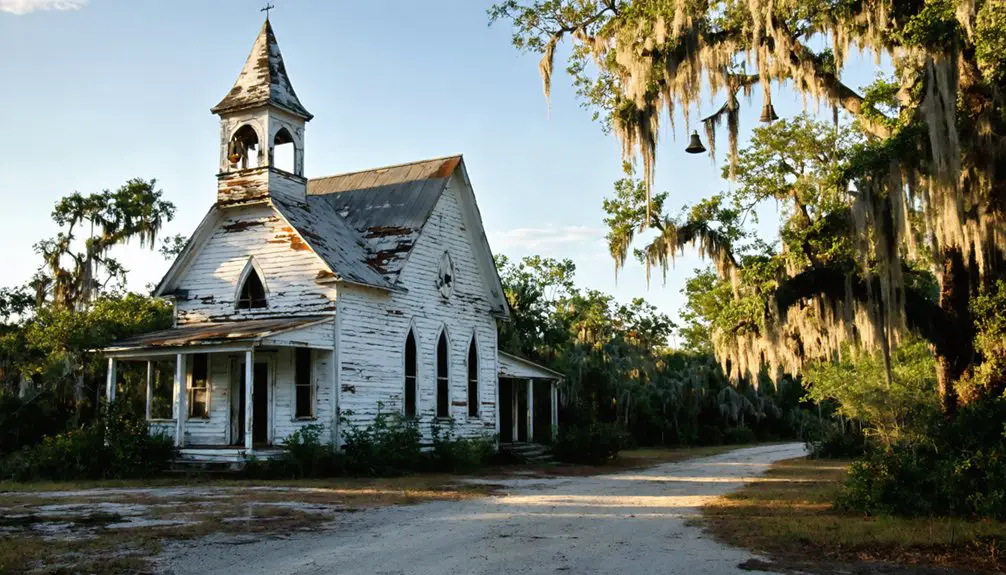
To visit ghost town Peru, take U.S. 301 through Hillsborough County and cross the Alafia River into what’s now Riverview. You’ll find Peru’s remnants along Hackney Road, where the 1890 William B. Moody residence and 1910 Hackney Home still stand as silent witnesses to this vanished phosphate mining community. The 1885 Simpson Homestead marks Peru’s most significant surviving structure, while foundations and clearings reveal where neighbors once lived. Below these weathered homesteads lies a deeper story of prosperity, migration, and the forces that erased entire settlements from Florida’s map.
Key Takeaways
- Peru thrived from 1843 to the 1920s before vanishing, absorbed by Riverview after mining declined and agriculture took over.
- Access the former settlement via U.S. 301 through Hillsborough County, crossing the Alafia River to reach Hackney Road.
- The 1885 Simpson Homestead, 1890 Moody residence, and 1910 Hackney Home are the most significant surviving historic structures.
- A standard passenger vehicle is sufficient; no special equipment or permits are needed to visit the preserved homes.
- Locals pronounce the town name as “pee-roo,” and original church sites remain identifiable despite buildings being long gone.
The Rise and Fall of Peru: From Bustling Settlement to Lost Community
In 1843, when Florida was still a wild frontier territory, Benjamin Moody and a handful of determined settlers staked their claims along the south bank of the Alafia River, establishing what would become Peru. They secured 160-acre parcels through the Armed Occupation Act, building elevated homes on piers where air circulated freely beneath.
By the 1870s, Peru had forged its identity with a post office, a church school, and early industries like the Peruvian Mining Company‘s phosphate operations. The community culture thrived on genuine hospitality, whether you knocked on wealthy or humble doors. Boats delivered supplies from Tampa while ferries—later a bridge—connected residents to Riverview.
But by the 1940s, Peru had vanished entirely, swallowed by its expanding neighbor across the river.
What Remains: Historic Structures and Landmarks You Can Still Visit
The 1885 Simpson Homestead still stands as Peru’s most significant survivor, waiting two miles down Boyette Road where you’ll turn east off Highway 301 and watch for the right angle turn.
Beyond this weathered sentinel, scattered foundations and overgrown clearings mark where other 1890s homes once lined dirt streets bustling with sawmill workers and their families.
The original church site remains identifiable today, though the building itself has long vanished, leaving only the consecrated ground where Peru’s faithful once gathered.
Standing Homes From 1890s
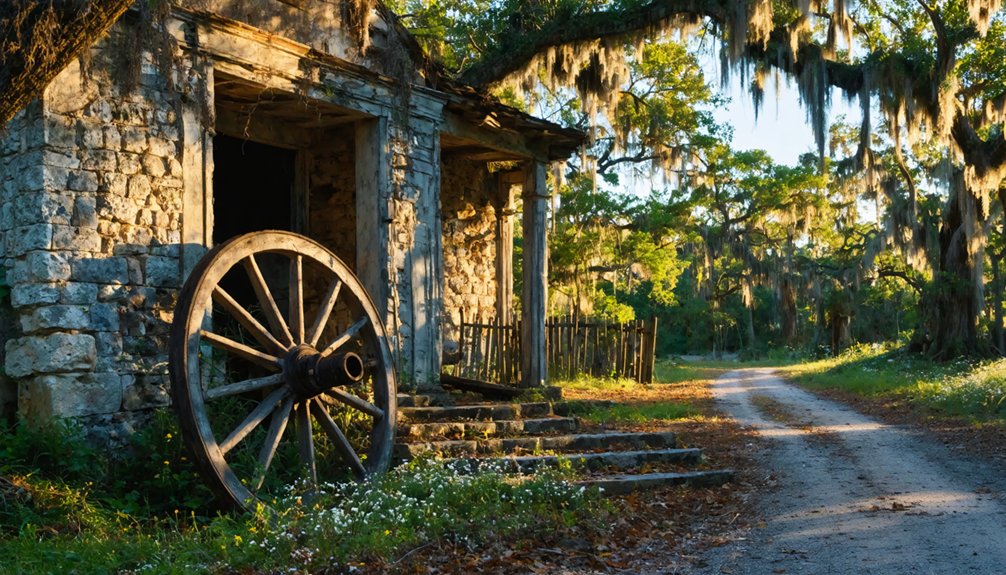
Few remnants of Peru’s bustling past pierce through the modern Florida landscape, but those that survive offer tangible connections to the town’s 1890s heyday. You’ll find William B. Moody’s 1890 residence standing proud on Hackney Road, accessible via the turnoff east of Highway 301. This key surviving structure represents the architectural character of Peru’s late 19th-century prosperity.
Just down the same road, the 1910 Hackney Home marks the shift into the new century. Both properties remain intact, though local preservation initiatives have been minimal compared to other historic sites. These homes offer you an authentic glimpse into residential life when Peru thrived.
The community pronounces the town name “pee-roo,” maintaining one linguistic tradition even as historical preservation efforts remain modest.
Original Church Location Today
Unlike the surviving Moody and Hackney residences, Peru’s original church structures have vanished entirely from the landscape. That 1850 log cabin Methodist church, built on Benjamin Moody’s donated land south of the Alafia River, left no visible trace. Neither did Lesley Chapel, constructed near the ferry crossing in 1870, nor the converted general store that once served Baptist congregants.
You won’t find church foundations marking these sacred grounds today. Modern development has swallowed the sites where pioneers gathered for worship and schooling. However, archaeological remains—fragments of glass and pottery—still surface near the old Goolsby property on Boyette Road, hinting at settlement activity.
Your best bet? Explore the riverbanks near the historic ferry crossing east of the present bridge, where these religious communities once flourished before Riverview’s expansion erased Peru’s spiritual landmarks.
Getting There: Directions and Access to the Former Peru Settlement
You’ll find the ghost town of Perky—often confused with Peru—waiting at mile marker 17 on the Overseas Highway, where US 1 cuts through the shimmering waters of the Lower Keys.
From Key West, head northeast for 17 miles along this legendary ribbon of asphalt and bridges; from Miami, point your vehicle south for a 120-mile journey that island-hops across turquoise channels.
Any standard vehicle can make the trip, as the highway’s smooth pavement and sturdy bridges require no special equipment beyond a full tank of gas and a sense of adventure.
Route via U.S. 301
Heading south on U.S. 301 through Hillsborough County, you’ll trace a route that’s swallowed Peru’s scattered remains into modern Riverview’s sprawl. The Alafia River signals you’ve arrived—your first geographic anchor in locating this vanished settlement. Route conditions remain straightforward, with standard 2WD roads handling all access needs.
Key navigation points:
- Primary intersections: 301 and Desoto Street mark the old school site
- Watch for the Alafia River crossing—your confirmation you’re entering Peru territory
- Hackney Road branches east off 301, leading to preserved historic homes
- The 1890 Moody house and 1910 Hackney residence await exploration
- First Baptist Church of Riverview traces its roots to Peru’s riverside congregation
- The Peruvian Phosphate Company relocated across the river by 1894
- Peru’s post office closed in 1900, routing mail through Riverview
- Peru Baptist Church moved north in 1905
- Agricultural transformation replaced mining with citrus groves
- By the 1920s, Peru had vanished into Riverview’s sprawl
- Disaster strikes: Yellow fever wiped out St. Joseph between 1841-1844
- Resources run dry: Timber and phosphate towns like Brewster collapsed post-1930s
- Nature reclaims: Floods and hurricanes prevented rebuilding efforts in places like Tuckersville
- Tourism fades: Lost hotels and springs meant economic death
- Development swallows: Railroads and urbanization consumed pioneer-era communities
No barriers block your path—just open roads threading through Florida’s ghost town landscape.
Vehicle Requirements and Accessibility
Any standard passenger car will handle the journey to Peru’s former footprint without breaking a sweat. The roads leading through modern Riverview follow paved highways—no off-roading equipment necessary. You’ll navigate suburban streets where Peru once thrived before the 1940s absorption erased its boundaries.
The reality: tour guide availability doesn’t exist for a settlement that’s vanished into Riverview’s sprawl. No official markers designate Peru’s location, and seasonal visitation hours are irrelevant when there’s no dedicated site to visit. You’re fundamentally exploring a neighborhood that consumed its predecessor.
Your vehicle becomes your freedom machine, letting you cruise U.S. 301 and surrounding areas independently. Park anywhere legal, walk the ground, and imagine the community that preceded today’s development. Standard clearance suffices—adventure meets accessibility.
The Story of Riverview’s Expansion and Peru’s Disappearance
Riverview’s expansion followed a predictable pattern:
You’ll find no boundary markers today—just Riverview stretching across both riverbanks where two distinct communities once competed.
Early Settlers and Families Who Shaped Peru’s History
Long before Peru faded into Riverview’s memory, hardy pioneer families carved homesteads from Florida’s untamed wilderness along the Alafia River’s banks. The Barnes families—Lon, John, and Bud—arrived first in the 1840s, drawn by abundant game and fertile soil near present-day Bell Shoals bridge.
John Pixton, a steamboat fireman, helped establish essential river transportation connecting Tampa Bay to inland settlements. The Goolsby family joined this brave community, where preservation of settler histories reveals remarkable peaceful coexistence with native tribes. You’ll find evidence of their determination in pottery shards scattered throughout the area.
Florida’s Vanished Towns: Understanding Peru in the Context of Ghost Settlements
Understanding Peru’s fate requires recognizing common patterns:
Ghost towns follow predictable trajectories: catastrophe, depletion, abandonment, erasure—leaving only traces in fading memories and contradictory cartography.
These ephemeral settlements—Tantie, Rio, Freeman—existed without leaving significant historical footprints, identifiable only through geographic memory and conflicting maps.
Frequently Asked Questions
Are There Any Guided Tours Available for Exploring Historic Peru?
No guided tours availability exists for Peru’s abandoned streets, but you’ll discover freedom exploring independently. Contact local historical societies in nearby Monticello for maps and stories before venturing into this forgotten settlement’s overgrown ruins and crumbling foundations.
What Is the Best Time of Year to Visit Peru, Florida?
Visit Peru, Florida during spring or fall when weather patterns bring mild temperatures and fewer crowds. You’ll discover authentic local events and experience the town’s genuine character without summer’s heat or winter’s typical tourist constraints.
Are There Nearby Accommodations or Camping Facilities for Overnight Stays?
You’ll find nearby hotels scattered throughout Riverview and Tampa, roughly 20-30 miles from Peru’s ghost town. Local camping grounds include Alafia River State Park and Hillsborough County RV parks, offering freedom-seekers authentic Florida wilderness experiences near your historical exploration.
Can Visitors Access Private Properties Where Historic Structures Still Stand?
You can’t legally enter without permission when accessing historic private properties like Moody’s home. Traversing restricted areas requires contacting owners first—trespassing laws apply statewide. Respect fences and signage, or document these atmospheric ruins from public roads only.
Are There Museums or Visitor Centers With Peru Artifacts and Exhibits?
No dedicated Peru museum exists, but you’ll discover historic preservation efforts at nearby Pioneer Florida Museum & Village. These cultural tourism opportunities showcase regional artifacts, fostering your connection to Florida’s forgotten settlements through authentic storytelling and immersive displays.