Your Pinkerton ghost town adventure begins in Rapid City, where you’ll need to download offline maps and fuel up before heading into remote Black Hills valleys where GPS signals vanish. You’ll find weathered cabins, crumbling stone chapel walls, and barely-visible foundations marking where miners once chased silver dreams in the 1870s. Pack emergency supplies—water, food, and roadside tools—because self-reliance isn’t optional in this landscape of 600 ghost towns. The abandoned structures, presidential history, and surrounding mining sites reveal stories that go far beyond what prairie grass has reclaimed.
Key Takeaways
- Download offline maps and fuel up completely in Rapid City before departing, as GPS signals and gas stations disappear quickly.
- Pack emergency supplies including water, food, and roadside tools to embrace the self-reliance this remote landscape demands.
- Visit Pinkerton’s weathered cabin, crumbling chapel walls, and post office foundation surviving since the 1950s flooding.
- Explore the historic presidential picnic grounds where Calvin Coolidge visited on July 16, 1927, now reclaimed by prairie grass.
- Extend your trip to nearby ghost towns including Spokane, Galena, Rockerville, and Tinton within the Black Hills Mining Triangle.
Discovering the History of Pinkerton’s Rise and Fall
Nestled in the rolling prairie of Tripp County, where Deer Creek cuts through the valley near Lake Westonka‘s shores, Pinkerton sprang to life as a dusty promise during South Dakota’s late 1800s mining fever.
You’ll find its story mirrors the boom-and-bust cycle that created over 600 ghost towns across the Black Hills. Rich silver veins drew three hundred fortune-seekers by the mid-1870s, transforming wilderness into a bustling camp with dance halls and a post office.
Population fluctuations marked each discovery—tin, tantalite, and feldspar deposits kept hope alive through the 1890s. The Pinkerton Times newspaper gave voice to the concerns of both miners and mine owners throughout these turbulent years. Like nearby Galena, Pinkerton’s fate hinged on railroad line operations that determined whether the town would thrive or decline. But mining venture struggles eventually won. Depleted ore bodies and failed revival attempts preceded the final blow: a catastrophic 1943 fire that consumed the main mill, leaving only crumbling ruins where dreams once glittered.
Getting There: Route Planning From Rapid City
Before you set out for Pinkerton’s haunting remains, you’ll need to chart a course through South Dakota’s unforgiving backcountry—a journey that demands preparation rather than impulsive wandering.
Unlike the historical transportation methods that brought miners to Pinkerton via wagon trails and horseback, you’ll navigate modern road infrastructure connecting Rapid City to this forsaken settlement. Your route traverses open prairie and rugged terrain where cell service vanishes. Step-by-step driving directions from Rapid City will help you navigate the most efficient path through these remote landscapes.
Essential Planning Steps:
- Download offline maps before departing—GPS signals disappear in remote valleys
- Fuel up completely in Rapid City; gas stations become scarce quickly
- Pack emergency supplies including water, food, and roadside tools
The isolation that killed Pinkerton now defines your adventure. Just as establishing a chronological framework helps lawyers distill complex cases into coherent narratives, planning your route chronologically—from departure to destination—creates a backbone for safe backcountry navigation. Embrace the self-reliance this landscape demands.
What Remains: Exploring Pinkerton’s Surviving Structures
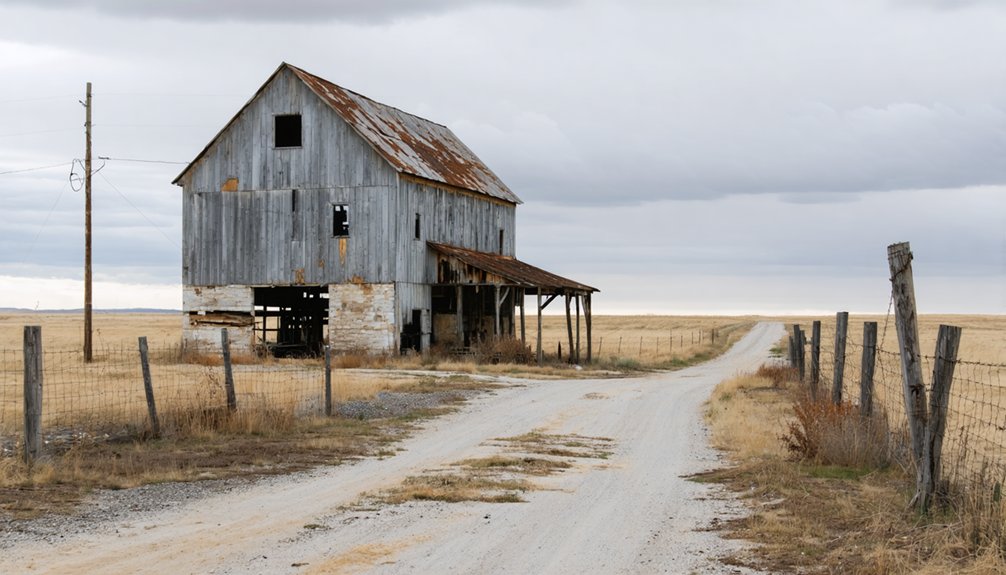
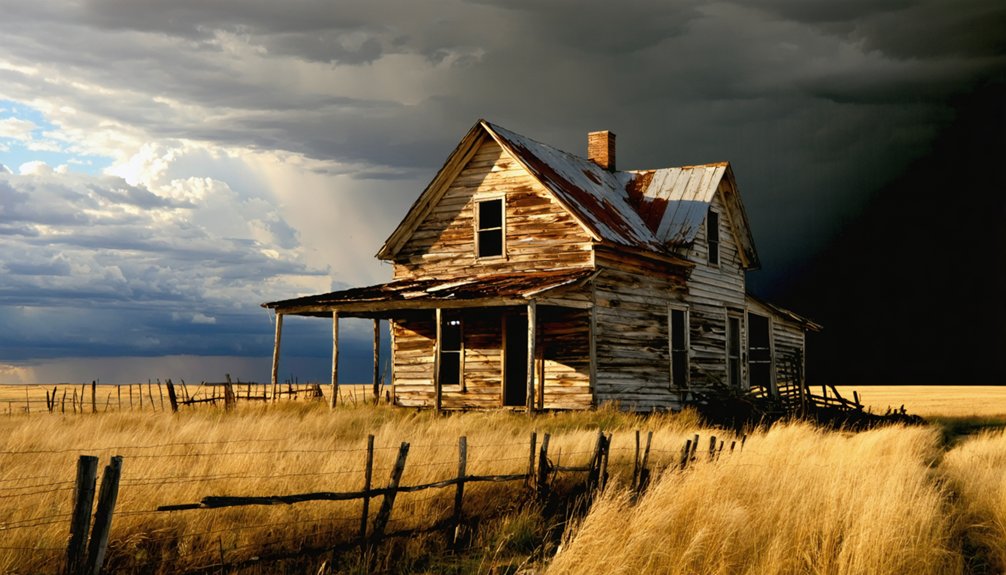
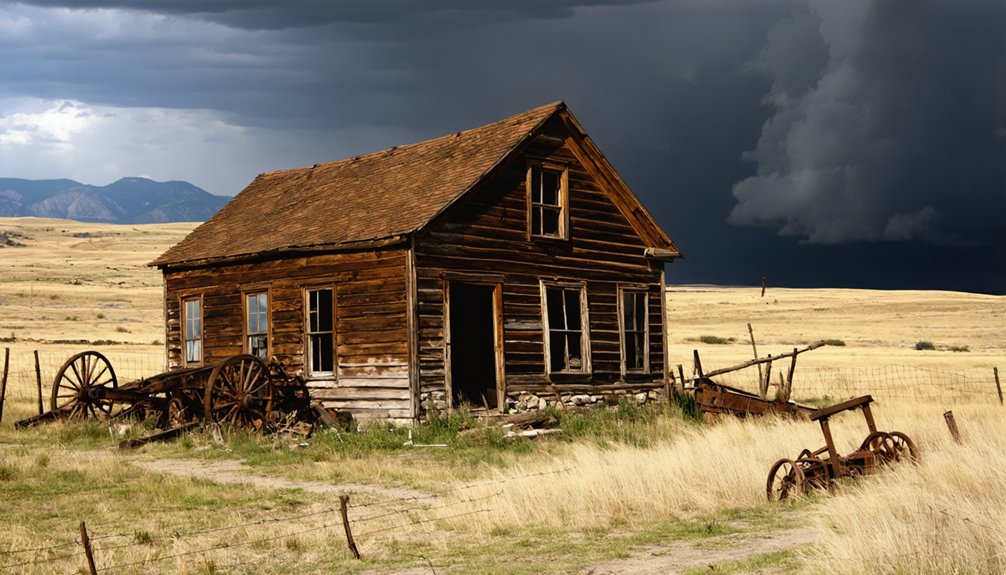
You’ll find Pinkerton’s legacy scattered across windswept terrain—a weathered cabin standing defiant against decades of abandonment, the crumbling stone walls of what locals say was once a chapel, and the barely-visible foundation where the post office sorted mail for hopeful miners. These remnants tell stories through splintered wood and collapsed rooflines, each structure more deteriorated than preserved. Like Cortland Rush’s cabin chimney in Rockerville, these few remaining structures stand as enduring testaments to the communities that once flourished here. Some ghost towns have completely reverted to pasture land, leaving no trace of the civilization that once existed there.
Walk carefully among the ruins; you’re stepping through what remains of a community that simply faded into the prairie.
Lone Cabin Still Stands
Among the towering pines near Route 385, a solitary wooden cabin defies the fate that claimed the rest of Pinkerton to the depths of Pactola Lake. This timber framed structure stands as the lone survivor of a once-thriving mining community that housed over 300 residents during the Black Hills gold rush.
While 150 feet of water swallowed the town’s dance hall, businesses, and historic post office, this solitary cabin standing marks where fortune-seekers built their dreams.
What You’ll Discover:
- The cabin’s weathered exterior tells stories of abandonment since the 1950s flooding
- Skeletal frameworks of submerged buildings visible through clear lake water
- Original construction details preserved in the pine-surrounded structure
You’re free to photograph and explore the grounds, though climbing inside is prohibited for your safety and the site’s preservation. The cabin sits approximately an hour east of Rapid City, making it an accessible stop for ghost town enthusiasts. Like many ghost towns across South Dakota, Pinkerton exists in various states of decay, with its lone cabin representing one end of the spectrum while most structures lie submerged beneath the reservoir.
Chapel Remnants and Ruins
Walking uphill from the lone cabin, you’ll find scattered foundation stones half-buried in pine needles—all that remains of Pinkerton’s modest chapel. These weathered limestone blocks trace the outline of where miners once gathered for Sunday services, their edges softened by decades of High Plains winters.
You can still identify surviving architectural features if you look carefully: rusted iron hinges clinging to fragments of wood, hand-forged nails scattered among the stones, and a partially intact root cellar that served as the chapel’s foundation. Despite minimal local preservation efforts, nature’s reclaiming this sacred ground faster than history can hold it.
Run your fingers across these sun-warmed stones. The Oahe Chapel Preservation Society formed by local citizens continues restoration work on similar frontier religious sites throughout the region. For those interested in experiencing a preserved example, the historic Oahe Chapel is available for rent year-round for weddings, baptisms, and memorials. They’re tangible proof that even in Dakota’s remotest corners, people built something meaningful before moving on.
Post Office Historical Footprint
Beyond the chapel ruins, searching for Pinkerton’s post office yields nothing but absence. Philip Lieber established this rural outpost on May 2, 1883, likely operating from his home or a shared storefront. For twenty years, he embodied the postmaster legacy that defined frontier communication networks.
When the office closed May 25, 1903, Pinkerton’s connection to the outside world vanished with it.
Today, you’ll find no building footprint to mark where mail once arrived:
- No surviving structures remain from the 1883-1903 operational period
- Zero physical markers identify the original postal location
- Complete abandonment characterizes the site, with records your only evidence
The ground reveals nothing—just prairie grass reclaiming what independence-seeking settlers once built, then left behind.
The Presidential Picnic: Calvin Coolidge’s 1927 Visit
When you stand at Pinkerton’s old picnic grounds, you’re treading soil where President Calvin Coolidge himself kicked back on July 16, 1927, attending a farmer’s gathering at what was then a government experimental farm. This wasn’t just any pastoral outing—Coolidge had extended his Black Hills “vacation” from three weeks to three full months, and this midpoint stop at Ardmore showcased his commitment to agricultural communities.
The site carries weight beyond its ghost town status; it marks where a sitting president chose to celebrate ordinary farmers, turning a crop rotation research station into a fleeting capital of American attention.
Summer 1927 Presidential Retreat
Through persistent lobbying and carefully crafted promises of pristine trout streams, South Dakota officials secured what would become one of the most significant presidential visits in the state’s history.
When Coolidge’s entourage arrived June 15, 1927, they transformed Custer State Park’s Game Lodge into a functioning Summer White House for three remarkable months.
Your exploration of this era reveals Coolidge’s authentic Western experience:
- Presidential fishing excursions became daily rituals across pristine mountain streams
- Black Hills landscape views captivated the typically reserved president during horseback rides
- Community visits from Deadwood to Pine Ridge showcased frontier authenticity
The retreat culminated August 2nd with Coolidge’s cryptic announcement: “I don’t choose to run for President in 1928″—twelve words that changed American political history.
Historic Picnic Site Legacy
Amid the rolling prairie near Ardmore, South Dakota, a government experimental farm became an unlikely stage for presidential hospitality on July 16, 1927. Calvin Coolidge traded Washington’s formality for a farmer’s picnic, where crop rotation experiments and planting methods took center stage. You’ll find the historic site significance lies not in grand speeches but in Coolidge’s willingness to meet agricultural communities on their own ground.
Local community involvement transformed a simple research station into a symbol of accessible leadership—farmers discussing harvest techniques with their president beneath prairie skies. This stop on Coolidge’s extensive Black Hills tour reinforced his image as a leader who’d venture beyond ballrooms into working landscapes. The Ardmore picnic endures as evidence of community-level outreach.
Ghost Town Circuit: Nearby Abandoned Sites Worth Visiting
Beyond Pinkerton’s weathered facades, South Dakota’s backcountry harbors a constellation of forgotten settlements where you can trace the boom-and-bust cycles that shaped the American West.
These abandoned settlements stand as weathered testaments to the volatile fortunes that defined frontier America’s relentless westward expansion.
Black Hills Mining Triangle:
- Spokane Ghost Town – Near Custer, this accessible site reveals scattered buildings and crumbling foundations where gold fever once raged. You’ll discover pioneer homestead sites amid towering pines along the easy Spokane Ghost Town Trail.
- Galena’s Living Remnants – East of Deadwood, you’ll find weathered cemeteries and hillside ruins where a handful of residents still inhabit this silver mining camp’s skeletal remains.
- Rockerville’s Charred Past – Founded as Captain Jack’s Dry Diggin’s in 1876, abandoned mining equipment and a lone chimney mark where fire training exercises consumed the town’s rebuilt structures in 2016.
Tinton and the Silver Mining Legacy
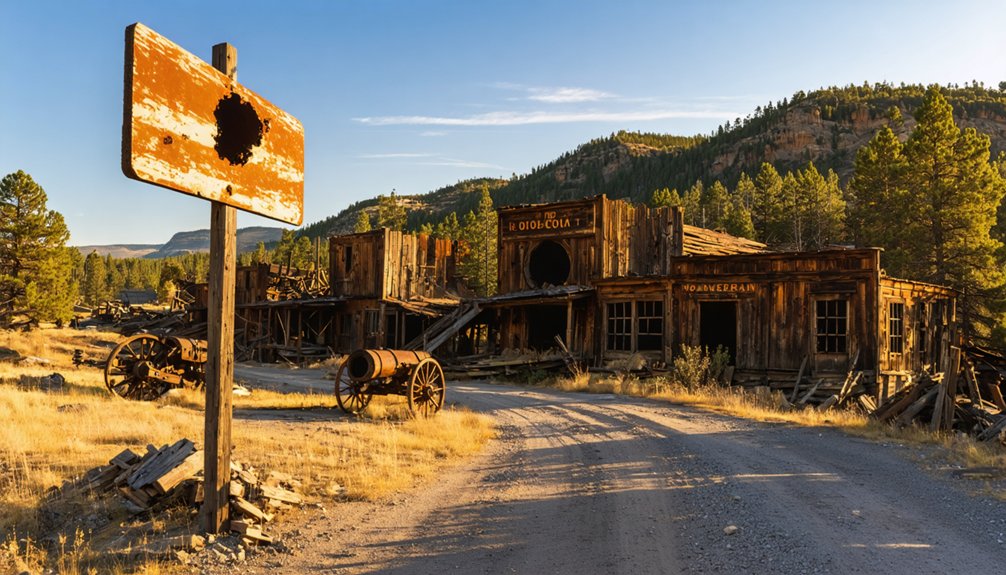
You’ll find Tinton nestled thirteen miles from Deadwood, where pegmatite veins slicing through Cement Ridge held not silver, but something rarer—tin deposits that sparked nearly a century of mining fever.
The town’s story unfolds against the backdrop of Spearfish Canyon‘s broader mineral wealth, where prospectors chased every glint of promise from gold to tantalum in the Black Hills’ ancient rock. While neighboring camps pursued silver dreams, Tinton’s miners extracted cassiterite from the hillsides, building a 300-person community around America’s most significant tin operations.
Spearfish Canyon Mining Operations
While Pinkerton draws most visitors’ attention today, the broader story of Spearfish Canyon’s mining legacy reveals a frantic silver rush that transformed these limestone walls in the late 1880s. Carbonate Camp’s boom peaked between 1885 and 1891, drawing fortune-seekers to these remote gulches before collapsing with the Panic of 1893.
You’ll find evidence of the technological evolution that followed:
- Cyanide mills converted abandoned facilities in 1898, making low-grade ores suddenly profitable
- Massive operations like the 250-ton Spearfish Gold mill quarried limestone directly from canyon walls
- Environmental disputes erupted as cyanide-laden waters threatened downstream fisheries
These mining impacts ultimately sparked conflicts between industrial ambitions and conservation interests. By 1907, mysterious fires and economic realities ended the canyon’s extraction era.
Tin and Silver Deposits
Deep in Spearfish Canyon‘s limestone recesses, Edgar St. John struck silver during the 1870s Black Hills Gold Rush, igniting two decades of prosperity in Tinton. You’ll find remnants of this resilient mining town where fortune-seekers once extracted rich silver veins from unforgiving rock.
When those deposits thinned by the late 1890s, miners pivoted to abundant tin reserves, extending the camp’s lifespan through tantalite production and feldspar mining operations.
The Clayton Silver Mine exemplifies this adaptive spirit—prospected in 1927 as the Camp Bird Group with 32 claims, it operated sporadically until steady production began in 1935. For fifty years, silver, lead, and zinc flowed from these tunnels until low metal prices forced closure in 1986, despite historic production valued at $347 million today.
Thirteen Miles From Deadwood
From Deadwood’s gambling halls and saloons, a thirteen-mile journey eastward leads you into Spearfish Canyon’s limestone depths, where Tinton emerged as a symbol of frontier determination. The geology of the region revealed unexpected treasures when Edgar St. John discovered ore during the mid-1870s Gold Rush, eventually leading to tin mining operations that would define this remote settlement.
Your exploration reveals three distinct phases of Tinton’s evolution:
- 1876-1902: Gold mining camp established in canyon’s rugged recesses
- 1903-1904: Company town constructed with mill, housing, and community infrastructure
- 1911-1959: Gradual decline following production decrease and devastating mill fires
The Tinton Tin Mining Company transformed this wilderness into a self-sufficient community of 300-500 souls, complete with newspaper, school, and Theodore Roosevelt Park commemorating the president’s 1903 visit.
Pactola: The Town Beneath the Lake
Beneath the placid waters of Pactola Reservoir lies one of the Black Hills’ most unusual ghost towns—a settlement that didn’t simply fade away but was deliberately drowned.
Founded during the 1875 gold rush, Camp Crook thrived with over 300 residents before Pactola Dam construction between 1952 and 1956 submerged everything. The government condemned acres of land, forcing cabin relocation throughout the valley. Most structures were auctioned off and moved to Silver City, while one cabin miraculously survived downstream.
Today, scuba divers explore underwater archaeology at 150 feet below—rotting foundations, building remnants, and a CCC dynamite bunker frozen in time. You’ll find the Black Hills’ least accessible ghost town here, where recreational boaters unknowingly drift above streets where miners once walked, their dreams of fortune now buried beneath 800 acres of water.
Local Legends and Haunting Tales of the Black Hills
While tourists photograph Mount Rushmore by day, the Black Hills harbor darker stories that emerge after sunset—tales of restless spirits who never left the gulches where they struck gold, lost fortunes, or met violent ends.
You’ll encounter these legends throughout your journey:
- Deadwood’s Mount Moriah Cemetery echoes with phantom bootsteps and spur clicks where Wild Bill Hickok and Calamity Jane rest uneasily
- Hooky Jack’s ectoplasmic apparitions still patrol Rapid City, where the armless former police officer meets his 1916 fate repeatedly
- Shupick Park’s frozen woman whispers names through Eagle Butte darkness, joining indigenous spirits who walked these lands long before prospectors arrived
These aren’t tourist-friendly ghost stories—they’re warnings that some sought freedom in these hills and found only eternal wandering instead.
Best Time to Visit and Weather Considerations
Your encounter with Pinkerton’s abandoned structures demands careful timing—the Black Hills climate shifts dramatically between seasons, transforming accessible ghost towns into treacherous expeditions within weeks. Summer’s 80-85°F highs and fifteen-hour daylight stretches offer maximum exploration freedom, though you’ll need ideal seasonal clothing for 55°F nights.
Fall delivers stunning mid-September foliage against weathered buildings, but temperatures plunge from 70°F to freezing after sunset. Winter buries Pinkerton under 30-40 inches of snow, with 30 mph wind gusts creating dangerous conditions. Spring balances moderate 60-70°F days with blooming prairies, though you’ll navigate muddy access roads. Year-round winds slash temperatures 10-15°F below actual readings.
Watch for seasonal wildlife encounters—bears emerge spring through fall, while elk roam winter landscapes seeking shelter near abandoned homesteads.
Photography Tips for Capturing Ghost Town Atmosphere
When sunlight breaks across Pinkerton’s weathered facades, you’ll discover that capturing ghost town atmosphere demands more than pointing and shooting—it requires orchestrating light, gear, and composition into visual stories of abandonment.
Ghost town photography transforms decay into art through deliberate orchestration of light, equipment, and framing choices that resurrect abandoned histories.
Master these fundamentals for compelling results:
- Golden hour camera settings: Shoot during dawn’s first light using bracketed exposures for HDR merges, controlling aperture for front-to-back sharpness while your tripod steadies long exposures through dusty interiors.
- Composition mastery: Frame leading lines through doorways, keep horizons level with wide-angle lenses, and isolate weathered details—rusting handles, broken switches, vegetation creeping through windows.
- Editing techniques that enhance: Convert to black-and-white for timeless contrast, boost sepia tones suggesting age, and craft narratives around discarded objects that whisper forgotten stories.
Your images become portals into Pinkerton’s abandoned past.
Frequently Asked Questions
Are There Any Nearby Accommodations or Camping Facilities for Overnight Stays?
You’ll find Ghost Canyon Getaway in Hermosa offers pet-friendly lodging options for your basecamp, sleeping nine adventurers. Nearby Deadwood’s historic hotels provide authentic haunted experiences, while local food and dining nearby fuel your supernatural explorations through South Dakota’s ghostly frontier.
Is Four-Wheel Drive Necessary to Access Pinkerton and Surrounding Ghost Towns?
You’ll navigate narrow roads through towering pines where limited cell coverage adds adventure. Four-wheel drive’s strongly recommended for Black Hills ghost towns, especially during winter’s packed snow, though some areas remain impassable even with 4WD beyond maintenance points.
Can Visitors Enter the Surviving Structures or Are They Private Property?
No structures survive at Pinkerton—it’s completely vanished into pastureland. Nearby ghost towns have access restrictions due to private ownership and structural integrity concerns. You’ll need permission for most sites, though some allow distant viewing from public areas.
Are There Any Guided Ghost Town Tours Available in the Region?
You’ll find self-guided tours throughout the Black Hills region, letting you explore abandoned settlements at your own pace. Local history museums in nearby towns offer maps and stories, giving you complete freedom to chart your ghost town adventure.
What Safety Precautions Should Be Taken When Exploring Abandoned Mining Sites?
Never enter abandoned mining sites—they’re deadly traps with unstable structures, hidden shafts, and toxic air. If you’re determined despite warnings, wear proper safety gear, test abandoned structure stability from distance, bring partners, and notify someone of your location beforehand.
References
- https://www.historynet.com/ghost-town-tinton-south-dakota/
- https://www.blackhillsbadlands.com/blog/post/old-west-legends-mines-ghost-towns-route-reimagined/
- https://www.wideopencountry.com/old-west-ghost-stories/
- https://www.youtube.com/watch?v=_0WNYsFLSLA
- https://www.sdhspress.com/journal/south-dakota-history-2-2/some-black-hills-ghost-towns-and-their-origins/vol-02-no-2-some-black-hills-ghost-towns-and-their-origins.pdf
- https://en.wikipedia.org/wiki/List_of_ghost_towns_in_South_Dakota
- https://www.sdpb.org/rural-life-and-history/2023-08-21/some-black-hills-ghost-towns-and-their-origins
- http://genealogytrails.com/sdak/tripp/town_info_01.htm
- https://www.truewestmagazine.com/article/the-towns-too-tough-to-die/
- http://files.usgwarchives.net/sd/brown/ehbc/ehbc-fulltext.txt