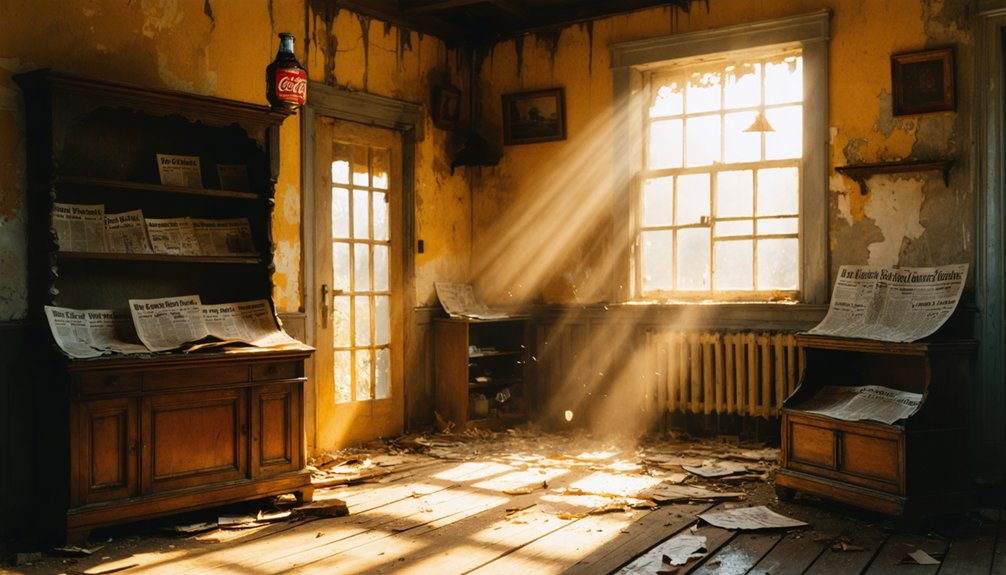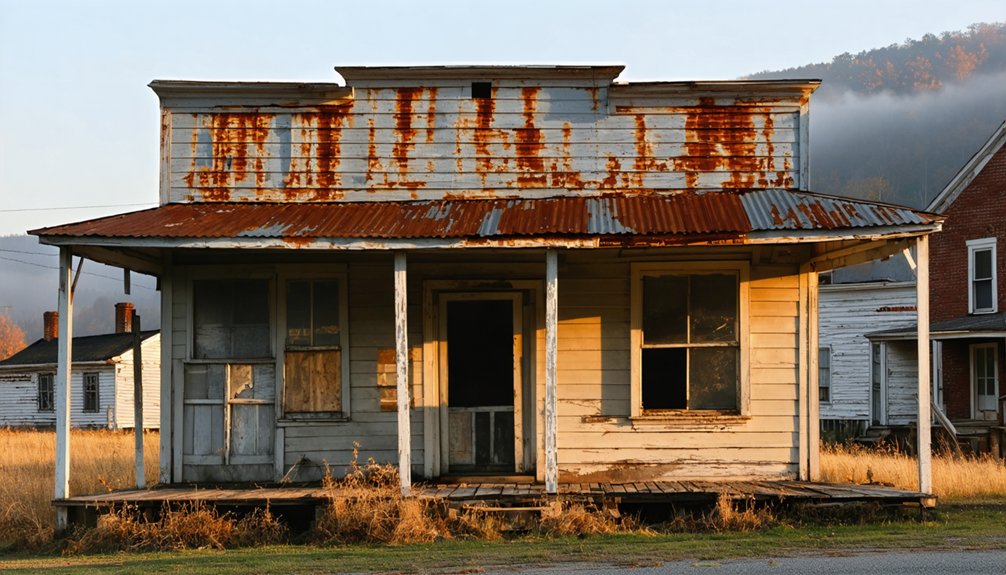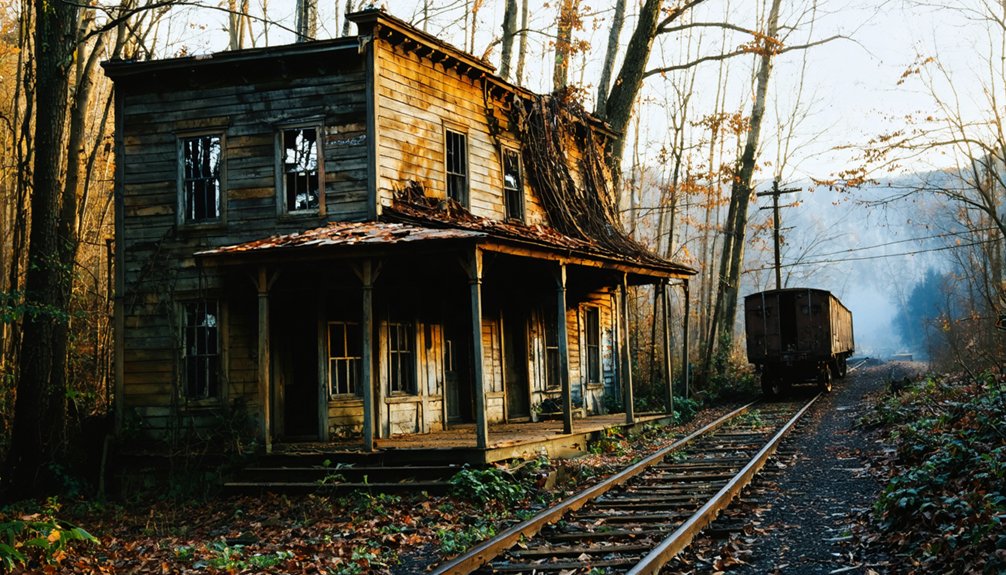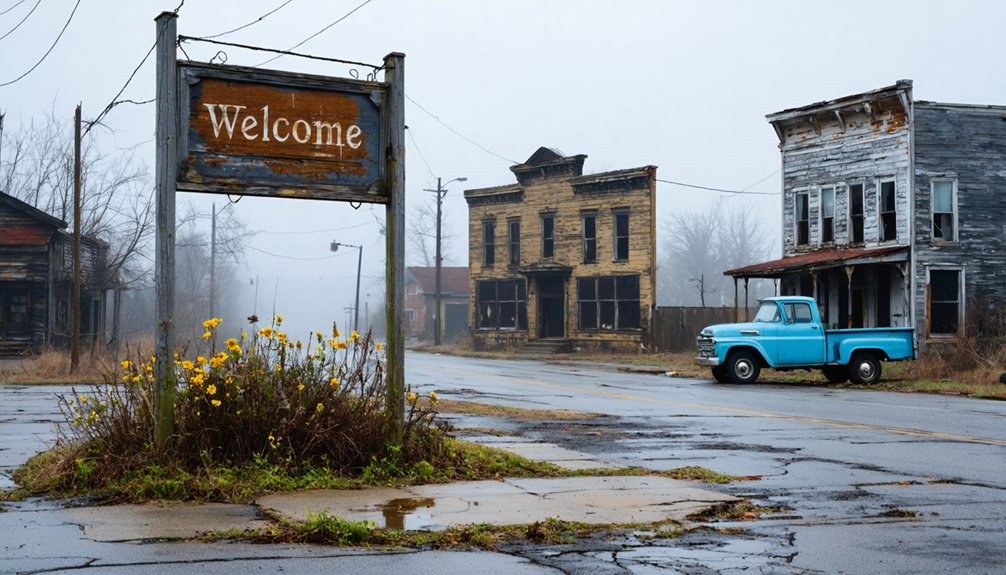
You’ll discover Kentucky’s most architecturally complete Shaker settlement at Pleasant Hill, where 34 original structures from 1809-1875 preserve America’s largest collection of Federal-style Shaker buildings. Located near Harrodsburg, this 3,000-acre National Historic Landmark offers guided tours through meticulously documented spaces where tragic deaths—including Louisiana Dunn’s fatal 1847 leap and violent 1870 incidents—continue generating verified paranormal reports. Reserve accommodations in advance to explore Micajah Burnett’s innovative designs, archaeological sites, and the spiritual residue that makes Pleasant Hill more than just preserved architecture.
Key Takeaways
- Pleasant Hill features 34 original Shaker buildings from 1809-1875 across 3,000 acres near Lexington, Kentucky’s largest collection.
- Architectural tours showcase Micajah Burnett’s Federal-style designs, including the column-free Meetinghouse and twin spiral staircases.
- Documented paranormal activity includes Room 194’s unexplained disturbances and Tanyard House’s malevolent presences from tragic deaths.
- Advanced planning enables access to archaeological sites, Shaker lifestyle experiences, and overnight stays at the National Historic Landmark.
- Revenue from visits supports preservation of America’s most complete surviving Shaker community with 40 miles of stone walls.
The Fascinating History of Pleasant Hill’s Shaker Community
When three Shaker missionaries departed Mount Lebanon, New York, on January 1, 1805, they couldn’t have anticipated the thriving community their journey would establish. John Meacham, Issachar Bates, and Benjamin Seth Youngs traveled over 1,000 miles—mostly on foot—through Cumberland Gap to Kentucky’s frontier. They found receptive converts among Great Revival participants, establishing Pleasant Hill that same year.
The community’s principles of Collective Property Ownership and Environmental Stewardship attracted hardworking pioneers seeking alternative social structures. By 1823, 491 members cultivated 4,500 acres, constructing over 260 buildings across 105 years. Membership peaked at 600 during the 1850s, making Pleasant Hill one of America’s largest Shaker settlements.
Their architectural innovations included an early municipal water system and Federal-style structures designed by Micajah Burnett, who arrived in 1809. The Shakers’ commitment to equality of race and sex set them apart from other communities of their era, with women holding leadership positions alongside men. Pleasant Hill shares its name with distinct geographical locations across the United States, each with its own unique history.
What Makes Pleasant Hill a Ghost Town Worth Visiting
You’ll find Pleasant Hill stands apart from typical ghost towns through its unparalleled preservation of 34 original Shaker structures dating from 1809 to 1875, representing the nation’s most complete surviving Shaker community.
The site’s authenticity extends beyond architectural integrity—documented paranormal phenomena, including footsteps in empty corridors and unexplained movement of period artifacts, have earned it recognition among historic properties with verified supernatural activity.
This convergence of material culture preservation and persistent spiritual presence transforms your visit into an encounter with both tangible and intangible heritage. The extensive calendar of special programs and activities ensures visitors can experience Shaker traditions through guided tours, historical exhibitions, and authentic demonstrations throughout the year. Knowledgeable interpreters stationed around the property provide insights into the Shaker lifestyle and help bring the historical experience to life.
Preserved 19th-Century Architecture
Standing as Kentucky’s largest National Historic Landmark District, Pleasant Hill preserves 34 original 19th-century buildings constructed between 1809 and 1875—the nation’s most extensive private collection of authentic period structures. Archaeological excavations have revealed ancient foundation structures including barns, kilns, and the 1810 Meeting House, documenting the self sufficient shaker lifestyle across 2,800 preserved acres.
The exploration of ghost towns in Kentucky history offers insights into the once-thriving communities that have faded away over the years. These historical sites reflect the rich tapestry of life in the region and the socio-economic changes that led to their decline. Visiting these remnants provides a unique opportunity to connect with the state’s past and understand the stories that shaped its development.
Notable architectural features include:
- Gender-separated dwellings with distinct doors, staircases, and living quarters—though the Eastern Family Dwelling reversed convention by placing men westward
- Kentucky’s first municipal water system (1830s) featuring a horse-powered tower distributing water through underground pipes to kitchens and wash houses
- Forty miles of stone walls enclosing 4,369 acres of orchards and fields at $1,000 per mile construction cost
Costumed interpreters now demonstrate period crafts within these meticulously restored structures. The village’s strategic location along a major road connecting Lexington and Perryville made it a significant commercial hub, where Shakers sold goods like jams and preserves to passersby.
Documented Paranormal Encounters
Why do documented tragedies and spiritual encounters from Pleasant Hill’s Shaker era continue to manifest in modern guest experiences? Louisiana Dunn’s fatal 1847 leap from Center House’s third-story garret window established the structure’s haunted reputation, while the 1870 violent assault in the stone shop added layers of trauma to the site’s spiritual residue.
You’ll find paranormal phenomena concentrated in specific locations: Room 194’s West Family House, where guests report covers manipulated at night, and Tanyard House’s hallways, where heavy boot steps echo without visible sources. The Trustees Office’s upper floor harbors particularly concerning activity.
Modern visitors must recognize these aren’t benign presences—documented accounts describe malevolent entities, not folklore. Shaker journals from Pleasant Hill’s active years recorded these supernatural interactions, creating an archival foundation for contemporary encounters that demand respect rather than casual investigation. The tragic death of farm deacon Abram Kulp, who fell from his horse and never regained consciousness after over 60 years serving the community, adds to the site’s documented catalog of untimely deaths that may contribute to residual spiritual energy. The Trustees building experiences include guests reporting chills and sleep paralysis, with metal door latches moving up and down and mysterious tugging on bedroom doors during the early morning hours between 3-4 AM.
Architectural Wonders: 34 Original Buildings Frozen in Time
When the last Shaker departed Pleasant Hill in 1910, she left behind America’s largest private collection of original 19th-century Shaker structures—34 buildings constructed between 1809 and 1875 that now anchor Kentucky’s largest National Historic Landmark district.
You’ll witness architectural mastery where functional minimalism meets intricate woodworking. Micajah Burnett’s designs transformed local materials into structures that maximized usable space while minimizing supports—a revolutionary approach blending Mount Lebanon guidelines with Federal style.
Three structures demand your attention:
- The 1820 Meetinghouse: Clapboard exterior concealing a column-free interior engineered to withstand worship-induced vibrations
- Trustees’ House: Rare twin spiral cherry staircases hand-bent without advanced tools
- Centre Family Dwelling: Vast open spaces demonstrating technical innovation with limited resources
Nonprofit restoration efforts since 1961 preserved original paint colors and buried modern utilities, returning you to authentic 1850s conditions. The community formed in 1805 reached its zenith with approximately 600 members during the 1850s before external pressures forced its eventual closure.
The Mysterious Deaths and Tragic Events at Pleasant Hill
Behind the pristine limestone walls and perfectly preserved timber frames, Pleasant Hill’s historical records reveal a darker narrative that contradicts the community’s reputation for peace and order. You’ll discover Louisiana Dunn’s fatal leap from Center House’s garret window in 1847, following months of confinement.
The community documented Charles Asher’s death beneath a falling tree limb and Charles Crutcher’s catastrophic mill accident—his body whirled violently through corn sheller gearing, breaking bones in multiple places.
Unresolved violent conflicts emerged in 1871 when cursed family legacies between the Pennebakers and Spencers culminated in a six-inch neck wound inflicted with a saddler’s tool. That same year, Joel Gibbs’s berrying expedition scandal exposed deeper community fractures, challenging Pleasant Hill’s carefully maintained façade of spiritual harmony. His attempted suicide by poisoning in 1875 occurred after divorce proceedings forced him to leave the settlement, revealing the devastating personal toll of the community’s rigid moral standards. The Shakers maintained meticulous journals and account books spanning over a century, documenting not only spiritual matters but also the mundane and tragic realities of community life from 1815 to 1917.
Understanding Shaker Life Through the Millennial Laws
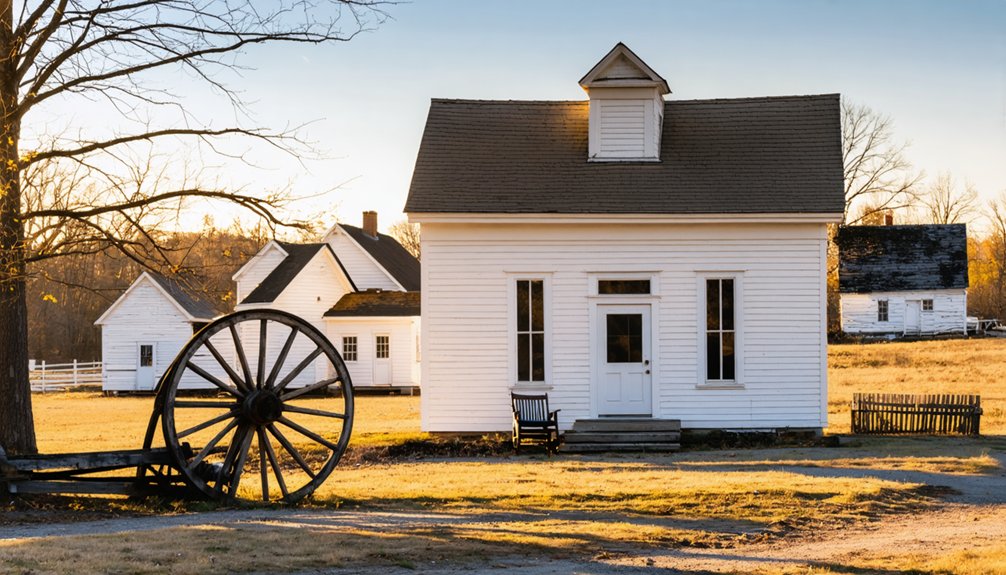
The Millennial Laws of 1821 governed every aspect of Shaker existence at Pleasant Hill, from the 4:30 AM rising bell to the mandatory 8 PM retirement. You’ll notice this regimentation reflected in the architecture itself—separate staircases, doorways, and living quarters enforced the absolute gender separation required by covenant.
Weekly confession sessions with elders, conducted in designated spaces within the trustees’ buildings, maintained the spiritual discipline that bound this celibate community together.
Daily Rules and Restrictions
Strict adherence to the Millennial Laws governed every aspect of Shaker existence at Pleasant Hill, transforming daily life into a carefully choreographed expression of faith. You’ll discover these regulations extended far beyond worship into mundane particulars that required constant vigilance and confession to elders when violated.
The most restrictive daily mandates included:
- Travel restrictions – Members needed explicit elder permission before leaving community boundaries, with worldly excursions granted sparingly
- Media prohibitions – Books, newspapers, maps, and pictures were forbidden in private quarters, limiting individual access to external information
- Food rules – Specific preparation requirements dictated even simple tasks like salting cucumbers properly
These regulations created an insular environment where collective purity superseded personal autonomy, though such constraints paradoxically allowed the community’s architectural achievements to flourish through focused communal labor.
Gender Separation Within Buildings
Walking through any Pleasant Hill dwelling today, you’ll immediately notice the paired entrances—a architectural manifestation of the Millennial Laws‘ most fundamental mandate. These symmetrical doorways enforced complete physical separation from arrival, with Brothers and Sisters ascending opposing stairways to gender-specific sleeping chambers on opposite hallway sides.
The architecture itself regulated behavior: you couldn’t pass someone on stairs, enter opposite-gender workshops without elder permission, or stand together unsupervised. Even clothing norms and workplace divisions reinforced this separation.
Yet paradoxically, this structured community achieved genuine gender equality by the 1780s—consensus governance valued women’s voices equally, with dual leadership teams managing operations.
Union Meetings offered controlled interaction: five feet apart, no whispering, discussing general topics under watchful supervision. This preserved individual autonomy while maintaining communal order.
Confession and Spiritual Practice
Physical separation through architecture represented only the surface layer of Shaker governance—beneath those paired doorways and divided stairways operated an intricate system of spiritual accountability centered on mandatory confession. You’ll discover that Elders and Eldresses monitored family units of 50-100 members, requiring regular admission of any infractions against the Millennial Laws.
Confession practices structured daily life through:
- Required disclosure of sins to leadership, no matter how minor the transgression
- Sin accountability extending from major violations to forgetting proper cucumber seasoning
- Spiritual purity maintenance through celibacy, communal property ownership, and separation from worldly influences
This framework sustained communities like Pleasant Hill at its 1823 peak of 500 members, integrating worship through work with rigorous ethical standards that distinguished their earthly plane from both worldly corruption and heavenly perfection.
Paranormal Activity Reports From Visitors and Staff
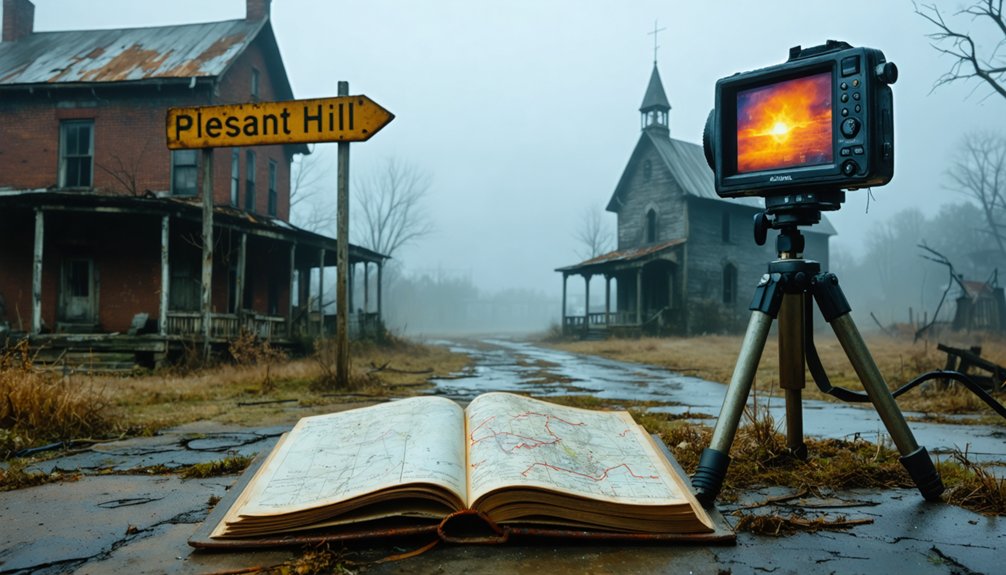
Since the 1970s preservation of Pleasant Hill’s 34 original structures, documented accounts of unexplained phenomena have accumulated across multiple buildings within the National Historic Landmark district. You’ll find visitor testimonials detailing experiences in haunted hotel rooms, particularly Room 194 of the West Family House, where guests report bedding disturbances and unexplained physical contact.
The Tanyard House generates warnings about heavy footsteps and what visitors characterize as malevolent presences rather than historical spirits. Trustees Office’s upper floor carries similar advisories. Ghost investigation equipment activates spontaneously on third-floor locations, correlating with documented Shaker-era deaths and incidents. Some guests claim demonic attachments following overnight stays.
While management offers Spirit Stroll historical tours, they don’t officially endorse paranormal interpretations of these recurring reports from independent travelers.
How to Plan Your Visit to Shaker Village of Pleasant Hill
Everything about your visit to Shaker Village of Pleasant Hill requires advance planning to maximize access to the 3,000-acre National Historic Landmark district. This nonprofit organization preserves Kentucky’s largest collection of original 19th-century structures spanning 1809 to 1875, offering tour options through 34 restored buildings along the historic gravel turnpike.
Plan ahead to explore 34 restored Shaker buildings across 3,000 acres of Kentucky’s premier 19th-century National Historic Landmark.
Your exploration should include:
- Architectural Tours: Examine Micajah Burnett’s Federal-style designs, including the 1820 Meetinghouse and Trustee House’s twin spiral cherry stairways
- Shaker Lifestyle Experiences: Participate in hands-on demonstrations of traditional crafts, farming techniques, and communal practices
- Archaeological Sites: Access excavated locations revealing the community’s sophisticated municipal water system
Revenue from guests and donations directly funds ongoing preservation. Located near Lexington, you’ll find flexibility for day trips or extended overnight stays supporting conservation efforts.
One option for an intriguing adventure is exploring ghost towns near Neal, Kentucky, where you can uncover the remnants of once-thriving communities. These hauntingly beautiful locations provide a unique glimpse into the past while contributing to the area’s rich history. As you venture through these sites, each tells a story, reinforcing the importance of preserving our heritage for future generations.
The history of Corwin in Indiana is also worth exploring, as it showcases the fascinating stories of local residents and their contributions to community development. Visiting this charming town allows travelers to appreciate the blend of past and present, making it an enriching addition to your journey through the region. Through various preserved sites, visitors can connect with the area’s legacy, furthering the understanding of Indiana’s role in American history.
What to Expect During Your Ghost Town Adventure
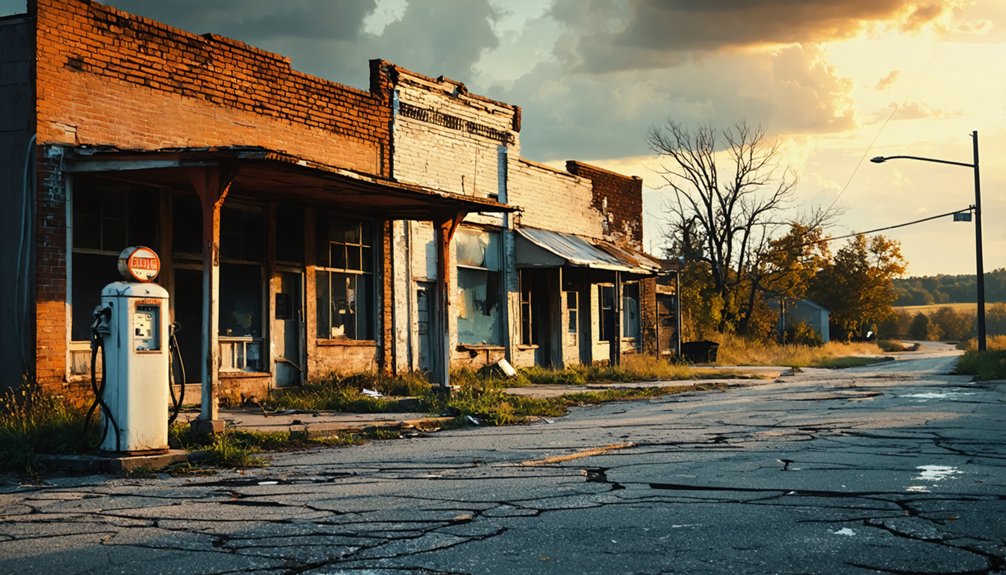
Walking through Pleasant Hill’s 3,000-acre National Historic Landmark, you’ll encounter a preserved landscape where architectural documentation intersects with documented tragedy. You’ll explore 34 original buildings that once housed nearly 500 residents practicing their communal lifestyle bound by celibacy and strict Millennial Laws. Archaeological foundations reveal boys’ dormitories, smokehouses, and fence post holes marking property boundaries that once exceeded 4,000 acres.
The site’s spiritual conflicts manifest in reported phenomena: crying babies, unexplained footsteps, and muffled voices in converted elderly housing. Louisiana Dunn’s fatal leap from Center House in 1846 exemplifies documented tragedies marking these grounds. You’ll navigate separate brother-sister staircases and doorways, understanding how architecture enforced religious doctrine. The preservation effort allows autonomous exploration of this complex religious experiment’s physical remnants.
Frequently Asked Questions
Are There Any Restaurants or Dining Options Available at Pleasant Hill?
You’ll find The Trustees’ Table restaurant serving farm-to-table local cuisine offerings at Shaker Village. They feature seasonal farmers market ingredients from their preserved gardens. Reservations are strongly recommended for this authentic dining experience celebrating Kentucky’s agricultural heritage.
Can Visitors Stay Overnight in the Historic Shaker Buildings?
Yes, you’ll discover overnight Shaker accommodations across 13 authentically preserved buildings housing 72 guest rooms. These historic structures offer immersive stays where you can experience the community’s architectural heritage firsthand, complementing daytime Shaker community tours through meticulously conserved spaces.
Is Pleasant Hill Accessible for Visitors With Mobility Limitations or Wheelchairs?
Pleasant Hill offers partial Shaker architecture accessibility through outdoor lifts, ADA pathways, and complimentary admission for mobility-limited guests. However, historic buildings require traversing steps, and public transportation options don’t serve this rural 3,000-acre site directly.
What Are the Admission Prices and Operating Hours for the Village?
You’ll find admission at $16 for adults, $8 for children 6-12, while those under 5 enter free. The village welcomes you Monday-Sunday, 10 a.m.-5 p.m., though seasonal hours vary. Self-guided tours offer unrestricted exploration.
Are Photography and Video Recording Allowed Inside the Historic Buildings?
Yes, you’re allowed photography inside historic buildings following equipment guidelines—no tripods, monopods, or stabilization devices due to space constraints. Photography policies require purchased admission, and you can’t impede guests or operations while documenting the architectural preservation.
References
- https://blog.shakervillageky.org/harrowing-history-halloween/
- https://shakervillageky.org/history-and-restoration/
- https://www.kentuckyhauntedhouses.com/real-haunt/shaker-village-pleasant-hill.html
- https://herlifeinruins.com/shaker-village-pleasant-hill/
- https://www.terrain.org/articles/15/yanarella.htm
- https://www.southernspiritguide.org/in-the-valley-of-love-and-delight-the-simple-spirits-of-pleasant-hill/
- https://en.wikipedia.org/wiki/Pleasant_Hill
- https://www.nps.gov/places/shaker-village-at-pleasant-hill.htm
- https://bigrocktravel.com/kentucky-shaker-village-of-pleasant-hill/
- https://history.ky.gov/markers/shakertown-at-pleasant-hill