Plan your Pleasant Plains ghost town expedition by accessing the site via U.S. Route 54 between Kismet and Plains in Meade County, Kansas. You’ll find remnants near Byers cemetery at coordinates 37°15′51″N 100°35′23″W. Visit during spring or fall when temperatures range 50-75°F, avoiding summer heat and winter storms. Pack emergency supplies, GPS equipment, and cameras to document foundation stones and cemetery markers. Notify contacts before departing, as no services exist in this remote location. The guide ahead covers seasonal hazards, photography techniques, and nearby historical sites to maximize your prairie documentation journey.
Key Takeaways
- Pleasant Plains is located in Meade County, Kansas, accessible via U.S. Route 54 between Kismet and Plains.
- Visit during spring or fall for moderate 50-75°F temperatures; avoid summer heat exceeding 90°F and harsh winter conditions.
- Search for foundation remnants, cemetery markers at nearby Byers cemetery, and agricultural infrastructure like wells and fence lines.
- Bring emergency supplies, vehicle repair kit, GPS, cameras, and notify contacts before visiting this remote location without services.
- Combine your trip with nearby ghost towns in Osborne, Douglas, Franklin, Chase, or Norton counties for extended exploration.
Getting to Pleasant Plains: Routes and Road Conditions
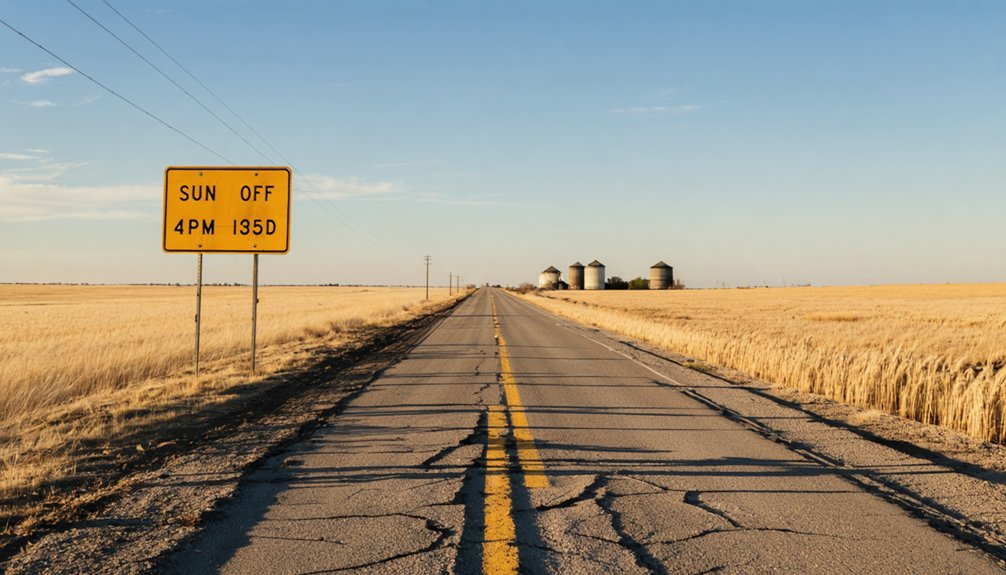
Where exactly does Pleasant Plains sit on the Kansas map? You’ll find this ghost town in Meade County at 37°15′51″N 100°35′23″W, accessible primarily via U.S. Route 54. The cemetery near Byers, Kansas marks the settlement’s location. For precise navigation, satellite imagery mapping through Google Maps reveals the exact coordinates and surrounding terrain that standard maps miss.
Highway access follows Route 54 between Kismet and Plains, where you’ll pass Southwestern Heights High School. Current road conditions are available through MapQuest’s real-time traffic data. Rome2Rio provides transport options from Kansas City with detailed journey times.
Download printable PDF maps for offline reference—cell service proves unreliable in remote Meade County. Interactive zoom features on World TimeZones.com offer additional location verification before you venture into this forgotten corner of southwestern Kansas.
What Remains: Exploring the Abandoned Townsite
Although earlier documentation pinpointed Pleasant Plains’ coordinates, the physical evidence at this location tells a more sobering story. Without verified sources confirming specific structures or artifacts, you’ll need to approach this site with realistic expectations about what survives.
Documented exploration priorities:
- Foundation remnants – Search for stone or concrete footprints indicating building locations
- Cemetery markers – Often the most enduring evidence, revealing local community stories and settlement dates
- Agricultural infrastructure – Well casings, fence lines, or equipment fragments showing economic activity
Current historic preservation efforts for Kansas ghost towns rarely extend to unincorporated sites lacking significant structures. You’re fundamentally conducting independent field research. Bring cameras, GPS coordinates, and reference materials. Document everything—your observations contribute to preserving these vanishing locations for future freedom-seekers exploring forgotten Kansas settlements.
Best Times to Visit This Kansas Ghost Town
You’ll find Pleasant Plains most accessible during spring (April-June) and fall (September-November), when moderate temperatures between 50-75°F allow extended documentation of structural remains without weather interference.
Summer heat exceeding 90°F can compromise both your safety and photographic equipment during midday exploration of exposed sites, while January-February snowfall may obscure architectural details and restrict access to unpaved approach roads.
March and early October offer the ideal balance of stable conditions and reduced visitor presence for uninterrupted archival work.
Seasonal Weather Considerations
Planning your visit to Pleasant Plains requires careful attention to Kansas’s dynamic weather patterns, which shift dramatically across seasons. You’ll encounter rising thunderstorm risks during spring months, with April-May showing 40-50% precipitation chances and potential large hail.
Summer brings intense heat reaching 84°F alongside frequent afternoon storms with damaging winds.
Seasonal Navigation Strategy:
- Prime Exploration Windows: Late spring to early summer offers ideal 70-80°F temperatures with minimal precipitation disruption
- Storm Avoidance: Monitor breezy weather patterns during fall alternations when winds gust 15-30 mph with blowing dust hazards
- Winter Documentation: Expect challenging conditions with temperatures near 30°F, north winds gusting to 40 mph, and reduced visibility
Shoulder seasons deliver clear skies and manageable winds under 15 mph, granting you unrestricted access to this abandoned landscape.
Avoiding Extreme Temperatures
Kansas’s temperature extremes transform Pleasant Plains from accessible historical site to inhospitable terrain within months. July-August highs risk heat exhaustion at exposed ruins, while December-February lows bring snow accumulation blocking rural roads.
You’ll find spring mornings cloaked in early morning fog that burns off for ideal exploration, whereas summer afternoon thunderstorms compound intense heat dangers.
Document your visit during April-June or September-November when moderate temperatures permit extended investigations. Winter’s freezing winds and short daylight constrain your freedom to roam abandoned structures safely. Summer’s dehydration risks during dusty walks prove particularly hazardous at midday peaks.
March and December offer shoulder-season compromises—tolerable conditions without extreme disruptions. Authentic ghost town documentation demands respect for Kansas plains weather patterns that determine whether you’ll capture historical authenticity or endure environmental adversity.
Essential Supplies and Safety Considerations
Venturing into Pleasant Plains requires meticulous preparation, as this remote Kansas ghost town offers no modern conveniences or emergency services within immediate reach. Your vehicle demands proper readiness: spare tire, jumper cables, tire repair kit, engine oil, and tire gauge prove essential for self-reliance. Off road vehicle recommendations include carrying recovery equipment and maintaining fuel reserves beyond calculated needs.
Critical Supply Categories:
- Emergency Kit: First aid supplies, flashlight with batteries, reflector triangles, duct tape, and emergency blankets establish baseline safety protocols
- Hydration System: Multiple reusable water bottles, cooler with ice packs, and non-perishable provisions like nuts and jerky sustain extended exploration
- Camping Essentials: Weather-appropriate clothing layers, rain gear, hiking footwear, hygiene supplies, and navigation tools including physical maps and cash reserves
Document your departure time and expected return with trusted contacts.
Nearby Ghost Towns and Historical Sites Worth Adding

The remarkable concentration of abandoned settlements throughout central Kansas transforms your Pleasant Plains expedition into a thorough frontier documentation circuit. Osborne County alone contains seventeen documented ghost towns within accessible driving distance, while Douglas County preserves eight distinct sites including Prairie City’s 1857 cemetery and stone ruins.
You’ll find Franklin County’s nine extinct settlements—Silkville, Ohio City, Minneola—offering self-guided walking tours through authentic frontier architecture. Chase County’s Clements features an 1887 stone arch bridge currently undergoing restoration, with interpretive signage installation documenting original construction methods.
Norton County’s Clayton maintains forty-four residents among standing historical structures near the Solomon River. This seventy-five-mile radius creates expansive access to Kansas territorial heritage without commercial interference or regulated visiting hours—pure historical investigation on your terms.
Photography Tips for Capturing Prairie Ruins
You’ll document Pleasant Plains most authentically by timing your shots during golden hour, when low-angle sunlight reveals texture in weathered wood and crumbling limestone.
Frame each structure with sufficient prairie context—these ruins derive meaning from their isolation within vast flatlands rather than as architectural specimens alone. Compose deliberately to capture both the decay of individual buildings and their relationship to the surrounding Kansas landscape, creating a visual record that future historians can reference.
Golden Hour Light Conditions
When low-angled sunlight rakes across weathered wood and crumbling stone, Pleasant Plains reveals architectural details you’ll miss during midday’s flat illumination. You’ll capture authentic textures as shadows carve deep relief into facades, exposing construction methods from another era.
Optimal Golden Hour Documentation Strategies:
- Directional Lighting Analysis – Position yourself to exploit side-lighting that emphasizes structural decay patterns and original craftsmanship details in timber frames and masonry.
- Low Light Techniques – Stabilize your camera against beams or use faster ISO settings to maintain sharpness as luminosity drops, preserving documentary accuracy without motion blur.
- Silhouette Opportunities – Backlight remaining structural elements against the prairie sky to create dramatic archival images showcasing building profiles and distinctive architectural features.
Document quickly—you’ve got roughly thirty minutes before conditions shift.
Composing Weathered Structure Shots
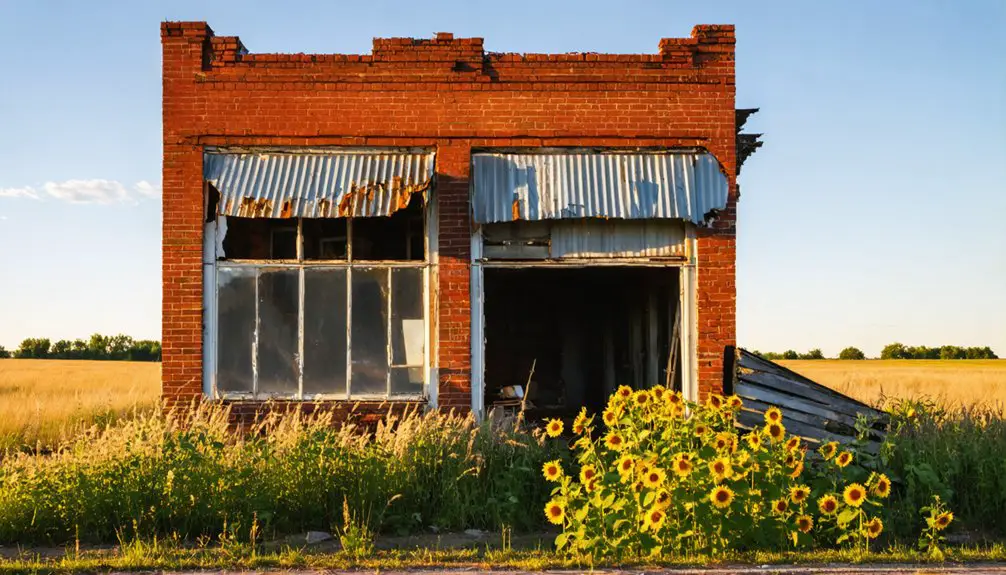
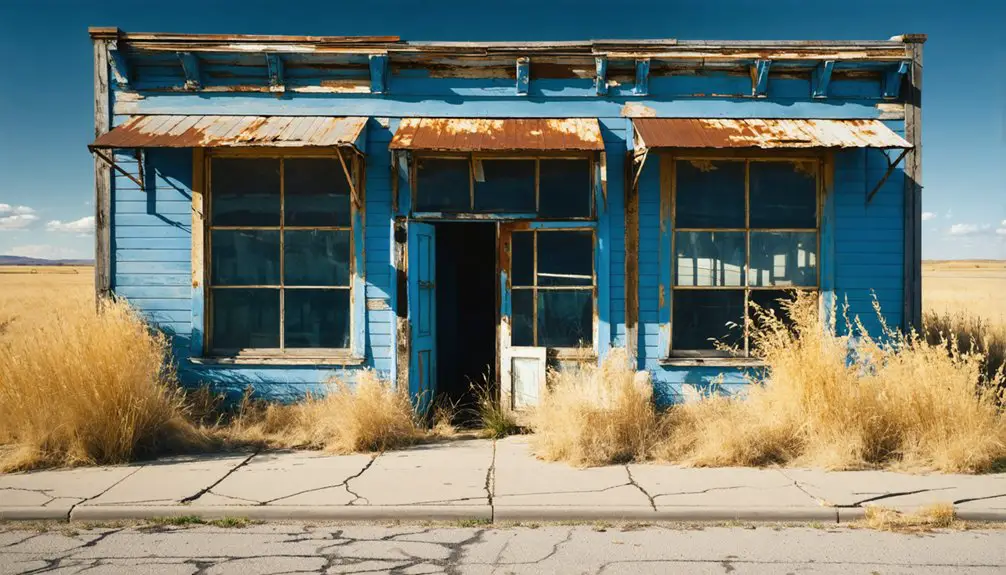
Because weathered structures demand different compositional approaches than intact buildings, you’ll need to frame decay as your primary subject rather than treating it as an unfortunate distraction. Embrace midday contrast optimization by converting high-noon shots to black and white—overhead sun creates deep shadows that accentuate pronounced lines on deteriorated wood and stone.
Position yourself low for worm’s-eye perspectives that emphasize vertical collapse and structural failure. Fill your frame with close-up textures: peeling paint, cracked masonry, rusted metals. The interplay of form and decay becomes your narrative through high-contrast elements.
Capture multiple exposures for shadowed interiors and bright exteriors, then blend them to preserve authentic detail. Use long exposures with ND filters to contrast static ruins against moving clouds, documenting both permanence and impermanence simultaneously.
Prairie Landscape Context Framing
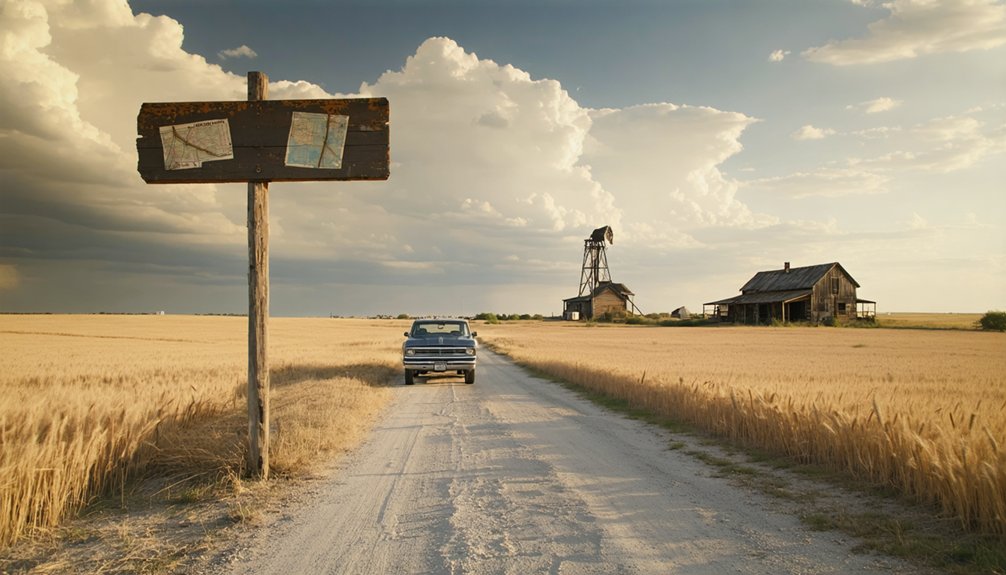
Prairie ruins gain documentary significance when photographed within their grassland context rather than isolated against empty sky. You’ll capture authentic historical narratives through strategic horizon placement adjustments that reveal how these structures relate to their environment.
Essential techniques for contextual documentation:
- Position your horizon in the top third to emphasize foreground remnants—weathered foundations, scattered timbers, or crumbling walls gain prominence against expansive grassland.
- Adopt low ground perspectives by dropping to earth level, allowing native grasses and wildflowers to frame ruins while creating three-dimensional depth through foreground-to-background layering.
- Incorporate leading lines from wagon ruts, fence lines, or natural drainage patterns that connect viewers to the structure’s original purpose and accessibility.
These composition choices transform simple ruin documentation into powerful visual records of prairie settlement history.
Frequently Asked Questions
What Caused Pleasant Plains to Become a Ghost Town?
Lead poisoning forced Pleasant Plains’ closure in 2011-2012 after mining ceased. You’ll find agricultural decline and lack of water resources compounded the exodus. Environmental contamination from decades of lead-zinc extraction made the town uninhabitable, requiring complete evacuation.
Did Pleasant Plains Have a Railroad Connection During Its Peak?
No documented evidence confirms Pleasant Plains had direct railroad operations during its peak. You’ll find the town’s commercial district development relied on nearby rail lines instead, limiting its competitive advantage and contributing to its eventual decline as neighboring towns prospered.
Are There Any Documented Stories of Former Residents Available?
The historical record doesn’t reveal specific oral histories or community archives for Pleasant Plains residents. You’ll find documentation sparse—most personal stories vanished with the town’s decline, leaving only physical remnants and official records to piece together.
Is Camping Allowed on or Near the Pleasant Plains Townsite?
You’ll find no documented camping permissions exist for Pleasant Plains’ private townsite. However, Kansas maintains 28 state parks offering nearby state park camping options. Historical preservation efforts haven’t established public access here, so you’ll need alternative locations for overnight stays.
What Was the Town’s Peak Population Before Abandonment?
Plains wasn’t abandoned—it’s still active today. You’ll find historical census data shows its peak at 1,040 residents in 2020. Former population estimates indicate steady growth since 1885, reaching 1,000 first in 1980, then stabilizing.