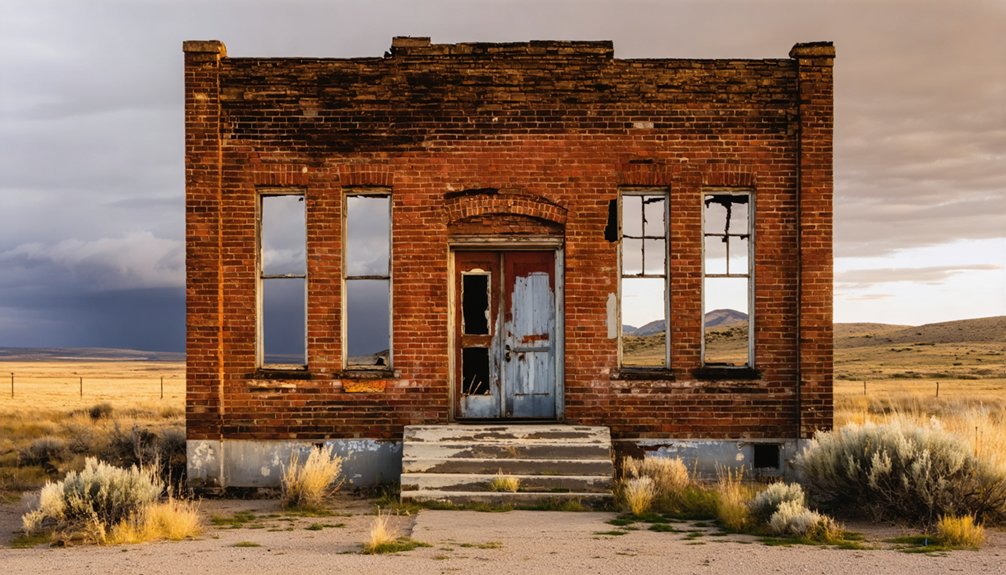
You’ll find Poison Creek Stage Stop 7 miles southwest of Marsing via Poison Creek Grade Road at coordinates 43.50210° N, 116.93820° W. The site preserves Matt Proud’s 1913 two-story sandstone house, built after fire destroyed the original 1886 structure, along with a barn featuring an intact hay trolley system, flagstone schoolhouse, and twin root cellars. Check seasonal road conditions before departing, and you’ll discover how this Jordan Valley-Caldwell corridor waystation evolved from essential frontier hub to architectural legacy.
Key Takeaways
- Located at 43.50210° N, 116.93820° W in Owyhee County, approximately 7 miles southwest of Marsing via Poison Creek Grade Road.
- Site features 1913 sandstone house, barn with hay trolley, flagstone schoolhouse, root cellars, and various frontier outbuildings.
- Established in 1886 as stage station, destroyed by fire in 1912, rebuilt in 1913 using local quarried sandstone.
- Check seasonal weather and road conditions before visiting, as accessibility may be affected on remote backcountry routes.
- Historic waypoint on Jordan Valley-Caldwell stage line showcasing Idaho’s frontier transportation infrastructure and settlement history.
The Historic Journey of Poison Creek Stage Station
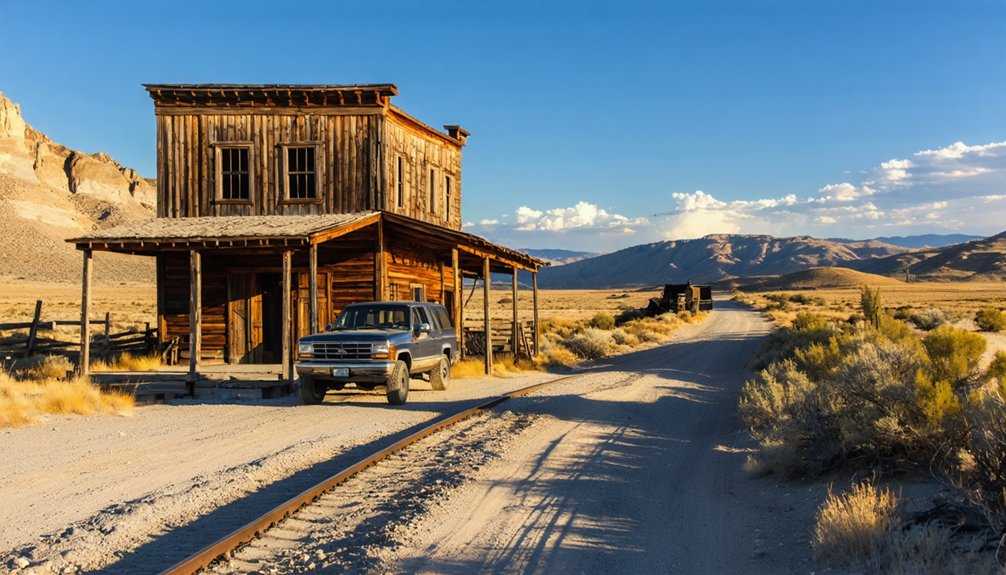
When the Jordan Valley-Caldwell stage line established operations in 1886, Poison Creek Station emerged as a critical waypoint along this remote Idaho route. You’ll discover how this isolated outpost anchored the rural economy, providing overnight lodging, hot meals, and provisions to stage passengers and freighters traversing Idaho’s backcountry.
The station’s architectural significance becomes evident when you examine its evolution. After fire destroyed the original wooden structure in 1912, builder Matt Proud quarried local sandstone to construct the 1913 replacement—a two-story house featuring a hipped roof and shuttered windows.
The property’s multiple outbuildings, including a schoolhouse, barn, and root cellars, demonstrate the station’s role as a community focal point until mechanized transportation rendered horse-drawn coaches obsolete after 1915.
What Made This Remote Waystation Essential to 19th Century Travel
As the Jordan Valley-Caldwell stage line extended across Idaho’s rugged terrain in 1886, Poison Creek Station fulfilled multiple transportation needs that defined frontier infrastructure. You’ll discover this waystation provided essential stage coach transportation services—fresh horses, hot meals, and overnight shelter for travelers bound to Silver City’s mining operations.
The station’s mail contract connected isolated ranchers to outside communications, while its role as precinct census center and brief post office operation anchored community life sustenance. Freighters stored supplies on elevated rocks, protecting goods from wildlife during their journeys.
The complex included a schoolhouse, reflecting how these remote stations served beyond mere traveler accommodation. They became critical hubs where settlers accessed education, government services, and social connection across Idaho’s expansive backcountry.
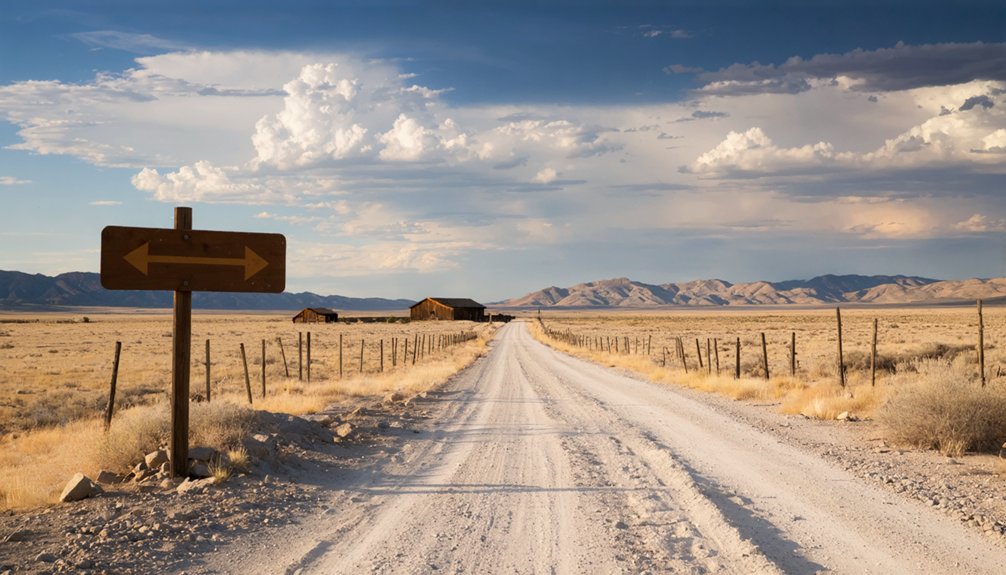
The Poison Creek Stage Stop occupies precise coordinates at 43.50210° N, 116.93820° W in Owyhee County, positioned at 2,486 feet elevation along what’s now designated as 9285 Poison Creek Grade Road. You’ll navigate approximately seven miles southwest from Marsing via this rural graded route, suitable for standard vehicles under normal conditions.
Wayfinding tips include marking the eastern terminus of Owyhee Uplands Backcountry Byway (Mud Flat Road) and locating the shaded cottonwood grove at Poison Creek Picnic Site. The main well displays distinctive car hood covering beside the roadway, while a second well near the riverbed features metal posts and protective fencing.
Seasonal access concerns merit verification—high-desert climate and potential weather impacts affect road status. Recent fires cleared vegetation, improving visibility to historic structures. Confirm current conditions before departure.
Exploring the 1913 Sandstone House and Original Structures
Upon arrival, you’ll encounter Matt Proud’s two-story sandstone house, erected in 1913 after fire destroyed the original structure. Proud quarried the stone directly from the property, creating a durable hipped-roof building that retains its original shuttered windows and stone porch, with timbered railings added during the 1930s.
The complex includes a barn, two root cellars, a rectangular dugout schoolhouse constructed from Owyhee flagstone chinked with clay, and frame outbuildings positioned strategically across the ranch site.
Matt Proud’s Stone Construction
Standing resilient against the harsh Idaho desert landscape, Matt Proud’s 1913 sandstone house represents frontier ingenuity born from necessity and loss. After fire consumed the original structure in 1912, Proud employed sandstone quarrying techniques directly on his property, extracting blocks that would anchor his rebuilt station.
The two-story structure showcases a hipped roof design, with shuttered front windows and a stone porch he later enhanced with timbered railings and balcony additions in the 1930s.
You’ll find Proud’s resourcefulness extended beyond the main house. He utilized Owyhee flagstone for the schoolhouse and root cellar entry, chinked with clay between stones. The root cellar demonstrates post-and-beam timber construction beneath a gabled cinder roof, while the schoolhouse features shallow gabled roof construction materials including planked surfaces and 2×2 cross beams.
Outbuildings and Ranch Layout
Beyond Matt Proud’s sandstone house, a network of specialized outbuildings reveals the station’s complete operational infrastructure. You’ll find square timber root cellars with gabled cinder roofs behind the main structure, their Owyhee flagstone entry piles still standing.
The rectangular dugout schoolhouse sits 100 feet right, constructed from local flagstone with clay chinking and eleven exposed cross beams supporting its planked roof.
Barn interiors showcase the original three-bay configuration, complete with intact hay trolley systems and concrete stall floors overlaid with planks. Outbuilding foundations demonstrate post-and-beam methodology typical of frontier construction.
Across Jordan Valley Road, you’ll discover the frame chicken coop and outhouse facility. The Hawks family’s ongoing restoration addresses deterioration while preserving this authentic waystation compound‘s functional layout.
Matt Proud’s Legacy: Architecture and Construction Details
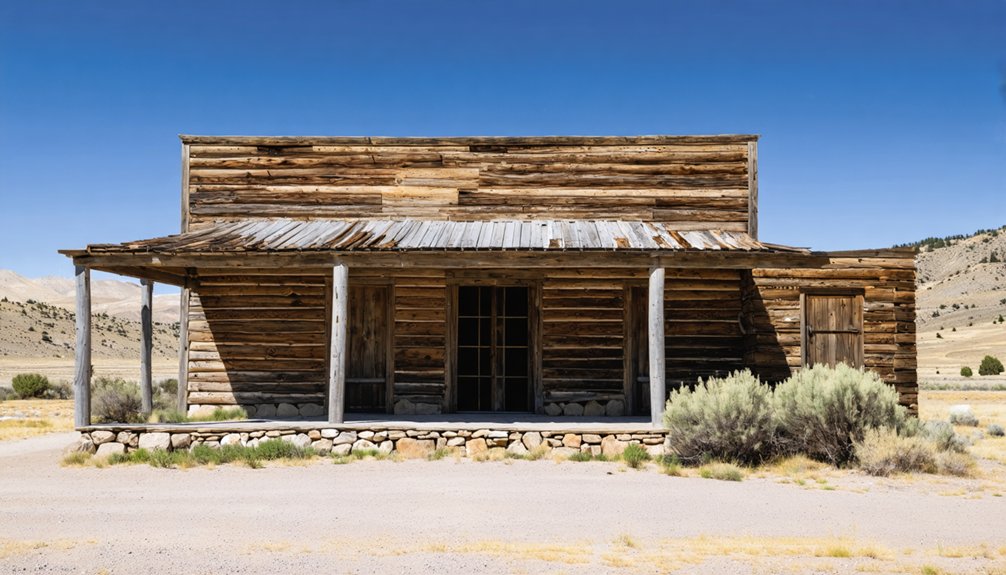
You’ll find Matt Proud’s construction expertise documented in every hand-quarried sandstone block of the 1913 two-story house, where he extracted building materials directly from the property following the 1912 fire. The structure’s original hipped roof design and shuttered front windows demonstrate period-appropriate architectural choices, while the stone porch remains integral to the building’s structural composition.
Documentation shows the timbered railing and balcony represent 1930s modifications that altered the dwelling’s original austere appearance while maintaining its sandstone integrity.
Quarried Sandstone Construction Methods
When Matt Proud rebuilt after the devastating 1912 fire, he established an on-site quarrying operation that would define the station’s architectural legacy for the next century. His sandstone quarry operations transformed raw Idaho stone into load-bearing walls supporting a two-story hipped-roof structure that’s withstood every season since 1913.
The stone masonry techniques employed reveal remarkable craftsmanship:
- Precision-cut openings accommodated shuttered windows within thick stone walls
- Integrated porch construction merged directly with the foundation system
- Load-bearing capacity supported full residential weight across two stories
- Weather-resistant natural properties protected against extreme climate variations
- Structural flexibility allowed 1930s timber additions without compromising integrity
This construction methodology represented late 1880s regional building standards, where builders selected premium materials—quarried sandstone—exclusively for primary structures while reserving simpler timber framing for secondary buildings.
Two-Story House Design
Matt Proud’s rebuilt station rose as a two-story sandstone monument that balanced functional necessity with architectural proportion. The home layout design reflected territorial practicality—living quarters upstairs, commercial operations below.
Proud’s construction crew stripped and leveled every timber stud before installing materials, ensuring walls stood plumb against Idaho’s demanding climate. Natural wood bowing was corrected through meticulous framing techniques that predated modern standards yet achieved remarkable precision.
The structure incorporated sustainable construction methods through locally quarried sandstone that provided thermal mass and weather resistance. Outside corners featured reinforced framing that eliminated structural voids. Each floor maintained independent function while creating unified proportions visible from the surrounding valley.
Proud’s attention to vertical alignment and material integrity established construction principles that’d influence regional building practices for decades.
1930s Balcony Addition
Two decades after its sandstone resurrection, Proud’s station received its final architectural enhancement—a timbered balcony that transformed the building’s front elevation. Added during the 1930s, this second-story feature demonstrates the balcony’s architectural merits through its careful integration with the 1913 stone structure.
The timber railing construction complements rather than competes with the original sandstone porch below.
Period Construction Documentation:
- Shuttered front windows frame the balcony’s Jordan Valley Road view
- Hipped roof shelters both original structure and later addition
- Local materials maintain architectural consistency across decades
- Timber elements contrast purposefully with quarried sandstone walls
- Enhancement preserved after 1915 end of stage operations
You’ll observe how Proud’s building evolved beyond functional necessity into documented frontier architecture worth protecting.
From Stagecoaches to Auto Trucks: The Decline of an Era
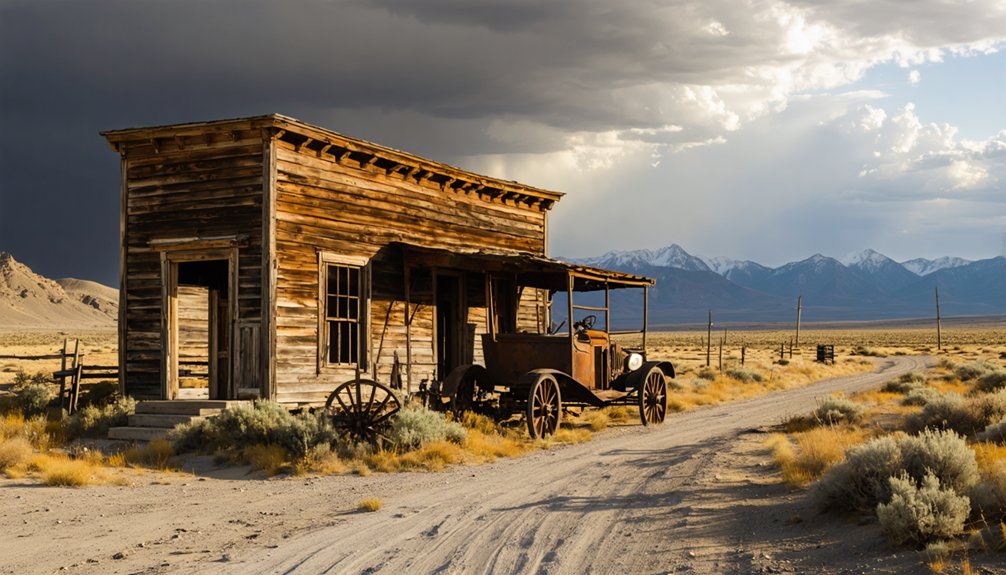
While Poison Creek Stage Station stood as essential infrastructure for twenty-six years, its operational significance collapsed within a single generation due to automotive innovation. When J. A. Wroten introduced auto trucks in 1915, you’re witnessing fundamental transportation metamorphosis that eliminated overnight waystation requirements.
Motorized vehicles didn’t need livestock care, feed supplies, or lodging facilities—they simply drove past stations that once sustained entire communities.
The 1913 sandstone house, rebuilt just two years before motorization arrived, represents tragic timing. You’ll find economic conversion implications everywhere: obsolete stables, unused lodging quarters, and abandoned supply infrastructure. This wasn’t gradual decline—automotive technology rendered the entire waystation model irrelevant almost instantly.
The structures survived precisely because they became economically insignificant, preserving pre-automotive transportation history through neglect rather than intention.
What to See: Wells, Cellars, and Hidden Foundations
The Poison Creek Stage Station site preserves a remarkably complete archaeological footprint of 1880s waystation infrastructure. You’ll discover undiscovered remnants scattered across overgrown terrain, revealing the self-sufficient design that enabled frontier survival.
Two root cellars remain intact, offering glimpses into pioneer food preservation methods essential for isolated operations.
Key features to explore:
- Hidden foundations from the original barn and outbuildings marking the 1886-1915 operational footprint
- Exposed well structures that sustained stagecoach passengers and livestock on the Jordan Valley-Caldwell line
- Stone cellar entrances built into hillside embankments for temperature-controlled storage
- Deteriorating schoolhouse framework with visible 2″ x 2″ beam construction
- Outhouse and chicken coop sites positioned along Jordan Valley Road
Document what you find—these fragile structures won’t withstand another century without recognition.
Best Times to Visit and Road Condition Considerations
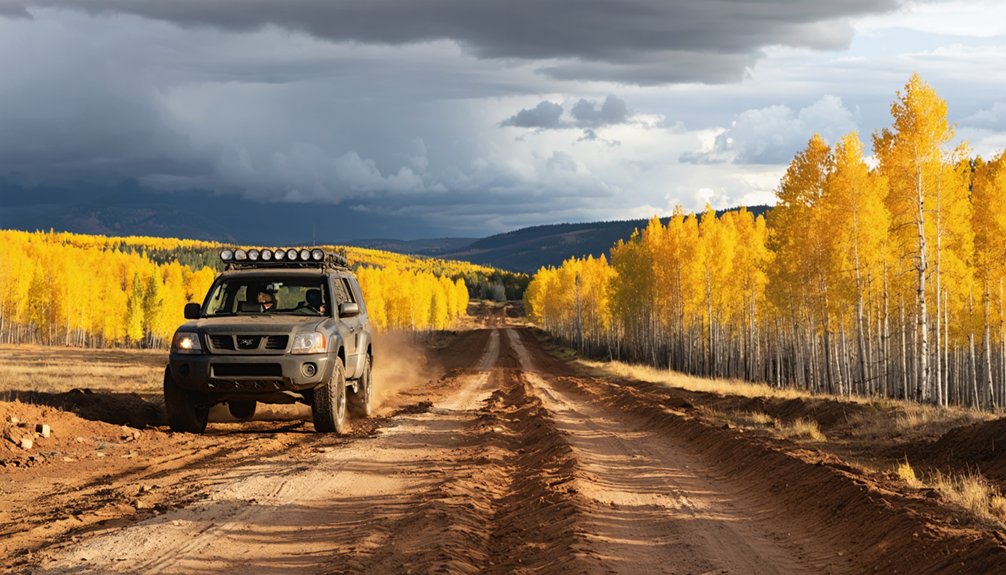
Planning your expedition to Poison Creek Stage Station requires careful attention to seasonal accessibility patterns that have shaped backcountry travel since the original stagecoach era. Road accessibility to remote Idaho historical sites typically follows established closure windows—many BLM routes remain impassable from mid-November through spring thaw to protect wildlife corridors and prevent erosion damage.
You’ll need to verify current conditions through Idaho 511 and local BLM field offices before departure, as seasonal variations dramatically affect route viability. The documented pattern suggests summer through early fall offers ideal windows, though you should confirm specific access requirements for Poison Creek’s location.
Consult regional historical societies and backcountry guidebooks for precise routing intelligence. These preparations honor both the landscape and your independence to explore authentically preserved frontier sites.
Connecting Your Trip to Other Silver City Freight Route Landmarks
Beyond Poison Creek’s weathered remnants, the Silver City freight corridor preserves a remarkable chain of nineteenth-century transportation infrastructure that you can document across southwestern Idaho’s high desert. Understanding the historical significance of these interconnected sites reveals how regional transportation networks enabled frontier commerce and settlement.
Key landmarks you’ll encounter along the freight route:
- Skinner Toll Road segments – Engineered sections dating to May 1866 that revolutionized ore transportation efficiency
- DeLamar junction – Where competing mining district routes converged, creating critical supply chain intersections
- Jordan Valley connections – Extended freight pathways linking Idaho operations to Oregon markets
- Reynolds Creek crossings – Strategic water access points that determined wagon route viability
- War Eagle Mountain approaches – Steep grades that tested freighter skill and equipment durability
Document coordinates, structural remnants, and route alignments before erosion claims these freedom-enabling pathways.
Frequently Asked Questions
Is the Poison Creek Stage Stop Open for Interior Tours?
No, you can’t tour the interior—it’s been closed since the 1970s. You’ll appreciate its historical significance and architectural features from the roadside viewing area, where preservation efforts protect this 1866 structure’s authentic condition for future generations.
Are Camping or Overnight Stays Permitted at the Historic Site?
You’ll discover remarkably preserved camping amenities available at Poison Creek, where 279 sites await your reservation from mid-May through mid-November. Parking accommodations nearby include designated boat launch areas for winter’s first-come, first-served freedom camping.
What Photography Restrictions Apply to the Sandstone House and Structures?
No photo release requirements or permitted camera equipment restrictions exist in documentation. You’ll find continuous photography encouraged at this privately-owned site, though you should seek permission before approaching structures closely for detailed preservation documentation purposes.
Is the Site Privately Owned or Managed by a Preservation Organization?
The site remains privately held—a preserved fragment of history in Dean and Phil Hawks’ hands. Ownership status confirms private stewardship at 233 West Maple, Meridian. Preservation initiatives proceed through National Register nomination, respecting property rights while safeguarding heritage.
Are There Entrance Fees Required to Visit the Stage Station?
You’ll pay $7.00 per vehicle to enter Lake Cascade State Park’s Poison Creek area. While parking availability exists at the historic site, you won’t find nearby dining options—pack provisions for your independent exploration of this preserved stage stop.