You’ll find Port Gamble frozen in time on Washington’s Kitsap Peninsula, where Victorian-era buildings from 1853 whisper tales of North America’s longest-operating sawmill community. Reach this preserved New England-style lumber town via Highway 16 north from Tacoma, crossing the dramatic Narrows Bridge before winding through evergreen forests on Highway 3 to Highway 104. The notorious Walker-Ames House anchors your ghost-hunting adventure, while the historic cemetery and museum reveal the darker chapters behind supernatural sightings that have captivated paranormal investigators since the 1950s—there’s much more haunting history awaiting your discovery.
Key Takeaways
- Access Port Gamble via Highway 16 north from Tacoma, then Highway 3 through Kitsap Peninsula, branching east onto Highway 104.
- Visit North America’s longest-operating sawmill town, which ran continuously for 142 years from 1853 to 1995.
- Explore the National Historic Landmark District featuring authentically preserved 19th-century New England-style architecture and neighborhoods.
- Tour the Walker-Ames House, an 1888 Queen Anne Victorian known as Washington State’s most haunted building.
- Plan travel for early morning or midday to avoid heavy traffic across the Tacoma Narrows Bridge suspension span.
The Historic Lumber Town That Time Forgot
The salty breeze off Gamble Bay carries whispers of a different era, when mill whistles ruled the rhythm of daily life and the screech of saws filled the air from dawn to dusk. You’ll discover Port Gamble frozen in time—a company town built by Maine lumbermen who transformed this frontier into something distinctly New England. Founded in 1853, it powered the early timber industry across the Pacific, shipping lumber to San Francisco, Hawaii, and beyond for 142 uninterrupted years.
Walk streets lined with elm trees descended from Maine slips, past white clapboard houses overlooking the Olympic range. This architectural preservation isn’t manufactured nostalgia—it’s authentic history. The original buildings stand where millworkers once lived, creating North America’s longest-operating sawmill community before that final whistle blew in 1995.
Getting to Port Gamble on the Kitsap Peninsula
If you’re coming from the south, take Highway 16 north from Tacoma across the dramatic Tacoma Narrows Bridge, where Puget Sound sparkles beneath you.
The route transforms into Highway 3 as you wind through the Kitsap Peninsula’s dense evergreen forests, passing small towns and military installations.
Watch for Highway 104 to branch east—it’ll carry you straight to Port Gamble, where the road narrows to 25 mph and the trees close in like a green tunnel before revealing the historic waterfront village.
Route via Tacoma Narrows
Twin suspension bridges stretch across the Tacoma Narrows strait, connecting mainland Tacoma to the Kitsap Peninsula via State Route 16—your gateway to Port Gamble’s historic streets. You’ll cross heading westbound, where no toll waits—the toll collection process only applies eastbound toward Tacoma. The 1950 and 2007 spans rank among America’s fifth-longest suspension bridges, carrying you 5,979 feet above Puget Sound’s churning waters.
Watch for high winds that can buffet your vehicle. Don’t change lanes on the westbound bridge’s surface grates—you’ll lose traction and face a $136 fine. Pedestrian safety measures include the Scott Pierson Trail running parallel to SR-16, keeping walkers separated from traffic.
Once across, continue straight toward Gig Harbor, then navigate north to Port Gamble’s weathered buildings.
Kitsap Peninsula Drive Details
Beyond the Narrows, four ferry terminals dot Puget Sound’s eastern shores, each offering passage to Kitsap Peninsula and your Port Gamble destination. Kingston and Bainbridge Island provide prime drive alternatives—Kingston delivers you thirty minutes across the water, then fifteen minutes northwest on HWY 104. Bainbridge requires thirty-five minutes sailing, followed by another thirty-five through Winslow and past Hood Canal Bridge’s iconic span.
Traffic considerations favor early departures or midday crossings when commuter congestion eases. From Kingston’s dock, you’ll chase westward five miles before spotting Port Gamble’s sign. The Bainbridge route winds thirteen miles on HWY 305, merging onto HWY 3 before shifting to 104 at the bridge. Watch for water towers marking your final turn—straight ahead when the highway veers sharply left, delivering you into history’s embrace.
America’s Longest-Running Sawmill Legacy
As you walk through Port Gamble’s tidy streets, you’re standing in what was North America’s longest continuously operating sawmill town—a remarkable 142-year run that began when Captain William C. Talbot spotted this sheltered sand spit in 1853.
The Puget Mill Company’s steam-powered operation roared to life just one week after its machinery arrived by schooner that September, cutting lumber that would eventually reach 37 ports from Cape Town to Shanghai.
142 Years of Operation
When the first log screamed through the muley saw in September 1853, nobody could have imagined that Port Gamble’s mill would still be cutting timber 142 years later. You’re standing on hallowed ground where America’s longest continuously operating sawmill carved its legacy from raw wilderness.
The chronicle reads like an American success story: from 2,000 feet daily in 1854 to a staggering 225,000 feet by 1909. Restructuring attempts in 1874 transformed the operation into Washington Territory’s largest timberland holder.
Through financial panics, ownership changes, and countless technological upgrades, the saws kept screaming.
When the final whistle blew on November 30, 1995, just twenty workers remained to close this remarkable chapter—a documentation to both industrial progress and the relentless march of economic change.
Puget Mill Company History
The story begins with three ambitious New Englanders who transformed a quiet harbor into America’s lumber empire. In 1853, William Talbot, Andrew Pope, and Josiah Keller established Puget Mill Company at Port Gamble, choosing this remote spot for its deep water and endless timber. Their mill operations quickly proved profitable—producing 2,000 board feet daily by year’s end and shipping to 37 ports worldwide by 1862.
The company created an entire community around their workers, with employee living conditions that included company-owned homes, churches, schools, and medical facilities. By the 1920s, over 250 workers called this company town home. The mill’s legacy stretched from 1853 until 1995—making it America’s longest-running sawmill operation.
Exploring the National Historic Landmark District
Walking through Port Gamble feels like stepping onto a meticulously preserved 19th-century New England stage set, except the weathered clapboard houses and white-steepled church are entirely authentic. You’ll discover the 1858 original residential plat rising above the mill site, where historic architecture preservation showcases Maine-style homes, the Masonic lodge, and schoolhouse.
The town’s two distinct neighborhoods tell different chapters of mill life—the bluff community and post-1890 residential district once housed fifty-one families. As you explore, you’re witnessing rare indigenous workforce representation history; S’Klallam tribal members paddled daily from Point Julia, working alongside Chinese, Hawaiian, and Maine transplants. This National Historic Landmark District represents the Pacific Northwest’s only surviving complete example of transplanted New England lumber town planning.
Walker-Ames House and Paranormal Encounters
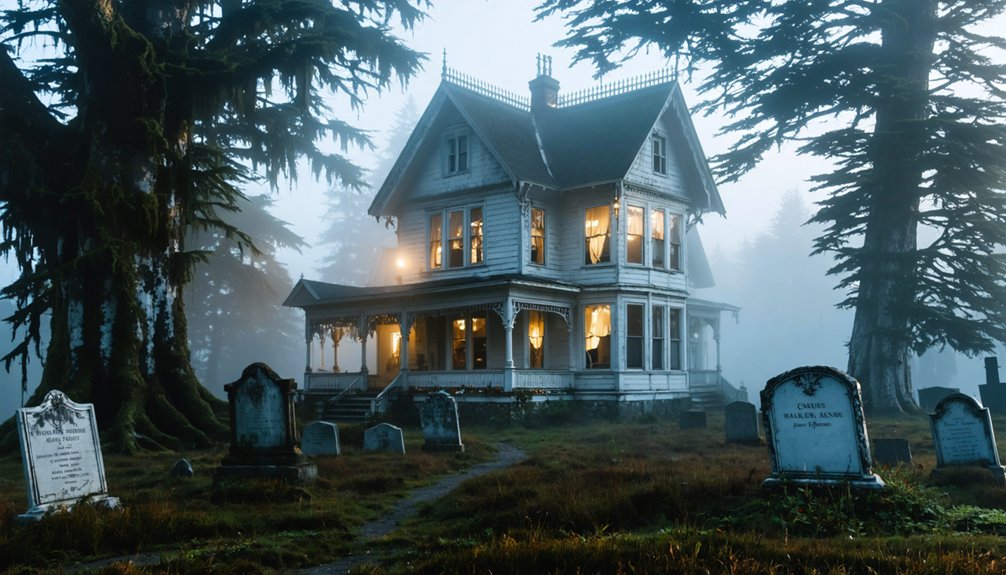
Perched near the old mill site, the Walker-Ames House rises like a Queen Anne Victorian jewel from 1888, its ornate architecture concealing Washington State’s most haunted reputation. Since the 1950s, paranormal investigations have documented unsettling phenomena within these walls, earning features on A&E’s “My Ghost Story” and drawing psychics, ghost tours, and thrill-seekers.
You’ll encounter eerie apparitions and unexplained disturbances:
- Two children’s faces appearing in attic windows
- Hair pulling and jacket tugging in the basement
- Furniture moving independently during investigations
- Doors slamming despite heavy weights
- Overwhelming stenches accompanying supernatural activity
Join the annual Ghost Conference or Special Investigations led by Pete Orbea. Evergreen Paranormal conducted the first formal investigation in 2006, while subsequent teams reported dizziness and nausea. Book ahead—overcrowded tours diminish spirit activity.
Must-See Historic Buildings and Attractions
Beyond the Walker-Ames House’s haunted halls, Port Gamble’s National Historic Landmark District unfolds across 120 tree-lined acres where perfectly preserved 19th-century buildings transport you to a New England mill town transplanted on Puget Sound’s shores.
Saint Paul’s Church, built in the 1880s, showcases classic New England-style historic architecture and offers stunning photo opportunities on your walking tour. The vibrant yellow 1906 Post Office building now houses Port Gamble Theatre, where you’ll catch live Shakespeare, concerts, and vintage cinema—check their schedule before visiting.
Explore the General Store’s eclectic gift selection and grab sandwiches at the small cafe while discovering turn-of-the-century structures throughout town. When you’re ready to escape into nature, venture to Port Gamble Forest Heritage Park‘s 3,500 acres featuring trails for hiking, biking, and kayaking along the waterfront.
The Dark History Behind the Hauntings
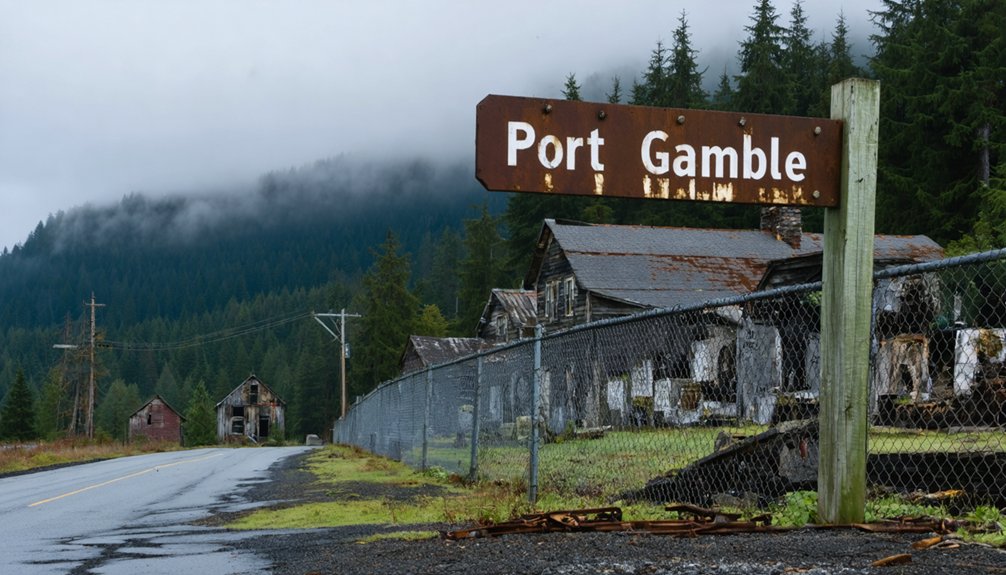
The picturesque streets and Victorian facades you’ll photograph during your Port Gamble visit mask a darker truth—this seemingly peaceful mill town harbors over 150 years of restless spirits. The lumber town’s grim past stretches back to 1853, when dangerous sawmill operations and isolation created conditions ripe for tragedy and unexplained phenomena.
Key elements of Port Gamble’s haunted history:
- Workers documented paranormal encounters in handwritten accounts during the 1950s—when discussing ghosts was taboo
- Nearly 45 of 50+ original structures report supernatural activity
- The Walker-Ames House stands vacant since 1995, allegedly Washington’s most haunted building
- The Painted Lady served as both physician’s office and hospital from 1879-1929
- Buena Vista Cemetery remains an active hotspot for nighttime encounters
These unsolved supernatural mysteries draw six paranormal investigation teams annually, all seeking answers to Port Gamble’s persistent hauntings.
Annual Ghost Conference and Supernatural Tourism
Each November, paranormal enthusiasts descend upon Port Gamble for what’s become Washington’s premier supernatural gathering—the Annual Ghost Conference. The 16th edition runs November 7-9, 2025, offering three days of expert speakers, psychic panels, and hands-on investigation procedures at genuinely haunted locations. You’ll explore the 1888 Walker-Ames House and 1871 Masonic Lodge during nighttime investigations, armed with flashlights and voice recorders to capture paranormal activity evidence.
Weekend passes cost just $45, granting access to all presentations and panels. Individual investigations run $20 per session, while specialized classes on ethics, automatic drawing, and research techniques are $30 each. Beyond the conference, Port Gamble hosts year-round ghost walks and special investigations, plus the adults-only Ghoulish Gala each Halloween. It’s supernatural tourism without corporate sanitization.
Planning Your Visit to the Cemetery and Museum
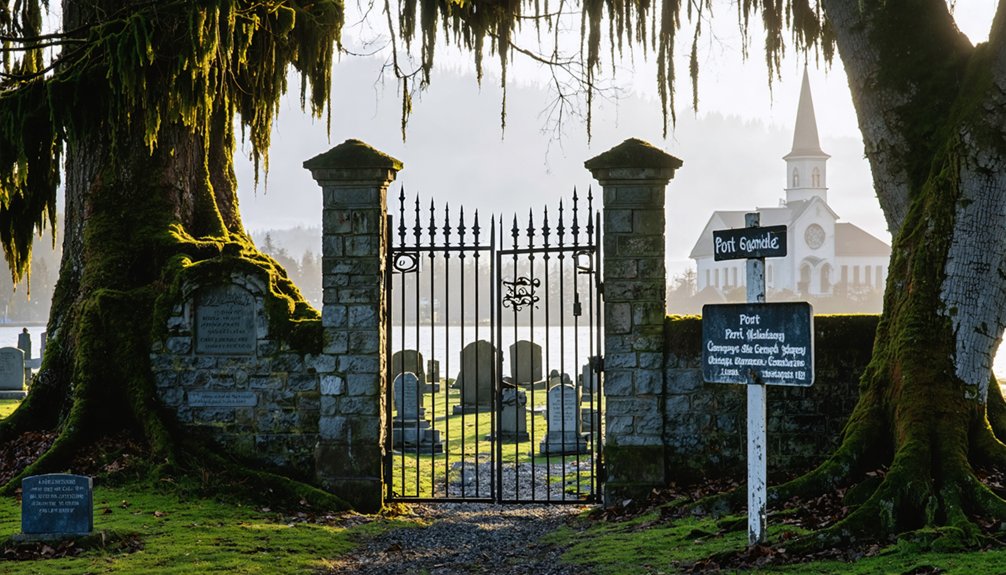
Perched on a wooded hill west of the community hall, Buena Vista Cemetery commands sweeping views across Port Gamble’s Victorian rooftops to the glittering bay beyond—making it both a solemn burial ground and the town’s finest vantage point. You’ll discover 115 souls resting here, including Josiah Keller, original partner in the Puget Mill Company, and USS Massachusetts coxswain Gustave Englebrecht—the first U.S. Navy casualty in Pacific waters.
Walk Walker Street to reach green-turfed grounds enclosed by picket fencing.
Explore 97 tombstones carved from Maine granite (1856-1941).
Reference Find a Grave’s 139 memorial records before arriving.
Combine cemetery exploration with Victorian Drew House tours.
Experience the integrated museum experience across 120 preserved acres.
The peaceful ambiance rewards independent exploration.
Frequently Asked Questions
Are There Restaurants or Places to Eat in Port Gamble?
You’ll discover charming local dining options amid this historic ghost town’s weathered facades. The Port Gamble General Store and Cafe serves scratch-made American cuisine, while waterfront eateries offer Pacific Northwest flavors with outdoor seating overlooking pristine waters.
Can I Stay Overnight in Port Gamble or Nearby Accommodations?
You’ll find charming guest houses right in Port Gamble’s historic township, plus bed and breakfasts nestled along the waterfront. Nearby lodging options include hotels in Poulsbo and Port Ludlow, offering freedom to explore at your own pace.
Is Port Gamble Suitable for Visiting With Children?
Yes, Port Gamble’s perfect for families! You’ll discover kid-friendly activities like forest hiking, kayaking adventures, and theater shows. Pack a lunch for waterfront picnic locations throughout town, then explore historic trails and specialty shops together.
What Are the Operating Hours and Admission Fees for Attractions?
Most attractions offer free admission, letting you explore without breaking the bank. The Historic Museum features seasonal operating hours Thursday-Sunday, 12pm-5pm (May-September). Private tours cost $100/hour. The General Store and trails welcome you anytime during business hours.
Are Pets Allowed in the Historic District and Buildings?
Your furry companion can explore Port Gamble’s historic trails leashed, but pet-friendly policies for indoor landmarks aren’t specified. Contact venues directly about access, or research nearby pet boarding services if buildings restrict four-legged adventurers from wandering inside.