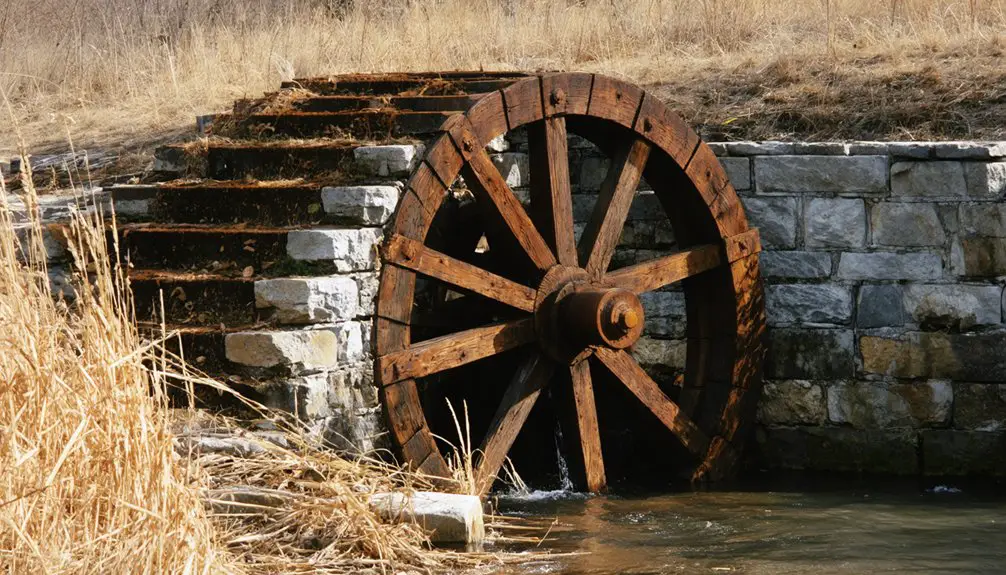
You’ll find Port Landis’s haunting remnants roughly ten miles east of Osborne in north-central Kansas, where the Solomon River still flows through land that once supported a thriving frontier community. Stock up on fuel and supplies in Osborne before traversing Norton County’s rural highways to reach the scattered foundations and nearby Oronoque cemetery, where commemorative markers and weathered headstones tell stories of murder, disease, and abandonment. The landscape itself reveals why settlers fought so desperately for this territory, and what happened when the railroad’s broken promise transformed promise into desolation.
Key Takeaways
- Port Landis is located ten miles east of Osborne in north-central Kansas’s Norton County rural backcountry.
- Stock up on fuel and supplies in Osborne city before venturing to the remote ghost town site.
- The Oronoque cemetery and commemorative marker are the main physical remnants at the Port Landis location.
- Visit nearby Edmond Historical Society Museum and Gower Cemetery to explore connected pioneer and frontier history.
- Contact Norton County historians for guidance navigating the scattered foundations and rural highways to Port Landis.
The Tragic Origins of Port Landis on the Solomon River

Long before Port Landis emerged along the Solomon River‘s winding banks, this fertile valley witnessed centuries of conflict and cultural collision. You’ll find that local native tribes—Pawnee, Cheyenne, and Kansa—hunted these grounds long before French explorers claimed the territory in 1712.
The geological characteristics that drew settlers here, particularly the river’s clear, hard limestone water, made this land worth fighting for. By the 1850s, American homesteaders pushed westward, triggering violent resistance from Kansa Indians defending their ancestral hunting grounds.
Stockades sprouted across the valley, including Fort Solomon in 1864, where twenty log houses formed a defensive square against raids. This cycle of displacement and defense shaped the Solomon River valley’s brutal transformation from tribal territory to settlement frontier.
Why Settlers Abandoned Port Landis for Edmond
The railroad’s broken promise transformed Port Landis from thriving river settlement into a desperate ghost town by the late 1960s. When freight service ceased in September 1968, the tracks fell into ruin—rails rusting, weeds consuming rotting ties, trees sprouting through abandoned infrastructure. You’ll find rails suspended in mid-air where ground collapsed beneath them.
The railroad repurposed land for parking lots and billboards instead of maintaining service, making no effort to solicit customers. Without transportation lifelines, settlers fled to nearby Edmond where opportunity remained.
Today’s environmental reclamation efforts target similar abandoned sites across Kansas, though government intervention policies often arrive decades too late. Port Landis stands as a testament/exemplar/model/representation to what happens when infrastructure dies and communities lose their economic heartbeat.
Getting to Port Landis: Directions and Highway Access
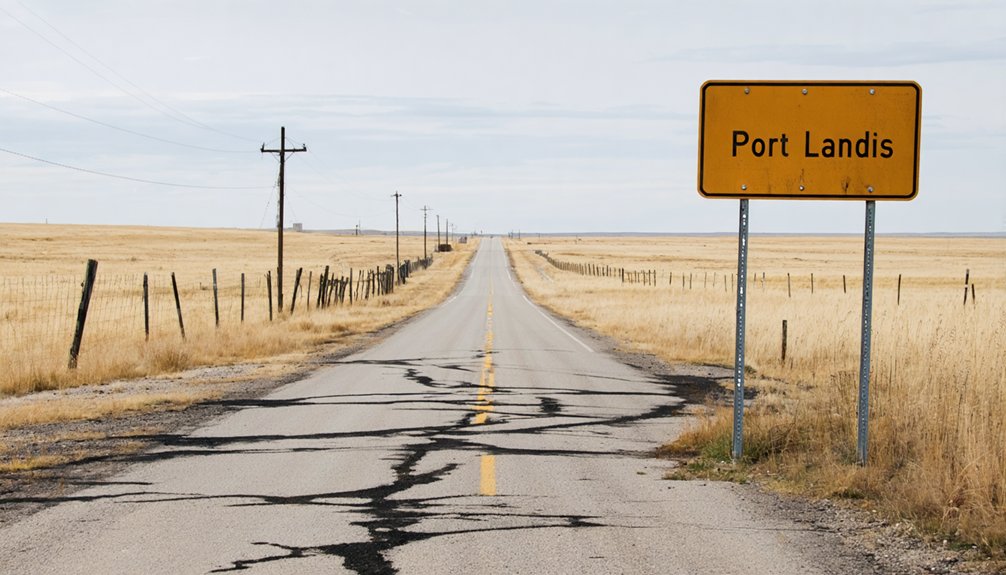
Reaching the remnants of Port Landis requires traversing north-central Kansas‘s grid of rural highways, where US 24 and US 183 form your primary corridors through Osborne County’s wheat-swept plains.
You’ll find the ghost town’s scattered foundations roughly ten miles east of Osborne city, accessible via unmarked county roads that demand either detailed GPS coordinates or a keen eye for weathered landmarks.
Stock up on fuel and supplies in Osborne before venturing onto these remote stretches, where cell service fades and the nearest interstate lies sixty miles south.
Route Planning and Highways
Finding Port Landis requires careful navigation through Norton County’s rural backcountry, where paved highways give way to gravel township roads and the ghost town’s remnants lie hidden along the north fork of the Solomon River. You’ll start from Norton, the county seat, heading southeast approximately 12 miles through Kansas farmland. Modern GPS coordinates prove unreliable here—directional signage placement remains scarce along these unmarked routes.
Local partnership efforts with Norton County historians can provide fundamental guidance before departure. The site sits nine miles north of Edmond, accessible primarily via county roads that may become impassable during wet seasons. You’re venturing into genuine frontier territory, where self-reliance matters. Bring detailed topographical maps, download offline navigation data, and inquire at Norton’s courthouse or historical society for current road conditions and precise access points.
While Port Landis itself offers few visible remains, you’ll navigate these remote Kansas plains more effectively by referencing prominent landmarks that anchor the surrounding region. Monument Rocks visibility from highways in Gove County provides exceptional orientation—these chalk formations rise dramatically from flatlands, with their keyhole gap creating a natural sunset frame.
Castle Rock navigation works similarly, serving as another prominent chalk pyramid that guides travelers through western Kansas’s expansive terrain. Fort Wallace Museum in Wallace County marks your northern reference point, while Fort Larned‘s preserved 1860s sandstone buildings southwest of Norton County orient southbound approaches.
These landmarks transform featureless prairie into navigable territory, letting you confidently explore ghost town sites where John Landis met his fate in 1878 and frontier communities vanished into grassland.
What Remains at the Port Landis Site Today
When you arrive at the Port Landis site, you’ll find nothing but open farmland where settlers once built their dreams along the north fork of the Solomon River. The landscape itself remains the most tangible connection to the past, with the river’s contours and prairie horizon unchanged since 1873.
While historical markers are absent and the town’s buildings vanished over a century ago, the nearby Oronoque cemetery preserves the only physical memorial to this vanished community.
Historical Markers and Signage
The Port Landis town site marker stands as a solitary sentinel on the Solomon River, commemorating a violent event that shaped Norton County’s settlement history. This memorial documents John Landis’s murder on September 2, 1878—the pivotal moment that gave this ghost town its name. While state historical marker funding wasn’t available for Port Landis like the fifty-six modern markers sponsored by Kansas State Chamber of Commerce, the interpretive marker features tell a stark frontier story.
You’ll find minimal infrastructure at this remote location:
- The commemorative marker standing where foundations once dotted the landscape
- Visible remnants of the town’s brief existence along the riverbank
- Panoramic views of the untamed prairie that attracted and challenged settlers
The marker represents freedom’s harsh price on the Kansas frontier.
Solomon River Landscape Features
The landscape shifts between flat prairie stretches and tree-covered hills, with the river’s clear, hard limestone water still flowing through this ghost town’s former heart.
What remains is raw, unobstructed territory: rugged west bank bluffs, prairie grass swaying across four to six miles of valley width, and the untamed beauty that drew pioneers here generations ago.
Cemetery and Memorial Stones
Just south of Hartford in Morris County, a shady corner holds what little remains of Port Landis’s human story. You’ll find eight small headstones clustered beneath a hooded family monument inscribed “Children of James & Anna O’Marra.” The memorial stones symbolism strikes immediately—uniform markers representing eight young lives claimed by diphtheria in April 1903.
The significance of children’s graves becomes visceral here:
- Julia, age 9, died April 14 from airway blockage
- Anastasia (Annie), 13, followed April 18
- James, 4, and Nellie, 17, shared a single coffin on April 19
The epidemic moved so swiftly that victims were buried the same day they died. These identical headstones, tight-clustered and age-worn, tell what history books often sanitize—frontier communities devastated in days.
Exploring Nearby Edmond’s Historic Landmarks
Don’t overlook Gower Cemetery, where 200 souls rest—African American pioneers who claimed their stake during the 1889 Land Run.
The Edmond Historical Society Museum reveals deeper connections to the Choctaw Trail of Tears and Butterfield Stage routes. Each site tells stories of persistence, from banking halls to burial grounds, reminding you that some communities endure while others vanish.
Understanding Kansas Ghost Town Patterns and Decline

When you trace the bones of Kansas’s abandoned settlements, patterns emerge as predictable as prairie winds. The socioeconomic drivers of ghost towns reveal themselves in layers—each forsaken main street tells the same fundamental story of opportunity gained and lost.
Ghost towns emerge from a predictable cycle: opportunity draws settlers in, then economic forces scatter them like dust across empty plains.
Factors impacting town viability:
- Resource depletion—Mining communities like Empire City and Picher thrived when ore ran deep, then withered when veins dried up or environmental disasters forced evacuation
- Transportation isolation—Towns without railroad connections or those bypassed by highways lost their commercial lifelines, leaving residents no choice but departure
- Agricultural mechanization—Larger farms operated by fewer hands pulled people toward urban centers, leaving once-bustling rural communities empty
You’ll find these forces working in combination, compounding decline until only foundations and memories remain scattered across the windswept landscape.
Combining Your Visit With Other Norton County Attractions
Since Port Landis exists only in fiction—likely a placeholder or misidentified location—you’ll need to redirect your Norton County exploration toward verified destinations that actually dot this corner of Kansas.
When searching for attractions near Port Landis, focus instead on Keith Sebelius Reservoir at Prairie Dog State Park, where limestone bluffs frame unexpected water recreation. The Norton County Museum preserves authentic pioneer stories you won’t find in ghost town fantasies. For aquatic relief after dusty backroads, Norton’s municipal pool beckons. Availability of lodging centers around Norton proper, where local motels provide simple accommodation.
Consider extending your route to Lucas’s Garden of Eden—a genuine oddball Kansas landmark—or Fort Wallace Museum westward. These real locations deliver the frontier atmosphere and historical authenticity that fictional Port Landis cannot.
Best Times to Visit and What to Bring

Timing your Norton County exploration makes all the difference between discovering photogenic ruins under perfect skies and battling torrential downpours on impassable mud roads. Spring and fall deliver ideal conditions—temperatures hover between 50-70°F without summer’s blistering heat or winter’s treacherous ice. Plan visits during daylight hours (8am-6pm) when structural hazards remain visible.
Spring and fall offer Norton County’s sweet spot: mild 50-70°F temperatures and clear skies perfect for exploring abandoned structures safely.
What to pack for backcountry ghost towns:
- Sturdy boots and layered clothing for 30°F temperature swings
- Flashlight, water, and first-aid kit (amenities in the area are nonexistent)
- Camera with backup batteries for documenting decaying architecture
Avoid May-June tornado season and summer afternoons when thunderstorms roll across Kansas plains. Winter access becomes challenging with gates locking at 5pm and temperatures plummeting below 20°F, limiting your freedom to explore Port Landis’s crumbling structures.
Additional Kansas Ghost Towns Worth Exploring
While Port Landis may have vanished from maps and memory, Kansas harbors dozens of authenticated ghost towns where history materializes in weathered limestone walls and grass-choked main streets. You’ll discover pioneer settlements like Hollenberg in Washington County, where a restored Pony Express station stands sentinel over vanished dreams.
Rush County offers multiple abandoned sites—their crumbling schoolhouses proof of a collapsed agricultural economy. In Osborne County, explore Natoma’s skeletal grain elevators rising from prairie swells. Norton County’s Edmond preserves stone foundations where homesteaders once planted roots. Lincoln County’s Carneiro holds weathered structures defying Kansas winds.
Each location presents tangible connections to frontier resilience—places where you can walk freely among authenticated ruins without manufactured tourist experiences diluting genuine historical encounters.
Frequently Asked Questions
Are There Any Guided Tours Available for Port Landis and Surrounding Ghost Towns?
Like a map with missing territories, visitor information guides for Port Landis remain elusive. You’ll need to explore independently, as organized tours aren’t documented. However, historical preservation efforts in nearby Kansas communities might offer self-guided alternatives worth investigating.
What Safety Precautions Should Visitors Take When Exploring Abandoned Site Structures?
Wear sturdy boots to navigate crumbling floors and debris-strewn corridors. Bring flashlight for dark interiors where daylight can’t penetrate. Test surfaces before trusting your weight, stay near walls, and always explore with companions who’ll watch your back.
Can I Legally Access Private Property Where Port Landis Ruins May Exist?
Maneuvering history’s door requires obtaining landowner consent before examining Port Landis’s disappeared remnants. You’ll need approval to prevent traversing trespassing laws—Kansas safeguards private farmland strictly, with fines reaching $1,000 for unauthorized entry.
Are There Nearby Accommodations or Camping Options for Overnight Ghost Town Trips?
You’ll find accommodations availability in Norton, just 12 miles away as the county seat. For nearby campgrounds, consider primitive camping along the North Fork Solomon River near Port Landis, where wild landscapes await your exploration.
What Photography Equipment Works Best for Capturing Ghost Town Remnants and Ruins?
You’ll want wide-angle camera lenses like 16-35mm for capturing entire structures, plus a sturdy tripod for low-light stability. Bring lighting equipment sparingly—natural light best preserves ghost towns’ haunting atmosphere. Pack backup batteries since remote locations lack power sources.