You’ll find Port Tampa hiding in plain sight—an “inhabited ghost town” where weathered worker cottages from 1885 still stand between rumbling warehouses and shipping terminals. Start at the self-guided historical trail‘s 18 markers documenting Henry Plant’s vanished railroad empire, then explore the Garrison neighborhood‘s preserved homes where African-American laborers once kept the port alive. Combine your visit with Tampa Bay’s five other ghost settlements—from military ruins on Mullet Key to pre-colonial temple mounds—to discover how this strategic port that mobilized 30,000 troops for the Spanish-American War faded so completely that locals forgot it existed as an independent city until 1961.
Key Takeaways
- Port Tampa, once a booming railroad terminus and Spanish-American War mobilization site, is now an industrial area within Tampa city limits.
- The self-guided Port Tampa Historical Trail features markers documenting Henry Plant’s infrastructure, worker homes, and the preserved brick power plant.
- Garrison neighborhood and Palmetto Beach contain preserved worker cottages that reveal the port’s working-class past and African-American labor history.
- Shipbuilding remnants like concrete ways and the graving dry dock’s outline remain visible across the waterfront between modern warehouses.
- Nearby ghost settlements include temple mounds, Seminole War sites, Indian Key, Brewster’s phosphate ruins, and St. Joseph for extended exploration.
Port Tampa’s Rise as Henry Plant’s Railroad and Steamboat Empire
While the ashes of the Civil War still smoldered across the South, Henry Plant recognized opportunity in the wreckage. He’d built Southern Express Company from confiscated properties, then systematically acquired 2,100 miles of bankrupt railroads.
By 1879, you’d find him extending his empire into Florida, where real freedom meant movement and commerce.
Henry Plant’s innovations in transportation and tourism transformed a sleepy Tampa—population 750—into his southern terminus by 1885. He laid 1,196 miles of Florida track, then connected rail to steamship, forging routes to Cuba and the Caribbean.
The Spanish-American War Transformed This Quiet Port Into a Military Hub
When the USS Maine exploded in Havana Harbor on February 15, 1898, Port Tampa‘s destiny shifted overnight. You’d have witnessed Henry Plant’s sleepy port transform into America’s primary military mobilization hub as over 30,000 troops descended between April and June.
General Shafter commanded from the opulent Tampa Bay Hotel while Colonel Roosevelt’s Rough Riders and Buffalo Soldiers trained in sweltering heat across open fields.
Luxury met military necessity as troops drilled under Florida’s brutal sun while commanders strategized from Plant’s gilded resort halls.
On June 7th, 16,000 soldiers set off for Cuba—just ninety miles across the straits. Artillery batteries rose on Mullet Key, guarding shipping channels as vessels crammed with men, horses, and munitions departed daily.
Clara Barton tended the wounded while reporters chronicled the chaos. This war time economy boom catapulted the once-quiet terminus into strategic prominence, forever marking Florida’s place in American military history.
Why Port Tampa Faded From Boom Town to Industrial Zone
As you stand where Victorian hotels once courted winter tourists, you’ll notice they never rebuilt after the Spanish-American War ended—travelers bypassed this industrial outpost for Tampa’s streetcar suburbs and cigar-scented boulevards.
The city that refused Port Tampa‘s overtures for decades finally absorbed it in 1961, not as a prize but as a phosphate-stained necessity. What you’re walking through isn’t a town that died overnight; it’s a community that watched its purpose shift from passenger steamers and resort dreams to cargo cranes and chemical dust, then lost even its name to annexation.
Travelers Chose Tampa Proper
The federal government’s decision to dredge a deeper channel south of downtown Tampa sealed Port Tampa City’s fate. When the Rio Grande docked at Franklin Street’s foot in 1908, you witnessed the shipping industry shift that would doom the old port.
Port Tampa’s shallow 8-foot channel couldn’t accommodate the massive vessels modern port operations demanded. Between 1920 and 1925, five phosphate-loading elevators rose at Tampa proper’s waterfront, centralizing bulk cargo operations where deeper waters allowed.
The 1945 creation of the Tampa Port Authority consolidated control downtown, while containerization’s arrival made Port Tampa’s limited infrastructure outdated. You’d have chosen Tampa proper too—its superior deep-water access meant faster loading, bigger ships, and direct routes to international markets your business required.
1961 Annexation Ended Independence
While Tampa proper wrestled shipping dominance from its bayfront rival, Port Tampa City clung to independent governance for another half-century. You’ll find its 1961 annexation wasn’t about economic impacts of annexation—those had already devastated the community. The political motivations for annexation merely formalized Port Tampa’s collapse into Tampa’s industrial backyard.
The transformation stripped away:
- Autonomous municipal decision-making that residents had exercised since 1888
- Local control over zoning as phosphate terminals claimed waterfront parcels
- Independent tax revenue streams from dwindling commercial operations
- Community identity as “Port Tampa City” vanished from official maps
While West Tampa celebrated its 1925 voluntary annexation with midnight banquets, Port Tampa’s absorption came quietly—a bureaucratic acknowledgment that this once-vital shipping hub had already surrendered its soul to industrial forces beyond local control.
Walking the Port Tampa Historical Trail Through 18 Historic Sites
Since Colonel S.G. Harvey transformed this beach amusement resort on July 4, 1888, you’ll discover 18 historic sites that reveal Port Tampa’s evolution from island paradise to railroad terminus. Your self-guided adventure begins with themed walking tours accessible through Steve Rajtar’s printed guide—request your hand-drawn map by mailing a self-addressed stamped envelope to 1614 Bimini Dr., Orlando, FL 32806.
You’ll trace the original 1885 townsite from Germer to Wall Streets, where C.W. Prescott and James W. Fitzgerald’s vision materialized. Historical markers documentation leads you past Henry B. Plant‘s nine-mile spur line infrastructure—freight stations, railroad yards, worker homes, and the brick power plant that powered commerce. The Yellow Gal commuter train once connected these sites to Tampa’s Polk Street station for just 40 cents.
Exploring Tampa Bay’s Other Abandoned Settlements and Fort Ruins
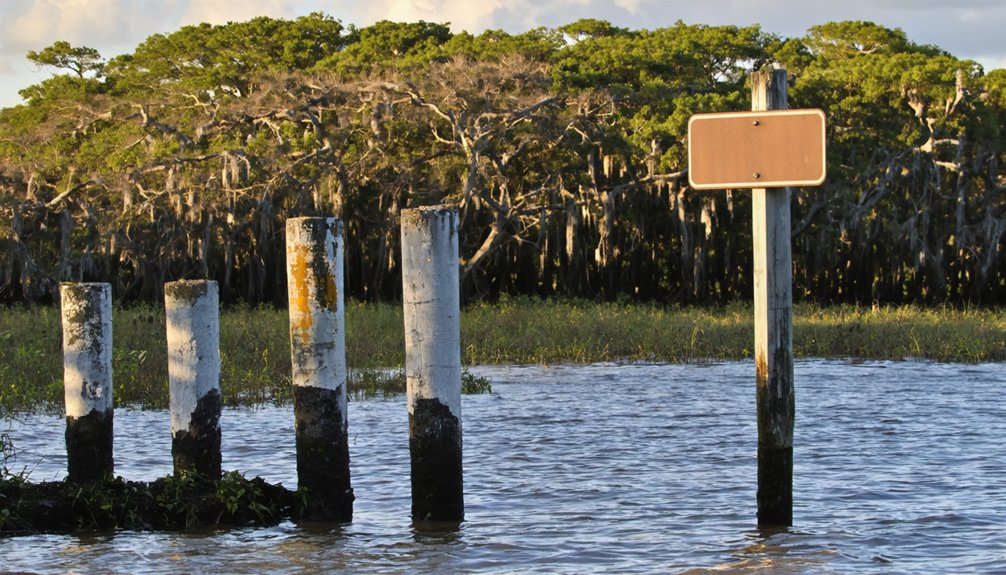
Beyond Port Tampa’s weathered streets, five remarkable ghost settlements and military ruins scatter across Tampa Bay’s shoreline, each harboring stories of ambition, conflict, and abandonment.
Fort Dade’s crumbling 1898 battlements guard Tampa Bay’s entrance, where erosion claimed what Spanish-American War cannons couldn’t destroy. The forgotten Dobyville community once thrived in west Hyde Park until the Crosstown Expressway bulldozed its churches and homes—only the Doby Family house at 1405 Azeele remains standing.
Sulphur Springs’ 214-foot Gothic tower still pierces the skyline, a monument to developer dreams drowned by 1933’s hurricane floods. Meanwhile, disappearing Seminole War sites like Fort Brooke’s foundations vanish beneath downtown Tampa’s concrete.
- Pre-colonial temple mounds flattened for modern roads
- Bealsville and Red Quarters erased completely
- Port Tampa City sections reclaimed by wilderness
- Federal occupation ruins buried under progress
What Remains Today: Worker Homes in an Industrial Landscape
You’ll spot weathered worker cottages tucked between warehouses and shipping terminals, their grid-pattern streets still tracing the 1885 blueprint Vicente Martinez Ybor laid out for his cigar laborers. The Port Tampa Historical Trail winds past these remaining structures—some restored, others listing on their foundations—where Cuban, Spanish, and Sicilian families once paid off their homes through interest-free installments.
Smokestacks now loom where mutual aid societies once guaranteed “cradle to grave” care for twenty-five cents a week, the industrial landscape swallowing what suburban flight and Interstate 4’s bulldozers didn’t already claim.
Original Structures Still Standing
Though decades have passed since Port Tampa’s industrial heyday, fragments of its working-class past still cling to the landscape like barnacles on a derelict pier. You’ll discover remnants of shipbuilding infrastructure scattered across the waterfront—concrete ways jutting into brackish water, the graving dry dock’s skeletal outline, rusted machinery half-buried in sediment.
The most tangible connections are preserved housing for port workers throughout the Garrison neighborhood and Palmetto Beach. These modest structures tell stories of African-American laborers who kept the port breathing.
What you’ll encounter:
- Empty warehouses haunting former phosphate elevator sites
- Burnt-out dock pilings on Seddon Island
- Rail track scars where riverfront lines once ran
- Five concrete shipbuilding ways crumbling into the bay
The landscape remembers, even when prosperity doesn’t.
Port Tampa Historical Trail
The worker homes that sheltered Port Tampa’s industrial backbone weren’t concentrated at the waterfront itself—they clustered in Tampa’s Scrub Settlement, a modest Black neighborhood that predated the port’s 1888 founding by several years.
By 1939, 21,000 residents packed into this segregated worker housing, living in meager shelters while laboring at lumber mills, shipyards, and phosphate operations. You’ll find remnants wedged between Kennedy Boulevard and Ybor City’s sprawl—a landscape where English, Spanish, and ancestral dialects once mingled among laborers.
The Tampa Shipyard Company and Hooker’s Point Yard built isolated housing at their facilities, employing 8,000 workers combined during the 1930s. Union organizing efforts emerged from these cramped quarters, though the Depression-era Tampa Urban League primarily fought battles through cooperative councils rather than picket lines.
Industrial Zone Transformation
Walking the cracked asphalt surrounding today’s Hookers Point, you’ll strain to picture the cramped wooden homes that once pressed against warehouse walls and loading docks. The deindustrialization impact fundamentally reshaped this landscape—immigrant neighborhoods vanished when phosphate facilities relocated to Rockport during the 1960s, displaced by modern cargo operations and containerized freight terminals.
The 52-acre shipyard acquisition in 1964 erased worker housing permanently. You’re witnessing freedom’s harsh bargain—economic evolution demanded these communities surrender to efficiency, leaving only traces of 36,000 workers who once called this industrial shoreline home.
What survives tells Port Tampa’s transformation story:
- Ghost foundations emerge during low tide along filled shorelines
- Rusted rail spurs curve toward demolished shipyards
- Repurposed industrial buildings stand isolated among sprawling logistics centers
- Faded street grids hint at vanished residential blocks
Planning Your Visit to Port Tampa and Nearby Ghost Town Destinations
Before you pack your camera and set out for Port Tampa’s abandoned streets, you’ll need to understand what awaits along Kissemmee Street’s boarded-up storefronts and industrial sprawl. This inhabited ghost town at 27°51.8’N 82°31.7’W offers limited access through industrial zones, but nearby haunted attractions provide richer experiences.
The Gothic Sulphur Springs Water Tower rises 214 feet—a monument to sulfur springs history halted by 1933’s devastating hurricane. Fort Brooke’s parking garage echoes with soldier spirits triggering car alarms and flickering lights. Oaklawn Cemetery’s 1847 grounds hold pirates and yellow fever victims.
Expand your journey to Indian Key’s hurricane-ravaged remains, Brewster’s phosphate ruins, or St. Joseph near Port St. Joe—Florida’s temporary capital destroyed by epidemic and storm.
Frequently Asked Questions
Are Any of the Original Port Tampa Hotels or Pier Structures Still Standing?
No original hotel renovations or pier structure preservation efforts saved Port Tampa’s past. You’ll find nothing remains of the St. Elmo, Port Tampa Inn, or the historic pier where steamships once docked—only industrial zones occupy these forgotten sites now.
Can Visitors Access the Sites Where Teddy Roosevelt Stayed During the War?
You can’t visit Teddy Roosevelt’s exact Port Tampa accommodations—they’ve vanished into history. The historic accommodations availability is zero; those grand waterfront hotels disappeared long ago. Presidential visit experiences exist only through Spanish-American War Memorial Park today.
Is the Port Tampa Historical Trail Suitable for Families With Young Children?
The trail isn’t ideal for young families. You’ll find limited child friendly activities and family friendly amenities here—unpaved paths challenge strollers, safety concerns arise in residential areas, and the historical focus suits older, independent explorers better.
What Are the Best Times of Year to Visit Port Tampa?
Winter becomes your gateway to freedom, offering Port Tampa’s best weather conditions from November through April. You’ll discover mild temperatures, sunshine-drenched days, and local seasonal events thriving without summer’s oppressive heat dampening your adventurous spirit.
Are There Guided Tours Available for the Port Tampa Historical Sites?
Yes, you’ll find several guided tours exploring Port Tampa’s rich maritime past. Choose from free Educational Harbor Tours aboard the Yacht Starship, waterfront walking tours through historic downtown, or immersive experiences at Tampa Bay History Center.