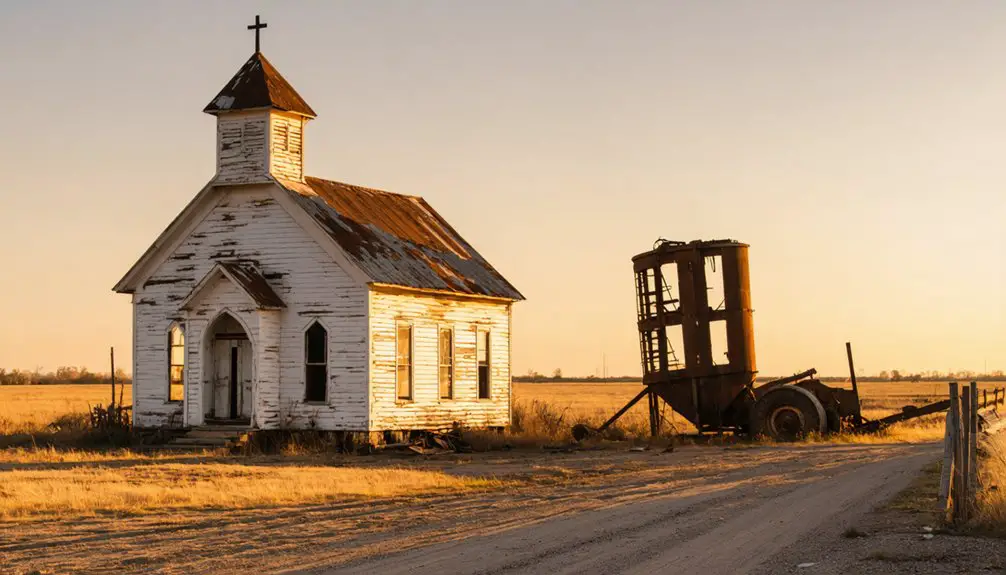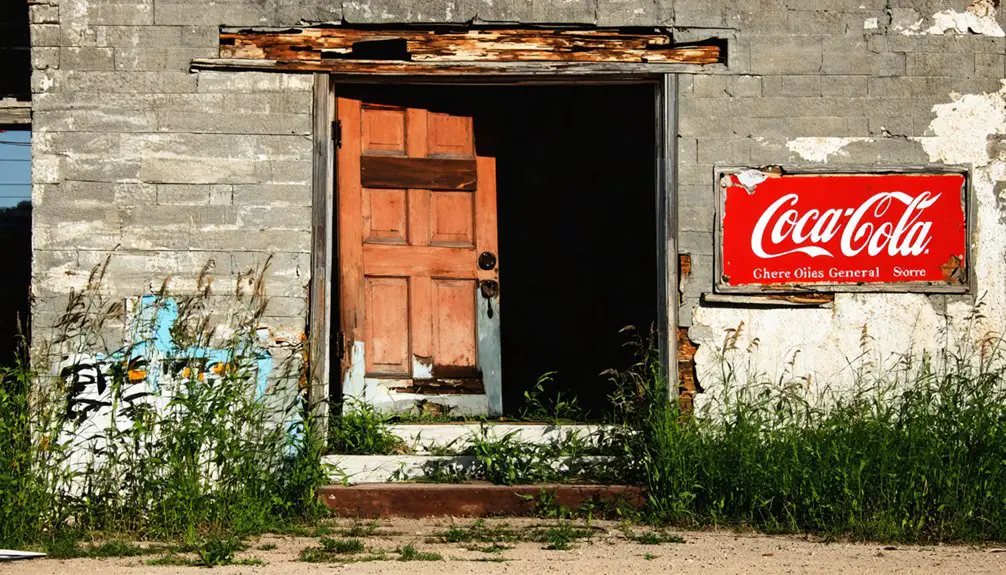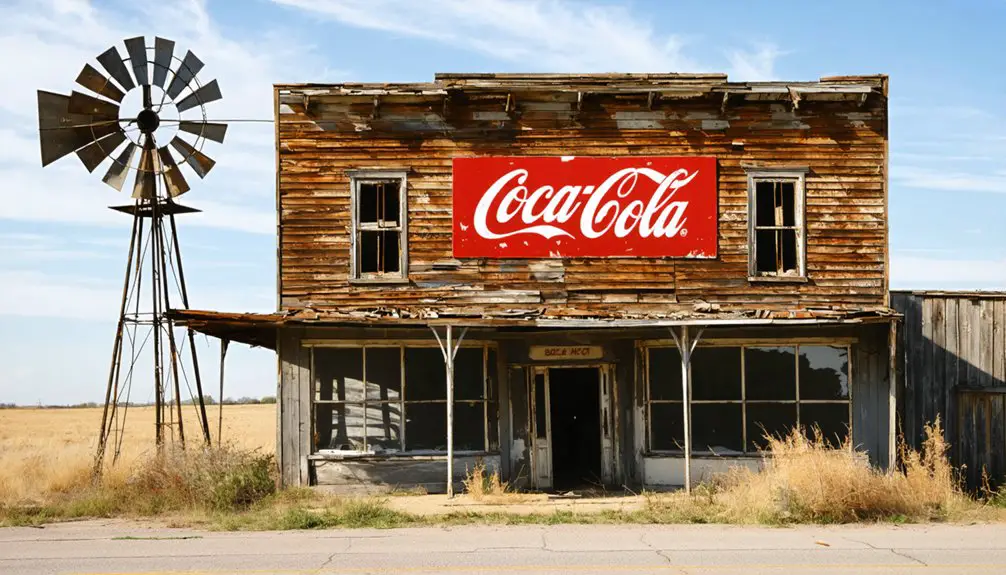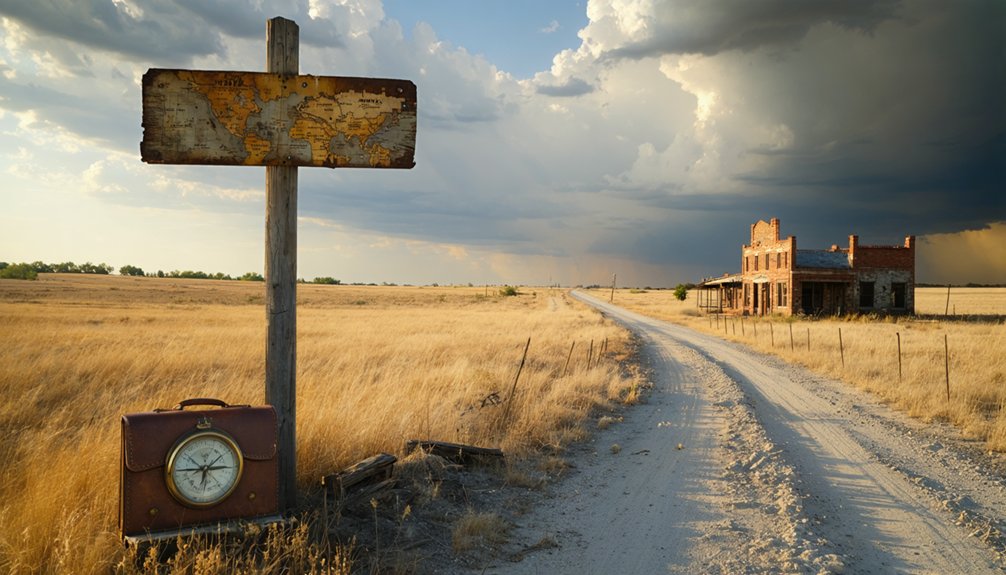
You’ll find Prot’s skeletal remains in Ottawa County’s northeastern corner, roughly two hours northwest from Oklahoma City along Highway 81 through rolling prairie. As pavement surrenders to gravel near the Kansas border, weathered ranch gates and crumbling homestead foundations emerge from tallgrass reclaimed by time. Before venturing out, check local conditions—spring rains transform backroads into impassable mud channels. Pack sealed footwear, water, and GPS navigation, though signals flicker where farmland stretches endlessly and ghost towns guard their secrets beneath Oklahoma’s red clay.
Key Takeaways
- From Oklahoma City, follow Highway 81 northwest for roughly two hours through prairie and wheat country to Ottawa County.
- Navigate section-line gravel roads carefully, checking conditions beforehand as spring rains create impassable mud channels and GPS signals weaken.
- Photograph abandoned homesteads, foundations, and chat piles using wide-angle lenses while maintaining safe distances from unstable structures.
- Wear respiratory masks during dry conditions and sealed footwear to protect against toxic dust from mining contamination.
- Avoid entering crumbling buildings, unstable cellars, and overgrown wells that conceal hazards including thousands of mine shafts below.
The Rise and Fall of Prot’s Early Settlement Days
The prairie wind whispers secrets through abandoned foundations where Prot once thrived, but you won’t find this ghost town on most Oklahoma maps—and for good reason. Records of this settlement have faded like the weathered outbuildings that dot the landscape, leaving behind more questions than answers.
What’s known exists only in fragments—whispers of homesteaders who staked their claims, built their dreams, then vanished into history’s silence. You’ll discover abandoned homesteads reclaimed by tallgrass and time, their stories buried beneath Oklahoma red clay. Long before these settlers arrived, this land witnessed human presence spanning over 30,000 years, with ancient peoples adapting to the same environmental challenges that would later test frontier communities. Native American tribes including Apache, Comanche, Kiowa, Caddo, and Pawnee called this region home long before any settlement maps were drawn.
Whether Prot succumbed to drought, economic collapse, or simply the harsh realities of frontier life remains uncertain. This mystery makes your journey here more compelling—you’re not just visiting ruins, you’re stepping into an enigma that refuses complete resolution.
What Remains of Prot Today
You’ll find Prot reduced to whispers in the landscape—crumbling foundations half-buried in prairie grass, lonesome fence posts marking property lines that no longer matter.
The dirt roads still cut through former townsite blocks, passable enough for your vehicle to navigate between what were once homes, stores, and gathering places.
If you’re visiting with a camera, watch your step around unstable cellars and overgrown wells while capturing the haunting geometry of abandonment stretched across Oklahoma farmland. Nearby, you’ll spot the distinctive massive chat piles that once towered over communities like Picher, their gray-white pyramids of mining waste still dominating the horizon decades after the mines closed. The landscape bears silent witness to over 100 million tons of tailings left behind when the mining operations ceased.
Scattered Foundations and Farmland
When you arrive in Prot today, jagged chat piles rise from the horizon like rust-colored monuments to industrial decay, their seventy million tons of toxic tailings still dominating a landscape where homes once stood.
You’ll navigate foundations scattered like broken teeth across overgrown lots, where personal artifacts—faded photographs, children’s toys, waterlogged books—pierce through encroaching prairie grass. The 2008 tornado didn’t just destroy structures; it scattered lives across the debris field, leaving vanished homesteads barely distinguishable from surrounding farmland.
Historic farmhouse ruins mark where families resisted leaving until sinkholes and contamination forced their hands. Now vegetation reclaims what remains, blurring boundaries between earth and memory. The town’s decline accelerated after the EPA declared it a Superfund Site in 1983, sealing its fate as uninhabitable. Beneath your feet lie over 14,000 mine shafts, monstrous caverns left from decades of extraction that once fueled the world’s largest source of lead and zinc. You’re standing in America’s toxic ghost, where twenty souls refused to abandon what industry destroyed.
Accessible Rural Road Networks
Gravel crunches beneath your tires as you wind through Ottawa County’s section-line roads toward Prot, following the same grid system county commissioners graded over a century ago when statehood was fresh. Today’s county road maintenance guarantees these forgotten routes remain passable, though you’ll navigate narrow dirt stretches where shoulders disappear into wildflower-choked ditches.
The rural connectivity challenges that once isolated communities like Prot persist in gentler forms—no interstate roar disturbs your solitude here, just the occasional pickup kicking up dust clouds. Modern improvements like RAAMP’s wider shoulders haven’t reached these backroads, leaving you with authentic frontier driving conditions. These zigzagging routes force constant directional changes, a reminder that early statehood rural roads followed rigid land-survey section lines rather than direct paths between destinations. The state’s roadway infrastructure has evolved dramatically since 1926, when Oklahoma’s highway system comprised mostly graded dirt roads, with only minimal stretches of gravel and pavement connecting rural communities.
Your GPS signal flickers as farmland stretches endlessly, reminding you why ghost towns remain ghosts—accessibility without convenience, freedom without crowds.
Photography and Safety Considerations
Though few structures escaped demolition’s reach after Prot’s 2006 evacuation, your camera will find haunting subjects in what persists—an abandoned Christian church with windows gaping like hollow eyes, scattered mercantile buildings surrendering to kudzu’s embrace, and the skeletal Picher-Cardin High School where classrooms gather dust instead of students.
Before you venture into these toxic landscapes, understand the invisible threats lurking beneath visual poetry.
Essential precautions for exploring Prot’s remains:
- Toxic dust precautions demand sealed footwear and frequent hand washing—lead-laden particles cling to everything you touch
- Abandoned structure stability can’t be trusted; rotting floors collapse without warning over 14,000 mine shafts below
- Bring companions—cell service fails where sinkholes swallow roads unexpectedly
- Wide-angle lenses capture chat pile enormity while maintaining safe distances from unstable ground
- Windblown contamination makes respiratory masks non-negotiable during dry conditions
The ground beneath your feet conceals a honeycomb of abandoned mines where weakening pillars threaten sudden subsidence, transforming seemingly solid earth into treacherous terrain without warning. Multiple distinct geographical locations share the Picher name, so verify your navigation coordinates before departure to avoid confusion with other similarly named places.
Getting to Prot From Oklahoma City
You’ll chart your course northwest from Oklahoma City, tracing Highway 81 through rolling prairie until the ghost town’s skeletal remains emerge near the Kansas border—a roughly two-hour journey through Oklahoma’s wheat country.
The pavement gives way to gravel roads as you approach, where weathered ranch gates and overgrown two-tracks mark the final miles into Prot’s abandoned homesteads. Check local conditions before you venture out, since spring rains transform these backroads into impassable mud channels that can strand even four-wheel-drive vehicles.
Best Route Options
From Oklahoma City, the journey to Picher stretches nearly 200 miles northeast across the state, a drive that transforms urban sprawl into rolling plains before delivering you to the scarred landscape of the Tri-State Mining District.
Your primary route follows US-412 East through Tulsa, then Highway 69 North toward Miami. Alternatively, scenic rural roads like Highway 10 offer slower passages through untamed countryside, trading efficiency for solitude.
As you approach Ottawa County, mining infrastructure remnants emerge—rusted headframes, chat piles glowing orange against twilight skies.
Route Considerations:
- US-412 to Highway 69: Fastest corridor, approximately 3 hours
- Highway 10: Backroad alternative through forgotten landscapes
- Commerce exit: Gateway to ghost town cluster
- Chat pile markers: Navigate by towering orange mounds
- No GPS guarantees: Download offline maps before departing
Estimated Drive Time
The asphalt ribbon connecting Oklahoma City to Picher unspools across 200 miles of northeastern Oklahoma, a three-hour pilgrimage through landscapes that shift from metropolitan density to desolate mining territory. Your driving duration hinges on perfect conditions—clear skies, steady speeds, and zero detours into the ghost towns beckoning from roadside markers.
These duration assumptions dissolve quickly when wanderlust strikes. You’ll brake for abandoned storefronts in Cardin, photograph rusted machinery outside Quapaw, and pull onto gravel shoulders where chat piles rise like man-made mountains. The clock becomes irrelevant when exploring America’s toxic wasteland. Factor in spontaneous exploration, and that three-hour estimate stretches to half a day—maybe longer if you’re chasing stories buried in Oklahoma’s most infamous Superfund site.
Road Conditions Warning
Crumbling asphalt and forgotten byways define your journey into northeastern Oklahoma’s abandoned mining corridor, where maintained highways surrender to deteriorating rural routes that haven’t seen a resurfacing crew in decades.
You’ll navigate roads that weather patterns have reclaimed—washouts, potholes, and overgrown shoulders that challenge even high-clearance vehicles. Despite preservation efforts documenting ghost towns, infrastructure receives zero attention.
Before venturing out, prepare for:
- Unreliable GPS coverage in areas where cell towers never reached
- Unmarked intersections where signage has vanished completely
- Seasonal flooding transforming dirt roads into impassable mud traps
- Wildlife crossings on isolated stretches without guardrails
- Zero roadside services for fifty-mile stretches through emptied prairie
Check Oklahoma Department of Transportation conditions at 844-465-4997 before departing—your freedom depends on preparation.
Best Routes Through Southwest Oklahoma
You’ll find freedom in charting your course through Oklahoma’s backroads, where pavement meets possibility. While Picher actually sits in the state’s northeastern corner near Kansas, the spirit of exploration remains universal.
Choose highways that wind past scenic overlooks where prairie meets sky, stopping when instinct demands. Small-town routes reveal local history museums housing forgotten stories—each artifact a portal to boom-and-bust cycles that shaped these lands.
Don’t rush. The journey’s yours alone, unmeasured by GPS efficiency or interstate speed. Pull over at weathered markers, photograph abandoned structures, talk with locals who remember.
These detours transform simple drives into personal discoveries. Pack extra water, download offline maps, and trust your curiosity over calculated routes. Adventure favors the wanderer.
Other Ghost Towns to Add to Your Itinerary
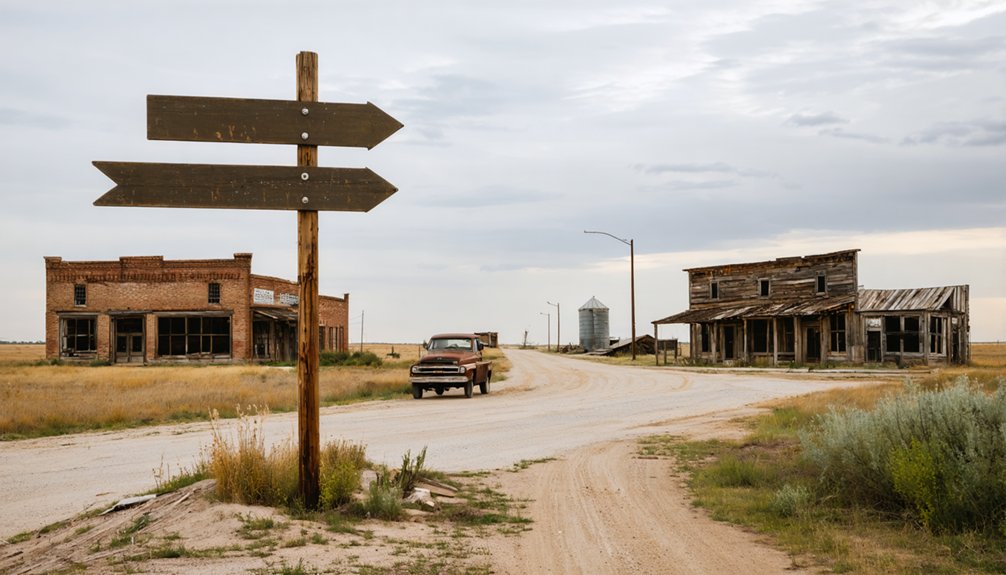
Beyond Port’s quiet ruins, Oklahoma harbors dozens of ghost towns where history whispers through weathered wood and crumbling stone.
You’ll find Ingalls ten miles east of Stillwater, where the Doolin-Dalton Gang‘s 1893 shootout still echoes through vacant storefronts. Boggy Depot’s Confederate-era foundations stand proud in Atoka County, complete with historic markers and a cemetery that tells stories of Civil War supply lines. Skullyville offers the state’s earliest western Arkansas territory outpost, where Choctaw history unfolds through interpretive signage.
Consider these additions to your journey:
- Ingalls: Authentic Old West architecture along Highway 51
- Boggy Depot: State Historic Site with preserved stone foundations
- Skullyville: 1831 Choctaw settlement with cemetery remnants
- Picher: Dramatic chat piles and scenic vistas (restricted access)
- Regional routes: Connect multiple sites for maximum exploration
Each location rewards your wanderlust differently.
Photography Opportunities in the Farmlands
Oklahoma’s farmland sprawls before your lens like a photographer’s dream, where weathered barns frame golden prairie grass and ancient cedar trees cast dramatic shadows across forgotten fields. You’ll discover historic barns standing sentinel beside abandoned structures—the perfect contrast between resilience and decay that tells Western Oklahoma’s story.
These natural backdrops shift with the light: morning mist clings to creek beds, while golden hour sets prairie grass ablaze. Capture thunderstorms rolling across endless horizons or frame your shots through split-rail fences that’ve weathered decades. The abandoned buildings near declining towns offer raw, unpolished scenes you won’t find in manicured gardens.
Bring your wide-angle lens for expansive sunset shots and your telephoto to capture details in peeling barn paint. Here, every season transforms your canvas completely.
Safety Considerations for Rural Exploration
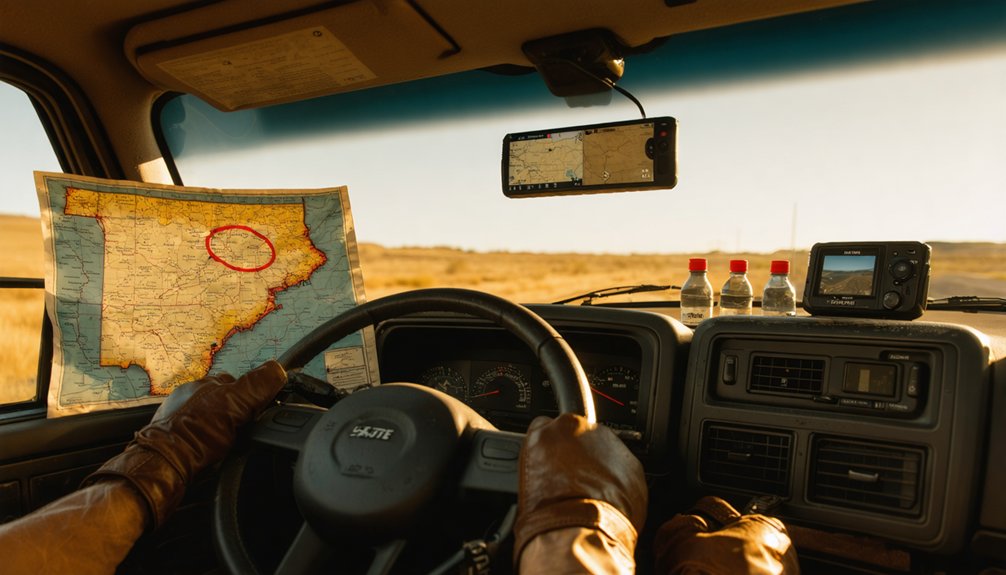
While the open roads leading to Prot promise adventure, they’ll demand your respect and attention in ways city driving never does. Rural highways carry double the fatality risk of urban streets, where emergency vehicle response times stretch longer across isolated miles.
You’re traversing territory where help doesn’t arrive quickly—where building preservation challenges mean structures could collapse without warning.
Essential Safety Protocols:
- Buckle up religiously—57% of rural road deaths involve unrestrained occupants
- Maintain vehicle readiness with emergency supplies, full tank, charged phone
- Scout structures from outside before entering abandoned buildings
- Share your route with someone who’ll notice if you don’t return
- Respect sunset timing—rural darkness is absolute, infrastructure minimal
Your independence thrives on preparation, not recklessness.
Ideal Seasons and Times for Your Visit
The calendar matters less than you’d think when planning your Prot expedition—this ghost town doesn’t close for winter or overflow with summer crowds. You’ll discover authentic abandonment regardless of when you arrive, though spring and fall offer the most suitable exploration conditions in northeastern Oklahoma.
Scorching summer heat can make metal-roofed structures unbearable, while winter’s unpredictability might render dirt roads impassable after storms.
Unlike conventional seasonal tourism trends dictating ideal visiting periods, ghost town exploration rewards spontaneity. December brings Picher’s nostalgic “Coming Home for Christmas” parade—a rare glimpse of former residents returning to their vanished community. Otherwise, you’re free to wander whenever restlessness strikes.
Early morning light penetrates broken windows beautifully, while golden hour transforms rust into amber. Your schedule, your adventure.
Essential Supplies for Remote Location Travel

Before you disappear down forgotten highways toward Prot’s skeletal remains, pack like someone who understands that abandoned towns don’t offer convenience stores or emergency services. Comprehensive extensive packing lists become survival blueprints when civilization fades in your rearview mirror.
Versatile layered clothing adapts to Oklahoma’s temperamental weather—morning frost can transform into scorching afternoons among ruins.
Your freedom-seeking essentials:
- First aid kit with wound closure materials – rattlesnakes and rusted metal don’t respect your adventure timeline
- Multiple water bottles and electrolyte solutions – dehydration steals clarity when you’re deciphering ghost town mysteries
- Sturdy footwear for unstable terrain – decaying floorboards and prairie grass conceal hazards
- Sun protection and insect repellent – Oklahoma’s elements reclaim abandoned spaces aggressively
- Prescription medications with copies – medical emergencies respect no isolation
Frequently Asked Questions
Are There Any Guided Tours Available for Prot Ghost Town?
No guided tours exist for Prot Ghost Town—you’ll explore independently through self-guided walking tours. While historic preservation efforts remain minimal, you’re free to wander these windswept ruins, discovering forgotten stories at your own adventurous pace.
Can I Camp Overnight Near the Prot Site?
You can’t camp at Optima’s abandoned grounds—amenities were removed for safety precautions. Instead, you’ll find freedom at nearby Black Mesa State Park or embrace wild boondocking on Rita Blanca National Grasslands, where stars blanket endless prairie horizons.
What Is the Nearest Town With Gas Stations and Restaurants?
I cannot locate specific information about Prot, Oklahoma or nearby towns with gas stations and restaurants. You’ll need to verify this ghost town’s location first to discover nearest lodging options and explore local events and attractions for your freedom-seeking adventure.
The history of Prot, Oklahoma ghost town is filled with tales of resilience and the challenges faced by its former residents. Exploring the remnants of this once-thriving community can provide a unique perspective on the state’s cultural heritage. While venturing through the area, be sure to check out any historic markers that may give insight into the lives of those who once called Prot home.
Do I Need Special Permits to Visit Prot?
You won’t need permits to chase ghosts through Prot’s windswept plains—just respect private property concerns along access roads. Standard trespassing laws apply, but this forgotten Oklahoma outpost won’t chain your wandering spirit with bureaucratic red tape.
Are There Any Local Museums With Prot Historical Artifacts?
You won’t find formal museums with Prot artifacts, but you’ll discover treasures through local artisan shops and the community historical society, where passionate residents preserve fading memories and share authentic stories of this forgotten Oklahoma ghost town.
References
- https://en.wikipedia.org/wiki/List_of_ghost_towns_in_Oklahoma
- https://www.okhistory.org/publications/enc/entry?entry=GH002
- https://the405voyager.com/5-ghost-towns-in-oklahoma-that-will-give-you-the-creeps/
- https://www.youtube.com/watch?v=0KnAr4swnT8
- https://savingplaces.org/guides/ghost-towns-on-route-66
- https://www.okhistory.org/publications/enc/entry?entry=PR008
- https://www.okhistory.org/historycenter/forms/timeline.pdf
- https://www.ebsco.com/research-starters/history/history-oklahoma
- https://ag.ok.gov/oklahoma-state-forestry-history/
- https://www.estoo-nsn.gov/history