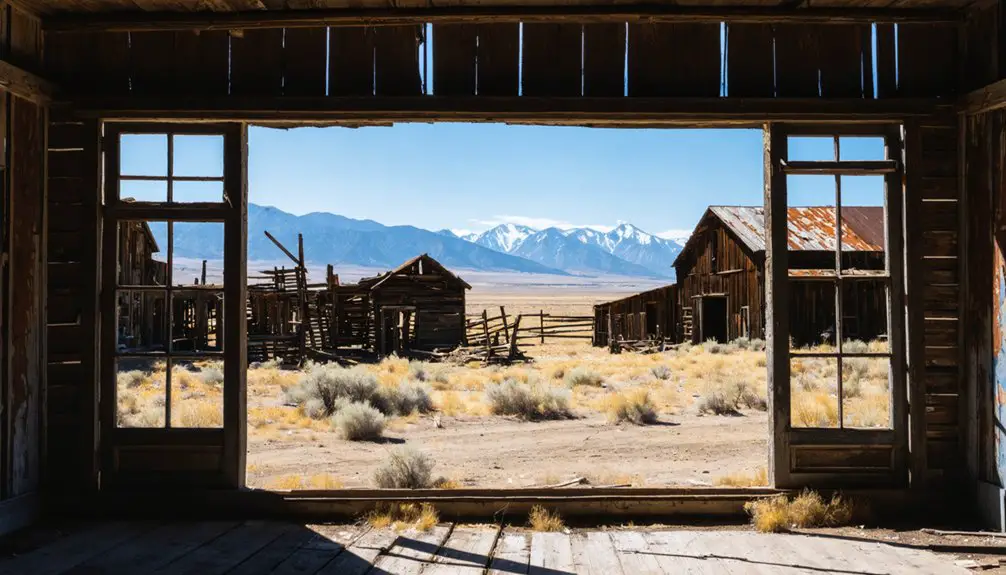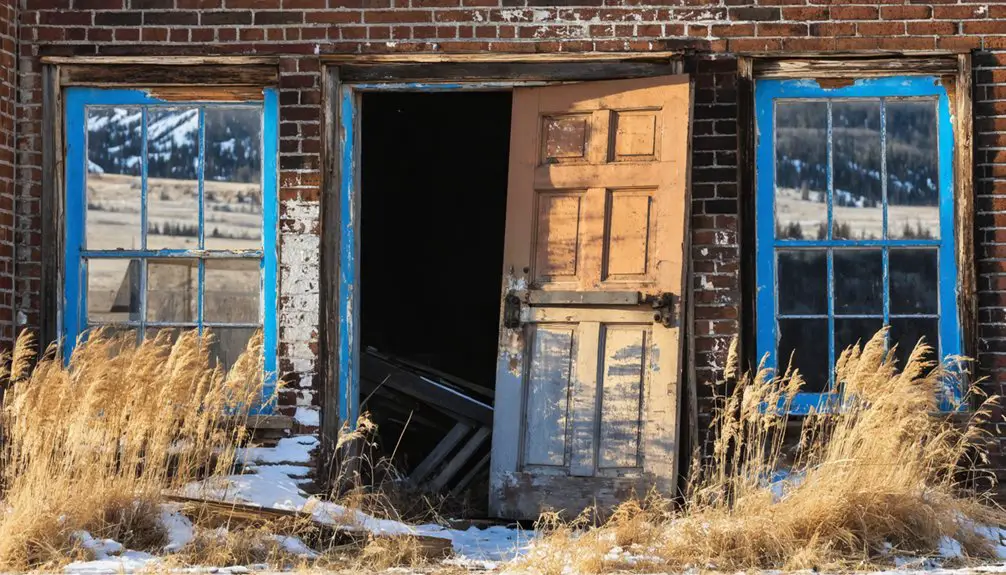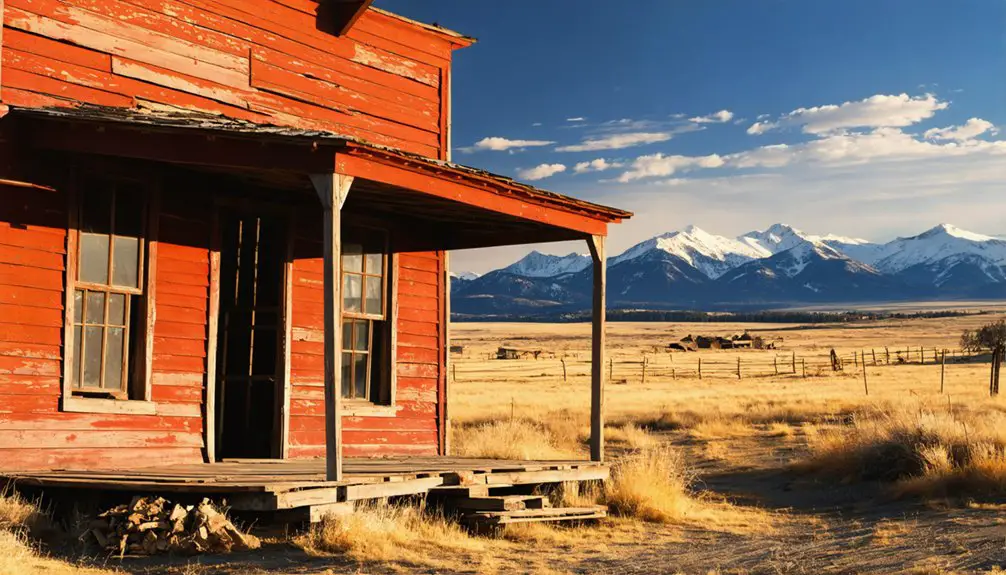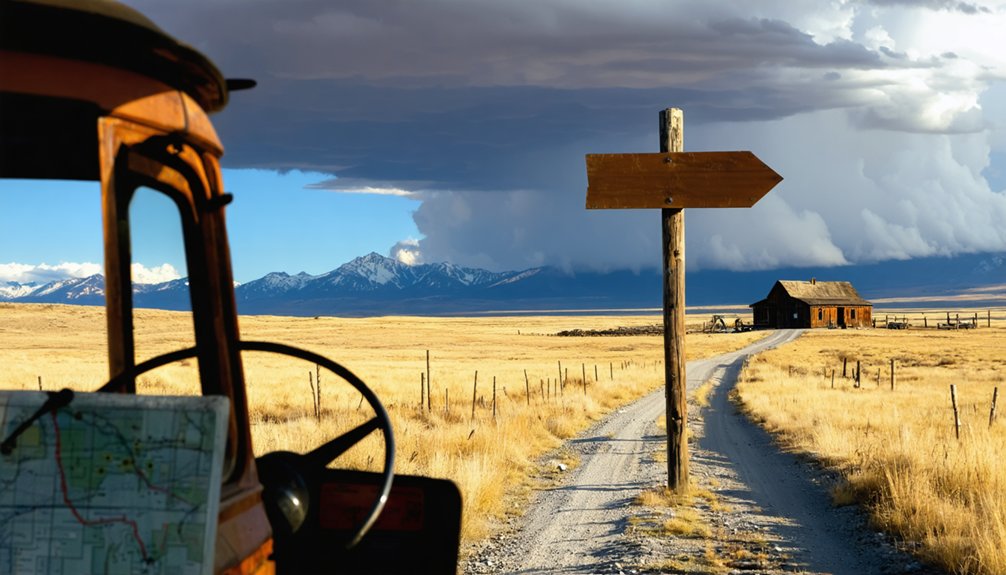
You’ll find Quartz nestled among Montana’s most authentic mining relics, where weathered timber frames and stone foundations tell stories of fortune-seekers who chased precious metals through boom-and-bust cycles. This remote ghost town requires sturdy boots with ankle support, offline maps, and a three-person minimum for safe exploration through pitch-dark interiors and unstable structures. Pack marking chalk to navigate the maze-like buildings, and always share your location before venturing into these skeletal remains where mining dreams turned to dust and abandonment.
Key Takeaways
- Wear ankle-support boots to protect against rusty nails, mold, and uneven terrain in abandoned structures.
- Bring offline maps, marking chalk, and doorstop tools to navigate complex interiors and prevent disorientation.
- Travel with minimum three people, share your location and return time, and stay together if injuries occur.
- Test communication devices and check first aid supplies before exploring due to potential asbestos and structural hazards.
- Quartz offers authentic mining-era remnants with abandoned buildings to explore while maintaining safety protocols throughout your visit.
Understanding Montana’s Historic Mining Ghost Towns
Montana’s ghost towns rise from the earth like weathered monuments to fortune and failure, their skeletal structures scattered across more than 100 sites throughout the state’s rugged mountains and valleys. You’ll find these abandoned settlements wherever miners struck gold, silver, copper, or zinc—starting with Gold Creek’s 1852 discovery and exploding during Bannack’s 1862 rush. Each town rode the boom-and-bust cycle that defined Montana’s mining era.
When the ore ran out, so did the people, leaving behind forgotten silver camps like Granite and Rimini. Today, you’ll encounter everything from Bannack’s preserved state park with 50+ buildings to Coolidge’s scattered ruins. These sites face historic preservation challenges—some survive as tourist destinations, while others crumble back into the wilderness, reclaiming their solitude.
Garnet Ghost Town: The Most Preserved Mining Settlement
Among Montana’s scattered remnants of mining history, Garnet stands apart—thirty original buildings frozen in time, their weathered facades and sagging rooflines preserved in what experts call “arrested decay.” You’ll find this settlement thirty miles east of Missoula, tucked into the Garnet Mountain Range where ruby-colored semi-precious stones gave the town its name.
Thirty original buildings stand in arrested decay, their weathered frames preserving Montana’s mining legacy against the backdrop of garnet-studded mountains.
The architectural design tells stories of survival: structures built without foundations, sized small for easier heating through brutal winters. Natural setting preservation efforts by the Bureau of Land Management maintain this authentic landscape.
What awaits your exploration:
- Four hotels and thirteen saloons showcasing 1890s commerce
- Cabins abandoned with furnishings still intact
- Two rentable cabins for overnight ghost town immersion
- Summer guided tours revealing miners’ daily lives
Your “Explore Ghost Town” license plate directly funds this freedom to wander history untamed.
Granite Ghost Town State Park: From Riches to Ruins
When a delayed telegram nearly ended operations in 1875, miners at the Granite mine ignored their backers’ shutdown order and fired one final blast—uncovering a silver bonanza worth $40 million that would transform this remote hillside above Philipsburg into the earth’s richest silver producer.
By 1890, over 3,000 free-spirited souls had carved out a thriving community here, complete with 18 saloons, a three-story Miners’ Union Hall, and monthly metal production exceeding $250,000. The early mining economy roared until the 1893 silver panic crashed it overnight.
Today you’ll navigate rough mountain roads to explore crumbling ruins that tell this boom-and-bust story. The skeletal Miners’ Union Hall and company hospital still stand as Montana’s best-preserved ghost camp, now protected as a state park where hiking trails weave through abandoned homes.
Copper City: A Remote Mining Camp Adventure
You’ll find Copper City’s origins tied to the Green Eagle Copper Discovery, which sparked the late 19th-century rush that built this high-altitude settlement at 7,198 feet.
Today, Forest Service Road 1808 serves as your mountain bike trail into history, winding past crumbling mill foundations and bunkhouse remains where 42 mining claims once thrived. The rough terrain that challenged ore wagons now offers adventurous cyclists a glimpse into Montana’s copper boom, accessible but unforgiving.
Green Eagle Copper Discovery
The story of Copper City begins with a glint of green in weathered rock—copper staining that caught the eyes of four Gallatin City men as they explored the rugged country northwest of their settlement in 1864.
James Alpin, Frank Akin, Samuel Seaman, and John Emmerson staked the Green Eagle claim after discovering a massive copper quartz boulder—six feet high with a twenty-foot circumference. The ore characterization revealed exceptional promise, but without transport or local demand, they’d wait.
Their discovery’s historical importance became clear when they returned in the 1870s:
- An incline shaft connected the Burlington mine to the original Green Eagle shaft
- Pockets of fine copper sustained hope for the main ore body
- One miner’s quartz bag yielded four hundred dollars at Jefferson River
- Malachite’s distinctive green staining marked the copper veins throughout
You’ll find their legacy carved into these Montana hillsides.
Mountain Bike Trail Access
Just seventeen miles of purpose-built singletrack now wind through the same copper-rich ridges that lured James Alpin and his companions in 1864. You’ll find everything from beginner-friendly flow trails to technical ridge lines that’ll test your nerve on a hardtail. The Southwest Montana Mountain Bike Association carved these routes between 2017 and 2019, creating a non-motorized sanctuary less than an hour from Three Forks off Highway 287.
Trail etiquette matters here—this is public land shared with hikers and runners. Prohibited vehicle usage includes e-bikes, dirt bikes, and ATVs. Don’t even think about driving beyond the Neversweat Kiosk; federal fines await violators. Park at designated spots only, respect dispersed camping rules, and you’ll have miles of rideable terrain year-round through Montana’s mining heartland.
Comet Ghost Town: Hidden Among the Foliage
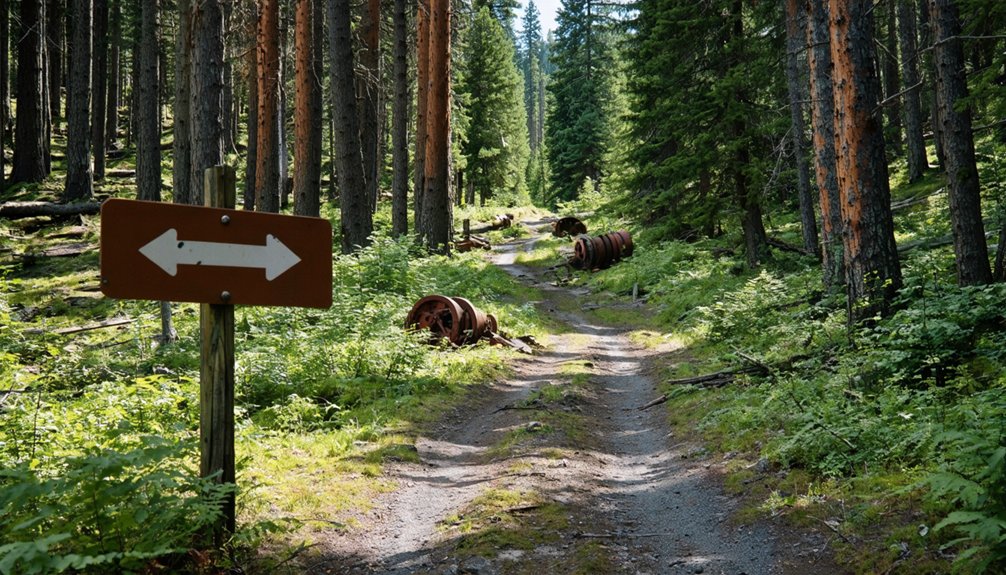
You’ll find Comet ghost town where thick foliage conceals the remains of Montana’s second-largest mining operation after Butte—a place where over $20 million in silver, lead, and copper once flowed from the earth.
Rosie’s boarding house still stands among the derelict buildings, a relic from the days when miners paid 75 cents for a bed and hot meal after grueling shifts in the depths below.
The hasty 1940 abandonment left behind an eerie time capsule: rusted machinery, scattered tools, and the skeleton of that state-of-the-art 200-ton flotation mill slowly surrendering to the mountain’s embrace.
Comet Mine’s Economic Heart
Hidden among sagebrush and lodgepole pine, Comet’s weathered buildings tell the story of Montana’s richest mine in the High Ore Mining District. You’ll discover how this mining community economy thrived on an astonishing $20 million in extracted wealth between 1874 and 1941.
The mine’s economic backbone included:
- Peak production: 58,000 tons of ore annually during the 1930s
- Innovation: Montana’s first continuous rope tramway to Wickes in 1884
- Resilience: Profitable operations surviving the 1893 silver panic
- Infrastructure: A 200-ton-per-day flotation mill supporting 300 residents
Rosie’s Boarding House Life
Among the lodgepole pines and sagebrush, Rosie’s Boarding House stands as a derelict reminder of the men who once crowded its rooms during Comet’s heyday. For just 75 cents daily, miners received bed and board—a bargain that sustained approximately 300 workers through the 1920s and ’30s Depression years. This boarding house culture defined miner lifestyles: communal meals after long shifts, shared sleeping quarters, and camaraderie forged in Montana’s Basin wilderness.
Rosie’s location near the mill superintendent’s home kept miners close to their work, essential when shifts started before dawn. The boarding house anchored a small community that included a schoolhouse with 20 students and reportedly 22 saloons. When operations ceased in 1941, workers abandoned Rosie’s so hastily that the building still stands, frozen in time.
Abandoned 1940s Time Capsule
Lodgepole pines and wild grasses have swallowed most of Comet since its 1941 abandonment, transforming what was once Montana’s second-largest mining operation into nature’s secret. This concealed history waited decades for recent rediscovery by adventurers willing to push through the underbrush.
When workers hastily evacuated, they left behind a complete 1940s snapshot:
- Machinery and equipment scattered where miners dropped them, now rusting into the mountainside
- Derelict boarding house “Rosie’s” standing sentinel over collapsed miners’ residences
- The mill superintendent’s home slowly surrendering to encroaching forest
- A 20-student schoolhouse frozen in time, textbooks and desks inside
You’ll find scrap metal glinting through vegetation—reminders that 300 Depression-era workers once called this wilderness home before vanishing overnight.
Mapping Your Ghost Town Route Through Montana
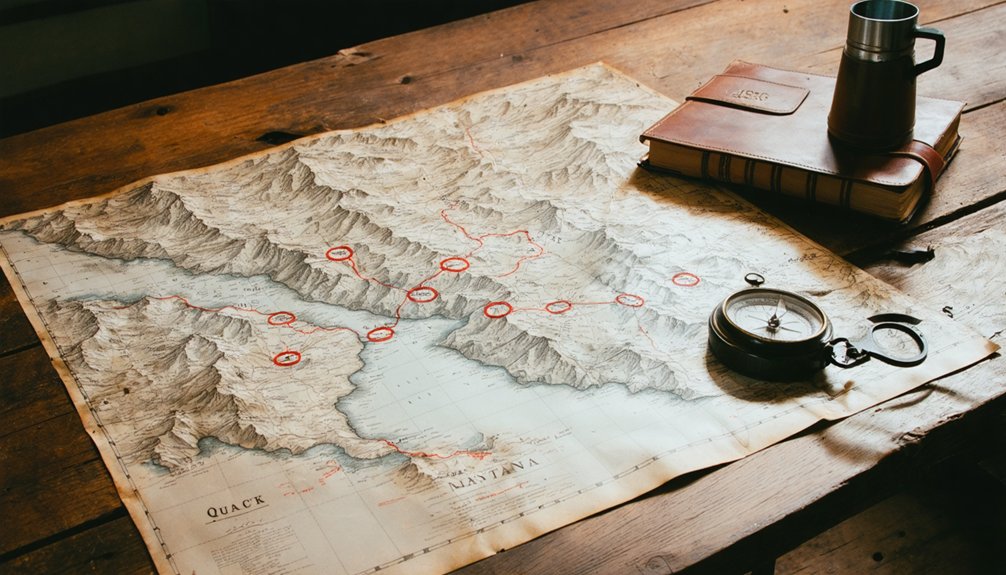
Montana’s ghost towns cluster like constellations across the state’s rugged terrain, and planning your route means deciding which era of history calls to you strongest. Southwest Montana offers the densest concentration—Bannack, Virginia City, and Pony form a triangle near Ennis and Butte.
Southwest Montana’s ghost town triangle—Bannack, Virginia City, and Pony—concentrates the state’s richest mining history within one rugged weekend loop.
Central routes from Helena along Highway 279 reach Marysville and Elkhorn, while Garnet sits east of Missoula via a washboard dirt trail that’ll test your suspension.
You’ll need printed maps or downloaded GPS tracks. Limited cell coverage makes real-time navigation impossible once you’re beyond pavement. Unmarked trailheads appear suddenly on BLM land, and that $3 parking fee at Garnet? Cash only.
The Southwest Montana PDF map marks clusters worth hitting in a weekend loop, letting you chase silver strikes through three mountain ranges without backtracking.
Best Times to Visit Montana Ghost Towns
Timing transforms a good ghost town adventure into an unforgettable one. You’ll find Montana’s ghost towns most accessible during these ideal windows:
During the warm summer months, you may uncover stories of lost towns beneath Montana lakes, each buried treasure adding to the mystique of the landscape. As the sun sets, the reflections on the water reveal silhouettes of forgotten structures, inviting exploration and reflection. With the right timing, you can experience the haunting beauty of these submerged remnants that tell tales of the past.
- September-October: Experience vivid fall colors and shoulder season crowds that vanish after Labor Day, leaving weathered buildings framed by crimson aspens all to yourself.
- May-June: Spring wildflowers surround abandoned structures while budget-friendly rates stretch your road trip funds further.
- July-August: Long daylight hours let you explore multiple sites daily, though you’ll share trails with peak-season visitors.
- Winter (for the bold): February offers snow-draped solitude, but demands serious packing considerations—4WD vehicles, emergency supplies, and acceptance that some roads become impassable.
Weather shifts rapidly in Big Sky Country, so layer your clothing and expect the unexpected.
What to Expect at Each Location
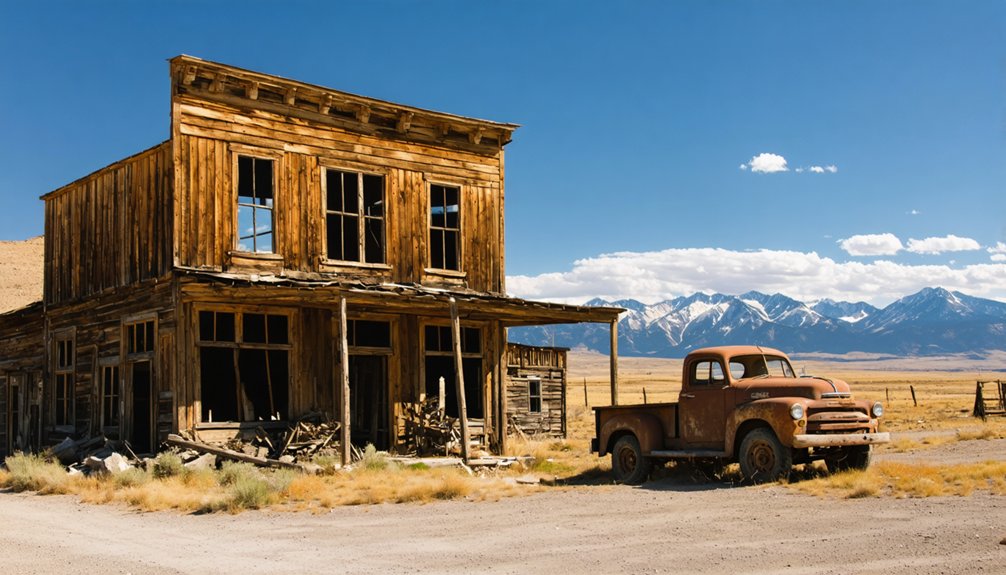
You’ll find each ghost town reveals its past through weathered buildings, scattered artifacts, and trails that range from easy strolls to rugged climbs. Some locations let you wander freely through accessible structures where miners once slept and saloon keepers poured whiskey, while others ask you to admire ruins from a respectful distance.
Your experience shifts with every stop—from Garnet’s well-preserved main street where you can peer into 30 intact buildings, to Granite’s remote hillside where you’ll hike two hours through sagebrush to reach crumbling stone walls.
Structures and Artifacts Remaining
Each ghost town along this route tells its story through the buildings and artifacts left behind. You’ll discover varying degrees of preservation, from stabilized structures to ruins scattered across mountainsides.
What You’ll Find:
- Garnet’s Restored Buildings – Walk through 22 stabilized structures including saloons, hotels, and the school where 41 students once learned. The cloth-backed wallpaper and oak staircases still stand.
- Bannack’s Main Street – Over 50 log and frame buildings line the street where Montana’s territorial government began.
- Granite’s Union Hall Ruins – Explore what remains of the 1890s miners’ gathering place that once served 3,000 residents.
- Quartz/Vipond’s Mining Remnants – Expect collapsed foundations, weathered shacks, and tailings piles marking this isolated camp’s former glory.
Accessibility and Trail Conditions
How challenging will these mountain roads test your vehicle and nerves? The answer depends on how far you push into Quartz Hill’s backcountry. Vehicle accessibility starts easy—gravel kicks in just 100 yards from Highway 43, maintaining semi-good condition as you climb toward the ghost town five miles south.
Your high-clearance 4×4 becomes essential beyond those weathered buildings, where road condition challenges intensify on primitive tracks reaching 8,300 feet. ATVs handle the rougher sections brilliantly, traversing potholed stretches and washboards with ease. Expect slow, deliberate travel at 10-15 mph through steep pine-studded grades.
Fenced mine shafts demand caution at elevation. Summer and fall offer favorable conditions—winter transforms these routes into snowmobile territory, locking out conventional vehicles until spring thaw.
Historical Features to Explore
Beyond traversing the rutted mountain approaches, Garnet stands as your primary destination—a remarkably preserved ghost town where weathered buildings still line the dusty main street. You’ll discover authentic remnants of quartz mining operations that once extracted millions in gold from these mountains between 1862 and 1916.
Essential structures worth exploring:
- Wells Hotel – Still furnished with original iron bedsteads and peeling wallpaper
- J.K. Wells General Store – Shelves lined with vintage merchandise and mining supplies
- Thirteen saloon sites – Imagine 1,000 miners crowding these establishments in 1898
- Davey’s General Store – The most photographed building, pre-1912 fire survivor
Your historical visitor experience includes wandering freely through accessible buildings, touching century-old artifacts, and experiencing Montana’s mining heritage without barriers or guided tours—pure exploration on your terms.
Preservation Efforts and Historical Significance
When you first glimpse Garnet’s weathered storefronts perched on their precarious hillside, you’re witnessing a preservation miracle decades in the making. After the 1912 fire and subsequent economic decline devastated this once-thriving mining camp of 1,000 residents, souvenir hunting risks nearly erased what remained.
A thousand miners once called this hillside home before fire and decline nearly erased their legacy forever.
The Bureau of Land Management stepped in post-1947, securing property titles before treasure hunters could strip the buildings bare.
Since 1970, the Garnet Preservation Association has partnered with BLM to stabilize these hastily-built structures—remarkably constructed without foundations between 1895-1948. Their work earned Garnet recognition as Montana’s most intact ghost town and a National Register listing in 2010.
You’ll find no commercialization here, just authentic remnants of Bear Gulch’s 1865 gold strike legacy, accessible year-round for those seeking unvarnished Western history.
Essential Tips for Ghost Town Exploration
Standing before Garnet’s aging structures, you’ll need more than historical appreciation—proper preparation separates memorable exploration from dangerous misadventure.
Essential gear and team coordination create safe exploration:
- Safety equipment: Heavy-duty gloves, respirator masks, headlamps with backup batteries, and sturdy boots with ankle support protect against rusty nails, mold exposure, and unstable terrain in pitch-dark interiors.
- Navigation tools: Offline maps, marking chalk, and doorstop tools prevent disorientation in complex buildings where one wrong turn leads to dead ends.
- Group protocols: Explore with minimum three people—someone stays with injured explorers while another seeks help. Share your location and return time with outside contacts.
- Equipment maintenance: Check first aid supplies, test communication devices, and inspect respiratory protection before entering structures where asbestos and degradation threaten your freedom to explore safely.
Frequently Asked Questions
Are There Any Ghost Towns Near Quartz, Montana Worth Visiting?
You’ll find three exceptional ghost towns nearby: Keystone’s crumbling structures with interesting historical architecture, Taft’s industrial ruins, and Garnet—Montana’s crown jewel featuring well preserved mining equipment across 30+ buildings. Each offers authentic exploration freedom beyond typical tourist traps.
What Safety Precautions Should I Take When Exploring Abandoned Mining Buildings?
Watch out for unstable structures that’ll crumble beneath you—rotting floors, collapsing timbers, hidden shafts. Be cautious of wildlife sheltering inside: rattlesnakes, bears seeking refuge. Never enter alone, bring flashlights, and tell someone your plans before venturing in.
Can I Camp Overnight at Any of These Ghost Town Locations?
You can’t camp directly at ghost town sites due to accessibility concerns and safety issues, but Quartz Flat Campground offers nearby lodging availability. It’s your perfect basecamp—just minutes away with full amenities for exploring freely.
Are the Roads to These Ghost Towns Suitable for RVS?
Road conditions matter here. Quartz welcomes your RV via Highway 43—standard vehicle accessibility for RVs works fine. However, Garnet’s Cave Gulch route isn’t recommended for motorhomes or trailers due to steep, narrow sections requiring high-clearance vehicles instead.
Do I Need Permits to Metal Detect at Montana Ghost Towns?
You’ll need written permission for metal detecting at Montana ghost towns due to historic preservation requirements. BLM prohibits detectors at sites like Garnet, while local metal detecting laws vary—always verify regulations and respect private property boundaries before exploring.