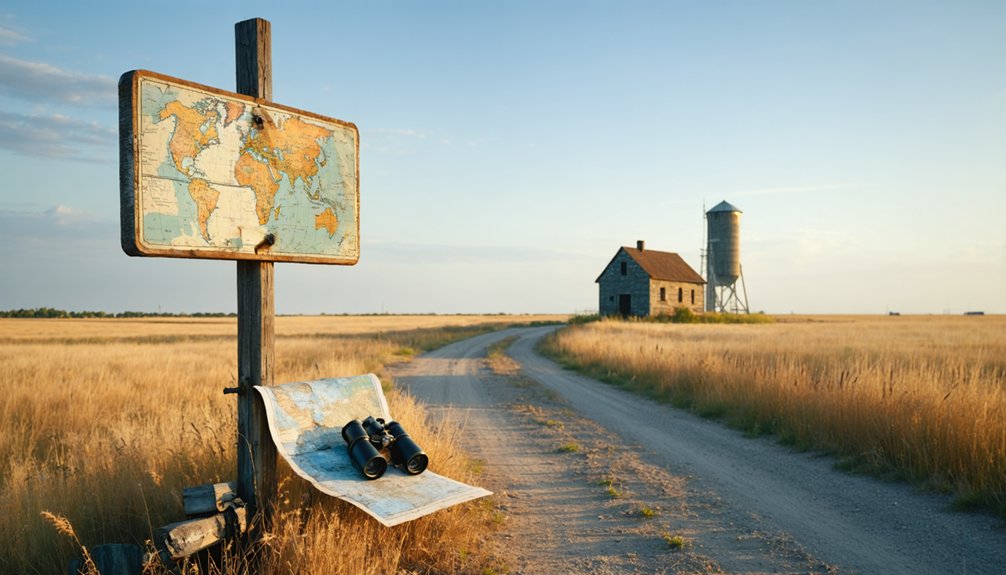
You’ll need GPS coordinates (38.15972, -100.38250) and a downloaded USGS map since cell service vanishes on these unmarked ranch roads. Fuel up completely in Garden City before venturing into this semi-arid landscape where dust devils obscure your visibility and rattlesnakes nest in the courthouse’s limestone archway. The crumbling brick schoolhouse pillars and weathered cemetery markers stand as lonely sentinels on the prairie, accessible only to those who can navigate by coordinates rather than road signs—and there’s much more to uncover about this vanished frontier settlement.
Key Takeaways
- Enter coordinates 38.15972, -100.38250 into GPS and download the USGS Ravanna Quadrangle before losing cell service.
- Fuel up completely in Garden City before departure, as unmarked roads and semi-arid conditions create navigation challenges.
- Visit the crumbling brick schoolhouse pillars, courthouse archway ruins, and Ravanna Cemetery half a mile from town site.
- Watch for rattlesnakes inhabiting the limestone ruins and bring appropriate footwear for exploring the remote prairie landscape.
- Verify coordinates frequently on unmarked roads, as no signs or landmarks remain to guide visitors to the ruins.
The Rise and Fall of Ravanna: From Bulltown to Ghost Town
In 1882, when John Bull first staked his claim on the Kansas prairie, he probably didn’t imagine his name would become a town joke. Locals quickly renamed it Cowland, then settled on Ravanna in 1885—possibly a misspelling that stuck.
You’d have found real opportunity here at its peak: over 700 residents built a thriving community with a newspaper, bank, schoolhouse, and cheese plant. The economic diversity attracted farmers and buffalo hunters alike, including descendants of the Barnum twins legacy—Eng and Chang’s children who’d settled the area.
But prosperity faded fast. The courthouse burned around 1900, the post office closed in 1922, and by the 1930s, even the schoolhouse stood empty. The town also lost its status as county seat to Eminence after a bitter political battle. When Garfield County was annexed to Finney County in 1893, Ravanna’s fate was essentially sealed. Today, only cemetery markers remain.
The Garfield County Seat War: Bat Masterson and Midnight Raids
When November 1887 rolled around, Garfield County’s election turned into one of Kansas’s most spectacular political frauds. You’ll find it hard to believe: Ravanna claimed 467 votes while Eminence tallied 432—yet both towns housed only 300-400 residents each. They’d stuffed ballot boxes with dead voters’ names and traded votes like cattle at market.
The political intrigue ran so deep that lawmen summoned Bat Masterson from Dodge City with twenty deputies to keep the peace. Eminence challenged the results, sparking a court battle that dragged until 1889. The Supreme Court reversed everything, but the economic consequences devastated both towns. Kansas declared the entire county unconstitutional in 1893, dissolving it completely. The fierce rivalry between Eminence and Ravanna ultimately led to Garfield County’s annexation into Finney County. By the 1930s, some residents remained even as maintaining the infrastructure became financially impossible. Neither town won—they both lost everything.
What Remains: Exploring the Ruins of Ravanna Today
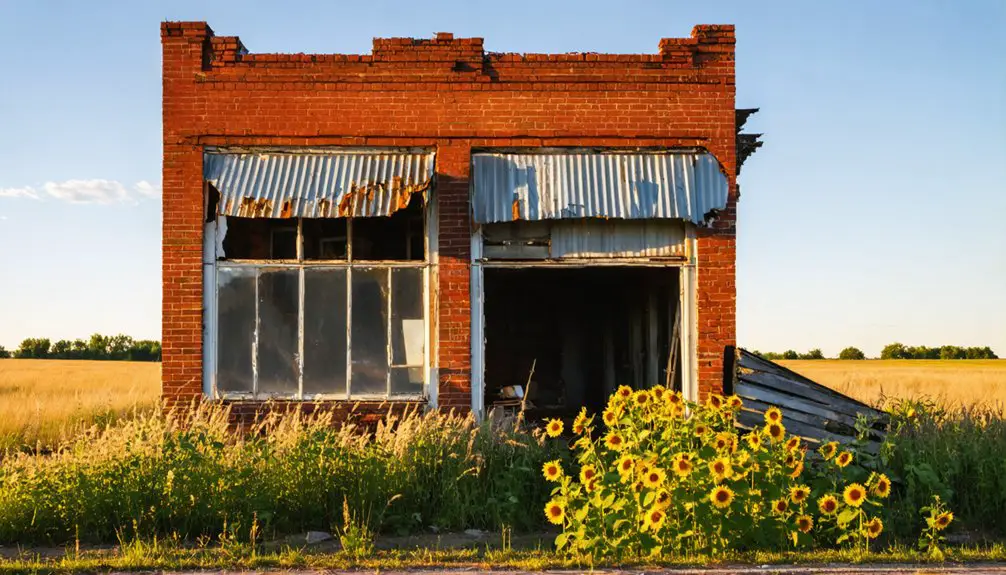
When you arrive at Ravanna today, you’ll find crumbling brick pillars jutting from the prairie grass—all that’s left of the schoolhouse that taught children until the early 1930s.
A short walk reveals the courthouse ruins: a ghostly archway and low walls of a building that never heard a single case argued within its boundaries. The structure burned down around 1900, leaving only rubble in an open field.
Half a mile from these scattered remains, the Ravanna Cemetery waits in the tall grass, its weathered stones marking the final resting places of those who once called this vanished town home. Watch your step as you explore, because the limestone ruins now serve as home to rattlesnakes.
Crumbling Schoolhouse Brick Pillars
Time has reduced Ravanna’s once-proud schoolhouse to a handful of brick pillars standing in an endless sea of prairie grass. Built from native white rock in 1889, this two-story structure educated children until 1930 before abandonment claimed it.
The gradual deterioration timeline accelerated through decades of Kansas weather—walls crumbling, floors collapsing, until only five partial supports remained by 2019.
You’ll find these lonely pillars rising from ground level, their corners defining what once was. No roads lead here, no signs mark the spot—just rattlesnake-infested ruins blending into the landscape near the courthouse rubble.
Historical preservation efforts never reached this remote Finney County site, leaving nature to reclaim what ambitious settlers built during Ravanna’s brief 700-resident boom. The town’s sudden collapse left many buildings hauled away by departing residents, though this schoolhouse remained too deteriorated to salvage. Ravanna’s $10,000 courthouse and this school represented the community’s investment in permanence before drought consumed the area.
Courthouse Walls and Archway
A weathered archway rises from the prairie grass, marking where Garfield County’s courthouse once administered justice for barely a year. You’ll find this stone sentinel standing among rubble formations and low wall remnants, exposed to wind and sky without protection. The archway silhouette frames endless Kansas horizons, a portal to nowhere that once welcomed county officials during the brief 1887-1889 period before Eminence stole the county seat.
Fire consumed the building around 1900, leaving scattered debris you can still walk through today. Guy Reed attended school nearby in 1930 when jail bars still stood upright. Those relics disappeared decades ago, stolen like most artifacts. Metal detector enthusiasts occasionally uncover coins, though scavengers have stripped the site clean over time.
Cemetery Half-Mile Away
Half a mile from the courthouse archway, you’ll find Ravanna’s cemetery standing as the town’s only intact legacy. The weathered gravestones mark 29 souls who once called this prairie home, their inscriptions fading beneath grass and Kansas wind. Some stones lie nearly hidden, requiring you to kneel close to decipher names dating back to the 1880s.
Visit during cooler months—rattlesnake presence becomes a real concern as temperatures rise. A dirt road leads between the limestone ruins to reach the graveyard, though you won’t find signs directing you there. The grounds stretch across approximately 5 acres of rolling prairie, maintained by volunteers from the surrounding communities. Pathways wind through the cemetery, allowing visitors to navigate between the scattered headstones and monuments. In 1969, 86-year-old Guy Reed walked these same grounds, locating family buried generations ago. Today, it remains utterly isolated, preserved only by the endless sky above and occasional ranchers who stop by at dusk.
The Cemetery and Schoolhouse: Last Remnants of a Frontier Dream
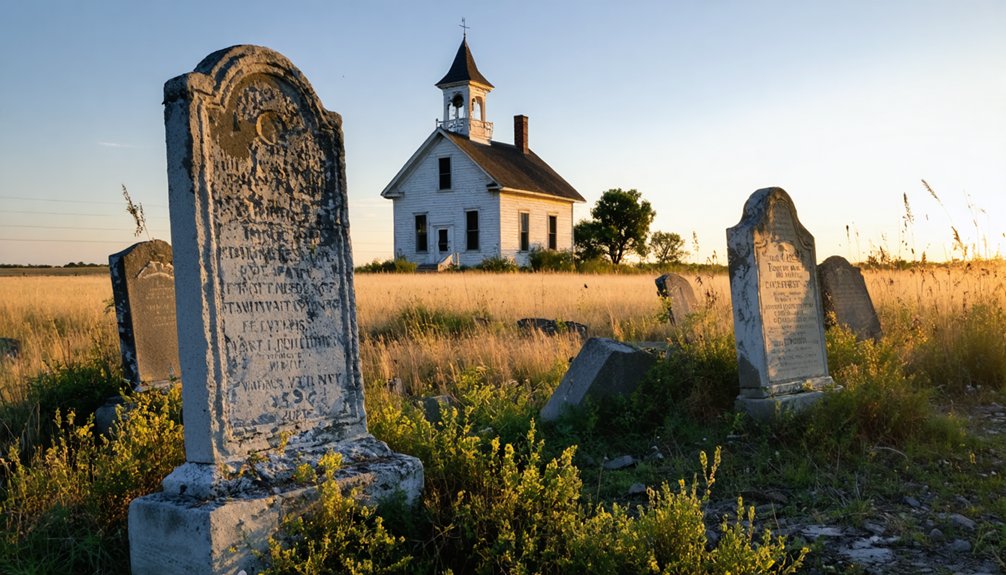
Standing among the windswept prairie grass, you’ll find five crumbling brick pillars—all that remains of Ravanna’s schoolhouse where children once gathered in the 1880s before it closed in the early 1930s.
Half a mile from these ruins lies the cemetery, the town’s most intact legacy, where over 700 former residents rest beneath the Kansas sky. You’ll need to navigate trackless prairie to reach these sites, and come summer, watch for rattlesnakes coiled in the tall grass around the weathered stones and brick fragments.
Crumbling School Brick Pillars
Less than half a mile from the cemetery, the Ravanna schoolhouse pillars rise from the prairie like scattered tombstones marking education’s death in this corner of Kansas. You’ll find only five brick supports standing where two-story stone walls once enclosed students through the early 1930s. These deteriorating architectural details—corner pillars and partial brick columns—are all that survived after the WPA salvaged the stone for Dighton High School’s football stands in the late 1930s.
The forgotten school history lives in these ruins. Guy Reed sat in that single classroom back in 1930, sharing space with all grades despite the building’s two-story design. Now you’ll walk dirt roads between limestone fragments, your metal detector perhaps catching coins previous collectors missed. Watch for rattlesnakes—they’ve claimed this educational ground as their own.
Cemetery Half-Mile Away
North of those scattered brick pillars, across open prairie where dirt roads fade into grass, you’ll spot the weathered stones of Ravanna Cemetery marking the town’s final resting place. Civil War veterans rest alongside pioneer families like the Parkers, whose memorial stone still defies the elements. You’ll need to navigate through prairie overgrowth to read the faded inscriptions—many graves lie hidden beneath native grasses, their markers broken or worn smooth by Kansas winds.
There’s no formal entrance or signage directing you here. Just open fields and the occasional descendant who drives in from distant states, seeking ancestral connections. The weathered gravestones stand as the cemetery’s most enduring feature, though locals have sporadically maintained the site since 1928, preventing complete abandonment of these frontier souls.
Accessing Remote Prairie Ruins
The two-story schoolhouse that rose from native white rock in 1889 now exists as scattered stone corners jutting through prairie grass—the last architectural echo of Ravanna’s ambitions. You’ll find these ruins 24 miles east of Garden City on K-156, then seven miles north on K-23, and four miles east on Lake Road. The crumbling pillars stand on the north side, though there’s no official unmarked trail directions to guide you—just endless prairie and a granite marker on K-156 acknowledging what once was.
Remote property access requires respect; these ruins rest on private land where no roads, signs, or houses interrupt the solitude. You’re truly alone here, surrounded by emptiness that both liberates and humbles, standing where twenty-one men built dreams from stone.
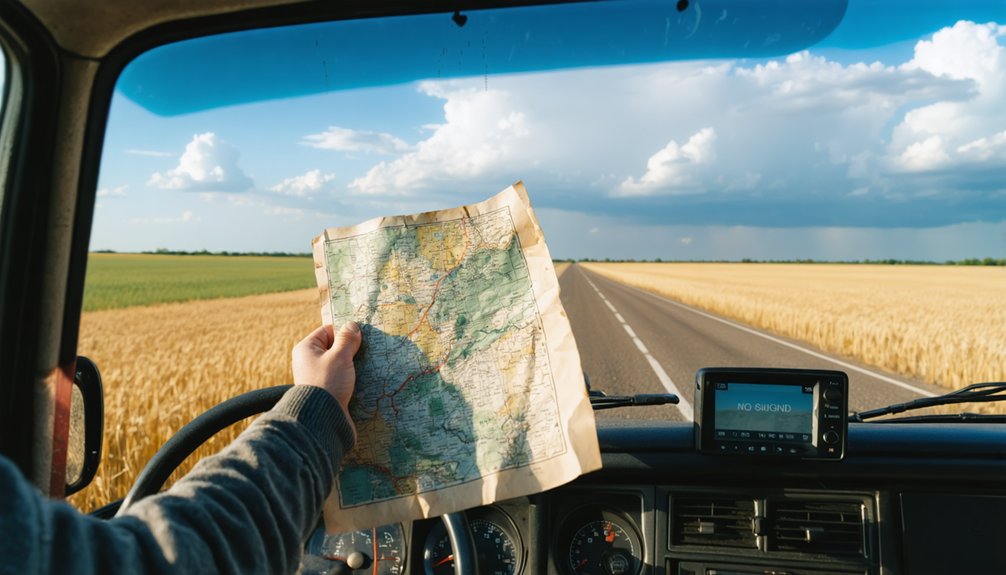
Finding Ravanna requires more precision than luck on Kansas’s sprawling eastern Finney County prairie, where few landmarks interrupt the horizon and even fewer road signs acknowledge what once was. You’ll navigate thirty miles east-northeast from Garden City into genuine backcountry, where unmarked roads demand coordinate verification before you commit to turning.
Essential Navigation Steps:
- Enter 38.15972, -100.38250 directly into your GPS or Google Maps search box
- Download the USGS Ravanna Quadrangle (2015 edition) before cell service fades
- Right-click your current position on Google Maps to confirm you’re tracking toward those exact coordinates
The semi-arid BSk climate means dusty visibility shifts with wind. Fuel up completely in Garden City—there’s nothing out here but ghost-scattered foundations and your determination to reach them.
Eminence and Kalvesta: Combining Your Ghost Town Adventure
Since you’ve already committed to eastern Finney County’s dusty coordinates, you might as well explore the sister ghost that shares Ravanna’s tragic backstory. Eminence sits 25 miles northeast of Garden City on the Pawnee River, where Catherine Doll’s crumbling hotel has stood empty since 1965.
These intriguing legal battles between rival towns culminated in Bat Masterson himself riding out from Dodge City to prevent bloodshed during the dramatic county seat transfer. You’ll find Eminence Cemetery half a mile north and a quarter mile west—look for the 1998 stone marker.
For modern amenities between these forsaken sites, detour through Kalvesta, a living town that survived what Eminence and Ravanna couldn’t. Gas up, grab supplies, and appreciate civilization before returning to sun-bleached ruins and prairie silence.
Essential Tips for Visiting Southwestern Kansas Ghost Towns
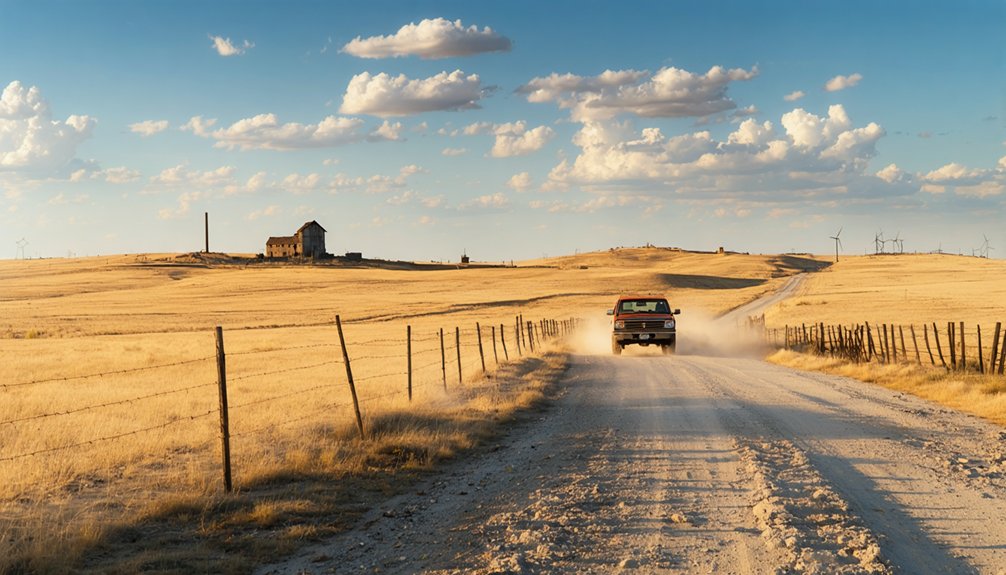
Before you load your camera gear and point your vehicle toward Ravanna’s empty coordinates, understand that southwestern Kansas ghost towns demand more preparation than your typical roadside attraction. You’ll navigate unmarked gravel roads where cell towers vanish behind wheat fields, making downloading offline maps non-negotiable before departure.
Exploring ghost towns to explore in Kansas offers a unique glimpse into the state’s history, with remnants of old buildings and structures telling stories of the past. Be sure to bring extra supplies, as amenities can be sparse in these secluded areas. Each town has its own character, so take your time to soak in the atmosphere and capture the essence of these forgotten places.
Critical preparation checklist:
- Water and fuel redundancy – Pack 2-3 gallons per person daily, with nearest gas stations 30-60 miles away in Garden City or Dodge City
- Four-wheel drive capability – Many sites require traversing rough terrain inaccessible to standard vehicles
- Wildlife awareness – Rattlesnakes frequent abandoned structures; wear sturdy boots and watch your step
Respect private property boundaries marked by barbed wire fences. These ghost towns represent Kansas’s untamed history—and accessing them requires embracing genuine backcountry independence.
The Legacy of Buffalo Hunters and Failed Railroads
The flat Kansas horizon you’ll encounter while searching for Ravanna’s remnants once thundered with millions of buffalo hooves—until hide-hunters armed with Sharp’s rifles turned the prairie into an industrial slaughterhouse. Between 1870-1880, specialized hide-hunters exterminated entire herds, selling dried skins for $3 each to feed the buffalo hide economy.
You’re standing where nearly 5,000 buffalo fell just to feed Kansas Pacific construction crews in 1867.
Ravanna’s brief existence in Buffalo County epitomizes how railroad expansion impacts created and destroyed frontier settlements within decades. The iron rails that promised prosperity—transporting commercial hides and connecting isolated homesteads—ultimately doomed towns like Ravanna when routes shifted or failed. By the early 1880s, both buffalo and Ravanna’s dreams had vanished into the windswept grasslands.
Frequently Asked Questions
Are There Any Accommodations or Camping Facilities Near Ravanna?
You won’t find lodging in abandoned Ravanna itself, but nearby Garden City offers bed and breakfast options for cozy stays. For adventurers seeking RV park amenities, Garnett’s facilities provide full hookups, letting you camp freely while exploring ghost town territory.
What Is the Best Time of Year to Photograph the Ruins?
You’ll capture Ravanna’s haunting beauty best during spring or fall when early morning light bathes crumbling brick in golden warmth. Overcast conditions soften harsh shadows, revealing textures. I’ve found October perfect—fewer crowds, dramatic skies, comfortable exploring temperatures.
Do I Need Permission From Landowners to Access the Site?
Yes, you’ll need permission since Ravanna sits on private property. Contact landowners beforehand to avoid legal liability concerns. Respect their boundaries—trespassing ruins the freedom these remote Kansas prairies represent and jeopardizes future private property access for everyone.
Are There Guided Tours Available for Ravanna and Nearby Ghost Towns?
Like a forgotten whisper on the prairie wind, guided tours for nearby ghost towns don’t exist here. You won’t find availability of private tours either—just wide-open country where you’re free to explore Ravanna’s crumbling ruins independently.
What Cell Phone Coverage Can I Expect in This Remote Area?
You’ll find limited connectivity in Ravanna’s wild expanses. Expect cellular dead zones where prairie meets sky—T-Mobile’s Extended Range offers your best shot, though signals fade unpredictably. Download maps offline before venturing into Kansas’s untamed backcountry.
References
- https://www.quincyvagell.com/2019/09/25/ravanna/
- https://www.visitgck.com/eminence-and-ravanna-the-story-of-finney-countys-ghost-towns/
- http://genealogytrails.com/kan/finney/history_ravanna.html
- https://legendsofkansas.com/kansas-ghost-town-list/
- http://kansasghosttowns.blogspot.com/2011/03/ravanna-kansas-former-county-seat-of.html
- https://www.youtube.com/watch?v=qv0HZHoIBgE
- https://legendsofkansas.com/finney-county-extinct-towns/
- https://lostkansas.ccrsdigitalprojects.com/sites/lostkansas/files/private_static/2022-12/LT_FI_Eminence_Doll.pdf
- https://en.wikipedia.org/wiki/County_seat_war
- https://visitenid.org/about-enid/enid-history/