Richards Spur isn’t your typical ghost town—it’s a living paleontological battleground where Dolese Brothers’ quarry has been systematically consuming Arbuckle Mountain bedrock since 1907. You’ll need to secure an entry permit before heading to these coordinates north of Lawton: 34.760069°N, -98.3869985°W. The limestone operation runs six days weekly, simultaneously destroying and revealing 288-million-year-old cave systems that harbor the world’s oldest fossilized skin. Your journey through Oklahoma’s mining heritage reveals where industrial grit meets irreplaceable scientific treasure.
Key Takeaways
- Richards Spur is not a ghost town but an active limestone quarry in Comanche County north of Lawton.
- Entry requires a permit from Dolese Brothers’ general office due to ongoing 24-hour industrial operations six days weekly.
- The site features 288-million-year-old fossil caves, yielding the world’s oldest preserved skin and exceptional Permian specimens.
- From Oklahoma City, take I-44 south toward Lawton, then use state highways to reach coordinates 34.760069°N, -98.3869985°W.
- Industrial operations continuously destroy fossil-bearing networks, making this a time-sensitive paleontological treasure rather than tourism destination.
Getting to Richards Spur: Directions and Access Points
Tucked into the red earth of Comanche County, Richards Spur sits at coordinates 34.760069°N, -98.3869985°W—a pinpoint on the map that belies its outsized reputation among paleontologists and fossil hunters. You’ll find this legendary fossil site north of Lawton, adjacent to Fort Sill military base, at roughly 1,178 feet elevation. The catch? It’s embedded within Dolese Brothers’ active limestone quarry, meaning you can’t simply roll up unannounced.
From Oklahoma City, take I-44 south toward Lawton, then navigate north via state highways and farm-to-market roads. Before making the trek, contact Dolese’s general office at 20 N.W. 13th regarding entry permit details—quarry company operations take precedence here. Without clearance, you’re facing locked gates and liability issues. This isn’t public land; respect the boundaries.
What Makes This Semi-Abandoned Mining Town Special
You’ll find yourself standing at the intersection of industrial grit and paleontological treasure, where active limestone quarry operations continue alongside some of North America’s most significant fossil beds.
The reddish cave fill exposed in these Permian-age deposits has yielded pristine specimens of 289-million-year-old amphibians, reptiles, and early synapsids—creatures preserved in extraordinary three-dimensional detail.
This working quarry’s remote location in the Arbuckle Mountains means you’re witnessing both Oklahoma’s mining heritage and a site that’s rewritten textbooks on early terrestrial vertebrate evolution.
World-Class Fossil Discoveries
The crumbling limestone hills around Richards Spur harbor one of paleontology’s most extraordinary treasure troves—a 288-million-year-old cave system that’s rewriting the story of early land animals. You’ll discover where paleontologists unearthed the world’s oldest fossilized skin—a fragment from *Captorhinus aguti* that’s 21 million years older than any previously known specimen.
The exquisite fossil preservation conditions here stem from a rare convergence: oxygen-starved caves, fine clay sediments, and petroleum seepage from ancient marine deposits. This chemical cocktail perfectly mummified soft tissues that normally vanish within days. Since systematic excavations began in 1932, researchers have repeatedly returned to collect three-dimensional skin fragments with crocodile-like pebbled surfaces.
These discoveries illuminate ancient land animal evolution, revealing when reptiles, birds, and mammals developed their tough, scaly armor for terrestrial life.
Active Quarry Operations
Unlike most ghost towns frozen in time, Richards Spur pulses with industrial life around the clock—massive crushers grinding limestone while paleontologists race against bulldozers to salvage 289-million-year-old treasures.
Operational logistics reveal a remarkable dual existence:
- Round-the-clock extraction: Six-day weeks with two production shifts plus maintenance, consuming massive electricity that forces evening operations to avoid overloading Oklahoma’s power grid
- Industrial scale: Specialized Irish machinery produces 12-36 inch riprap across thousands of feet of conveyor belts spanning one square mile
- Calculated destruction: Blasting exposes new fossil-bearing cave networks continuously, though Permian sediments get discarded without documentation
The environmental impact extends beyond alkaline reservoirs (pH 8-8.5) and power consumption. You’re witnessing systematic erasure of irreplaceable geological records—vertically-tilted Ordovician limestone harboring karst caves filled with ancient bones, demolished before detailed mapping occurs.
Remote Limestone Mining Heritage
Since 1907, Dolese Brothers’ limestone quarry has clawed through more than a square mile of Arbuckle Mountain bedrock—a pre-statehood operation that predates Oklahoma itself by mere months. You’ll witness quarry history still unfolding: conveyor belts rumble six days weekly across 24-hour shifts, extracting Ordovician limestone for construction adhesion.
The mining footprint tells its own story—half the site remains untouched after 113 years, waiting beneath your feet. This isn’t preserved amber; it’s living industrial archaeology where blast schedules dictate access and ancient cave systems appear overnight in fresh-cut walls.
Workers first reported strange fossils here in 1932, but the hammers never stopped. You’re exploring a location where commerce and paleontology collide, where million-year-old secrets emerge between dynamite charges and crushing equipment.
The Ancient Limestone Quarry That Changed Paleontology
North of Lawton, where massive limestone blocks emerge from industrial crushers, the Dolese Brothers Limestone Quarry conceals one of paleontology’s most revolutionary sites. Since quarry workers first reported fossils in 1932, this unassuming industrial operation has yielded discoveries that’ve rewritten evolutionary history.
Where limestone crushers meet ancient history, an Oklahoma quarry has quietly upended our understanding of early reptilian evolution.
What makes Richards Spur extraordinary:
- 289-million-year-old reptile skin—the oldest ever found, preserved in oxygen-poor cave sediments
- Petroleum seeps that mummified soft tissues before decay could erase them
- Articulated skeletons of captorhinids like the 10-inch Captorhinus aguti, revealing pebbled crocodile-like epidermis
You’ll find academic studies still examining how ancient oil and fine clay combined to capture details usually lost to time. The evolutionary implications stretch from these early amniotes to modern bird feathers and mammalian hair follicles—all documented where limestone meets paleontological gold.
Exploring the Cave System and Fossil Discovery Sites
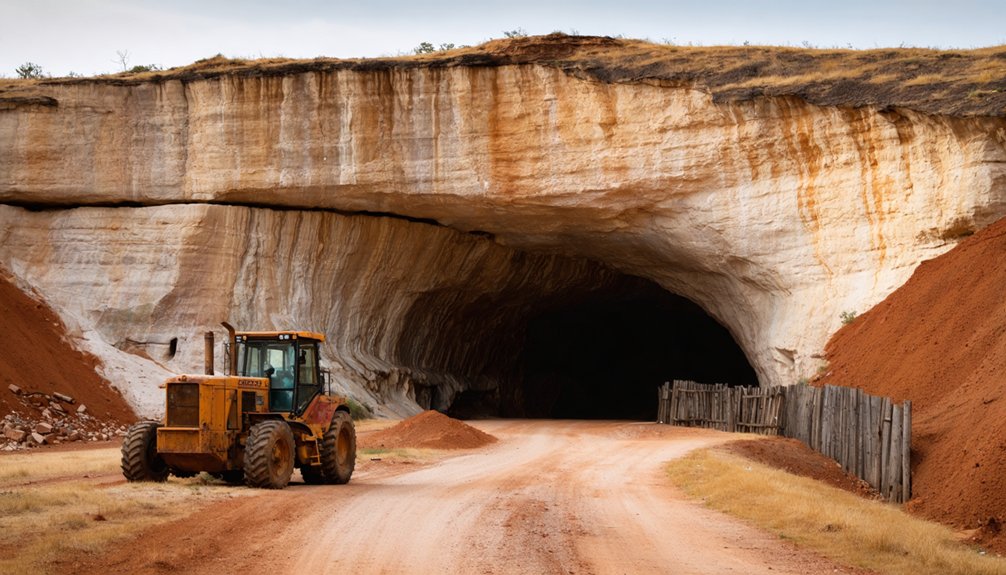
Deep beneath the working quarry, where Ordovician limestone tilted skyward 300 million years ago, an ancient karst system cradles paleontology’s most intimate secrets. You’ll discover a rich cave environment where oxygen-starved sediments and oil seeps from the Woodford Shale created unique preservation conditions unlike anywhere else on Earth.
Picture stalagmites and stalactites encasing 289-million-year-old creatures in calcite tombs, their skin mummified by petroleum before decay could claim them.
The Mays’ collection site reveals fossil treasures embedded in soft claystone and calcite conglomerates. Here, tar-blackened bones of Captorhinus aguti rest alongside fearsome Dimetrodon remains. These fissure fills, packed with ancient clay and mudstone, transformed the caves into time capsules where pioneering reptiles, synapsids, and amphibians met their final fate.
Best Times to Visit and What to Expect at an Active Quarry
You’ll want to plan your Richards Spur visit carefully, as this isn’t a passive museum experience but an active industrial site where massive crushers grind limestone and haul trucks rumble past exposed fossil layers around the clock.
The quarry operates six days weekly with 24-hour shifts, so you’ll need advance coordination with Dolese management to access the site safely amid heavy equipment and regular blasting operations.
Oklahoma’s mild spring and fall months offer the most comfortable conditions for traversing this working quarry, though the fossil discoveries continue year-round as mining operations constantly expose new geological strata from the Permian period.
Seasonal Weather and Accessibility
Planning your ghost town road trip to Richards Spur means timing it right with Oklahoma’s temperamental weather patterns. You’ll encounter dramatic seasonal shifts that directly impact your quarry access and exploration comfort.
The rich history of Little Chief, Oklahoma offers intriguing stories of its past that are often overlooked. As you delve into this ghost town’s legacy, you’ll discover unique artifacts and remnants that tell tales of resilience and change. Prepare to be fascinated by the community’s transformation over the years, which adds depth to your journey through the forgotten landscapes of the state.
Optimal seasonal visitation windows:
- Spring (70-80°F): Prime exploration weather, but watch for flash floods from Gulf air masses dumping 30-90 cm rainfall along rivers
- Summer (August peaks at 93°F): Active quarry remains accessible despite muggy conditions—early morning fossil viewing beats afternoon heat
- Fall: Gradually cooling temperatures create ideal hiking conditions with decreased precipitation and manageable 8-11 mph winds
Winter’s harsh reality brings very cold snaps down to 17°F with unpredictable snowfall, making road conditions treacherous. Spring-fall offers your best balance of comfortable temperatures, quarry accessibility, and safe driving conditions for this backcountry adventure.
Quarry Activity and Safety
Beyond checking weather forecasts and packing your gear, understanding the quarry’s 24/7 operational rhythm becomes your next priority for a safe visit. This active operation runs six days weekly with two production shifts and one maintenance window.
You’ll encounter loaders, haul trucks, gyratory crushers, and thousands of feet of conveyor belts transforming limestone into aggregate. Peak blasting occurs during production hours, making coordination essential for site monitoring.
The company maintains rigorous safety protocols—one location achieved 12.5 years without injury through constant training and awareness. Their ‘Quarry Challenge’ events demonstrate commitment to eliminating hazards.
You’ll navigate quarry challenges including heavy machinery, blasting debris, crusher noise, and exposed karst fissures. Contact Dolese directly to identify public access windows, typically during off-peak maintenance shifts when equipment stands silent.
Fossil Viewing Opportunities
The Richards Spur fossil beds reveal themselves on no predictable calendar—your viewing window depends entirely on Dolese Brothers’ grinding, crushing, and blasting schedule rather than seasonal weather patterns. Visitor passes aren’t handed out freely at this working industrial site. Tour availability hinges on quarry operators’ willingness and timing, requiring advance contact and permission.
When you do gain access, expect:
- Fresh exposures appearing unpredictably as excavators tear into 286-million-year-old karst fissures
- Fossils dumped unceremoniously into waste piles, including potential specimens with ancient reptile skin
- No curated exhibits or designated viewing areas—just raw limestone faces and discarded rubble
You’re witnessing paleontology in real-time chaos, where world-class discoveries get crushed into aggregate unless someone’s watching. Mining continues year-round, constantly revealing and destroying evidence of Earth’s earliest terrestrial ecosystems.
Safety Considerations and Viewing Restrictions
While Richards Spur’s eerie landscape might beckon urban explorers and ghost town enthusiasts, this isn’t your typical abandoned settlement where you can wander freely with a camera. The EPA designated this area America’s most toxic city, with chat piles functioning as toxic waste storage surrounding accessible roads.
You’ll encounter U.S. property signs and “Keep Out” warnings blocking entry to hazardous zones—heed them. The long term environmental impact includes lead-contaminated dust, groundwater seepage, and sinkholes from over-mining that’ve closed side streets.
Your freedom here means driving the main thoroughfare that cuts through town toward Kansas, observing 200-foot chat piles and abandoned structures from your vehicle. Trespassing risks serious health consequences from heavy metal exposure, making external viewing your only safe option.
Nearby Attractions in Comanche County and Lawton Area
Round out your adventure with:
- Comanche Lake’s fishing and boating permits
- Kinder Park’s summer splash pad
- Annual Comanche Nation Fair and PowWow celebrations
Frequently Asked Questions
Are There Any Accommodations or Restaurants in Richards Spur?
Richards Spur’s a ghost for good reason—you won’t find accommodations or restaurants there. You’ll discover nearby lodging options in Lawton, 10-15 miles away, with local dining establishments at hotels like Hilton Garden Inn’s Garden Grille.
Can I Collect Fossils as Souvenirs From the Quarry Site?
No, you can’t collect fossils there without collecting permits. The site contains protected vertebrate remains, and paleontological ethics demand leaving specimens in place for research. Unauthorized removal risks hefty fines and imprisonment while destroying irreplaceable scientific treasures.
Is Richards Spur Suitable for Visiting With Young Children?
Richards Spur isn’t ideal for young children due to active quarry operations and safety concerns for young children. The site offers minimal amenities for families, lacks visitor infrastructure, and features hazardous terrain better suited for experienced fossil enthusiasts than family outings.
What Photography Equipment Is Recommended for Documenting the Ghost Town?
Like capturing fleeting memories before they vanish, you’ll need a DSLR camera with a wide-angle lens (14-24mm works perfectly), sturdy tripod for long exposures, and flashlight for traversing shadows while documenting your urban exploration adventure.
Are Guided Paleontology Tours Available at the Fossil Locality?
No guided group tours or private paleontology excursions operate at Richards Spur’s active quarry. You’ll need special access permissions from the quarry operator beforehand, as safety protocols restrict public visits to this fossil-rich limestone operation.