Planning your Ridgewood ghost town road trip requires choosing between two vanished settlements. The Polk County site sits along State Road 60 near Mulberry, accessible year-round through active phosphate zones. The Putnam County location rests beneath King High School’s campus, where the Welaka-Georgetown Cemetery marks 189 graves from 1917 onward. You’ll need offline maps for patchy cell service, and visiting between October and April offers the most comfortable exploring conditions. The full story of how these communities disappeared reveals even more unexpected discoveries.
Key Takeaways
- Two Ridgewood ghost towns exist in Florida—Polk County (accessible via State Road 60) and Putnam County (minimal remains in farmland).
- Polk County site is easiest to reach from Mulberry or Bartow on State Road 60, passing active phosphate mining operations year-round.
- Visit October through April for optimal weather, with temperatures in the 70s and lower humidity than summer months.
- Welaka-Georgetown Cemetery preserves Ridgewood’s history with 189 graves; park off North Street, avoiding the school lot during operations.
- Download offline maps before departing, fuel up in Crescent City, and expect patchy cell service in rural areas.
The Rise and Fall of Ridgewood: From Settlement to Ghost Town
In 1871, a handful of pioneers carved out a settlement in the pine flatwoods of central Florida, establishing what would become Ridgewood. By 1883, you’d have found 100 residents, a post office, one store, two sawmills, and a schoolhouse—the makings of frontier independence.
Then Davison Chemical arrived, transforming everything. Ridgewood’s company town origins meant workers traded autonomy for steady paychecks, living in company housing while mining phosphate beneath their feet.
The phosphate industry’s impact on Ridgewood proved both blessing and curse. Population doubled to 200 during the boom years, but hard freezes and industry shifts shattered prosperity. By the early 1950s, economic pressures consumed the town entirely. Bulldozers razed every building, converting homes into open-pit mines. Today, nothing remains—just extraction operations where families once lived. Like many ghost towns across Florida, including nearby Rosewood, which was destroyed by racial violence in 1923, only a marker stands as evidence of the community that once thrived here.
What Remains: The Welaka-Georgetown Cemetery
The only memorial to Ridgewood’s existence stands along a dusty stretch of Beecher Springs Road—the Welaka-Georgetown Cemetery, where weathered headstones mark the lives of a predominantly Black community that once flourished here. You’ll find 189 documented graves dating back to 1917, including Alec Lucas, who died in 1927 after managing groves for the Stephens family. The headstone designs range from simple markers to composite funeral home placements, some barely legible after decades of neglect.
Cemetery maintenance remains minimal—vegetation creeps between rows, and two white wooden crosses appeared mysteriously after 2013 at the southern end. Esther Sinton Mills once lived in Ridgewood and taught school in the one-room Ridgewood School. Currently, 58% of the memorials include photographs of the graves, offering visual documentation of this historic burial ground. Drive 0.6 miles down Beecher Springs Road from CR 308-B, and you’ll spot it on your left, a quiet record to families like the Bradshaws, Pinners, and Littles who built their lives here.
Getting There: Directions and Coordinates

You’ll find Ridgewood’s ghost at 27°53.4’N, 81°54.8’W—coordinates that’ll lead you deep into Putnam County’s forgotten backcountry where asphalt gives way to gravel and silence.
From Palatka, head southwest on US-17 for about 30 miles, then veer onto rural county roads that snake toward the site, your GPS becoming essential as street signs disappear into palmetto scrub.
I’ve learned to fuel up in Crescent City and download offline maps beforehand, since cell service gets patchy once you leave the main highway behind. Like the intersection at Fort Lonesome’s SR 674/CR 39, these forgotten crossroads serve as the only geographic markers in Florida’s abandoned settlements.
Be aware that this area overlaps with the location of Ridgewood Cemetery, where ground-penetrating radar revealed at least 145 graves on what is now King High School campus, a sobering reminder that Florida’s lost communities often rest beneath modern development.
Finding Ridgewood requires first determining which ghost town you’re hunting. The Polk County site sits brazenly on State Road 60 between Mulberry and Bartow, east of Bonnie Mine Road where phosphate workers once called home. You’ll drive right past where 200 souls lived before the mines swallowed everything in the 1950s.
Road conditions remain excellent year-round—standard 2WD handles the asphalt without drama. However, access restrictions complicate exploration since active phosphate operations now occupy the townsite. No structures remain visible from the highway, just industrial sprawl where Davison Chemical’s company housing stood. Similar company-owned phosphate mining towns like Brewster were established in 1910 by the American Cyanamid Company throughout Polk County.
The Putnam County variant at coordinates 27°53.4’N 81°54.8’W presents a different beast entirely, buried deeper in central Florida’s ghost town labyrinth with minimal surviving traces. Ridgewood can be visited anytime since no restrictions prevent access to the general area, though little remains to see beyond the phosphate mining landscape.
GPS Coordinates for Access
Punching 27°53.4’N 81°54.8’W into your GPS seems straightforward until you realize these coordinates drop you into Putnam County farmland where Ridgewood’s whispers have faded beneath decades of overgrowth. The historical coordinates match the original platting, but nature’s reclaimed what civilization abandoned.
You’ll need these navigation essentials:
- Convert to decimal format (27.89°N 81.91°W) for smartphone apps
- Download offline maps—cell service disappears fast
- Cross-reference coordinates with satellite imagery beforehand
- Mark waypoints for dirt road turnoffs you’ll encounter
Your GPS will confidently announce arrival at coordinates pointing nowhere obvious. That’s exactly right. Ridgewood exists between what maps show and what remains—a ghost town demanding you navigate beyond technology’s certainty into exploration’s uncertainty. Like Karl Stanley’s homemade submarine lacking an abyss-to-surface communication system, you’ll need to rely on preparation rather than real-time digital guidance when venturing into this forgotten territory. Like the parking garage entrance positioned at South Broad Street and Hudson Street, finding the right access point makes all the difference in your journey.
Routes From Nearby Towns
From Mulberry, the most direct path follows State Road 60 eastward through a landscape where abandoned phosphate operations tell their own ghost stories. You’ll cover 10-15 miles through active mining zones where industrial operations have swallowed the original townsite. The route skirts east of Bonnie Mine Road, accessible year-round in any vehicle.
Heading west from Bartow, you’ll find an even shorter journey—under 10 miles along the same highway. This mining transportation corridor cuts through remnants of Florida’s phosphate boom, though surface evidence has vanished beneath continuing excavation.
From I-75, take the CR 575 exit near Dade City, then drive east toward the Polk County line before connecting to SR 60. This southern approach adds 30-40 minutes but rewards you with swamp-edge scenery and authentic back-road atmosphere.
Best Times to Visit This Forgotten Community
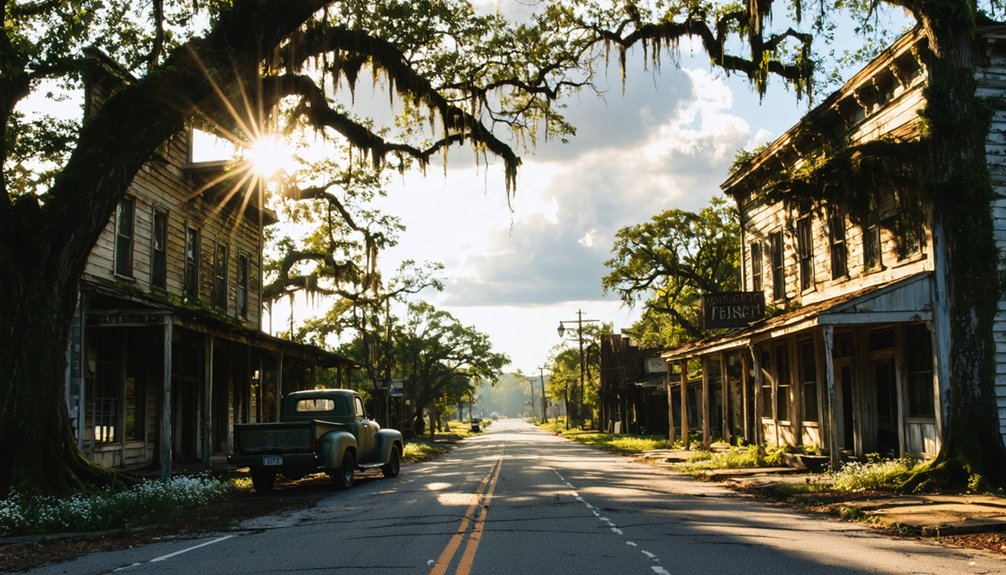
You’ll find central Florida’s subtropical climate most forgiving between October and April, when temperatures hover in the 70s and humidity loosens its grip on the phosphate-scarred landscape.
Summer’s brutal heat and afternoon thunderstorms can turn a quick roadside stop into a sweat-soaked ordeal, so I’d pack extra water if you’re visiting May through September.
Since no cemetery or formal access points remain at this vanished company town—just active mining operations—you won’t need to worry about gate hours, only whether the industrial roads remain passable after heavy rains.
Seasonal Weather Considerations
Consider these seasonal factors:
- Spring/Fall: Extended daylight (sunrise 06:54, sunset 17:29) maximizes exploration time
- Summer: High UV index and 77°F RealFeel demand extra sun protection
- Winter: Mild 21-27°C days with 8-15°C nights, perfect camping weather
- Year-round: East-northeast winds at 12 km/h won’t disrupt photography or hiking
Choose wisely for unrestricted roaming through Ridgewood’s forgotten corners.
Cemetery Access Hours
While most cemeteries post clear visiting hours, Ridgewood Cemetery operates in a legal gray zone—fenced off on King High School grounds with no official schedule governing when you can pay respects to the 145-268 souls buried there. Florida’s vague state laws haven’t clarified cemetery management policies since Tampa purchased the property in 1959.
Your best approach? Drive by from 56th Street for roadside views, or attempt weekday visits during school hours when gates appear open—though actual burial ground access remains restricted. The February 27 memorial presentation at 9 a.m. proved formal events occasionally break this barrier.
Unlike neighboring Cypress Hills Cemetery’s reliable 8am-4:30pm daily schedule, Ridgewood lacks memorial visitation protocols entirely.
Park in the paved lot off North Street, never the school lot, respecting both educational operations and the forgotten community beneath your feet.
What to See at the Cemetery Site
Behind a chain-link fence on King High School’s grounds, the memorial stands where 145 souls still rest beneath the earth. Architect Jerel McCants designed the structure as symbolic dove wings—a powerful record to liberation and remembrance. The memorial features hold deep historical significance for this forgotten pauper’s cemetery, active from 1942 to 1954.
You’ll discover:
- The Dove Wing Memorial – Carefully positioned to avoid disturbing remains below
- Florida State Historic Site Marker – Documenting the cemetery’s role serving African American and indigent residents
- Reflection Pond – A contemplative space within the fenced area
- Agricultural Lab Buildings – Surrounding structures that mark where ground-penetrating radar detected burials 3-5 feet deep
This site honors 250-268 individuals, including 77 infants, who deserved dignity in death.
Understanding the Town’s Postal History
Three centuries of Florida’s postal evolution frame Ridgewood’s own correspondence story, though the ghost town’s mail trail proves harder to trace than neighboring Belleview’s well-documented route. You’ll find Belleview’s 1889 Grant letter sheet and period postcards showcasing postal artifact provenance that Ridgewood itself lacks. The nearby Bakers Mill post office operated intermittently from 1883, but Ridgewood residents likely collected mail from Belleview’s established station instead.
Your best chance at discovering Ridgewood connections lies in examining postcard imagery rather than postmarks. That 1922 Lake Lillian view and 1940s road merger scene document infrastructure without direct postal evidence. Early postmark rarity makes authenticated Ridgewood mail nearly impossible to verify. You’re fundamentally/principally/chiefly tracking a settlement that communicated through neighboring towns’ postal systems, leaving whispers rather than records.
The Forest Fire That Erased Ridgewood
Lightning crackled across Florida’s pine flatwoods in the 1920s, igniting the conflagration that would finish what the freezes had started. You’ll find little left of Ridgewood after that blaze swept through Crane Swamp, erasing buildings already abandoned by families who’d fled economic ruin.
Fire consumed what frost had weakened, leaving only cemetery stones to mark where Ridgewood’s pioneer families once thrived.
Fire season impacts shaped this landscape through:
- Natural lightning strikes during seasonal dry periods
- Three-to-seven-year burn cycles essential for pine ecosystems
- Rapid vegetation regrowth from Florida’s high rainfall
- Absence of suppression efforts before the 1930s
Regional forest fire trends intensified by mid-century—the 1948 Crane Swamp fire burned three months straight. But Ridgewood’s cemetery survived, marking where your ancestors built dreams before nature reclaimed its territory. That’s frontier reality: sometimes the wilderness wins.
Combining Your Trip With Nearby Welaka and Pomona Park
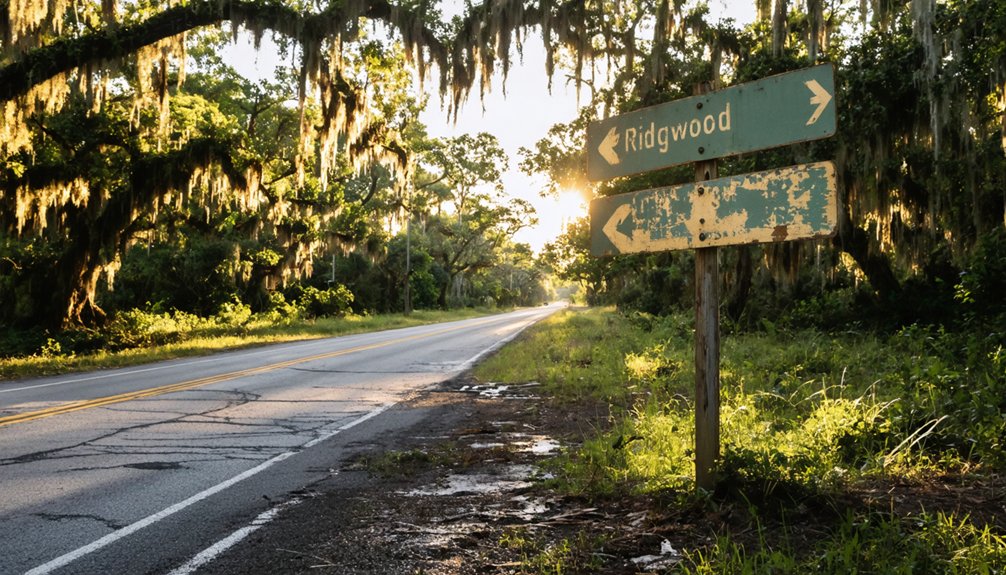
After wandering through Ridgewood’s vanished streets, you’ll find living history just fifteen minutes north in Welaka and Pomona Park—communities that survived where others didn’t.
Welaka’s charm hits you immediately on County Road 309, where oak canopies drape Spanish moss over three historic churches. The historical sites in Welaka tell stories reaching back centuries—from the 1925 National Fish Hatchery to Mount Royal’s Native American burial mound, documented by William Bartram in 1765. You can hike the diverse ecosystems in Welaka State Forest’s 2,287 acres, then cool off at Mud Spring’s serene swimming hole.
Pomona Park adds Ravine Gardens’ Depression-era beauty and the Putnam County Speedway’s Saturday night roar. These roads deliver old Florida tranquility—low traffic, big bass, and freedom from crowds.
Other North Florida Ghost Towns Worth Exploring
North Florida’s forgotten settlements sprawl across counties like breadcrumbs through pine forests and palmetto scrub. Beyond Ridgewood, you’ll discover territories where abandoned farmsteads crumble alongside derelict roadside motels, each whispering stories of boom-and-bust cycles.
Prime exploration targets include:
- Kerr City (Marion County) – phosphate mining ruins near Ocala National Forest, accessible via challenging off-road trails
- Newnansville (Alachua County) – territorial-era county seat bypassed by railroads, featuring historic cemetery and foundations
- Electra (Marion County) – 1880s mining village within national forest boundaries, popular hiking destination
- Ellaville (Madison County) – sawmill company town near Georgia border with substantial mill foundations
You’ll need sturdy boots, GPS coordinates, and respect for private property boundaries. These sites reward adventurers who crave authentic discovery over sanitized tourist experiences.
Frequently Asked Questions
Are There Any Admission Fees to Visit the Ridgewood Cemetery Site?
You won’t pay admission fees to explore Ridgewood Cemetery’s historic significance. You’ll find free access during operating hours, where preservation efforts maintain the grounds. Just arrive respectfully, and you’re welcome to wander among the stories carved in stone.
Is the Cemetery Accessible for Visitors With Mobility Limitations or Wheelchairs?
You’ll find wheelchair accessible pathways at Ridgewood Memorial Park’s paved parking lot, though no GPS will guide you through the gated cemetery grounds. Unfortunately, on-site mobility assistance isn’t available at this remote historical burial site.
Can Visitors Take Photographs or Record Videos at the Cemetery?
You’re welcome to snap casual photos, but photography policies restrict professional shoots without permission. Video recording restrictions prohibit filming during services, and you’ll need to blur recent headstone names. Commercial work isn’t allowed—keep it personal and respectful.
Are There Restroom Facilities or Amenities Available Near the Cemetery?
You’ll find basic restrooms inside King High School’s main building during operating hours, but there aren’t nearby picnic areas or local dining options at the fenced cemetery site—you’ll need to venture into Tampa proper for amenities.
Is Camping or Overnight Parking Allowed at or Near the Site?
Camping isn’t permitted at the cemetery itself, but you’ll find nearby RV parks offering overnight spots. Check for organized camping events at local campgrounds where you can legally set up and explore freely under Florida’s stars.
References
- https://www.smithsonianmag.com/history/how-history-forgot-rosewood-a-black-town-razed-by-a-white-mob-180981385/
- https://www.youtube.com/watch?v=AYfwtQADZRc
- https://www.youtube.com/watch?v=ehhPhBXEV9s
- https://en.wikipedia.org/wiki/Ridgewood
- https://www.ghosttowns.com/states/fl/ridgewood.html
- https://www.bunkhistory.org/resources/how-history-forgot-rosewood-a-black-town-razed-by-a-white-mob
- http://www.shrimpnfishflorida.com/forums/threads/lake-county-fl-ghost-towns.5641/
- https://substack.com/home/post/p-134206110
- https://greatfloridaroadtrip.com/rosewood-history-buried-then-remembered/
- https://en.wikipedia.org/wiki/Rosewood_massacre