You’ll find Rocky Bar 37 miles north of Mountain Home via Highway 20 and Forest Road 61, where nine weathered structures cling to the gulch that once produced $6 million in gold. Plan your visit mid-summer through early fall when graded dirt roads stay passable and you can explore Peg Leg Annie’s whiskey cabin among the ruins of Idaho Territory’s most ambitious boomtown. The journey demands proper preparation, but these mountains reveal their secrets generously to those who venture beyond the pavement.
Key Takeaways
- From Mountain Home’s I-84 Exit 95, drive north on HWY 20 for 31.5 miles, then turn left onto NF 61 toward Featherville.
- Visit mid-summer through early fall for optimal road conditions, as dirt roads become muddy and impassable after storms or during winter.
- Featherville offers the last reliable services before turning left onto NF 156, a well-maintained dirt track leading to Rocky Bar.
- Nine weathered structures remain at the townsite, including Peg Leg Annie’s cabin and mining equipment like stamp mill foundations and arrastre circles.
- The ghost town sits at Bear and Steel creeks’ confluence, 8 miles north of Featherville, where $6 million in gold was extracted.
The Rise and Fall of a Gold Rush Boomtown
When gold dust glittered in Feather River’s gravel bars in 1863, fortune seekers didn’t hesitate—they rushed into the South Boise diggings with picks, pans, and dreams of striking it rich. Rocky Bar’s intriguing mining history began that year, exploding into Idaho Territory’s largest South Boise settlement within twenty-four months. The camp’s prominence grew so rapidly that officials considered it for territorial capital. You’d have witnessed five-stamp mills crushing ore worth $100 per ton, yielding $45,000 in single seasons. By 1866, more milling capacity operated here than anywhere else in Idaho.
Then reality struck hard. Eastern capitalists underestimated transportation costs and overestimated ore reserves. Mills stood silent by late 1866, starving for rock to crush. The dramatic town decline accelerated when fire consumed Rocky Bar in 1892, destroying most structures. The trans-continental railroad’s completion in 1869 and improved mining technology sparked renewed interest in the South Boise mines by 1870. Wartime mining suspensions sealed the camp’s fate in 1942, leaving behind whispers of $6,000,000 in extracted gold.
How to Get to Rocky Bar From Mountain Home
The journey to Rocky Bar begins at Mountain Home’s I-84 Exit 95, where asphalt civilization gives way to high desert sage and distant pine-covered ridges. You’ll point your rig north on HWY 20 for 31.5 miles before hanging left onto NF 61 (Pine-Featherville Road). The driving conditions for remote route travel demand attention—graded dirt replaces pavement as you push deeper into the Sawtooth backcountry.
Where interstate asphalt surrenders to sage and pine, the backcountry demands respect—graded dirt is your new pavement.
After 28.6 miles, Featherville marks your last reliable services. Turn left onto NF 156, a well-maintained dirt track that climbs through ponderosa stands. This route passes through Township 4N, Range 10E in Elmore County, historically significant for its gold-bearing tributaries. The road eventually leads you to Rocky Bar, which was founded in December 1863 following the discovery of gold along the nearby Feather River.
Road options beyond Featherville:
- NF 156 north—your 7.7-mile path to Rocky Bar
- NF 126 right—leads to Atlanta’s ghost streets
- Bear Creek route—follows NF 156 straight
- Return south—retrace to civilization
Total distance: 62 miles from interstate to isolation.
What Remains Standing in Rocky Bar Today
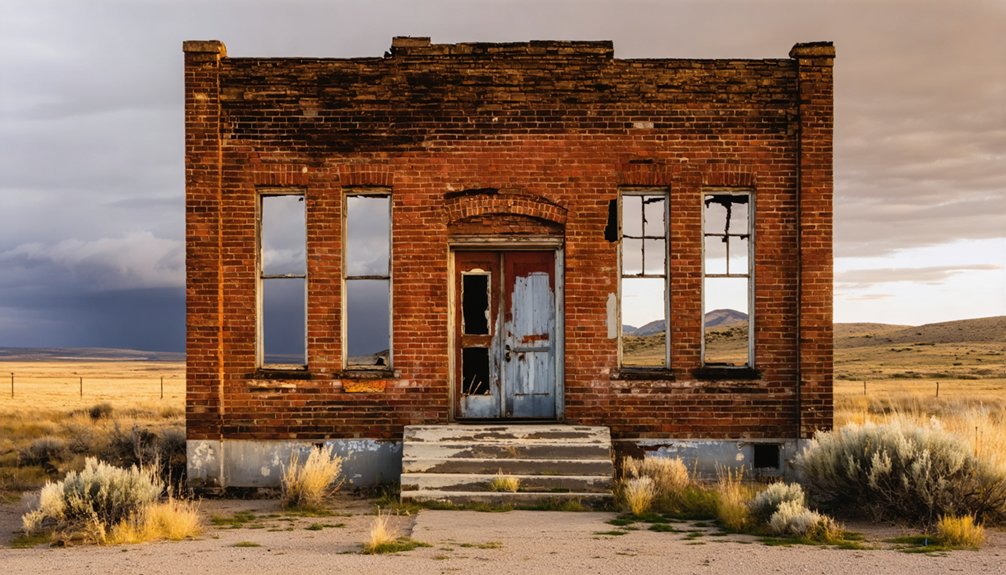
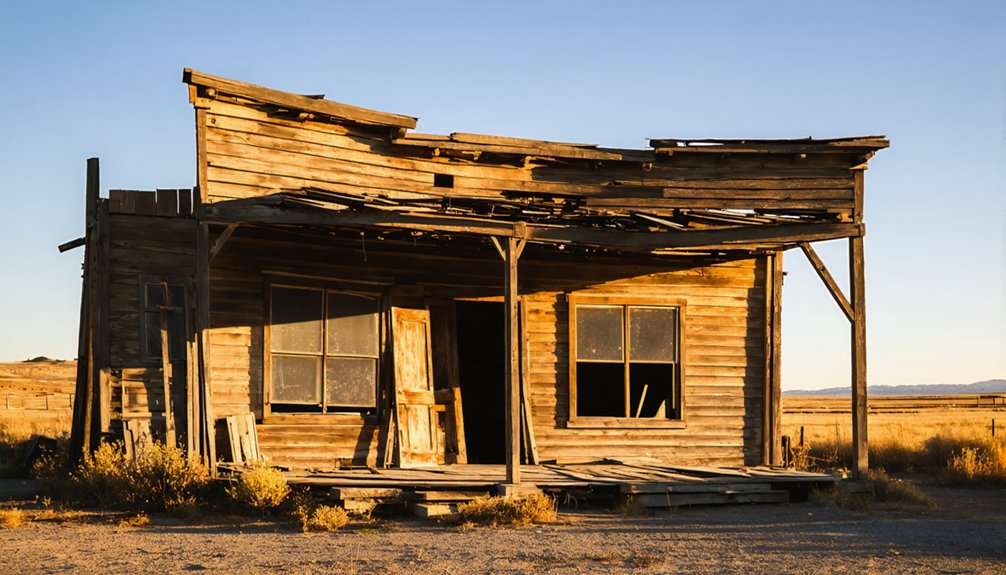
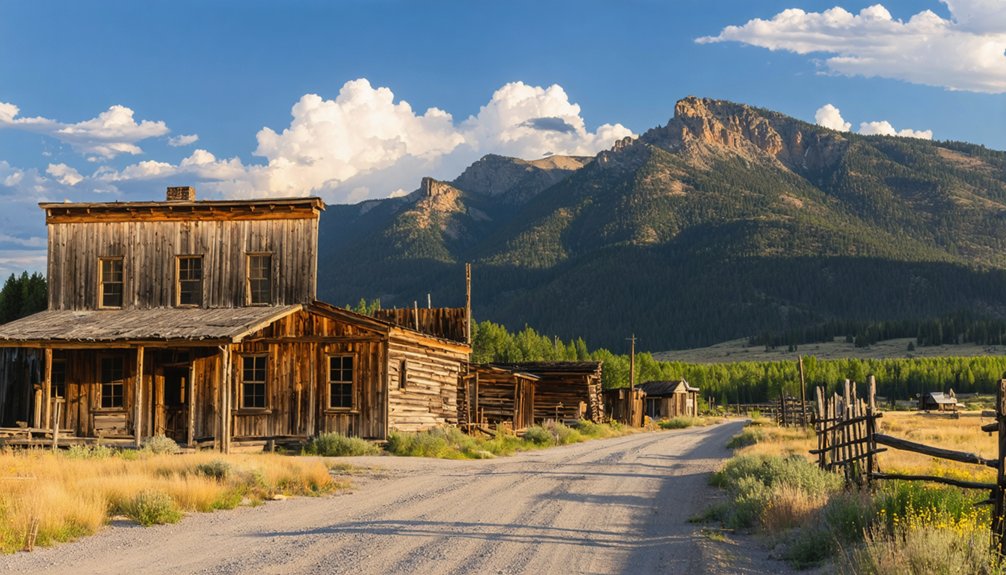
After rattling up NF 156’s final switchbacks, you’ll drop into a narrow gulch where nine weathered structures cling to Rocky Bar’s original townsite. These buildings tell two stories—some survived the 1892 fire that leveled the boomtown, while others rose from its ashes during the halfhearted rebuild.
You’ll spot mining equipment remnants scattered throughout: rusted stamp mill foundations, collapsed arrastre circles, and the Pittsburgh & Idaho Mill’s skeletal framework at Main Street’s west end. Rocky Bar’s prospectors primarily extracted gold and silver from these mountains during the camp’s productive years. The district reached approximately $6,000,000 in total production before shutting down entirely in 1942. A handful of dedicated locals employ architectural preservation techniques to stabilize what’s left, and their work earned the entire ten-mile district a National Register listing.
There’s no gift shop, no restrooms—just authentic decay and the freedom to explore a ghost town that remembers when 2,500 souls chased gold through these hills.
The Story Behind Peg Leg Annie’s Cabin
Among Rocky Bar’s weathered cabins, one tells the story of a woman who refused to let catastrophe define her limits. Peg Leg Annie lost both legs carrying a friend through a blizzard—a friend who didn’t survive. Yet she built a thriving whiskey business from her rugged cabin accommodations, developing a unique business model that worked around her disability.
Her operation was ingeniously simple:
- Bottles lined up under cover along the building’s side
- Payment collected upfront, no exceptions
- Shotgun across her lap pointed customers toward their purchases
- Zero overhead, maximum efficiency
She paid suppliers in advance and maintained financial independence well into the 1930s. After recovering from her amputations, Annie later lived with a man and raised five children together. This wasn’t charity—it was frontier capitalism at its rawest. The warehouse structure where she conducted this formidable business operation can still be identified among the town’s remaining buildings. Her cabin still stands, legacy to one woman’s refusal to surrender.
Best Time of Year to Visit This Remote Ghost Town
Summer transforms Rocky Bar from an icy fortress into an accessible adventure, but timing your visit requires more strategy than simply avoiding snow. Season variations here aren’t subtle—winter’s deep snowpack claimed the town’s last resident during a 1964 storm, while summer opens gravel routes through spectacular mountain terrain.
Travel safety considerations demand checking weather before you leave. Post-storm conditions turn accessible roads into muddy challenges, even with high clearance vehicles. Plan for extra daylight since rugged terrain slows progress. The town sits 8 miles north of Featherville, positioned at the confluence of Bear and Steel creeks where miners once struck gold. Brick safes and stone foundations still stubbornly outline the grid where Rocky Bar once imagined itself the future capital.
Mid-summer through early fall offers your sweet spot: dry gravel, lingering evening light, and birdsong replacing wintry winds. You’ll find hiking, camping, and fishing conditions at their peak, with fog lifting off ridges to reveal views that reward patient explorers.
Historic Buildings You Can Still Explore
Walking through Rocky Bar‘s weathered main street, you’ll discover four primary structures that have defied time and the elements. The crown jewel is George Golden’s 1892 Masonic Hall, which once buzzed with miners picking up mail, buying supplies, and attending lodge meetings under one roof.
Beyond it, Peg Leg Annie’s modest cabin and the saloon where she peddled whiskey to thirsty prospectors stand as monuments to the town’s rougher side, while vintage warehouse buildings reveal the commercial backbone that kept this remote settlement alive.
Peg Leg Annie’s Cabin
When you step into the weathered warehouse that once served as Peg Leg Annie’s whiskey operation, you’re walking into one of Rocky Bar’s most colorful legends. Annie’s tragic backstory—losing her legs while carrying a friend through a blizzard—shaped her into the formidable businesswoman who ran this establishment with a shotgun across her lap.
Her whiskey business operations followed a strict protocol:
- Payment required upfront before revealing bottle locations
- Strategic hiding spots throughout the warehouse
- Armed defense of her inventory and profits
- Direct sales from her wheelchair position
You’ll find the structure still standing among Rocky Bar’s preserved buildings. Picture Annie conducting transactions here, fiercely independent despite her disability, refusing to let tragedy define her. She became legendary throughout surrounding communities—a hallmark of frontier resilience and entrepreneurial spirit.
The 1892 Masonic Hall
Rising from the ashes of Rocky Bar’s devastating 1892 fire, George Golden’s reconstructed Masonic Hall stands as embodiment of frontier determination. This structure’s history reveals remarkable versatility—Golden packed his home, general store, post office, and Masonic meeting space into one building. The Elmore Bulletin documented the lodge’s establishment that July, when Rocky Bar’s population still numbered in the thousands.
Today, you’ll find the building features weathered but standing, its interior post office relocated to Boise’s State Historical Museum. Walk through carefully, imagining miners collecting mail and lodge members gathering upstairs. The hall represents Rocky Bar’s phoenix moment—that brief flourish between catastrophic fire and inevitable decline when shallow ore bodies couldn’t sustain the boom. It’s pure frontier resourcefulness captured in wood and nails.
Vintage Warehouse Remnants
Beyond the Masonic Hall, Rocky Bar’s scattered remnants paint a portrait of frontier life in wood and stone. You’ll find weathered structures that showcase vintage warehouse construction techniques—simple, sturdy buildings designed for function over form. The vintage warehouse architecture reflects miners’ pragmatic approach to shelter and commerce.
As you explore, you’ll encounter:
- Peg Leg Annie’s House – where whiskey flowed and stories accumulated
- General Store remnants – once post office, shop, and home combined
- Saloon structures – serving 2,500 souls at Rocky Bar’s peak
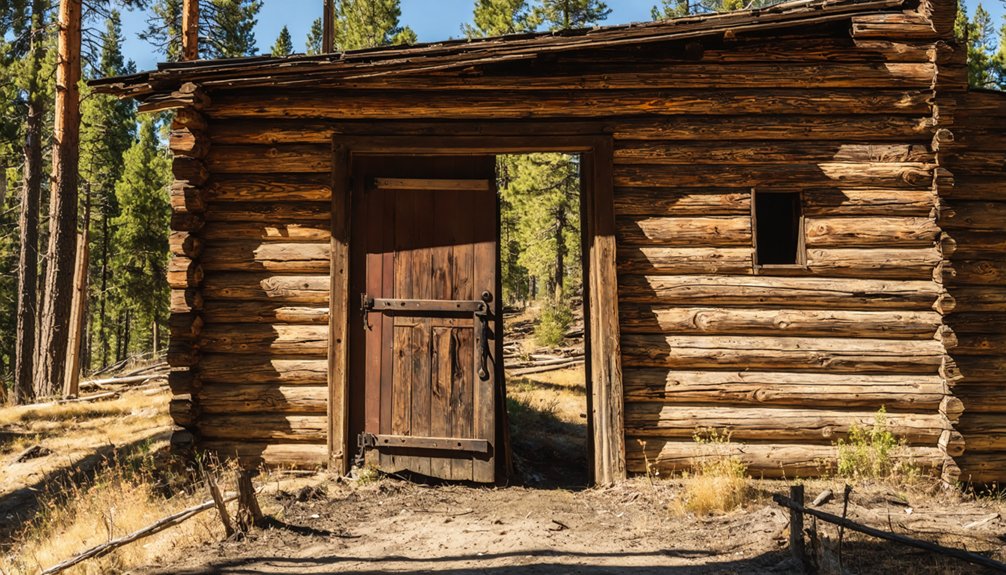
- The old jail – holding lawbreakers when this was Alturas County’s seat
These four survivors stand accessible along the creeks, inviting you to walk unmarked paths. No ropes, no fees—just honest exploration among buildings that refused to vanish completely.
The 1892 Fire That Changed Everything
On September 1, 1892, flames tore through Rocky Bar with merciless speed, reducing most of the town to ash and leaving over half its 200-300 residents without homes or businesses.
You’ll find it remarkable that the citizens didn’t abandon their mountain settlement—instead, they grabbed hammers and lumber to rebuild what the fire had stolen. George Golden‘s reconstructed Masonic Hall still stands as proof of their determination, serving simultaneously as his home, the general store, post office, and meeting place for the Lodge.
Devastating Blaze Destroys Town
September 1, 1892 marked Rocky Bar’s darkest day—a devastating fire swept through the settlement, consuming over half the town’s structures in a matter of hours. You’ll find this event fundamentally altered Rocky Bar’s trajectory, as the blaze destroyed the original Masonic Hall and much of the business district while the town already faced declining mine reserves.
The impact on population proved severe:
- Over half of 200-300 residents lost their homes
- Many families departed permanently afterward
- The Elmore Bulletin had ceased publishing three months prior
- Shallow ore bodies meant no economic recovery
This catastrophic combination triggered shifts in local economy that sealed Rocky Bar’s fate. The town struggled through rebuilding efforts, but you’ll discover it never regained its boom-era robustness, beginning its slow descent into ghost town status.
Rebuilding From The Ashes
Despite the devastation, Rocky Bar’s citizens refused to surrender their town to the flames. You’d have witnessed 500-600 determined residents immediately mobilizing to reconstruct their community. The large Chinese settlement along Steel Creek banks rose again through sheer volunteer grit.
Building materials used included timber hauled by ox teams—like that legendary twelve-stamp mill transported from Omaha at thirty cents per pound. Labor challenges overcome were significant: coordinating reconstruction while mines operated, sourcing supplies in remote wilderness, and maintaining the Elmore Bulletin until June 1892.
Yet their resilience couldn’t overcome geology’s verdict. The mines’ depleted reserves meant no boom town revival awaited. Within decades, that thriving population dwindled to a handful, transforming Rocky Bar from phoenix to ghost.
Combining Rocky Bar With Atlanta and Sawtooth Wilderness
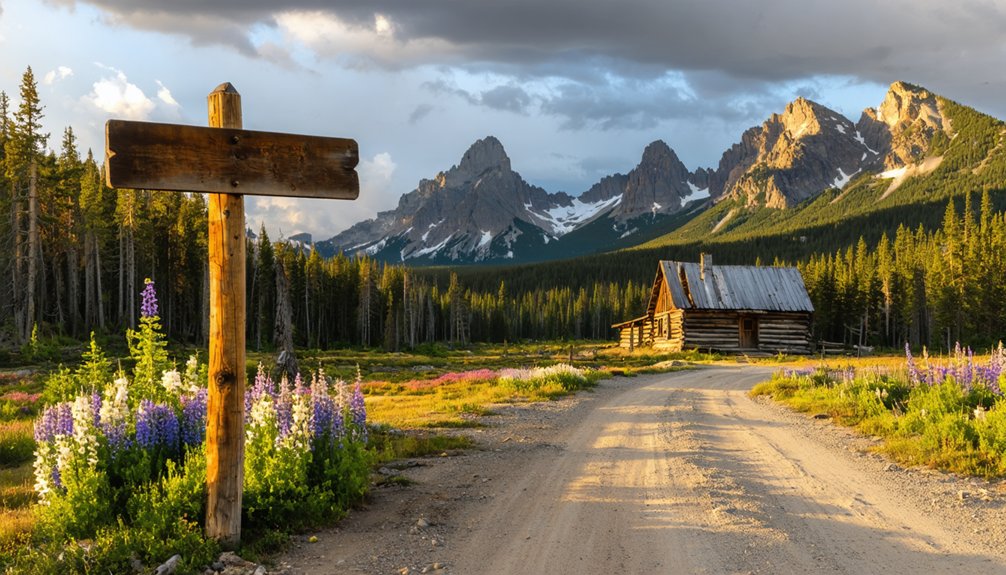
Tucked into the rugged Sawtooth Mountains of central Idaho, Rocky Bar makes an ideal launching point for a ghost town double feature. Just eight miles from the paved road near Featherville, you’ll find yourself perfectly positioned to explore both Rocky Bar and Atlanta in one adventurous day. The scenic mountain driving between these historic camps delivers picturesque nature views that’ll make every hairpin turn worthwhile.
The history of Rocky Bar, Idaho, is rich with tales of early miners and the quest for silver during the late 19th century. As you wander through the remnants of this once-thriving community, you can almost hear the echoes of those who called it home. Exploring the area provides a fascinating glimpse into the resilience of those who built a life in such a remote and rugged landscape.
Your ghost town adventure includes:
- Rocky Bar’s well-preserved structures and mining artifacts
- The winding route to Atlanta, another semi-ghost town deeper in the Sawtooths
- Access to Sawtooth Wilderness for serious backcountry solitude
- Shared Boise Basin mining history spanning 1862-1863
Plan this trip for warmer months when mountain passes open fully. You’re trading pavement for freedom here—remote, rugged, and absolutely unforgettable.
Essential Gear and Preparations for Your Trip
Before you point your rig toward Rocky Bar’s weathered buildings, you’ll need more than wanderlust and a full tank of gas. Off road vehicle preparations start with high-clearance capability, spare tires, and tools—gravel washouts don’t care about your schedule. Fill up before leaving civilization; this ghost town hasn’t pumped fuel since the mines went quiet.
Pack layered clothing for mountain weather that shifts faster than old prospectors changed claims. GPS devices and paper maps aren’t redundant here—they’re lifelines on unmarked routes where cell signals vanish.
Remote campsite planning means carrying extra water, bear-proof containers, and first aid supplies.
I learned this preparing for Steel Mountain’s brutal elevation climbs. Your freedom depends on self-sufficiency, so pack emergency gear, fire starters, and enough food to outlast whatever the Sawtooths throw at you.
Frequently Asked Questions
Are There Any Camping Facilities or Accommodations Near Rocky Bar?
You’ll find 15 campsites near Rocky Bar, including tent and RV sites, plus cabin rentals at Deadman Hole. Dispersed camping’s available too. Explore scenic hiking trails around Trinity Lakes while experiencing true backcountry freedom without cell service.
Do I Need a Four-Wheel Drive Vehicle to Reach Rocky Bar?
You’ll taste true freedom here—no four-wheel drive needed during summer’s embrace. Road conditions stay excellent with reliable maintenance on this well-graded route. However, winter transforms everything, demanding 4WD to conquer snow-packed passages to Rocky Bar.
Is There Cell Phone Service in Rocky Bar and Surrounding Areas?
Cell service is extremely unreliable in Rocky Bar. You’ll face serious communication challenges as available cellular networks rarely penetrate this remote canyon. Expect dead zones—pack satellite messengers or embrace disconnection. Test your carrier beforehand, but don’t count on bars.
Are There Guided Tours Available for Rocky Bar’s Historic Buildings?
No guided walking tours exist for Rocky Bar—you’ll explore independently among the weathered buildings. Historical preservation efforts provide interpretive signs at original structures, letting you discover this remote ghost town’s secrets at your own adventurous pace.
What Permits or Fees Are Required to Visit Rocky Bar?
You won’t need parking permits or fees to explore Rocky Bar—it’s free and wild. However, respect trespassing concerns around private property with posted signs. Watch for caution notices about residents and unstable structures while you roam.
References
- https://www.ghosttowns.com/states/id/rockybar.html
- https://authorkevinkelley.com/2014/07/21/rocky-bar-ghost-town-idaho/
- https://idahonews.com/news/idaho-photo-galleries/ghost-town-idaho-rocky-bar
- https://www.rickjust.com/blog/a-very-ghosty-ghost-town
- https://westernmininghistory.com/towns/idaho/rocky-bar/
- https://www.idahoheritagetrust.org/projects-grants/rocky-bar-masonic-hall/
- https://www.livesimplecaremuch.com/2010/05/rocky-bar.html
- https://www.idahogeology.org/pub/Pamphlets/P-26.pdf
- https://www.idahogoldmining.com/claims-for-sale/rocky-bar/
- https://yellowpinetimes.wordpress.com/2019/09/29/idaho-history-sep-29-2019/