You’ll find Round Mountain nestled in Nevada’s high desert, where weathered 1900s structures stand defiantly against an expanding open pit mine. Start at the state historical marker, then explore the distinctive bottle house built from hundreds of glass bottles and the crumbling mill ruins that once processed millions in ore. Watch massive CAT shovels work the active pit that consumed the original townsite, then visit relocated Hadley below for amenities. Our guide covers timing, photography spots, and hidden historical gems worth discovering.
Key Takeaways
- Round Mountain features weathered structures from the 1900s, including a distinctive bottle house cellar and historic mills processing over $3 million in ore.
- Visit dual active mining pits with massive equipment before operations transition underground in 2028 during the $400 million expansion project.
- The original town was consumed by mining in the 1980s; residents relocated to Hadley, a purpose-built community with modern amenities.
- Population declined from 400 fortune-seekers in 1906 to 100 by 1959 after $709,184 in gold production and dangerous underground conditions.
- Explore historic landmarks including the 1915 bottle cellar, Sunnyside Mill ruins, and the picturesque wooden community hall from the original settlement.
The Rise and Fall of a Nevada Gold Camp
In February 1906, when Louis D. Gordon’s ground revealed gold, you’d have witnessed an electrifying transformation. Within months, 400 fortune-seekers flooded in from Goldfield, establishing the original community infrastructure of a camp they named Gordon.
You’d see organizations materializing overnight as miners pulled slabs of virgin metal from the earth daily. The mine plunged 800 feet deep, while a 100-ton mill processed ore that yielded $709,184 in just two years.
Fast-forward through economic changes over time, and you’ll find boom turned to bust. Underground operations became too dangerous by 1935. Though 234 residents clung on through 1939, population crashed to 100 by 1959.
Today, corporate heap-leach operations have replaced hand-tooled veins—modern efficiency erasing the wild independence that built this camp.
What to Expect at the Round Mountain Townsite Today
When you arrive at Round Mountain’s townsite today, you’ll find a haunting landscape where weathered structures from the early 1900s cling to existence amid the expanding open pit mine that’s steadily consuming the original settlement.
Two crumbling mills stand sentinel on the hillside above scattered buildings and rubble, while massive mining equipment operates just beyond, extracting gold from the very ground where this community once thrived.
The relocated town of Hadley now sits in the valley below, where former residents established a new home as the insatiable pit claimed their original townsite piece by piece.
Remnants of Original Structures
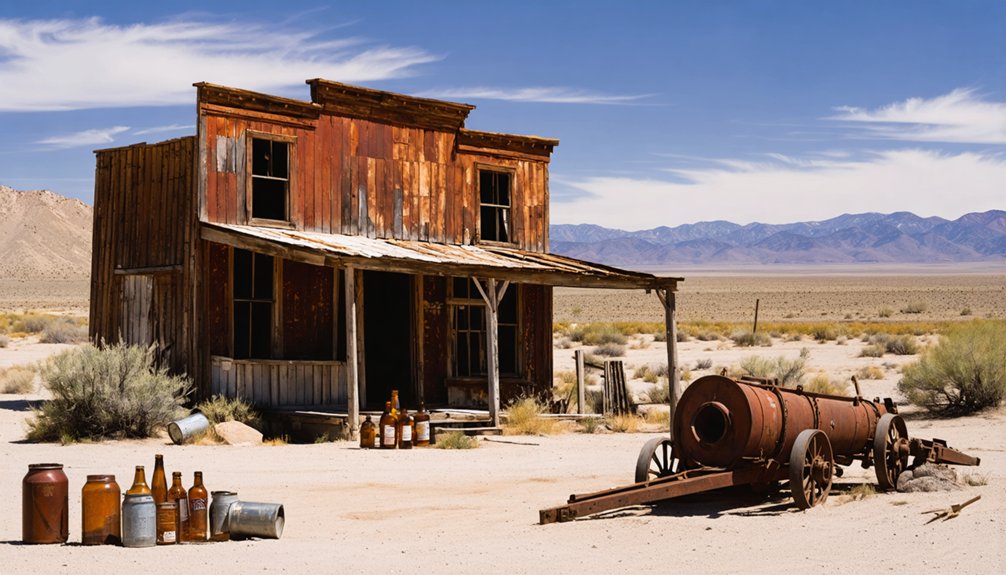
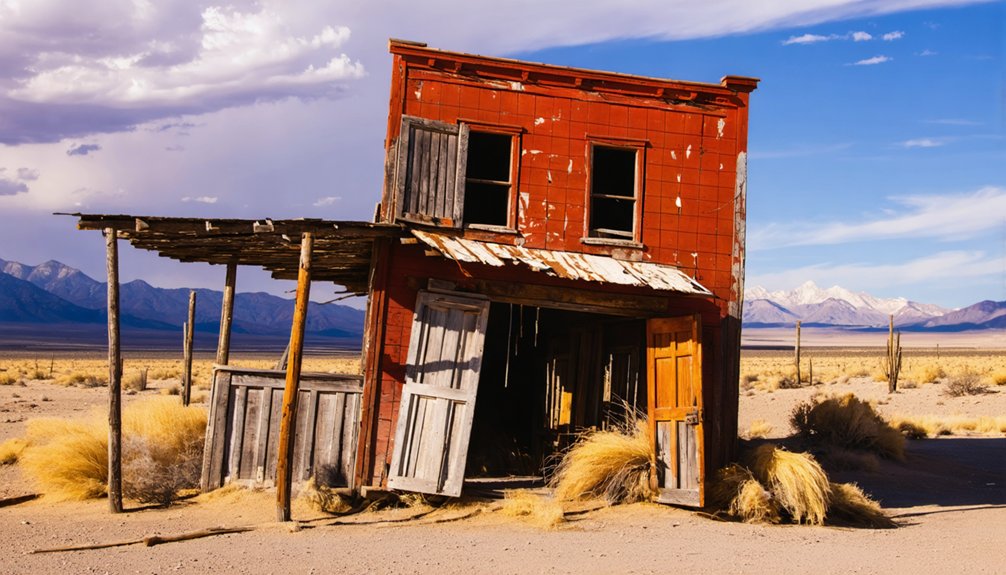
The ghost town of Round Mountain offers visitors a fascinating glimpse into early 1900s Nevada mining life, though you’ll find the original townsite has been gradually slipping away over the decades. Modern mining operations have excavated portions of the settlement, but several wood-frame structures from the 1906 establishment still stand, including a picturesque community hall.
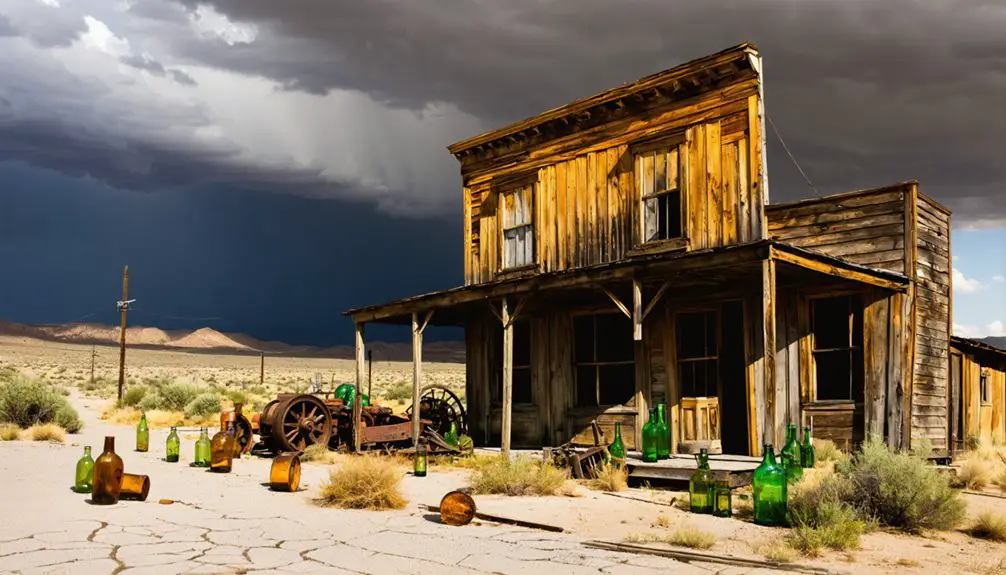
You’ll discover the most unique remnant—a partially above-ground cellar built from hundreds of glass bottles bonded with stucco, echoing the famous Rhyolite design. These bottle house construction methods showcased early settlers’ resourcefulness. Behind town, dilapidated mill ruins dot the hillside, remnants of operations that processed over $3 million in ore. Historic preservation challenges continue as weather and time take their toll on these unrestricted frontier relics.
Active Mining Operations Nearby
Massive earth-moving equipment rumbles across the landscape as Round Mountain’s active mining operations continue extracting gold from these Nevada hills—a striking contrast to the weathered ghost town remnants nearby. You’ll witness colossal haul trucks maneuvering terraced benches while observing the evolution of this century-old mining district.
The operation’s shifting from open-pit to underground mining operations in 2028, with dual declines already driven six kilometers into the earth. This $400 million expansion will extract 1.2 million ounces from underground reserves, extending operations through 2038.
Modern mining equipment operates around the clock, maintaining the area’s gold-producing legacy while you explore historical structures that housed the original prospectors who first discovered these rich deposits over a hundred years ago.
Relocated Community of Hadley
Beyond the rumbling machinery and expanding pit, Round Mountain‘s story took an unexpected turn in the 1980s when mining operations literally consumed the town. Rather than vanish entirely, the community shifted across Big Smoky Valley to Hadley—a purpose-built settlement that’s anything but a ghost town.
You’ll find modern infrastructure including schools, a post office, and fire department, alongside recreational amenities that rival much larger Nevada towns. Test your swing at the golf course, cool off in the indoor pool, or explore three baseball fields and tennis courts.
The grocery store, gas station, and restaurant keep basics covered, while horse corrals and fishing ponds offer escape. It’s a living chronicle/record/documentation to adaptation—when the mountain demands space, build elsewhere.
Exploring the Massive Open Pit Mine and Mining Operations
Standing at the rim of Round Mountain’s excavation, you’ll witness one of Nevada’s most impressive mining operations where CAT 7495 Electric Rope shovels and 793 haul trucks crawl across benched terrain 35 feet high, their movements synchronized in a relentless 24/7 dance of extraction.
The operation spans two active pits—Round Mountain Pit and Gold Hill Pit—where production drills bore 6¾-inch holes 40 feet deep into the earth. You can observe CAT 994k loaders cleaning pit floors between blasting cycles.
Extracted ore travels through heap leach facilities utilizing cyanide leaching circuits before reaching the mill’s 2,000-ton-per-hour processing capacity. While current site remediation planning addresses environmental compliance, the pit continues deepening toward its ultimate 4,120-foot elevation, requiring 42 dewatering installations pumping 5,200 gallons per minute.
Historic Buildings and Structures Still Standing
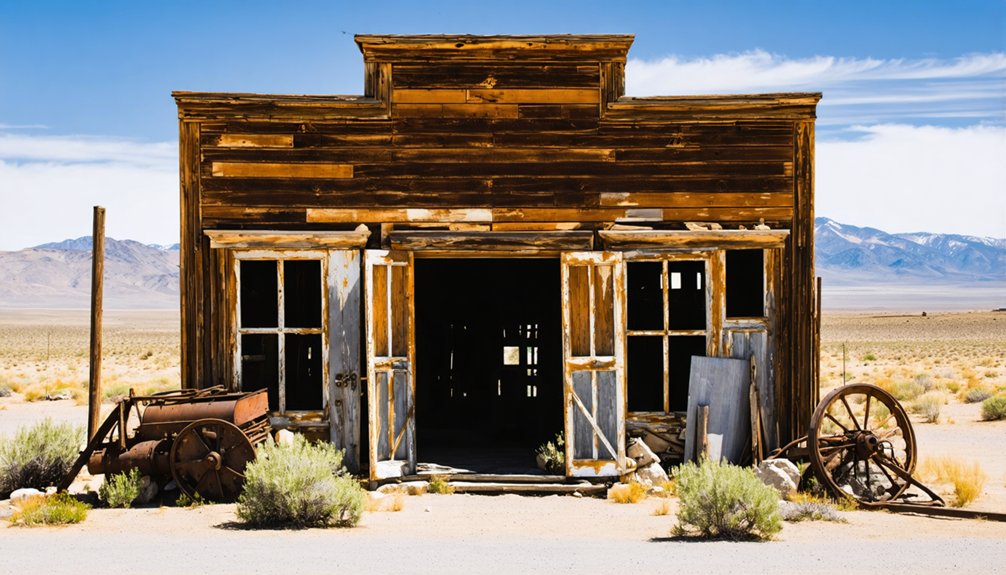
Beyond the massive pit, Round Mountain’s scattered ruins tell stories of its booming early 1900s past. You’ll spot dilapidated mills perched on hillsides behind town, their weathered frames still clinging to existence after more than a century.
Among the wooden structures slowly surrendering to time, a distinctive bottle house stands out—its walls built from hundreds of glass bottles cemented together, creating one of Nevada’s most unusual ghost town remnants.
Dilapidated Mills on Hill
Two crumbling mills cling to the hillside behind Round Mountain, their weathered frames stark against the desert sky. You’ll spot these derelict infrastructure remnants despite the massive open pit consuming most of the original townsite. Ghost town expert Shawn Hall documented these structures as significant survivors of the mining era.
The Sunnyside Mill, expanded to 200-ton capacity in 1926, once powered the district’s $7.8 million production run. Later, the 1949 placer mill processed low-quality ore as a 17,000-ton facility before shutting down in 1952. While modern operations continue below, this mining equipment stands as chronicle to Round Mountain’s industrial past.
You can still photograph these skeletal structures from accessible viewpoints, though the expanding pit guarantees they won’t stand forever.
Early 1900s Original Structures
While the expanding open pit has consumed much of Round Mountain’s original townsite, a handful of early 1900s structures still punctuate the landscape. You’ll discover the Berg family’s 1915 bottle cellar standing sentinel near where their home once welcomed guests—tangible proof of pioneer resilience. Though many wooden buildings that housed stage lines and businesses during the 1907 boom disappeared beneath mine expansion, you can trace their legacy through relocated structures in nearby Hadley.
The Sunnyside Mill improvements of 1926 expanded capacity to 200 tons, transforming how miners processed lower-grade ore. By 1909, electricity hummed through town, powering six operating mills. From the 234 residents who remained in 1939, few physical reminders persist—making each surviving foundation, cellar, and mill remnant you encounter genuinely precious.
Remnants Before Mine Expansion
Standing against the relentless advance of modern mining, Round Mountain’s remaining structures tell stories of resilience and community. You’ll discover a picturesque wooden community hall among scattered ruins, while two dilapidated mills perch on the hillside behind town—silent witnesses to Nevada’s gold fever days.
The crown jewel? A partially above-ground cellar constructed entirely of glass bottles bonded with stucco, rivaling Rhyolite’s famous bottle house architecture. Adjacent substantial homes and early home foundations reveal where families once carved out lives in this harsh terrain.
Don’t delay your visit—mine expansion has already excavated portions of the old townsite, and these remaining buildings slip away steadily. What you see today may vanish tomorrow beneath progress’s inevitable march.
Finding the State Historical Marker and Old Town Remnants
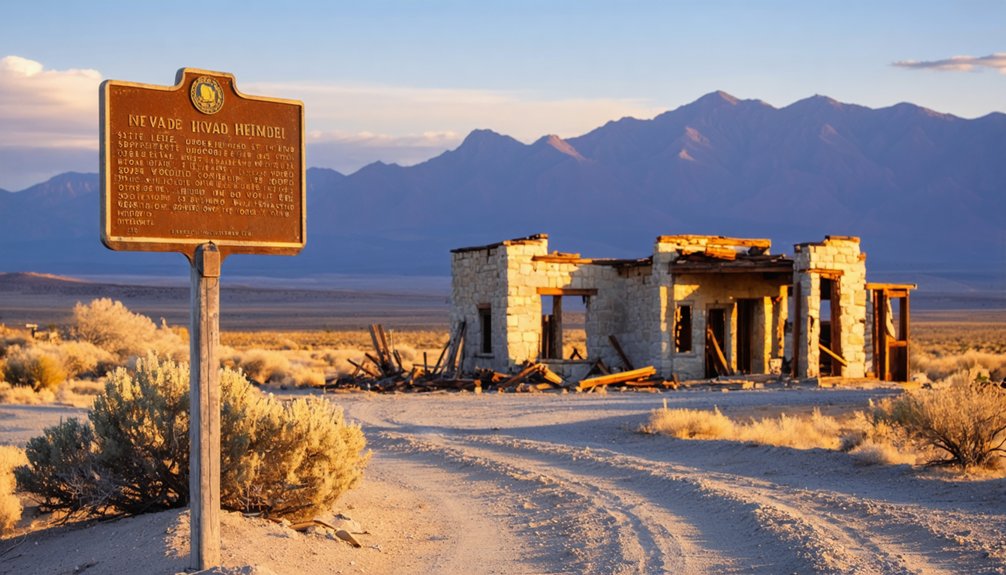
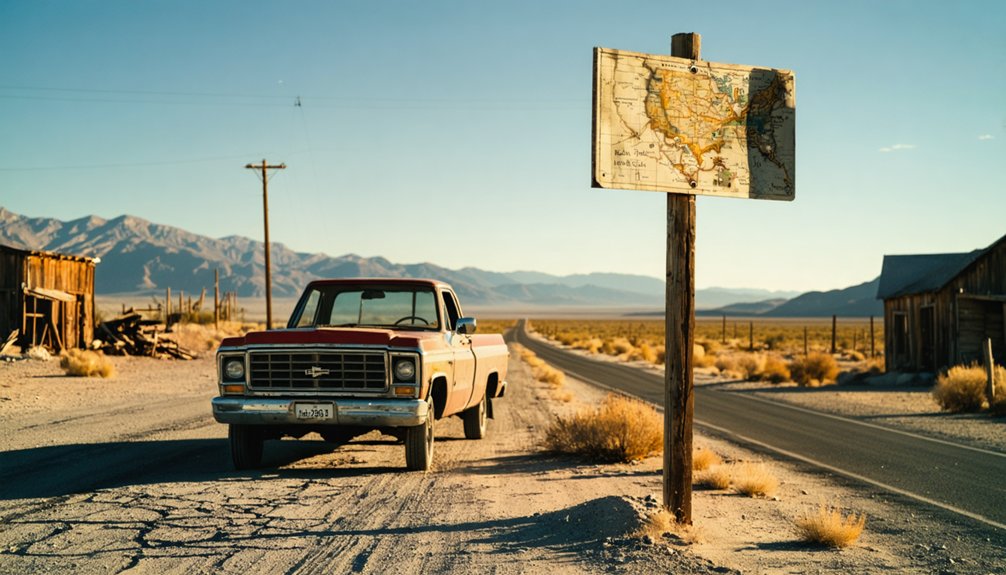
As you approach Round Mountain from the west, Nevada State Historical Marker 96 stands sentinel along the roadway, commemorating over six decades of gold production that began in the early 1900s. You’ll find this marker at coordinates 38.74277°N, 117.124042°W in Nye County, where it details Louis D. Gordon‘s 1929 consolidation of claims into Nevada Porphyry Gold Mines, Inc.
The marker location sits several miles west of the original settlement, which now hides behind massive open pit operations. Town remnant access proves challenging—you’ll need to navigate around current mining activity to reach what’s left.
The landscape has transformed dramatically since heavy equipment began extracting deeper gravels, but persistent explorers can still discover fragments of this once-thriving gold camp near the 89045 post office area.
The New Settlement of Hadley in the Valley Below
The modern community of Hadley spreads across Big Smoky Valley like a planned oasis, born from necessity when Round Mountain’s expanding open-pit operations consumed the original hilltop settlement during the 1980s.
When the mine swallowed old Round Mountain whole, Hadley emerged below—a necessary refuge built where valley met ambition.
You’ll find modern community features that mining camps could only dream of—racquetball courts, fishing ponds, tennis courts, and horse corrals blend with essential services like fire departments and RV parks.
The distinct architectural styles here contrast sharply with the weathered remnants up the hill; neat ranch homes and functional buildings replace weathered wooden structures.
Most former Round Mountain residents now call Hadley home, creating a thriving settlement that supports mine workers while maintaining its own identity.
It’s a practical solution to progress, though the valley lacks the romantic desolation that draws ghost town enthusiasts.
Best Time to Visit and Road Trip Tips

Round Mountain’s desert climate grants you remarkable flexibility for your visit, with mild winters and warm summers creating a year-round exploration window that most ghost towns can’t match. Spring and fall deliver moderate weather conditions perfect for extended explorations without battling extreme temperatures.
If you’re planning multi state ghost town road trips through Nevada, Arizona, and Utah, summer works well—just avoid July-August’s peak heat and explore during early mornings.
You’ll find graded gravel roads accessible by standard 2WD vehicles from Highway 376 near milemarker 52. Pack abundant water and sun protection for desert conditions. Nearby artesian springs and tree shade offer excellent boondocking spots, while mountain bikes let you tackle old mining roads and remote ranch sites.
Visit soon—ongoing mining operations continue reshaping this historic landscape.
Frequently Asked Questions
Are There Any Guided Tours Available at Round Mountain?
No guided tours available at Round Mountain—you’re completely on your own to explore this wild, forgotten outpost. Navigate rugged 4×4 trails independently to discover the local history significance hidden among weathered ruins and desert silence.
Where Can I Find Overnight Accommodations Near Round Mountain?
You’ll find cozy rooms at Jumping Jack Motel ($65-$75/night) or explore Tonopah’s hotels just miles away. For adventurers, nearby campsites offer starlit freedom, while local bed and breakfasts provide intimate desert hospitality along your ghost town journey.
Is It Safe to Explore the Old Mine Sites?
Don’t let curiosity kill the cat—exploring old mine sites isn’t safe. You’ll face potential hazards like explosive dynamite, toxic chemicals, and unstable structures with rotting timbers. Admire these ghost town relics from behind safety barriers instead.
Do I Need Special Permits to Visit the Area?
You won’t need special permits for visiting Round Mountain’s ghost town areas. However, if you’re planning extended stays, follow BLM’s 14-day limit on permitted camping locations and respect public land access requirements to preserve your freedom to explore responsibly.
What Other Ghost Towns Are Nearby for a Combined Trip?
You’ll find Jefferson, Belmont, Manhattan, and Ione within striking distance—each offering unique historical significance and cultural attractions. These abandoned silver and gold camps let you explore Nevada’s mining heritage freely across stunning desert landscapes.