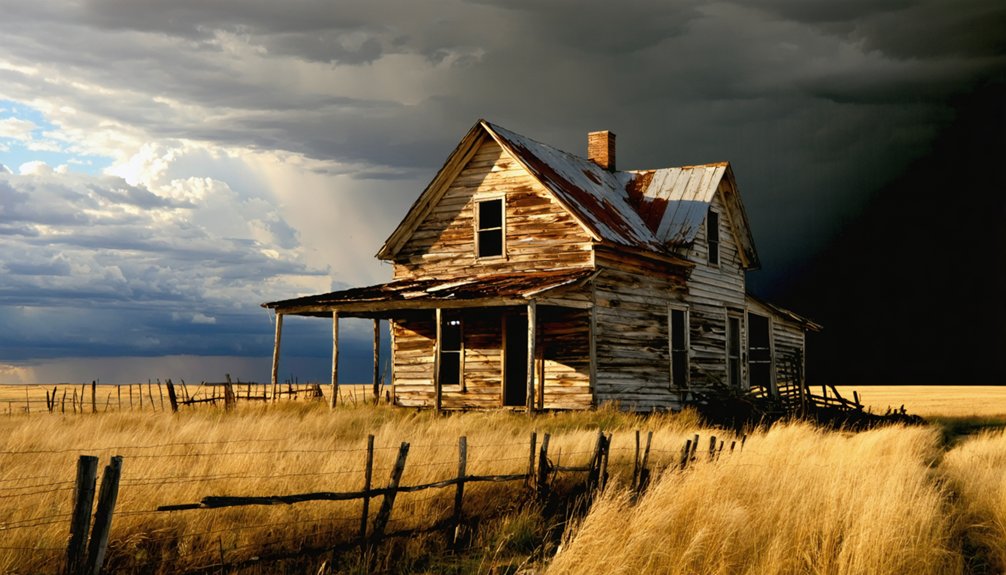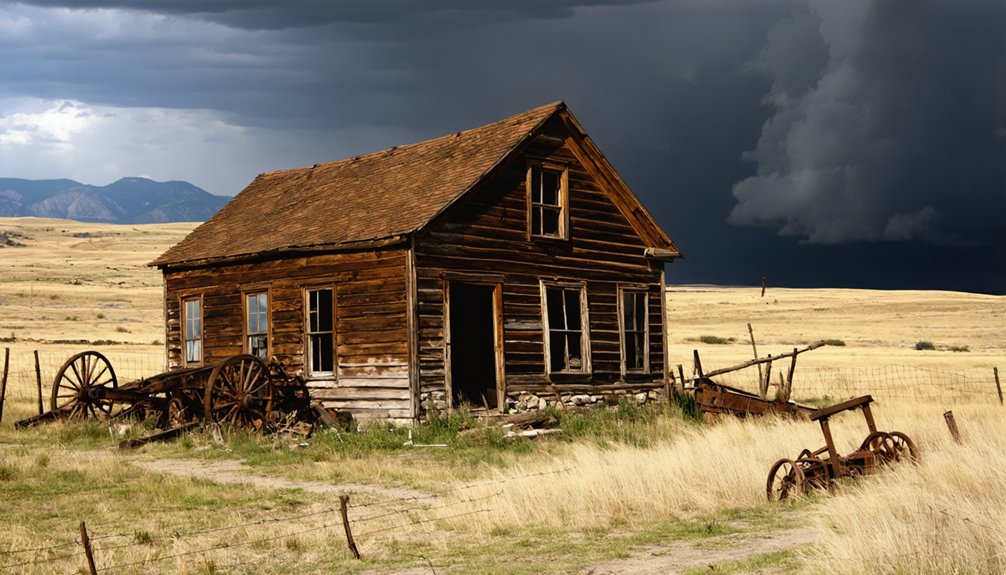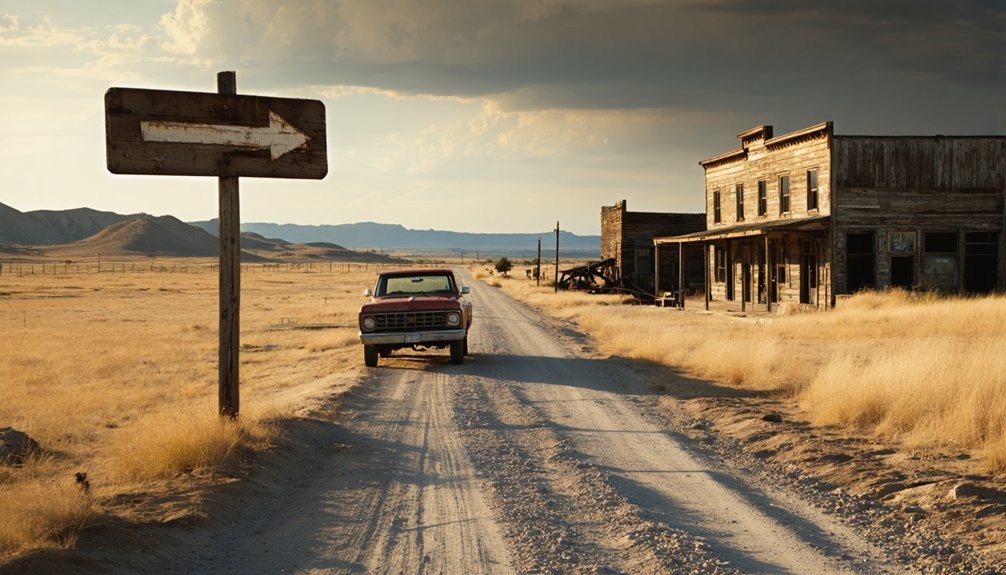
You’ll find Safe Investment ghost town at 5,299 feet on Boxelder Creek in Lawrence County’s Black Hills, accessible via Route 385 near Rochford and Mystic. This authentic 1870s mining site features exposed shafts, ore waste piles, and frontier-era artifacts without commercialization—one of over 600 documented ghost towns in the region. Pack offline maps for spotty cell service, bring a gravel-capable vehicle, and secure a Black Hills National Forest pass. Your adventure expands with nearby sites like Spokane, Galena, and Deadwood, where historical context transforms scattered ruins into compelling narratives.
Key Takeaways
- Safe Investment Mine sits at 5,299 feet elevation in Lawrence County with exposed shafts, waste piles, and scattered mining artifacts.
- Access requires a gravel-capable vehicle and Black Hills National Forest pass for remote Lawrence County mining sites.
- Download offline maps before departure as Spearfish Canyon and surrounding areas have unreliable cell service.
- Combine with nearby ghost towns along Route 385 including Spokane, Galena, Rochford, Mystic, and Rockerville.
- Pack weather layers for unpredictable Black Hills conditions and exercise caution around deteriorated shafts and shallow workings.
Discovering Safe Investment: Gold Mining Heritage on Boxelder Creek
The Safe Investment Mine stands 5,299 feet above sea level in Lawrence County’s Black Hills, where gold and silver deposits have fueled South Dakota’s economy for 145 years. You’ll discover enduring local legends here, where prospectors staked claims during the 1870s gold rush that generated $8 million by 1901.
Hard-rock mining operations required substantial capital investment—wealthy partnerships like George Hearst’s Homestake extracted 40 million ounces worth $420 billion in today’s currency. Modern exploration across 48,000 acres continues this legacy, with Dakota Gold Corp. securing $6 million in financing for district revitalization.
Contemporary operations emphasize sustainable mining practices while targeting underground veins that built fortunes. You’re witnessing strategic mineral extraction that transformed individual claims into generational wealth.
Your journey from Fort Pierre to the Black Hills follows 200 miles of historic terrain where three transportation eras converged—Native American buffalo trails, the Fort Pierre to Deadwood freight corridor (1876-1906), and the railroad networks that revolutionized mineral extraction.
The fort pierre depot history began in 1880 when Chicago & North Western Railroad bridged the Missouri River, establishing the primary access point to western goldfields. You’ll trace routes where black hills railroad infrastructure expanded from standard gauge mainlines to Homestake Mining Company‘s 53.798-mile narrow gauge network, operating from 1882 to 1930. The Fort Pierre depot, sold in 1963 and relocated to Mud Butte, marks your starting point for exploring how rail transportation liberated Black Hills minerals from geographic isolation, creating wealth-building opportunities across the frontier.
What to Explore at the Safe Investment Ghost Town Site
Where can you find authentic evidence of Black Hills mining ambition reduced to rubble and shaft openings? Safe Investment delivers precisely that frontier experience. You’ll navigate foundations in SW¼ Sec. 29, T1S, R5E, where gaping shafts and waste piles mark 1870s-1890s hard rock extraction sites.
The terrain yields mining era artifacts—rusted tools, ore fragments, structural remnants from hydraulic operations that briefly fueled regional prosperity. No standing buildings survive, distinguishing this barren historic site from partially intact ghost towns. Exercise caution around shallow workings and deteriorated shafts reminiscent of Copper Camp’s 800-foot incline.
Local folklore tales enhance exploration, whispering of boom-era desperation as gold veins depleted rapidly. The visual history you’ll encounter—dump piles, shaft openings, foundation traces—offers unfiltered access to South Dakota’s mining heritage without commercialized interpretation.
Nearby Ghost Towns Worth Adding to Your Journey
Beyond Safe Investment’s scattered foundations, South Dakota’s Black Hills region harbors over six hundred documented ghost towns within striking distance of your basecamp. Route 385 delivers you to Spokane, Galena, Rochford, and Mystic—each representing unrealized economic opportunities from the 1876 gold rush era.
Six hundred ghost towns cluster within reach—1876 gold rush failures turned expedition destinations along Route 385’s accessible corridor.
Rockerville’s brief prominence and Lake Pactola’s submerged Camp Crook offer contrasting preservation states. You’ll find Deadwood’s Wild Bill Hickok connections and Mount Moriah Cemetery provide prospective tourism appeal with established ghost tours.
Prairie settlements like Ardmore (ghost town since 2004) and Okaton’s abandoned petting zoo infrastructure reveal agricultural collapse patterns. Argonne, Capa, and Conata—now prairie dog territory—demonstrate complete desertion.
Powderhouselodge positions you strategically for organized expeditions to mine shafts, mill structures, and the operational Mineral Hill Mine near Wyoming’s border.
Essential Tips for Your Black Hills Ghost Town Adventure
Before you venture into South Dakota’s 600+ documented ghost towns, strategic preparation separates memorable exploration from costly mishaps. Download offline maps for Spearfish Canyon’s spotty cell service and pack layers for unpredictable Black Hills weather. Your vehicle needs gravel-road capability to reach Lawrence County’s abandoned mining sites, while a Black Hills National Forest pass grants access to public lands.
Understanding regional historical significance enhances your experience—Tinton’s evolution from gold to tin mining reflects 1870s boom-and-bust cycles. The unique architecture highlights include remnants of the 1927 community hall and foundations from the 1926 resort development. Pack bear spray for wildlife encounters and inform others of your itinerary. Most importantly, respect property boundaries and never enter unstable structures or mine shafts. Winter snow closures demand seasonal timing for ideal access.
Frequently Asked Questions
Are There Any Entrance Fees to Visit Safe Investment Ghost Town?
You won’t find entrance fees at Safe Investment Ghost Town—it’s freely accessible to independent explorers. However, you’ll need to verify parking availability and current accessibility for visitors, as this remote site lacks developed tourist infrastructure.
What Is the Best Time of Year to Explore Safe Investment?
Visit Safe Investment during spring or fall for ideal exploration. You’ll enjoy mild temperatures perfect for discovering scenic highlights and historical significance without summer crowds. These seasons offer perfect conditions for photographing abandoned structures and experiencing authentic Old West atmosphere.
Can I Metal Detect or Pan for Gold at Safe Investment?
You’ll need permission since Safe Investment sits on private property with existing mineral rights ownership. Recreational gold panning requires landowner consent and verified claim status. Always respect property boundaries—your freedom to explore depends on honoring others’ rights first.
Is Overnight Camping Allowed Near the Safe Investment Site?
“Home is where you park it”—but not at Safe Investment. You’ll need designated state park campsites for overnight stays. Camping policies restrict overnight visitor accommodations on undesignated lands, so plan accordingly for your freedom-filled adventure.
Are Guided Tours Available for Safe Investment and Surrounding Ghost Towns?
You’ll find limited guided tours for Safe Investment itself, but you can explore independently. Nearby Deadwood offers professional ghost town tours supporting historic preservation efforts and community development initiatives, with customizable Black Hills routes covering multiple abandoned mining settlements.