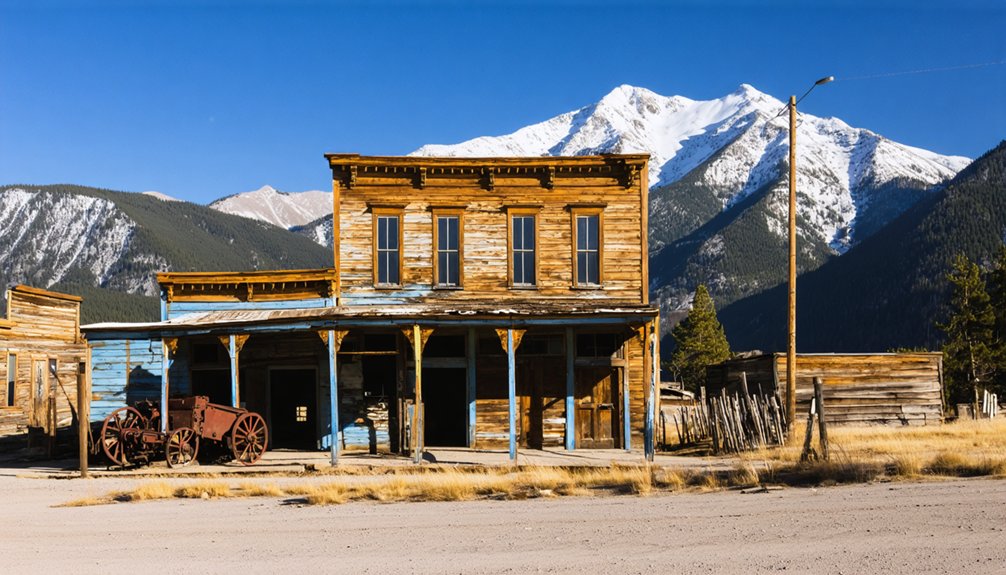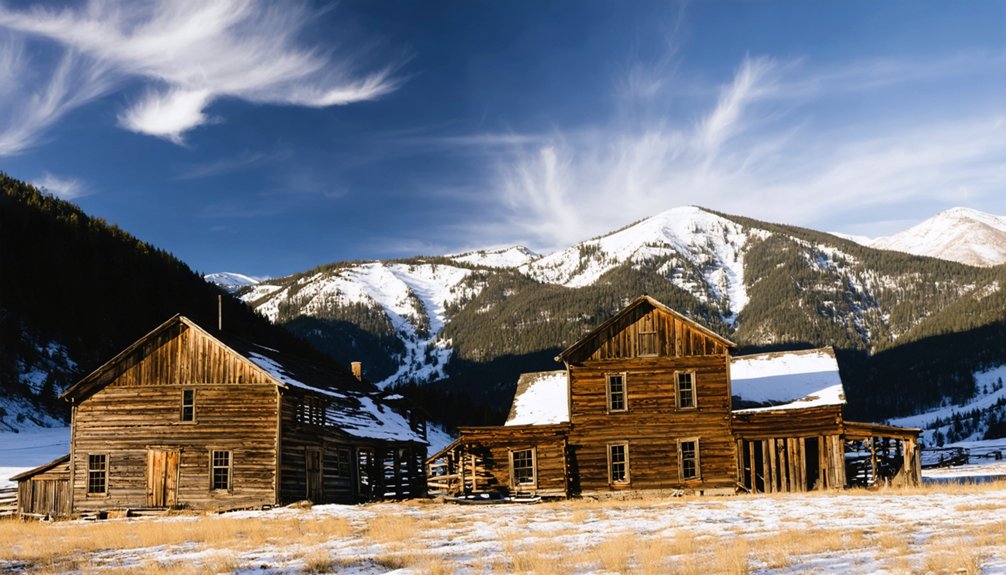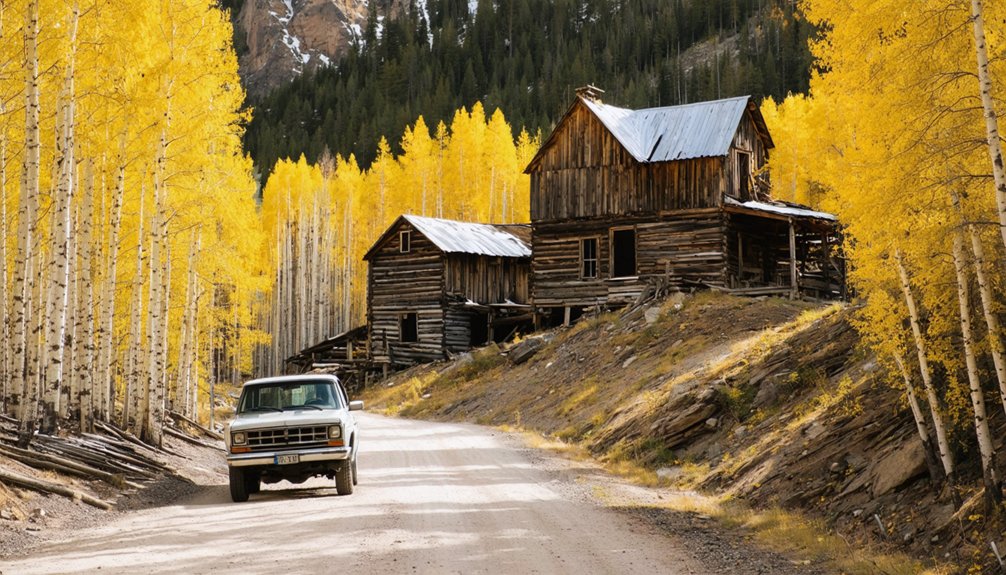
Your Saints John ghost town adventure starts in Montezuma, where you’ll navigate 1.5 miles of increasingly rugged terrain requiring high clearance and serious off-road capability. Time your visit for summer or fall, when you can explore the 1876 smelter ruins, rusted tramway cables, and weathered mining cabins at 10,764 feet. Pack layers for rapidly shifting weather—sunshine can turn to snowstorms within hours—and prepare for altitude effects as you discover why these remote alpine slopes captivated fortune seekers.
Key Takeaways
- Start your journey from Montezuma, Colorado, traveling 1.5 miles on increasingly technical terrain requiring high-clearance, off-road-capable vehicles.
- Visit only during summer and fall months, as winter conditions make the route impassable without snowshoes or skis.
- Prepare for high-elevation challenges at 10,764 feet, including altitude symptoms and rapidly changing weather conditions with potential snowstorms.
- Explore the 1876 Boston Silver Mining smelter, concentrating mill, rusted tramway cables, and steam-powered mill with impressive machinery remnants.
- Respect private property boundaries at Wild Irishman Mine while viewing weathered cabins, foundations, and tailings from mining operations.
The Rich Mining History of Saints John
The screech of metal against rock echoed through Glacier Mountain‘s slopes when prospector Coley first struck silver sometime between 1863 and 1864. He built a crude furnace right there, refusing to let anyone else control his discovery.
Prospector Coley’s fierce independence drove him to build his own crude furnace, determined that no one else would control his silver discovery.
Soon after, John Cullom uncovered the Saints John Lode—one of Colorado’s first significant silver finds—which sold to the Boston Silver Mining Company in 1867.
You’ll appreciate how mining technology evolved here: from Coley’s primitive furnace to sophisticated mills and smelters by 1876. The main St. Elmo vein yielded $100-per-ton ore, though labor challenges plagued operations. Ore required multiple handlings through shafts, tramways, and chutes—wasteful and expensive work that burdened the small population.
Old-timers claim production reached $5 million before operations ceased in 1928.
Getting to Saints John: Route and Vehicle Requirements
Where exactly does your adventure to Saints John begin? You’ll launch from Montezuma, Colorado, tackling 1.5 miles of increasingly technical terrain. The graded two-lane dirt road deceives you initially—it’s straightforward through private property with adequate parking logistics near the trailhead.
Then everything changes. After the creek crossing, your 4WD gets tested through rocky sections, tight switchbacks, and steep descents along exposed ridges. This “Difficult” rated route demands high clearance and genuine off-road capability. ATVs and UTVs handle it confidently.
Summer and fall offer favorable conditions at this 10,764-foot elevation, where scenic viewpoints reveal aspen-dotted valleys. Budget five hours for the complete 12.2-mile loop. Winter? Forget it—snow transforms this challenging route into an impassable gauntlet.
What to Expect at High Elevation: Terrain and Climate
Your vehicle conquers the switchbacks, but now your body faces a different challenge—Saints John sits at a lung-squeezing 10,764 feet, where every breath delivers 30% less oxygen than sea level. You’ll feel it immediately: headaches, dizziness, that subtle shortness of breath that makes simple tasks exhausting.
The terrain rewards your discomfort with stunning alpine ridges offering 360-degree mountain views. Summer brings spectacular wildflower displays across glacial valleys, while challenging trail conditions test your navigation skills through rocky paths and creek crossings.
Weather shifts violently here—morning sunshine can become afternoon snowstorms within hours. Pack layers, even in July. The treeline disappears above 11,500 feet, exposing you to fierce winds. That’s the price of freedom: no guardrails, no warnings, just you against Colorado’s unforgiving high country.
Exploring the Saints John Mine and Surrounding Operations
As you scramble up the rocky trail toward Wild Irishman Mine Peak, the massive stone walls of the 1876 smelter come into view—a monument to the Boston Silver Mining Operations that once pulled millions of dollars from these mountains.
You’ll want to pause at the St. Elmo vein site, where ore ranging from 18 inches to 5 feet wide yielded $100 per ton in silver, lead, and zinc. The rusted tramway cables still snake down Glacier Mountain, tracing the path where workers moved tons of ore through multiple handlings before it reached the concentrating mill below.
Historic Saints John Lode
The milling technology here was impressive for its era: a steam-powered mill with 100-horsepower engine and 6,000-pound flywheel processed tons of silver-bearing rock.
You’ll still see the concentrating mill standing in remarkable condition, alongside the defunct smelter. Between tramways, chutes, and multiple handlings, extracting wealth from this remote peak demanded serious determination.
Wild Irishman Mine Peak
Beyond the towering concentrating mill at Saints John, an ambitious 4×4 road climbs west toward Glacier Mountain‘s flanks, where Irish policeman-turned-prospector Michael Dulhaney struck silver in the late 1870s. The Dulhaney legend warns that his joyful hollering triggered flash flood devastation, wiping out three camps below—earning him the “Crazy Irishman” moniker.
Your ascent to 11,702 feet reveals remnants of this 1880s boom:
- Two weathered cabins marking the mining camp
- Scattered foundations and a private outhouse
- Visible tailings stretching east from the structures
- Switchbacks climbing through four creek crossings
The main mine sits on private property—respect the boundaries. Winter explorers tackle this 3-mile route via snowshoes or skis, gaining nearly 1,700 feet through tundra and rocky terrain that demands low-range gearing and serious clearance.
Boston Silver Mining Operations
What drives prospectors to haul 6,000-pound flywheels up narrow mountain passes? The answer lies in Saints John’s stubborn galena ore, which laughed at normal smelters.
When the Boston Silver Mining Association took control in 1867, they built a massive mill that sparked Coleyville’s birth. British investors’ influence on operations brought serious capital—and serious machinery.
By 1875, technological innovations in ore processing transformed everything. A steam-powered beast with a 13-inch cylinder cranked out 100 horsepower, its massive flywheel hauled by wagon teams that must’ve cursed every switchback.
Roasting furnaces finally cracked galena’s secrets, letting miners extract silver locally instead of shipping raw ore. You’ll still find the superintendent’s home standing—a monument to engineering that conquered mountains.
Wild Irishman Camp and Other Notable Mining Sites
Perched at over 12,000 feet on Glacier Mountain’s western slope, Wild Irishman Camp tells one of Colorado’s most colorful mining legends through its scattered cabin remains and weathered foundations. Irish policeman Michael Dulhaney discovered this silver operation in the 1860s-1880s, and legend claims his celebratory hollering triggered a flash flood down Saints John Creek.
Where an Irish prospector’s jubilant shouts allegedly unleashed disaster, creating one of Colorado’s most enduring mining tales.
You’ll find wild irishman mine infrastructure scattered throughout alpine terrain:
- Two remaining cabins dating back 155 years
- Mine supervisor’s residence with historic mining equipment traces
- Foundation remnants hidden among weathered timber
- Switch-backed trails ascending to original extraction sites
The 1893 silver crash abandoned this remote outpost. Reaching it requires four-wheel-drive capability and creek crossings, but you’ll experience authentic high-altitude mining history where nature’s gradually reclaiming what prospectors built.
Remaining Structures and Historic Buildings
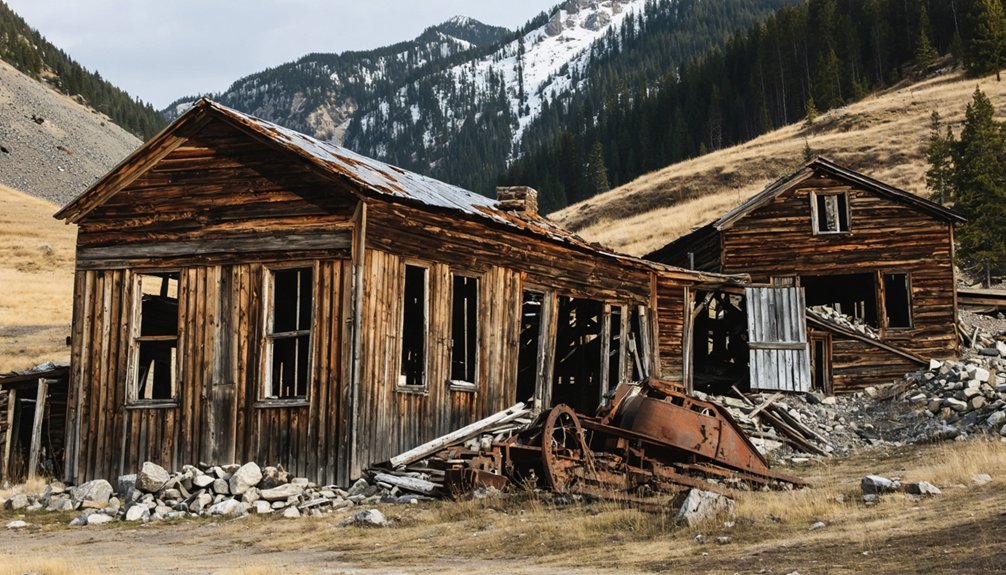
You’ll discover two preserved buildings nestled among the trees near the creek crossing—the former superintendent’s office and another structure now serving as private residences.
As you explore the ridgeline south of the road, look for the collapsed remains of what 1990s photographs identified as the ore house and boarding house, with a mysterious shed standing nearby whose original purpose remains unclear.
The real photography gem sits at the Saints John Mines Mill, where you can frame shots of the collapsed mill structure and spot the old smokestack hidden in the trees, though be cautious around the tailings piles where toxic water still flows downslope.
Frame Cabins in Meadows
Scattered across sun-drenched meadows where stagecoaches once rumbled along the Cache la Poudre valley, frame cabins stand as weathered sentinels of Colorado’s mining past. You’ll discover two-story structures with white clapboard siding and red roofs, some dating back to Frank Langdon Kennicott’s 1869-70 homestead. These buildings served as swing stations, lodges, and homes for miners chasing fortune.
What You’ll Find:
- Kennicott Cabin’s original log construction with mansion additions from 1871
- Craftsman-style details including overhanging eaves and paned windows
- Batterson barn’s 13 acres, rescued from collapse through historic preservation efforts
- Stage road alignments still visible across 800-acre ranch landscapes
Despite restoration challenges from fires, avalanches, and eighty years of abandonment, these structures earned National Register designation, offering you an authentic glimpse into frontier independence.
Mining Camp Remnants Today
High in the mountain basin above Montezuma, Saints John’s remaining structures cling to steep slopes at 10,800 feet, their weathered timbers defying decades of harsh alpine winters. You’ll find three original buildings still standing—the concentrating mill in remarkably solid condition, the manager’s home, and the combined store-office-assay building. The 1876 smelter facility looms silent, its machinery long dormant.
Wander carefully around these weathered structures and you’ll spot untouched artifacts scattered across tailings piles where mine entrances once pierced Glacier Mountain. Fifteen miles up-mountain, Wild Irishman’s two cabins sit abandoned, one missing its roof. Note: EPA cleanup crews began remediation work in September 2024, addressing decades of heavy metal contamination eroding into streams below.
Best Time to Visit and Trip Planning Tips
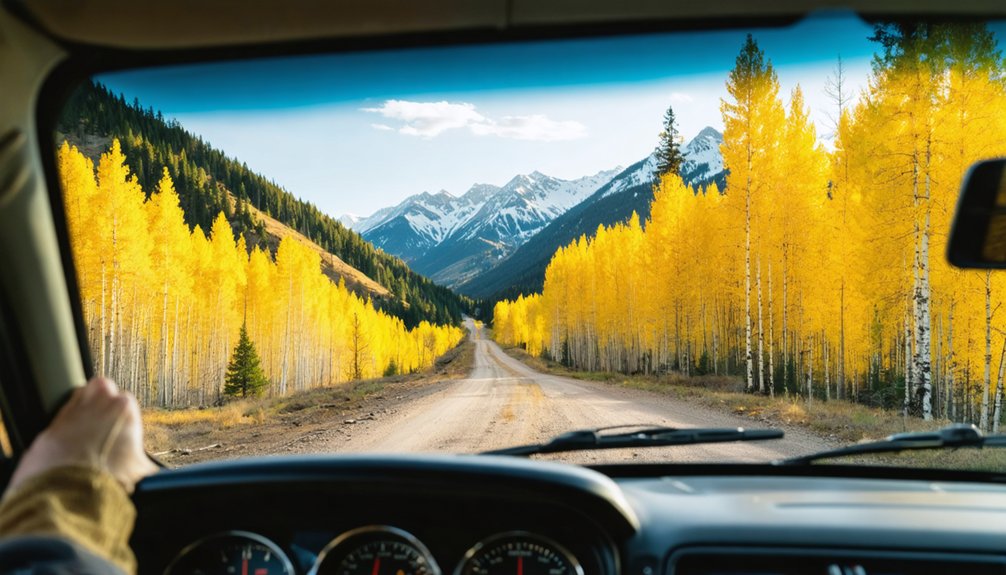
Timing your journey to Saints John can mean the difference between trudging through waist-deep snowdrifts and wandering freely among sun-warmed ruins where wooden beams still cast shadows across abandoned doorways. The shoulder seasons—late September through early November—deliver golden aspens, lighter crowds, and accessible trails before consistent snowfall locks down the backcountry.
Trip planning essentials:
- Verify Webster Pass conditions and bring 4WD for routes beyond Montezuma
- Pack cold-weather gear even in October; elevation changes everything
- Check wildfire updates during summer visits to western Colorado
- Download offline maps since cell service vanishes past Saints John
Summer grants maximum access but crowds swarm. Winter transforms the ghost town into a silent, snow-buried time capsule requiring serious preparation. Fall rewards those seeking solitude among Colorado’s mining heritage.
as you plan your ghost town road trip, consider the lesser-known history of the area and the stories waiting to be uncovered. Local attractions often offer guided tours that dive deep into the origins of these abandoned places. When traveling off the beaten path, ensure you have the right gear to enjoy the serene beauty in the crisp mountain air.
Nearby Attractions in Montezuma and Breckenridge
The wooden skeleton of Montezuma sprawls at 10,200 feet, close enough to Saints John that you’ll pass through its weathered streets before tackling the rougher climb upward. This 1865 silver camp offers scenic mountain views from its dirt roads, where the original schoolhouse still stands among rustic cabins.
I’ve found the Radical Hill trail delivers solid intermediate hiking—six miles with 1,500 feet of gain from a trailhead just beyond town. Come winter, Peru Creek’s backcountry transforms into touring paradise for skiers and snowshoers seeking untracked powder. Winter recreational activities flourish in Deer Creek’s meadows, where you’ll carve fresh lines before families arrive midday. Breckenridge sits nearby for resupply runs, but you won’t need much once you’re threading these high-altitude ridgelines.
Frequently Asked Questions
Are There Any Camping Facilities or Accommodations Near Saints John Ghost Town?
You’ll find primitive roadside campsites with fire rings along Saints John Trail—perfect family-friendly campsites for adventurers. For comfort, nearby bed & breakfasts and vacation condos at Keystone offer hot tubs and mountain views after your ghost town exploration.
Is It Safe to Enter the Old Mine Shafts and Structures?
Definitely don’t enter—Saints John’s shafts and structures severely lack structural integrity. You’ll face deadly safety hazards: thousand-foot drops, poisonous air, collapsing timbers, and hidden vertical shafts. Eleven deaths since 1982 prove these aren’t worth risking your freedom or life.
Do I Need a Permit to Visit Saints John?
You don’t need a permit to visit Saints John, but respect private property access boundaries at the site. However, seasonal road conditions close the route to most vehicles from November through May, limiting your entry options considerably.
What Wildlife Might I Encounter in the Saints John Area?
Nature’s stage unfolds dramatically here. You’ll encounter mule deer, black bears, elk, and mountain lions roaming freely. Migratory bird species like golden eagles soar overhead, while native wildflowers carpet meadows where smaller mammals scurry beneath towering pines.
Are Guided Tours Available for Saints John Ghost Town?
No guided tours operate at Saints John—you’ll explore independently via self-guided walking tours up the mountain road. Private group tours aren’t available, but that means total freedom to wander the haunting ruins at your own adventurous pace.