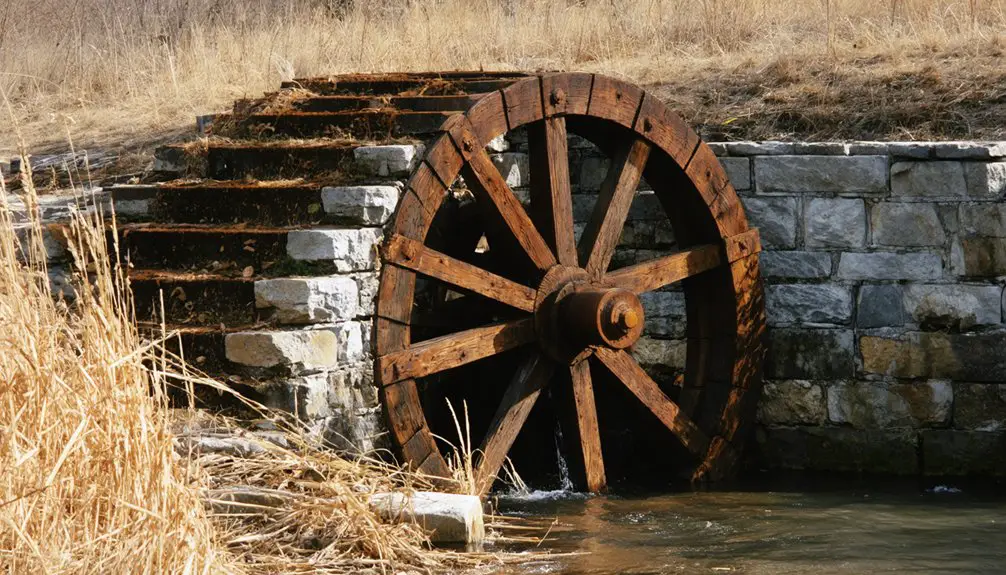
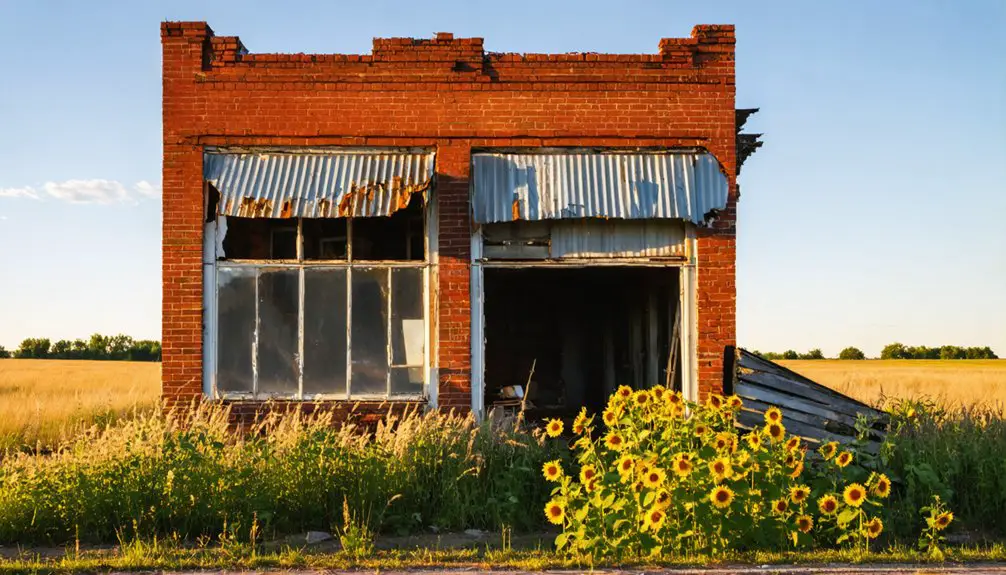
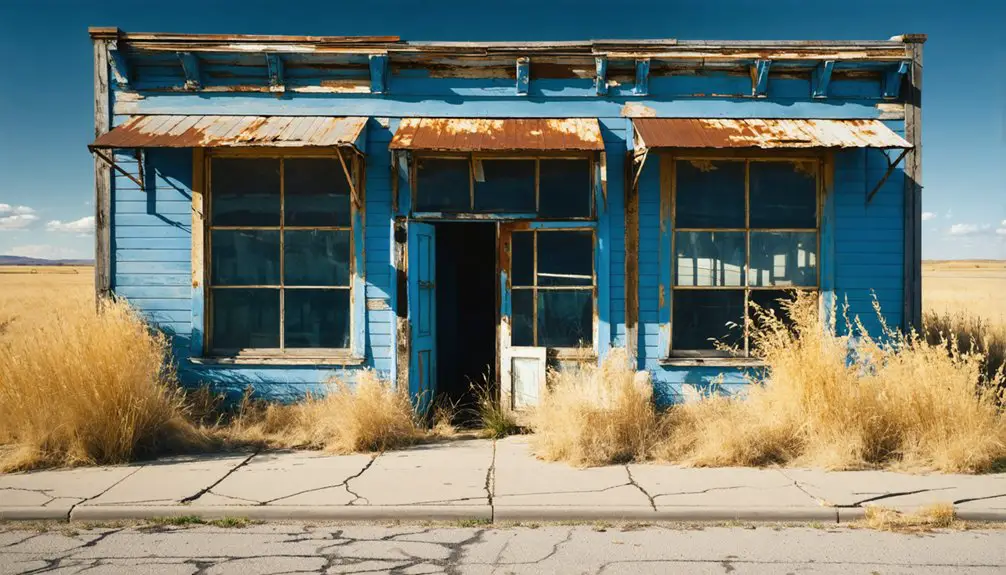
Your ghost town adventure to Saratoga begins with checking Pratt County road conditions—backcountry routes receive minimal maintenance and can become impassable after storms. You’ll find the crumbling brick schoolhouse and Carter Barker Home standing sentinel among wild prairie grasses, with Summit Hill Cemetery’s weathered headstones nearby. Visit during late spring through early summer when wild irises and spider milkweed transform the ruins into botanical monuments. The Pratt County Museum preserves photographic records of what once stood here, while the cemetery’s purple blooms reveal nature’s patient reclamation of abandoned dreams.
Key Takeaways
- Check Pratt County road conditions before departure, as maintenance crews rarely prioritize backcountry routes and conditions vary seasonally.
- Visit late spring through early summer for peak wildflower displays including wild irises, violet wood sorrel, and butterfly milkweed.
- Explore the Carter Barker Home, brick school ruins, and Summit Hill Cemetery with no gates barring access.
- Stop at Pratt County Museum first to view pictorial records and exhibits of Saratoga’s vanished structures.
- Bring photography equipment like tripods for deteriorating buildings and prepare for radical temperature swings and variable winds.
The Rise and Fall of a Pratt County Contender

The empty prairies of Pratt County saw their first trickle of settlement in 1876, when a handful of hardy pioneers staked their claims on the windswept grasslands. You’ll discover that by 1877, over 100 Iowa families transformed this frontier into a thriving community, establishing Iuka at the county’s heart. But you’re about to encounter one of Kansas’s most notorious chapters—where bloody county seat battles and bitter town rivalries turned neighbors into armed adversaries.
Saratoga emerged as a determined challenger, manipulating elections through fraud and vote-buying schemes. When commissioners declared Pratt the rightful county seat in 1885, Saratoga refused to surrender. You’d have witnessed armed partisans storming Iuka, attacking rivals, and seizing records by force. The governor eventually deployed militia to restore order, cementing Pratt’s victory in 1888 and sealing Saratoga’s fate.
What Remains at the Saratoga Townsite Today
When you turn off the highway onto the dusty access road, Saratoga materializes like a fever dream through the wheat fields—a scattered collection of weathered buildings that refuse to completely vanish into the Kansas prairie. You’ll find persisting residences still standing among the farmland, some maintained by private owners who’ve held on despite commercial abandonment consuming every storefront.
The brick high school dominates the landscape, its deteriorating facade a monument to forgotten ambitions. Walk freely among these relics—no gates bar your exploration, just open roads and footpaths weaving between structures. The absence of grain elevators distinguishes Saratoga from neighboring ghost towns, while seasonal crops create ever-changing approaches to this site.
Natural overgrowth claims buildings nobody bothered saving.
Summit Hill Cemetery: The Heart of Saratoga’s Legacy
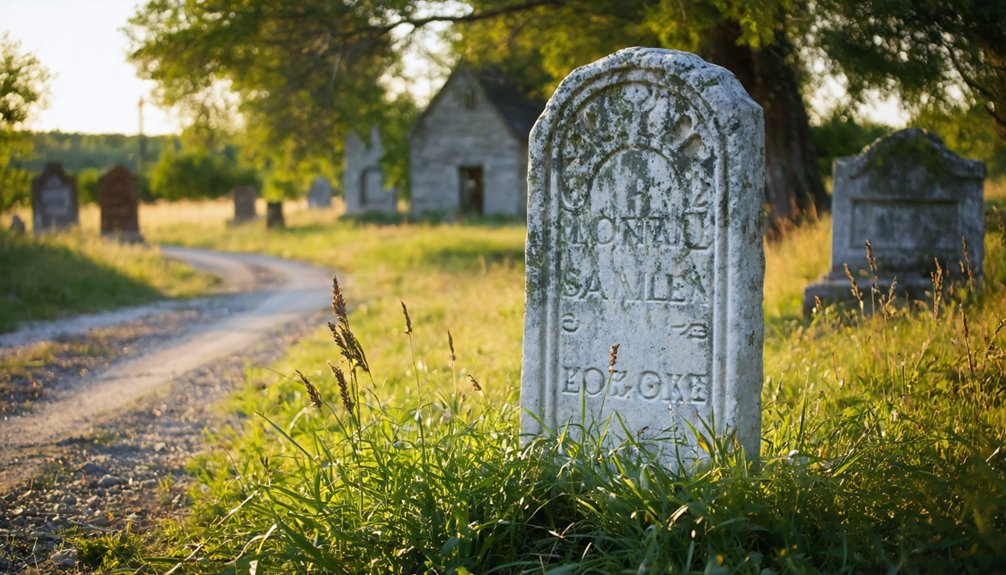
You’ll find Summit Hill Cemetery standing as Saratoga’s most enduring monument, where weathered headstones like Jane Martin’s—resting against an old tree—and Lizzie Eisenhour’s marker tell stories of settlers who believed this would become a thriving county seat.
Each spring, wild irises push through the prairie grass in brilliant purple waves, a natural memorial that returns year after year regardless of the cracked stones and missing markers.
Price Gibbons understood this place needed protection, establishing a maintenance fund just years before his death to safeguard these graves wouldn’t be completely forgotten by time and neglect.
Historic Graves and Markers
Where does a town’s soul rest when its buildings crumble and its streets fade back into prairie grass? You’ll find it among Summit Hill’s weathered stones, where Jane Martin’s marker leans against a gnarled tree and the Miles grave stands sentinel over forgotten dreams. These vandalized headstones tell stories that official histories overlooked—of African American settlers claiming their quarter-acre section, of Lizzie Eisenhour’s brief life, of ambitions that died with Saratoga.
What You’ll Discover Among the Markers:
- Deteriorated marker inscriptions requiring sexton records to decipher
- Stones cracked by Kansas weather and time’s relentless pressure
- Empty spaces where thieves stole memorial markers decades ago
- Wild iris blooming defiantly each spring around forgotten graves
Price Gibbons knew these stories deserved preservation, establishing an upkeep fund that fights nature’s reclamation.
Annual Wildflower Blooms
Death’s garden blooms with unexpected defiance at Summit Hill. You’ll find wild iris claiming Memorial Day as their own, blooming purple alongside weathered headstones—heirloom prairie cultivars that refused to surrender when the town did. These naturalized wildflower communities follow nature’s calendar with ruthless precision.
May brings violet wood sorrel and spider milkweed threading through the grasses. June explodes with butterfly milkweed’s orange fire and wooly verbena’s purple spikes. By July, blue sage and compass plant tower above the markers, while late August delivers curly-cup gumweed’s stubborn yellow blooms.
You’re witnessing what happens when humans step back—the prairie reclaims everything. These aren’t cultivated gardens requiring permission or maintenance. They’re wild, persistent, and utterly free, transforming a cemetery into Kansas’s most honest botanical monument.
Gibbons Maintenance Fund Legacy
In 1940, when most Kansas ghost towns were surrendering their last structures to prairie winds, the Gibbons family made a different choice—they wrote a $50,000 check to guarantee Summit Hill Cemetery would outlast the town itself. That endowment investment strategy still funds headstone repairs and fencing maintenance through interest earnings, managed by the Saratoga Historical Preservation Society.
What Your $5 Donation Supports:
- Biennial groundskeeping contracts protecting 2,300 graves across 12 acres
- Emergency restoration projects for Civil War veteran monuments
- Invasive species removal keeping native prairie grasses dominant
- Digital mapping systems helping genealogists locate ancestor graves
The fund’s annual fundraising initiatives have grown the balance to $250,000, achieving a 92% restoration success rate. You’re not just visiting history—you’re actively preserving it.
Exploring the Carter Barker Home and School Ruins
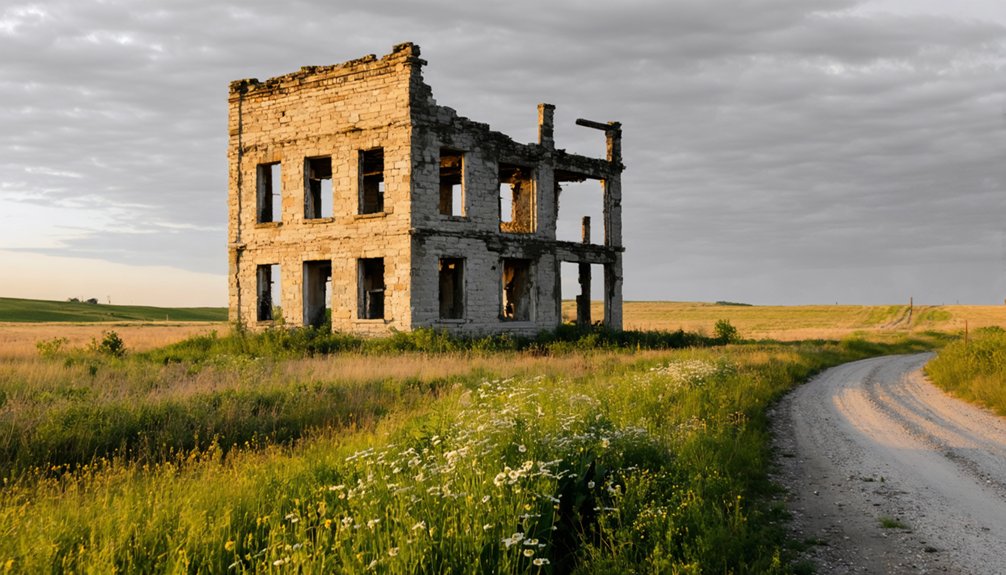
The Carter Barker Home stands as the sole visible sentinel where Saratoga’s platted streets once promised a thriving county seat. You’ll find this weathered structure standing alone amid empty prairie where an entire town vanished. I visited on a cold, rainy afternoon, feeling the weight of abandonment in every creaking board.
Up the hill near Summit Hill Cemetery, you’ll discover the school’s few remaining bricks nestled among trees—photogenic dilapidated structures that tell stories of educational ambitions cut short. The museum in Pratt preserves pictorial records of what once stood here. These forgotten state of the ruins offer powerful photo opportunities, especially when wild irises bloom nearby. Bring sturdy boots; the terrain’s unforgiving but rewards those seeking authentic ghost town exploration.
Getting There: Directions and Road Conditions
You’ll find Saratoga tucked in the rolling prairie of Pratt County, accessible via a network of gravel roads that branch off from Kansas Highway 61. The final approach requires careful navigation, as weather transforms these county roads from dusty ribbons in summer to muddy quagmires after spring rains.
I’ve learned to check conditions with the Pratt County road department before setting out, especially during winter months when snow can make these remote routes impassable for days.
Locating Saratoga in Pratt County
Finding this forgotten settlement requires pinpointing coordinates that most modern maps no longer label. You’ll navigate to 37.6394626° N, -98.6939781° W—coordinates that mark Saratoga’s historical prominence in Pratt County’s central landscape. Despite the community demographics dwindling to nothing, physical markers remain.
Key reference points for navigation:
- Saratoga Cemetery sits 1.3 miles from the coordinates, accessible via SE 25th Ave between Lake Rd and SE 20th St
- Pratt Fish Hatchery lies 0.6 miles away, serving as your closest modern landmark
- Pratt County Lake provides another reference point just 1.0 mile from the site
- KWNS-AM radio tower stands 0.9 miles distant, visible across the prairie
Your GPS will guide you where town names have vanished, revealing remnants of what once thrived here.
Although county maintenance crews rarely prioritize these backcountry routes, accessing Saratoga demands confidence traversing unmarked gravel road approaches that shift from packed hardpan to washboard corrugation without warning. You’ll navigate by instinct and coordinates rather than signage, watching the gravel road surface condition transform with each passing mile.
Spring thaws compromise seasonal road accessibility—muddy ruts can swallow sedans whole, stranding you miles from assistance. Summer bakes these passages into bone-hard strips, while winter snows erase boundaries between road and prairie entirely.
I’ve learned to trust my truck’s clearance and pack recovery gear: shovel, tow strap, extra water. The isolation feels liberating until your GPS signal flickers. Study your maps beforehand, download offline coordinates, and inform someone of your route before vanishing into Pratt County’s forgotten corners.
Weather and Seasonal Considerations
Beyond traversing the physical roadbed itself, timing your arrival to Saratoga determines whether you’re capturing haunting photographs in golden light or white-knuckling through a plains blizzard. Kansas’s continental climate delivers radical temperature swings—January lows around 20°F versus July peaks near 93°F—demanding adaptable gear regardless of season.
Optimal visiting windows:
- Late May through mid-September offers warm, stable conditions with minimal precipitation interference
- Spring months (March-May) bring severe thunderstorms and tornado risks alongside spectacular wildflower backdrops
- Winter weather preparedness proves essential December through February, when northwestern Kansas receives 28-42 inches of snow
- Variable wind impacts affect year-round driving stability and photographic equipment on exposed terrain
Pack layers for 20-degree daily temperature fluctuations. Southeastern Kansas receives 45+ inches annual precipitation; southwestern areas get less than 18 inches.
Best Times to Visit for Wildflowers and Weather
Since Saratoga sits in central Kansas where the growing season stretches seven to eight months from March through October, you’ll find wildflowers painting the prairie in waves that shift with the calendar.
For ideal viewing timeframes, late spring through early summer brings False Indigo‘s purple spikes and Plains Coreopsis‘s yellow-red petals across the landscape.
Late summer becomes spectacular when Common Sunflowers tower overhead and Compass Plant blooms alongside prairie grasses. Black-eyed Susans endure from May clear through September, offering dependable color even during drought-stressed July and August.
Weather impact considerations matter here—wind and dry spells test less resilient species, but survivors like Goldenrod burst mustard-yellow from mid-summer into October.
You’ll catch the most diverse display visiting between late May and early September when overlapping blooms create that untamed prairie palette.
Pratt County Museum: Saratoga Artifacts and Exhibits
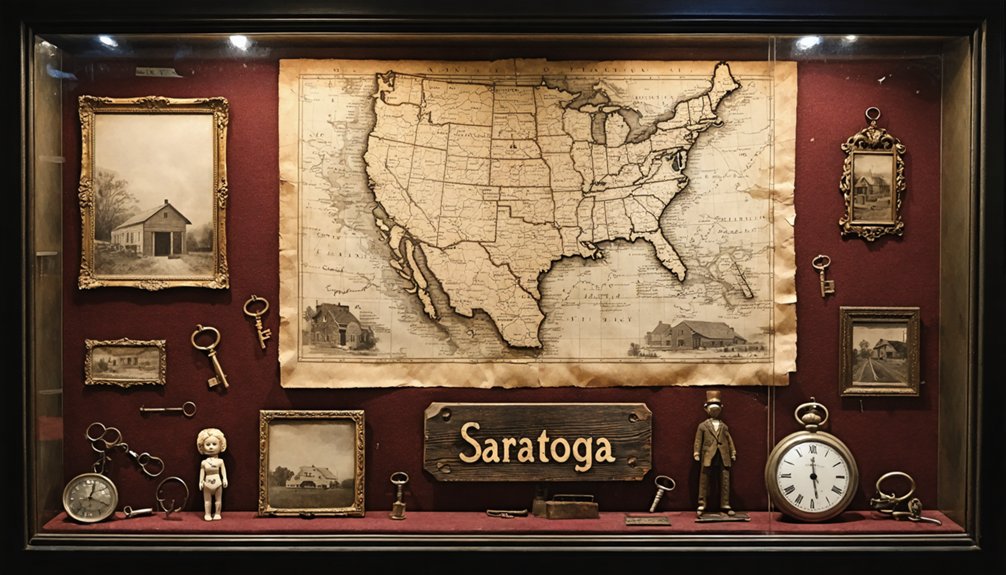
When you walk through the doors of the Pratt County Museum twenty miles northeast of Saratoga’s vanished streets, you’re stepping into the archive that holds what little physical evidence remains of the ghost town’s era. Pre-historic fossils and Native American artifacts from Turkey Creek trace the land’s story long before settlers arrived.
The Pratt County Museum preserves Saratoga’s fragile legacy—physical echoes of a vanished frontier world waiting twenty miles away.
You’ll discover Saratoga’s timeline through:
- Pioneer tools and cookware from 1870s homesteads identical to those used in Saratoga
- Antique farming equipment that worked the same prairie soil
- Recreated storefronts mirroring Saratoga’s vanished businesses
- Military displays honoring residents who left ghost towns for war
The museum’s Main Street boardwalk recreates the frontier commerce Saratoga once knew—mercantiles, livery stables, and one-room schoolhouses that defined Kansas settlement life.
Photography and Exploration Tips for Your Visit
Saratoga’s empty landscape demands more than a casual snapshot—the weathered foundations and prairie grasses stretching toward endless horizons require deliberate technique to capture their haunting beauty. Arrive during golden hour when low sun carves dramatic shadows across crumbling walls. Your tripod placement techniques matter here: position low among wildflowers to emphasize foreground textures, or elevate for sweeping vistas that reveal the town’s skeletal layout.
Seek unique photographic angles by shooting through doorless frames or capturing reflections in broken glass. Long exposures transform prairie clouds into ghostly streaks above static ruins. Don’t overlook intimate details—rusted hinges, windswept grasses threading through foundation cracks, lichen patterns on forgotten stones. Light painting with colored flashlights during blue hour adds surreal dimension to deteriorating structures, transforming abandonment into artistry.
Respecting the Site and Supporting Preservation Efforts
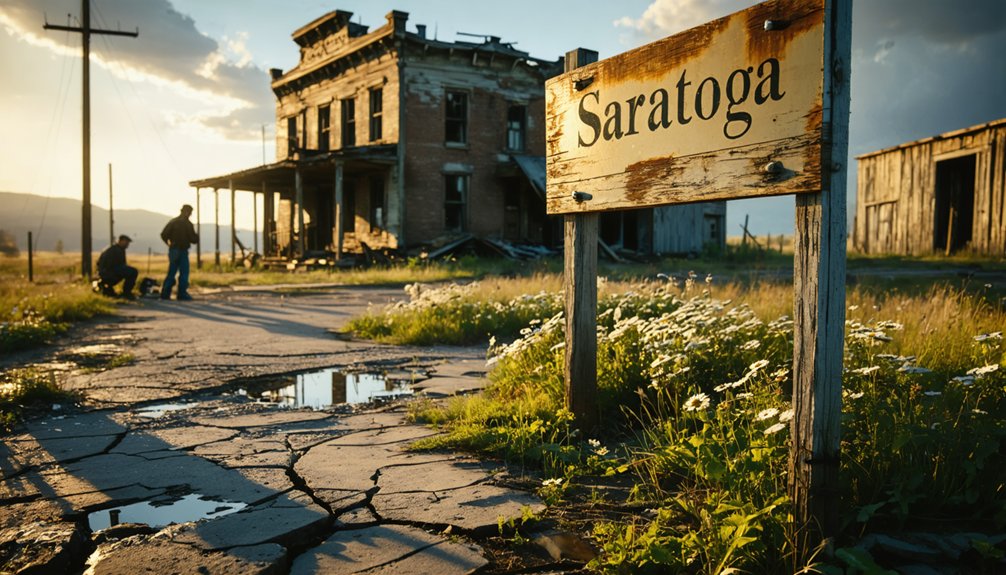
Every footprint you leave at Saratoga carries weight—not just in the prairie dust, but in the fragile timeline of this vanishing settlement. Respecting land rights means honoring fenced boundaries where ghost town remnants merge with working ranches. You’re free to explore, but that freedom demands responsibility.
Preserve Saratoga’s legacy through these actions:
- Stay clear of crumbling 1870s structures risking collapse—your safety and the site’s integrity both matter
- Leave artifacts untouched, allowing future visitors their own discovery moments
- Tread carefully at Barrett Cemetery, where traders’ and settlers’ headstones from the 1880s still stand
- Contribute to supporting preservation fundraisers funding restoration projects across Kansas ghost towns
Scavengers have already raided much. Don’t become another extraction point in Saratoga’s slow fade into oblivion.
Frequently Asked Questions
Are There Any Nearby Accommodations or Camping Options for Overnight Visitors?
Unfortunately, you’ll find limited overnight options near Saratoga’s remote location. There aren’t nearby bed and breakfast options or on-site camping facilities. You’ll need to plan ahead, bringing your own camping gear or booking accommodations in distant Wilson or Russell.
Can Metal Detectors Be Used to Search for Artifacts at the Site?
Metal detector use restrictions prohibit artifact hunting without landowner permission and proper permits. You’ll face serious fines for unauthorized digging. Cultural preservation concerns protect Saratoga’s history—respect the site by observing only, leaving artifacts undisturbed for future generations.
Is the Cemetery Accessible for Visitors With Mobility Challenges or Wheelchairs?
Accessibility options remain limited at Saratoga Cemetery. You’ll find wheelchair accessibility challenging due to uneven terrain, gravel paths, and lack of paved walkways. The rural setting offers freedom to explore, but mobility aids may require assistance traversing the grounds.
Are There Any Guided Tours Available for Saratoga and Surrounding Ghost Towns?
Unfortunately, you won’t find guided walking tours or self-guided audio tours for Saratoga, Kansas. You’ll explore these windswept ruins independently, following dusty roads at your own pace, discovering forgotten stories through crumbling walls and weathered foundations alone.
What Safety Precautions Should Visitors Take When Exploring the Abandoned Structures?
Avoid venturing near unstable buildings with crumbling walls or sagging roofs. Bring proper safety gear for exploration—sturdy boots, gloves, flashlight, and first-aid kit. Watch for debris, rusty nails, and rotted floors. Stay alert, respect boundaries, and never explore alone for maximum freedom.