Your ghost town road trip to Sardis, Oklahoma, won’t follow the typical route through abandoned buildings—the entire town lies beneath Sardis Lake, deliberately flooded in 1974 when the U.S. Army Corps of Engineers dammed the Kiamichi River. You’ll find only a cemetery island rising above the water, where 45 graves dating to 1869 mark the community that once thrived here. This submerged settlement carries profound significance as descendants of Cherokee, Choctaw, and Creek peoples who survived the Trail of Tears rebuilt their lives here, only to face displacement again. The lake’s depths hold stories that extend far beyond what you’ll see from shore.
Key Takeaways
- Sardis lies completely submerged beneath Sardis Lake, with only a cemetery island visible above the reservoir’s surface.
- The town was flooded in 1974 when the Army Corps of Engineers dammed the Kiamichi River for water supply.
- Visit the cemetery island containing 45 graves dating to 1869, accessible only by boat on the lake.
- The site marks Trail of Tears history where Cherokee, Choctaw, and Creek survivors rebuilt communities after forced migration.
- Commemoration markers along back roads trace the original Trail of Tears route through the region.
The Trail of Tears Legacy That Shaped Sardis
The dusty highways leading to Sardis wind through land that remembers America’s darkest chapter of forced migration. You’re traveling routes where Cherokee, Choctaw, and Creek families trudged over 1,000 miles after the 1830 Indian Removal Act. The forced relocation impact still echoes through these Oklahoma hills—over 10,000 died from exposure, disease, and starvation during those brutal journeys.
Sardis emerged where survivors rebuilt their shattered communities in Indian Territory. You’ll find Trail of Tears commemoration markers along back roads, reminding travelers that freedom comes at devastating costs. The town’s weathered buildings stand as testament, emblem, symbol to resilience, where descendants of those who endured winter marches created new homes from nothing. Their story isn’t just history—it’s woven into every abandoned structure you’ll explore.
How the Kiamichi River Dam Submerged an Entire Community
Just as Sardis residents rebuilt after surviving the Trail of Tears, their descendants faced another displacement in 1974. The U.S. Army Corps of Engineers contracted with Oklahoma to construct a dam on the Kiamichi River, flooding the entire town beneath what became Sardis Lake. You’ll find only the cemetery remains visible—a haunting island emerging from the water’s surface.
The environmental impact of dam construction devastated three endangered mussel species found nowhere else on Earth. The disruption of river ecosystem eliminated bullfrogs and other wildlife through unnatural water fluctuations. Tribal burial grounds and cultural sites disappeared beneath the reservoir, erasing sacred landscapes that connected generations.
Today, you’re witnessing what happens when bureaucratic flood control priorities override communities who’ve already endured government-mandated removal once before.
Visiting the Cemetery Island: Sardis’ Only Visible Remnant
Rising from Sardis Lake‘s waters like a sentinel to forgotten lives, the cemetery island marks the sole visible trace of a community that once thrived along the Kiamichi River. You’ll need a boat to reach these 45 graves, where fieldstones and marble monuments dating to 1869 stand amid changing island ecology.
Metal guards protect some headstones, while others bear poignant stories—like Hester’s 1914 smallpox death and infant graves from the early 1900s. The maintenance challenges are obvious: rotted door remnants, weathered markers, and a mysterious mailbox-like box hint at preservation struggles.
This floating graveyard represents freedom’s cost—families displaced by eminent domain, their town sacrificed for flood control while their ancestors remain, watching over waters that erased everything else.
Understanding the Choctaw Nation’s Deep Roots in the Region
Long before Sardis Lake‘s waters submerged this valley, the Choctaw people had already endured a catastrophic uprooting that reshaped their entire world. Between 1831 and 1834, approximately 11,500 Choctaws walked the Trail of Tears to this region, establishing settlements that honored their resilience:
- Skullyville (founded 1829) became an early anchor of survival
- Doaksville served as the nation’s capital from 1860-1863
- Boggy Depot emerged as a critical commercial center
These weren’t temporary camps—they represented ancestral land claims hard-won after losing 32 million acres back east. When tribal sovereignty challenges intensified during the 1906 allotment era, the government dissolved their council entirely. Yet the Choctaw Nation persisted, maintaining cultural identity even as Oklahoma statehood transformed everything around them.
What Makes Sardis Different From Other Oklahoma Ghost Towns
Unlike ghost towns where you’ll walk dusty streets past collapsing storefronts, Sardis lies completely underwater—submerged beneath 14,360 acres when the U.S. Army Corps of Engineers dammed Jackfork Creek in 1980. You can boat across the lake and spot the cemetery island where headstones still mark the original settlers, a haunting sight that no other Oklahoma ghost town can match.
What’s more striking is that this town didn’t fade from economic decline—it was deliberately flooded to create a reservoir that now supplies water to Oklahoma City, raising questions about Native American water rights in the Choctaw Nation.
Submerged Beneath Reservoir Waters
When the U.S. Army Corps of Engineers impounded Jack’s Fork Creek in the early 1980s, they didn’t just flood land—they erased an entire community. The government’s community resettlement efforts forced every resident to abandon homes, livelihoods, and generations of memories. Your freedom to stay rooted disappeared under eminent domain’s authority.
The ecological impacts of flooding transformed the landscape:
- Original ground level now lies beneath water and sediment
- Cemetery markers stand separated from graves by lake bottom
- Streets, buildings, and daily life vanished without archaeological record
You’ll find the cemetery island’s causeway leading to headstones dating back to 1875, elevated on landfill above the reservoir. Everything else—the post office, homes, the community’s heartbeat—rests beneath Sardis Lake’s surface, visible only in memory.
Native American Water Rights
Most Oklahoma ghost towns died quietly—abandoned after oil dried up or railroads changed routes. Sardis drowned beneath treaty negotiations gone wrong.
When you stand at Sardis Lake’s shore, you’re witnessing ongoing legal battles over water that stretch back to 1830’s Treaty of Dancing Rabbit Creek. The Choctaw and Chickasaw Nations claimed these waters seventy-seven years before Oklahoma existed as a state.
In 2011, the tribes sued Oklahoma City after the city secured rights to 90% of the reservoir’s water—built without proper tribal consultation in 1974. You’ll find no resolution yet; courts stayed the case six times as both sides negotiated. This isn’t just history—it’s living sovereignty dispute where $100+ million debts and ancient treaty rights collide over every gallon flowing through pipes.
Exploring Good Springs Methodist Church and Surrounding Historical Sites
When you stand before the Good Springs Methodist Church, you’re touching 120 years of unbroken history—a rare thread connecting today’s visitors to descendants of families who survived the Trail of Tears in the 1830s.
The weathered structure sits exactly where Choctaw settlers established it in 1897, decades before the Army Corps flooded the valley below to create Sardis Lake.
Within a few miles, you’ll find other Choctaw cultural landmarks that mark this landscape as a place of resilience, where communities rebuilt themselves after forced removal only to face displacement again a century later.
Church’s 120-Year Heritage
The church’s journey reflects frontier determination:
- Brush arbor beginnings – Early worshippers gathered under makeshift shelters before permanent structures existed
- Community-built upgrades – Local electricians, plumbers, and craftsmen donated skilled labor for modern improvements
- Historic milestone – The 2019 renovation finally brought indoor plumbing to the century-old sanctuary
You’ll discover how Choctaw Nation grants, Oklahoma Methodist Foundation funding, and Pennsylvania volunteers transformed this humble church while preserving its authentic character—proof that independence and community spirit thrive together.
Trail of Tears Connections
Standing beside Good Springs Methodist Church, you’re treading ground where Choctaw families gathered to worship and heal after surviving one of America’s darkest chapters. This 1830s sanctuary offered rest to multiple tribes during forced removal from Mississippi.
Just miles away, tribal oral histories come alive at Yasho UMC, named for the “big black pot” a Choctaw ancestor carried during the journey—used for cooking and preparing medicine. That pot marked their worship spot in Broken Bow.
You’ll find the importance of preservation evident at Pine Ridge Mission (1836) and Riley’s Chapel (1843), where the First Indian Mission Conference convened in 1844. Plan your exploration using the National Historic Trail‘s interactive map, connecting these sites that testify to Indigenous resilience and survival.
Nearby Choctaw Cultural Landmarks
Beyond the weathered gravestones and ancient oaks at Good Springs Methodist Church near Talihina, you’ll discover a living memorial to Choctaw perseverance that pulses through Southeast Oklahoma’s red clay hills. This 2019 building—the congregation’s first with indoor plumbing—stands where Methodist missionary work among Choctaw began in 1827.
Your exploration reveals three essential stops:
- Riley’s Chapel site at Park Hill where historical Native preachers formed the Indian Mission Conference in 1844
- Shawneetown’s remnants near the original center for relocated Choctaws
- Caddo’s First Methodist Church founded by Sarah Ann Harlan in 1873
These landmarks aren’t museum pieces. They’re breathing testimonies to a people who sustained 3,000 Methodists through forced removal, building faith communities on their own terms.
The Ongoing Water Rights Battle Over Sardis Lake
When Oklahoma City turned its sights toward Sardis Lake in 2011, few anticipated the legal storm that would follow. You’ll find this dispute reflects deeper questions about sovereignty and resource control. The Choctaw and Chickasaw Nations challenged state authority over waters flowing through their ancestral homeland, triggering a complex legal battle that reached federal courts by 2012.
Former U.S. District Judge Michael Burrage led the mediation process, bringing together tribes, state officials, and Oklahoma City representatives. After five years of negotiations, they hammered out water supply guarantees that respected tribal sovereignty while ensuring Oklahoma City’s access to the reservoir. The settlement eliminated uncertainty for everyone—ranchers, developers, and communities alike—proving that even contentious resource disputes can be resolved when all parties negotiate freely.
Archaeological Discoveries Dating Back 8,000 Years
You’ll find traces of human life stretching back 8,000 years beneath the red Oklahoma soil around Sardis, where Caddo families once cultivated corn and beans along creek bottoms.
When construction crews carved out Sardis Lake in the 1970s, their bulldozers exposed ancient campsites and stone tools buried thirteen feet deep in layered sediments. The evidence reveals seasonal hunting camps from the Archaic Period, where nomadic groups tracked bison through the arroyos before permanent villages took root.
Caddo Settlements and Agriculture
Along the dusty back roads leading to Sardis, you’re traveling through lands where Caddo people established thriving communities more than a thousand years ago. The Hasinai Caddo migrated from the Red River area around 850-900 CE, drawn by rich soil and abundant resources. Their sophisticated caddo farming techniques produced impressive corn reserves that Spanish explorers later documented.
You’ll find evidence of their presence in three key ways:
- Earthwork mounds rising from the landscape, built between 1100-1300 CE as temple platforms
- Engraved ceramic vessels displaying distinct regional designs from the Frankston phase
- Circular house remains showing their innovative caddo architectural styles
These settlements weren’t isolated outposts—they were interconnected communities along ancient trails, where traders exchanged goods from the Caribbean to Canada, creating a vibrant network across the frontier.
Evidence From Dam Construction
During the 1960s construction of Sardis Dam, bulldozers and excavation crews unearthed far more than soil and rock—they exposed 8,000 years of human history buried beneath what would soon become lakebed. State archaeologists raced against rising waters, documenting eight mounds and surrounding village remains before inundation swallowed the evidence.
They mapped barracks, storerooms, and guardhouses from Fort Towson’s military occupation, preserving what flooding couldn’t erase from record.
The real treasure hunt began with underwater excavation. Divers recovered barrels of salted pork, ceramic saucers, and mechanical engine pieces from the depths. Sunken artifacts like hasp fittings and tiller rope blocks emerged from sediment matrices, each piece revealing stories of frontier commerce and daily survival. You’re standing above a submerged time capsule that required entirely different recovery methods than traditional terrestrial digs.
Archaic Period Human Activity
Before Sardis became a ghost town or even a settlement recognized on maps, human hands shaped stone tools along these riverbanks for millennia. You’re standing where spear-wielding bison hunters camped 1,900 years ago at site 34RM507, their Late Archaic campsite features buried beneath 25 feet of reshuffled sediment.
These ancient wanderers weren’t isolated. Extensive regional lithic networks connected them across the Southern Plains:
- Dakota formation quartzites traveled from Oklahoma’s Panhandle to Nebraska
- Shell fishing operations harvested freshwater mollusks 8,000 years ago
- Bison kill sites lined nearby arroyos from 2,400 to 1,000 years before present
The calcium carbonate in discarded shells preserved their story, neutralizing acidic soil that would’ve erased lesser evidence. You’re walking where truly free people once roamed.
Recreational Activities at Modern-Day Sardis Lake
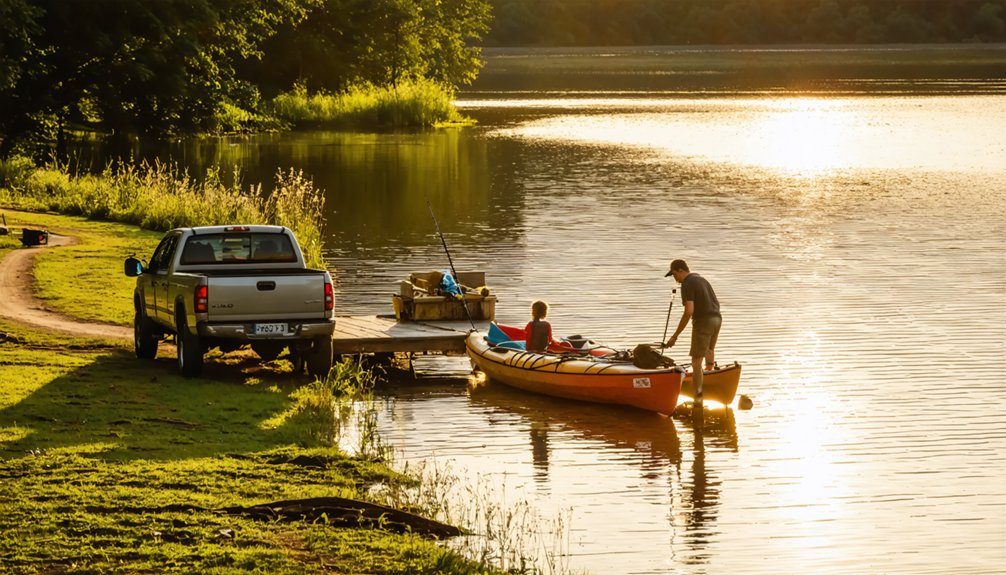
The transformation of Sardis from forgotten settlement to recreational paradise centers on the 14,360-acre lake that now bears its name. You’ll find fishing opportunities rivaling anywhere in Oklahoma—channel catfish, blue catfish, largemouth bass, and walleye patrol 117 miles of shoreline beneath submerged timber and marked brush shelters. The lake produces some of the state’s largest bass, rewarding your patience with trophy catches.
Water recreation extends beyond angling. You can launch at Potato Hills South, Sardis Cove, or The Narrows for jet skiing, canoeing, or simply exploring 55 feet of depth. Three Corps-managed campgrounds provide hookups and facilities for extended stays.
Over 8,000 acres accommodate turkey and waterfowl hunters, while spring dogwoods and autumn’s rainbow-colored mountains frame exceptional sunsets. Five miles north of Clayton along Highway 2, freedom awaits.
Documenting Displacement: Films and Stories From Former Residents
Beneath those 14,360 acres of recreational paradise lies a story most visitors never hear. Rocky Mountain PBS’s “Native Lens: Sardis” preserves what the Army Corps of Engineers erased—a complete community displaced through eminent domain in the early 1980s.
Former residents share oral histories that reveal profound losses:
- Joe and Betty Brown describe watching their homes, jobs, and identities submerged
- Tobe and Rowletta Anderson connect displacement to ongoing Choctaw water rights battles
- Don Huddleston details the cemetery tombstones dating to 1875, now marooned on a landfill island
Director Colleen Thurston’s documentary ties this ghost town to modern fights protecting Oklahoma rivers from exploitation. The film captures the trauma of documenting cultural losses—from erased ecological knowledge to the deliberate flooding of Native communities across Indian Country, echoing patterns stretching back to the Trail of Tears.
Frequently Asked Questions
What Is the Best Time of Year to Visit Sardis Lake?
You’ll find fall offers the best experience, with vibrant foliage and peak bass fishing. Water levels stabilize perfectly for boating, while fewer seasonal events mean uncrowded shores. Spring’s wildflowers run close second for pure, unscripted natural beauty.
Are There Boat Rentals or Camping Facilities Available at Sardis Lake?
You’ll find three boat rentals available at Sardis Lake, offering everything from pontoons to jet skis for your water adventures. While camping facilities on site exist nearby, the marina provides full services including fuel, dining, and water toy rentals.
How Far Is Sardis Lake From Major Oklahoma Cities Like Tulsa?
You’ll find Sardis Lake just three hours from Tulsa, Oklahoma City, or Dallas. The distance from major airports makes it perfectly accessible, with transportation options including scenic highway drives through Oklahoma’s wild backcountry—your gateway to untamed freedom.
Can Visitors Access the Cemetery Island or Is It Restricted?
You’ll find the cemetery island is typically inaccessible—no official boat launches lead there. Accessibility restrictions and private property concerns keep visitors at bay, though you can glimpse the haunting headstones from shore, frozen in their watery isolation.
What Other Ghost Towns Are Nearby for a Combined Road Trip?
You’ll find Zoraya’s cemetery and Big Cedar’s remnants within driving distance, both nearby abandoned settlements echoing Choctaw heritage. These sites offer historical significance of ghost towns through crumbling foundations and weathered markers—perfect for your freedom-seeking exploration beyond Sardis.