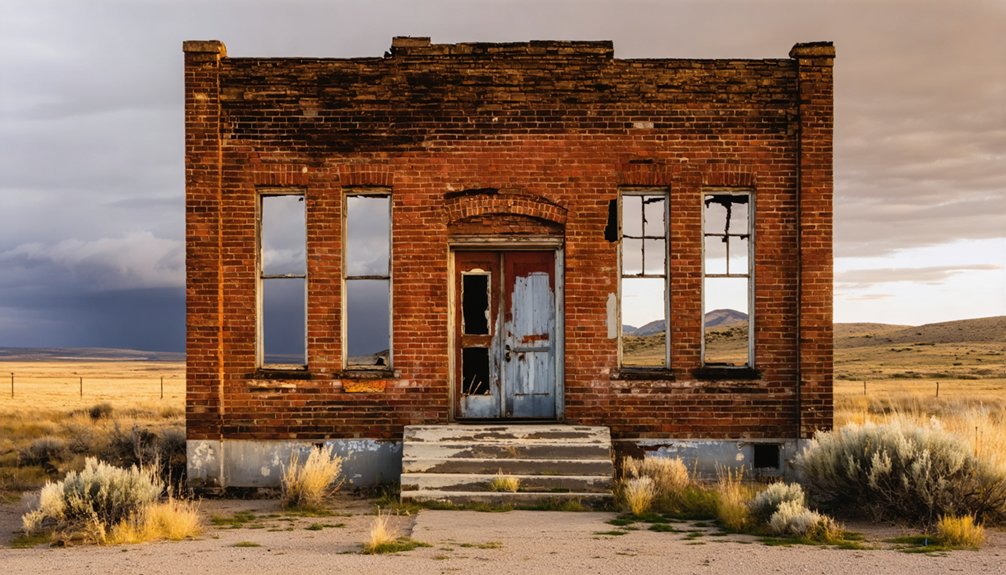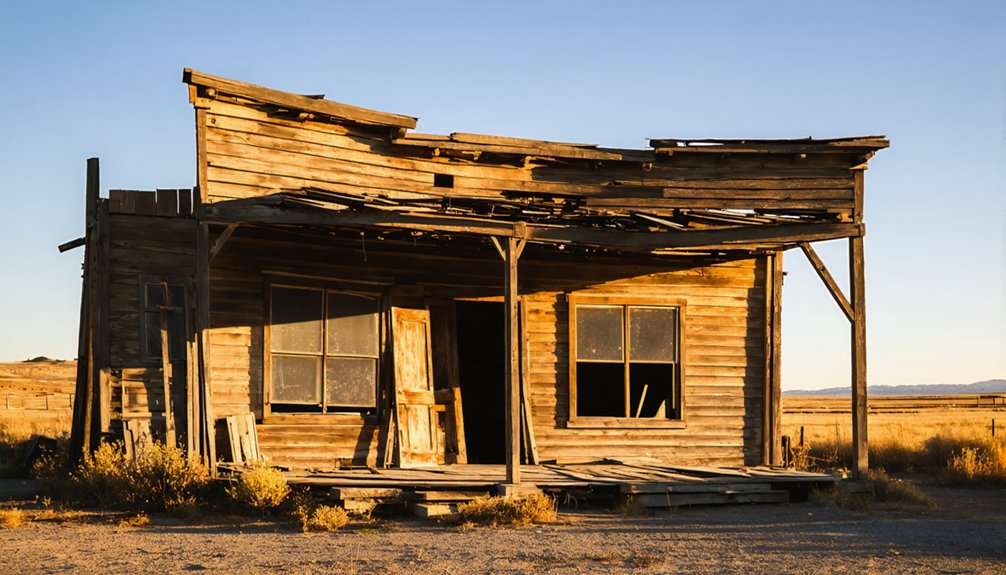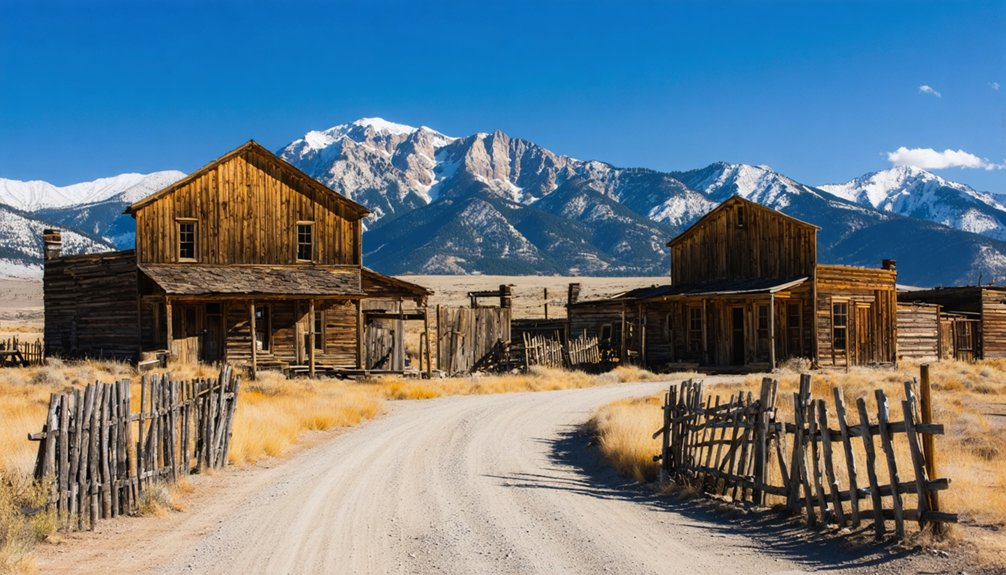
You’ll find Sawtooth City hidden deep in Beaver Canyon within Idaho’s Sawtooth National Recreation Area, accessible only by high-clearance 4WD vehicle from July through September. Plan a full day to navigate the rugged 131-mile Ponderosa Pine Scenic Byway, bringing provisions since there’s zero cell service. Once there, you’ll explore weathered mill foundations, a solitary log cabin, and a historic cemetery where miners rest beneath barely legible gravestones. Your ghost town adventure reveals how 600 fortune-seekers carved $5 million from these mountains before winter’s harsh reality forced complete abandonment.
Key Takeaways
- Visit between July and September when unpaved roads are passable; winter closures near Banner Summit can strand visitors.
- Bring a high-clearance four-wheel-drive vehicle to navigate rough terrain in remote Beaver Canyon with zero cell service.
- Allocate a full day for the 131-mile Ponderosa Pine Scenic Byway and exploring Sawtooth City’s scattered ruins.
- Pack supplies for self-sufficiency, weather changes, and extended outdoor exploration in this isolated location.
- Explore weathered mill foundations, a solitary log cabin, historic cemetery, and artifacts from the 1880s silver boom.
The Rise and Fall of a Silver Mining Boomtown
The glint of silver-bearing quartz along a remote creek bank in 1878 sparked one of Idaho’s most dramatic mining booms. You’ll discover how Sawtooth City exploded from wilderness to a thriving community of 600 souls by 1882, complete with saloons, hotels, and even an assay office.
The boomtown lifestyle flourished as miners poured $100,000 into infrastructure before extracting a single ore nugget. Rich silver deposits yielded hundreds of ounces per ton, fueling prosperity and adventure.
But mining challenges—harsh weather, expensive processing, and remote isolation—proved insurmountable. By 1888, Sawtooth City stood abandoned, its $5 million legacy frozen in time. Today, you can walk among the remnants of this untamed chapter in Western history.
Getting to Sawtooth City: Location and Access Details
You’ll find Sawtooth City hidden deep in Beaver Canyon, where State Highway 75 gives way to rough, unpaved roads that snake through the Sawtooth Valley at over 7,300 feet elevation. Your vehicle needs four-wheel drive to handle the rutted track that climbs from the Salmon River’s headwaters, especially after spring snowmelt turns the path into a muddy gauntlet.
Summer and early fall offer your best window—typically July through September—when the high-altitude terrain becomes passable and wildflowers blanket the abandoned mining site.
Remote Beaver Canyon Location
Nestled deep within Beaver Canyon at 7,342 feet above sea level, Sawtooth City occupies one of Idaho’s most dramatic alpine settings. You’ll find this abandoned mining camp along Beaver Creek, where crystalline waters cut through Sawtooth Valley’s heart.
The natural scenery here is unmatched—towering peaks of the Sawtooth Range soar to 10,751 feet, creating a fortress of granite around you.
Your coordinates place you at 43°53′48″N, 114°50′25″W within the Sawtooth National Recreation Area‘s protected wilderness. Wildlife encounters are common on this backcountry route, where elk, mule deer, and black bears roam freely.
The barometric pressure at 77 kPa reminds you just how high you’ve climbed into these remote mountains, far from civilization’s constraints.
4WD Road Requirements
Getting to this isolated ghost town demands serious preparation and the right vehicle. You’ll navigate rough mountain terrain where standard cars won’t cut it. High-clearance four-wheel-drive isn’t just recommended—it’s essential for conquering Beaver Canyon’s challenging approach.
Essential Requirements:
- Vehicle Capability: Your rig needs true 4WD with solid ground clearance to handle rocky, rutted surfaces carved by mountain weather and elevation changes.
- Seasonal Access: Plan between May 1 and November 30 when roads are passable, avoiding snow-locked winter months.
- Roadside Safety Considerations: Account for limited maintenance levels and zero cell service in remote wilderness zones.
- Permit Acquisition Timeline: If you’re considering longer stays or establishing access points, start ITD permit processes well ahead—approvals take time.
Pack recovery gear, spare fuel, and emergency supplies before venturing into this backcountry adventure.
Best Seasonal Visiting Times
Timing your Sawtooth City expedition can make the difference between an unforgettable adventure and a frustrating ordeal. You’ll find year-round access via Idaho Highways 21 and 75, but summer and fall deliver the sweet spot for exploring dirt roads like the Sawtooth Mountain Views Loop.
Winter driving conditions demand checking Idaho Department of Transportation updates—snowpack transforms these routes into unpredictable challenges. Spring snowmelt impacts create their own spectacle at nearby Shoshone Falls, where runoff roars with raw power, though muddy trails might slow your ghost town approach.
The Sawtooth Drive remains accessible all seasons, with Stanley and surrounding towns offering services when you need to refuel. Choose your season wisely, and the backcountry rewards your independence with unobstructed exploration.
What Made This Settlement Thrive in the 1880s
Few places can claim a more dramatic rise than Sawtooth City experienced in the early 1880s. You’ll discover a settlement that exploded from wilderness to thriving hub through sheer determination and fortune-seeking spirit.
Four Forces That Built This Mountain Empire:
- Rich mineral strikes drew 600 independent souls who staked over 120 claims by 1879, creating instant wealth from operations like Silver King mine
- Competitive business climate spawned four saloons, three restaurants, two hotels, and essential services serving miners’ every need
- Industrial backbone emerged with two quartz mills processing ore, plus the strategic Galena Toll Road connecting commerce to Ketchum
- Diverse economic base included blacksmiths, assay offices, Chinese laundries, and meat markets—everything required for self-sufficient frontier living
This wasn’t just survival; it was prosperity carved from granite.
Mining Legacy: Mills, Mines, and Silver Riches
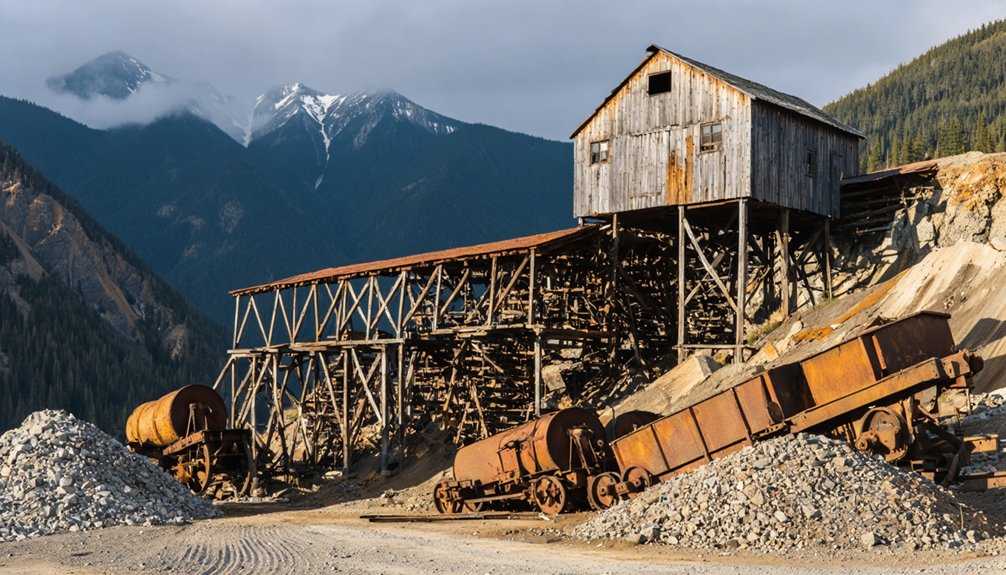
When Levi Smiley and T.B. Mulkey discovered quartz outcroppings in 1878, they couldn’t have imagined the $5 million legacy they’d trigger. You’ll find that Sawtooth City’s ore characteristics were extraordinary—silver-lead deposits often yielding several hundred ounces per ton near the surface.
The Silver King mine became the crown jewel, operating profitably under Major William Hyndman from 1886, while the Pilgrim mine‘s rich ore fueled the initial boom.
Despite the wealth beneath your feet, processing challenges proved brutal. The ten-stamp quartz mill sat idle for years due to crushing costs and harsh weather. You’ll discover that only high-grade ores justified the expensive extraction.
Exploring the Ruins: What You’ll Find Today
As you step onto the weathered ground of Sawtooth City, the skeletal remains of quartz mill foundations rise from the earth like ancient monuments, their 1882 stonework still defiant against time.
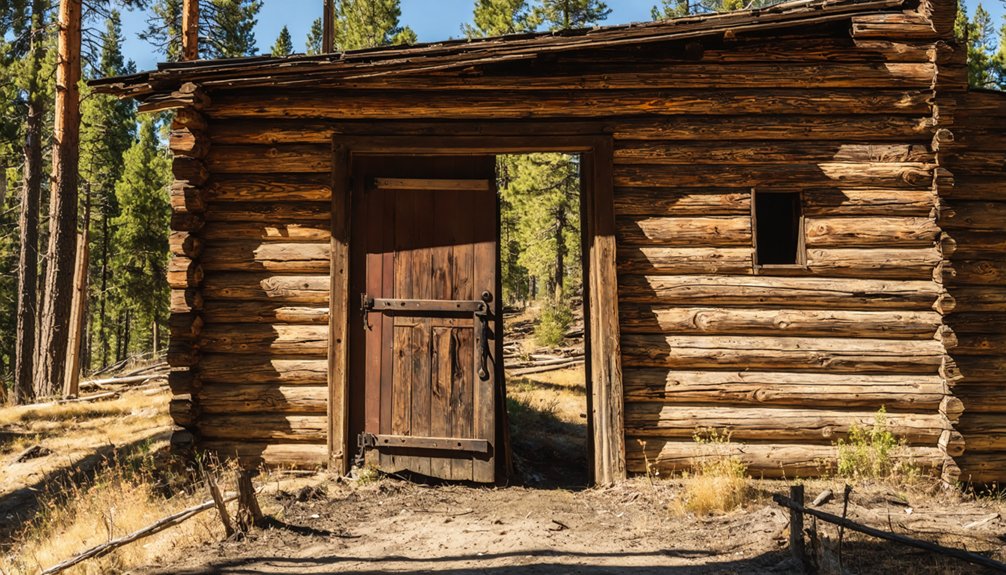
A solitary log cabin stands guard over scattered building remnants, while twisted iron pieces and rusted tin cans lie frozen in place—silent witnesses to the frenzy that once gripped this 7,342-foot canyon.
Beyond the crumbling walls, deep archaeological pits scar the landscape behind the foundations, and to the northeast, a lonely cemetery holds the final chapter of those who never left.
Standing Structures and Foundations
The weathered bones of Sawtooth City emerge from the mountain landscape like monuments to ambition and failure. You’ll discover remnants worth over $100,000 in 1880s investment, now reclaimed by wilderness.
Key structures you’ll encounter:
- Mill foundations from the massive sawmill complex, plus two quartz mill sites that processed silver and lead ore starting in 1885
- One standing log cabin showcasing late pioneer construction—a rare example of log cabin preservation surviving Sawtooth Valley’s harsh winters
- Crumbling commercial buildings where 25 substantial houses once stood alongside meat markets, assay offices, and three saloons
- Foundation restoration opportunities visible throughout the $50,000 mill site, where archaeological features remain largely intact despite bottle hunters
These scattered ruins tell stories of 600 souls who gambled everything on silver dreams before abandoning camp by 1888.
Cemetery and Artifacts
Beyond the crumbling walls and collapsed timbers, a small cemetery clings to the mountainside—the most haunting remnant of Sawtooth City’s brief existence. You’ll find weathered marble markers tilting among the pines, their inscriptions barely legible after 150 years of harsh mountain winters. The oldest stone marks Grover Jones’s resting place from 1865. But most graves remain silent—unmarked graves far outnumber the identified, swallowed by forest undergrowth and time.
The 2022 Ross Fork Fire swept through, consuming everything except this sacred ground. Now, gravesite preservation efforts by Sawtooth National Forest and local Boy Scouts work to protect what’s left. Wear sturdy boots—the uneven, wooded terrain demands respect, just like the miners and pioneers who chose this wild country as their final home.
Best Times to Visit and Essential Trip Planning Tips
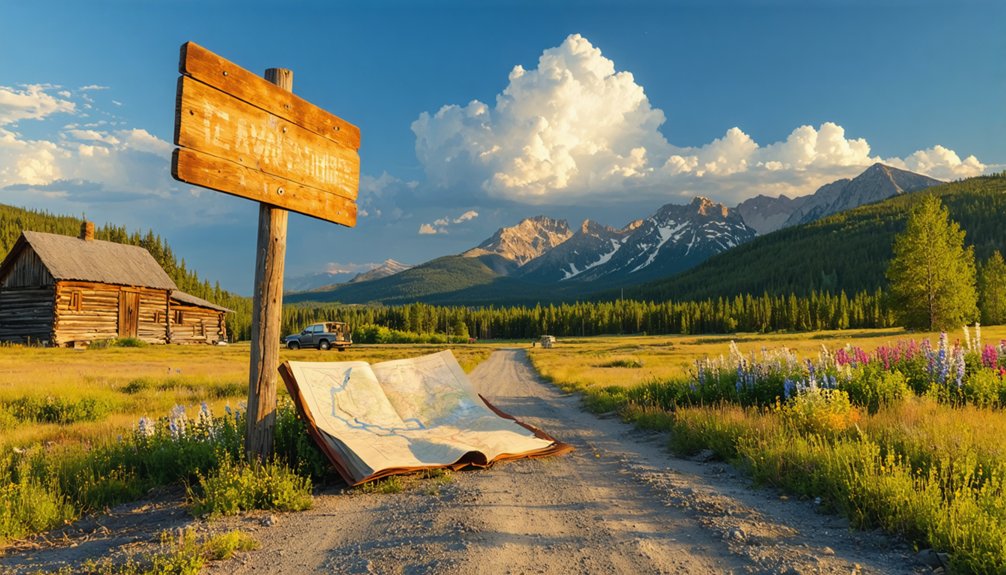
Planning your ghost town adventure requires careful consideration of Idaho’s dramatic seasonal shifts. You’ll find ideal road conditions from late spring through fall, when mountain passes stay open and gravel routes remain passable. Summer guarantees accessible terrain and minimal crowd sizes at these remote sites, while autumn paints the Sawtooths in brilliant gold. Winter closes sections near Banner Summit, potentially stranding you.
Essential Planning Tips:
- Allocate a full day minimum – the 131-mile Ponderosa Pine Scenic Byway demands three hours driving alone, plus exploration time
- Prepare for rugged gravel roads – surfaces shift dramatically from paved highways to challenging terrain
- Check seasonal closures – spring’s variable weather affects accessibility unpredictably
- Pack accordingly – remote locations require self-sufficiency for weather changes and extended outdoor exploration
Making the Most of Your Sawtooth Valley Adventure
Your Sawtooth Valley adventure extends far beyond Sawtooth City’s weathered remnants, unfolding across a spectacular wilderness where ghost towns punctuate a landscape of jagged granite peaks and crystalline lakes.
You’ll discover cultural immersion wandering Main Streets lined with historic saloons and antique shops in Custer, where restored buildings transport you to frontier days. The massive Dredge awaits 40 minutes north, its guided tours revealing gold mining’s mechanical scale.
Educational exhibits at the Sawtooth Fish Hatchery demonstrate salmon migration along the 425-mile river system, while evening campfire programs at Redfish Lake Amphitheater deepen your wilderness connection. Between heritage sites, you’re free to chase trout across 300+ alpine lakes, tackle 1,000+ miles of backcountry trails, or simply absorb mountain reflections dancing across pristine waters.
Frequently Asked Questions
Are There Any Entrance Fees or Permits Required to Visit Sawtooth City?
You’ll pay $5 per vehicle for seven-day access to Sawtooth National Recreation Area. Pack light, drive free-spirited, explore unbounded—parking availability awaits your adventure. The ghost town’s accessibility for visitors means you’re unshackled to wander weathered cabins and forgotten mining trails.
Can I Camp Overnight Near the Ghost Town Ruins?
You can’t camp directly at the abandoned structures—safety hazards make that risky. Instead, explore nearby camping options at designated dispersed sites or established campgrounds within the stunning Sawtooth wilderness, where you’ll find freedom under endless stars.
Is It Safe to Enter the Remaining Log Cabin Structure?
You shouldn’t enter without evaluating the cabin’s structural integrity first. Check for rotted logs, unstable corners, and roof damage before stepping inside. Take precautions—decayed wood and weakened foundations make ghost town structures dangerously unpredictable for explorers.
Are There Restrooms or Facilities Available at the Site?
No restrooms exist at this remote ghost town—you’ll need complete self-sufficiency here. Parking availability sits wherever your 4×4 stops, though wheelchair accessibility remains impossible across this rugged, high-altitude terrain demanding your adventurous spirit and careful preparation.
What Wildlife Might I Encounter While Exploring the Area?
You’ll spot native small mammals like chipmunks and pikas darting among abandoned structures, while migratory bird sightings include osprey and Swainson’s hawks soaring overhead. Black bears occasionally wander through, so you’ll want to stay alert and free-spirited.