You’ll need a high-clearance vehicle to navigate the unpaved Taos County tracks leading to Servilleta, an authentic ghost town north of Taos where weathered fence posts and scattered foundation stones tell stories of a vanished railroad settlement. Unlike romanticized tourist sites, this isolated spot offers genuine solitude year-round—just bring weather-appropriate gear since conditions vary dramatically by season. The faint railroad grade still scars the landscape, and rusted fragments hint at frontier life. There’s much more to discover about this forgotten high desert outpost.
Key Takeaways
- Servilleta features authentic, unromanticized ruins including weathered fence posts, foundation stones, and a visible railroad grade scar across the landscape.
- High-clearance vehicles are recommended to navigate unpaved Taos County tracks leading to the remote ghost town site.
- The site is accessible year-round with no formal operating hours, allowing exploration on your own timeline and schedule.
- Visitors should prepare for seasonal weather variations in temperature, precipitation, and wind conditions throughout the year.
- Expect genuine isolation and solitude, as Servilleta attracts fewer visitors than other ghost towns in the region.
Discovering Servilleta’s Wild West Past
The desert winds that sweep through Servilleta carry echoes of New Mexico’s most turbulent era, when territorial disputes and land grant conflicts turned this remote valley into a flashpoint of Wild West violence.
You’ll discover native american cultural influences here, where Jicarilla Apaches once roamed freely before Spanish pioneers settled around 1849. The Maxwell Land Grant‘s expansion to two million acres sparked deadly confrontations as homesteaders, miners, and nuevomexicanos lost access to communal lands they’d depended on for generations.
Today’s local ranching heritage stems from those who survived the shift from communal systems to private property regimes. Walk these grounds and you’re tracing the footsteps of those who fought against monopolies and political machines—people who refused to surrender their freedom without resistance.
The Rise and Fall of a Mining Boom Town
Centuries before Servilleta became a ghost town, the nearby Cerrillos District was already experiencing the boom-and-bust cycles that would define New Mexico’s mining heritage. You’ll discover that Spanish colonizers struck silver and lead here in 1598, launching operations that would span centuries.
By 1879, Robert Hart’s discovery of rich silver ore ignited a frenzy—miners flooded in after news spread that April.
But mining challenges proved brutal. When the Mina del Tiro collapsed in the 1860s, terrified workers walked away for good. Economic factors sealed Cerrillos’s fate: new turquoise discoveries elsewhere crushed prices, while development required expensive machinery and financing most operators couldn’t secure. By 1914, the American Turquoise Company shuttered operations, leaving behind the skeletal remains you’ll explore today.
Historic Buildings and Landmarks to Explore
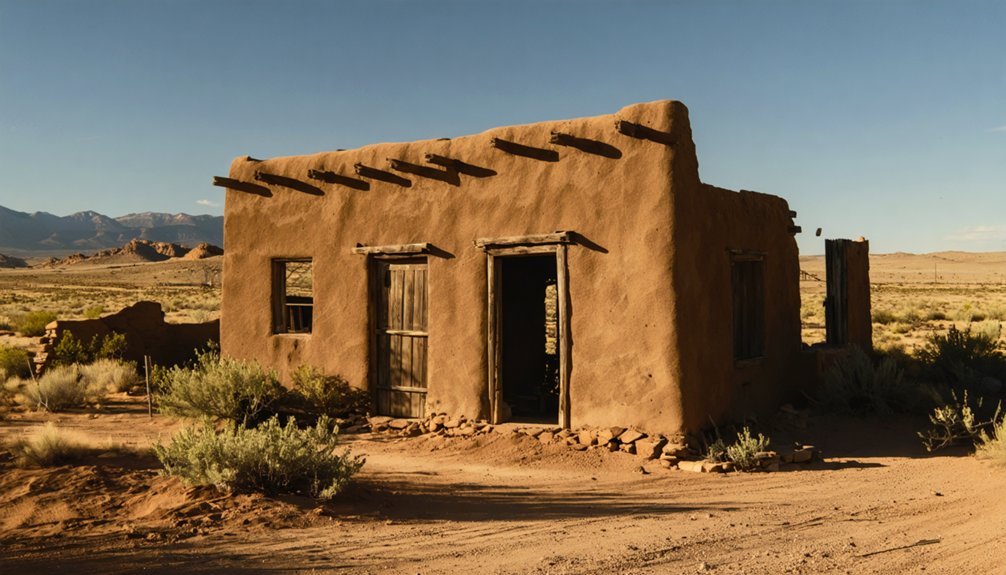
While Servilleta’s mining operations crumbled into memory, nearby Taos preserved architectural treasures that tell a richer, more enduring story. You’ll find Taos Pueblo’s multi-storied adobe dwellings—continuously inhabited for over 1000 years—standing as the only living Native American community designated both a World Heritage Site and National Historic Landmark. This architectural preservation showcases native american culture through walls that’ve witnessed centuries of freedom and resilience.
Drive minutes south to discover San Francisco de Asis Church, where Georgia O’Keeffe and Ansel Adams captured iconic adobe curves on film. In town, the 1825 Kit Carson Home reveals Wild West independence, while Martinez Hacienda’s Spanish Colonial walls echo self-sufficient frontier living. These landmarks didn’t just survive—they thrived, unlike Servilleta’s forgotten ruins.
What Remains in This High Desert Settlement
Pulling off US 285 onto the flat plain where Servilleta once bustled, you’ll strain to find anything beyond weathered fence posts and scattered foundation stones. The high desert’s claimed everything—no depot walls, no ranch structures, nothing defying the wind and sage.
Unlike preserved ghost towns with photogenic facades, Servilleta’s existing archaeological sites demand imagination. You’re reading the land itself: depressions where buildings stood, rusted iron fragments hinting at homesteads, and subtle remnants of transportation infrastructure where the DYRGW tracks once connected this settlement to distant markets.
The railroad grade’s still visible if you know where to look, a faint scar across the landscape. It’s raw and unromanticized—perfect for explorers who prefer authentic ruins over tourist traps.
Getting There: Directions and Route Planning
Finding Servilleta isn’t a straightforward Sunday drive—the ghost town’s location confounds even modern GPS units thanks to conflicting coordinate data scattered across geographic databases. Your best bet? Download the USGS Servilleta Plaza quadrangle before leaving civilization, since availability of cell service vanishes once you leave NM-68 or US-64. The primary waypoint at 36.5533523°N, -105.9355719°W gets you closest, though you’ll navigate by landmarks rather than turn-by-turn directions.
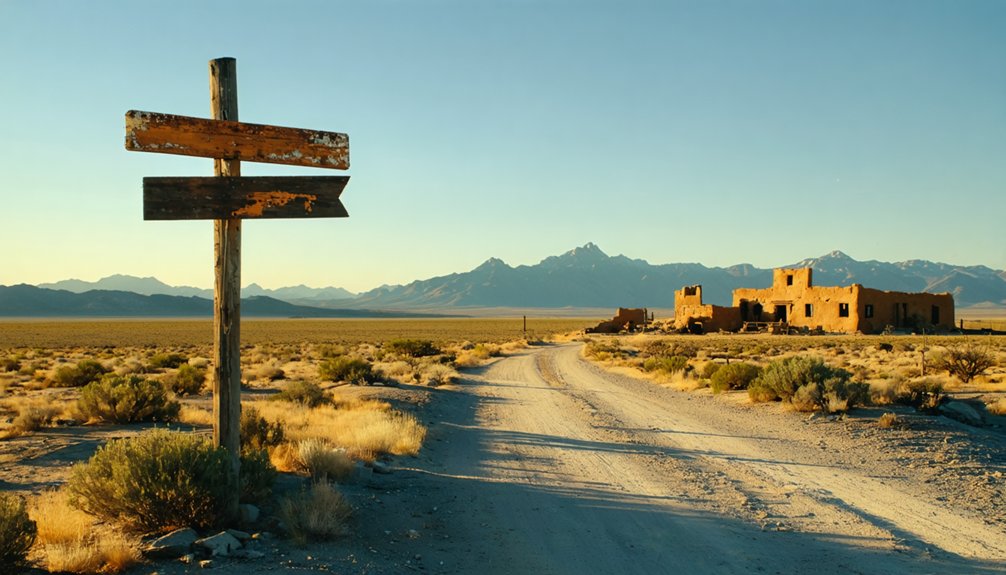
Recommended transportation options lean heavily toward high-clearance vehicles—these unpaved Taos County tracks punish sedans mercilessly. I’ve watched rental cars limp back with shredded undercarriages. Pack paper maps, offline GPS coordinates, and extra water. The 7,000+ foot elevation and remote desert location demand self-reliance. You’re genuinely off-grid here.
Best Times to Visit and What to Expect
You’ll find Servilleta accessible year-round via 2WD roads, though you should brace yourself for cold winters that sweep through this high-desert landscape. I’ve learned from visiting similar New Mexico ghost towns that packing extra water and sunscreen matters more than the calendar date—the sun punishes even in cooler months.
Since the site lacks formal operating hours or seasonal closures, your main consideration becomes weather preparedness rather than timing your visit around crowds or gate schedules.
Seasonal Weather and Accessibility
With four distinct seasons painting the high desert landscape in ever-changing hues, Servilleta’s weather demands careful planning for your ghost town exploration. You’ll find roads accessible year-round, though seasonal variability shapes your experience dramatically.
Spring’s April winds gust to 14 mph, while summer monsoons from July through August bring unpredictable precipitation and potential flash floods—time your photography for morning hours. Winter treats you to 70-75% possible sunshine and highs around 48°F in December, with snow-capped mountains framing your shots.
Fall delivers ideal conditions: September’s 83°F days and reduced rainfall let you roam freely. Pack synthetic layers for temperature swings from 33°F March mornings to 92°F July afternoons. That 280-day sunshine average means you’re rarely disappointed.
Crowd Levels Throughout Year
Servilleta rewards solitude-seekers with what most commercial ghost towns can’t deliver: genuine isolation. Winter brings cold that chases visitors away entirely—I’ve wandered cemetery trails without seeing another soul.
Spring thaws attract a handful of independent photographers chasing abandoned structures on quiet weekdays, but you’ll rarely encounter groups. Summer peaks slightly when road-trippers on US 285 pause for mining remnants, yet even July sees fewer than fifty daily visitors compared to hundreds at Mogollon.
Fall becomes ideal—mild weather without crowds, perfect for exploring at your own pace. With populations under thirty in similar outposts and limited accommodation forcing day-trip scheduling, Servilleta maintains its authentic remoteness year-round. Expect yourself, the wind, and history.
Operating Hours and Closures
Unlike preserved attractions with posted schedules, Servilleta operates on ghost town time—meaning there’s no gate, no ticket booth, and no closing bell. You’ll find accessible 2WD roads off US 285 leading to whatever remains stand today. There are no tour reservations required and no group size limitations to worry about—just you and the high desert ruins.
While neighboring ghost towns like Shakespeare demand advance scheduling at +1-545-542-9034 for guided experiences, and Lake Valley closes Tuesdays and Wednesdays, Servilleta lets you explore on your own timeline. Winter brings harsh cold to this elevation, so locals recommend inquiring about current conditions before heading out. You’re free to wander whenever the spirit moves you, though smart travelers confirm road access locally first.
Nearby Ghost Towns and Attractions Worth Adding
Your Servilleta adventure pairs perfectly with the Turquoise Trail between Albuquerque and Santa Fe, where Golden awaits with its 1854 structures and mayor-led tours down a quarter-mile dirt road. I’ve watched tarantula hawk wasps patrol the dusty paths here while learning mining stories that stretch back 170 years.
Madrid follows just up State Road 14, transforming from coal camp to artists’ colony with galleries tucked into weathered buildings that once housed miners.
Golden and Madrid Stops
While Servilleta offers solitude in New Mexico’s northern reaches, the ghost towns along the Turquoise Trail deliver a completely different experience—one where you can explore multiple sites in a single afternoon without dodging cattle guards on dirt roads.
These ghost towns to visit in New Mexico reveal the rich history and culture of the American Southwest. From abandoned mines to historic storefronts, each site tells a unique story of life in the desert. As you wander through these remnants of the past, you’ll also find stunning landscapes that provide an unforgettable backdrop for your exploration.
Golden and Madrid await just 10 miles apart on NM 14:
- Golden’s San Francisco Catholic Church (circa 1830) stands beautifully restored among scattered ruins and mining remnants
- Chat with Golden’s unofficial “Mayor” who maintains an eclectic roadside art gallery near the historic structures
- Madrid’s reinvented main street combines preserved coal-mining history with thriving art galleries and quirky attractions
- The entire loop from Santa Fe through Cerrillos, Madrid, Golden, and back via Tijeras takes half a day
I’ve photographed both towns multiple times—Golden delivers authentic abandonment while Madrid offers cold beer and functioning bathrooms.
Turquoise Trail Historic Route
The 63-mile stretch of NM 14 connecting Albuquerque to Santa Fe packs enough ghost towns, turquoise mines, and mountain scenery to fill an entire weekend, though most travelers blast past on I-25 in 90 minutes without realizing what they’re missing.
You’ll discover Cerrillos, where Puebloans extracted turquoise for trade thousands of years before Spanish colonizers shipped it to crown jewels. This boomtown once supported 21 saloons and now shelters 200 residents.
The route climbs through five life zones to Sandia Crest‘s 10,678-foot viewpoint, where you’ll spot Mount Taylor 65 miles distant. Stop at Tijeras, the “scissors” gateway where mountain ranges converge, and explore the thriving regional artist community that’s transformed mining camps into galleries. Turquoise mining history bleeds from every roadside marker.
Essential Tips for Your Servilleta Adventure

Planning your journey to this remote high-desert settlement requires attention to detail, since you’ll navigate washboard dirt roads that shake loose fillings and test your vehicle’s suspension. The local community involvement keeps this semi-ghost town alive, though restoration projects remain selective—some structures deliberately retain their weathered authenticity.
This living relic balances preservation with decay, where locals carefully choose which histories to polish and which to leave weathered by time.
Your Essential Checklist:
- Visit weekends May-October when the turquoise mining museum, galleries, and café operate
- Pack emergency supplies since health services are limited in this population-260 outpost
- Respect private property around decaying adobe structures from the 1890 fire rebuilds
- Allow full-day exploration including the 1.25-mile graveyard hike and five miles of Cerrillos Hills State Park trails
Sunday mass at 1922-built St. Joseph Church offers authentic small-town atmosphere minus tourist crowds.
Frequently Asked Questions
Are There Any Restrooms or Facilities Available in Servilleta?
You won’t find a single modern convenience in this utterly desolate ghost town. There’s absolutely nothing—no restrooms, water, or facilities. You’ll need nearby lodging options in Taos and should grab supplies from dining establishments nearby before venturing out.
Is Cell Phone Service Reliable in the Area?
Cell phone connectivity coverage is spotty at best in Servilleta’s remote desert location. You’ll likely encounter dead zones and unreliable cellular data speeds. Verizon and AT&T offer your best chances, but don’t count on consistent service here.
Can I Bring My Dog to Explore Servilleta?
You can bring your dog to explore Servilleta’s ruins, though pet friendly accommodations and dog walking trails don’t exist here. Keep your pup leashed, pack water, and watch for hazards around abandoned structures in this remote terrain.
Are There Any Entrance Fees or Permits Required?
The best things in life are free—Servilleta requires no entrance fees or permits. You’ll find no permitted visitation hours or guided tour availability, giving you complete freedom to explore this authentic ghost town whenever adventure calls.
What Safety Precautions Should I Take When Visiting Abandoned Buildings?
Watch out for structural issues like rotted floors and unstable walls—I’ve seen beams collapse without warning. Be cautious of wildlife seeking shelter inside. Never enter alone, wear sturdy boots, and always have an exit plan ready.