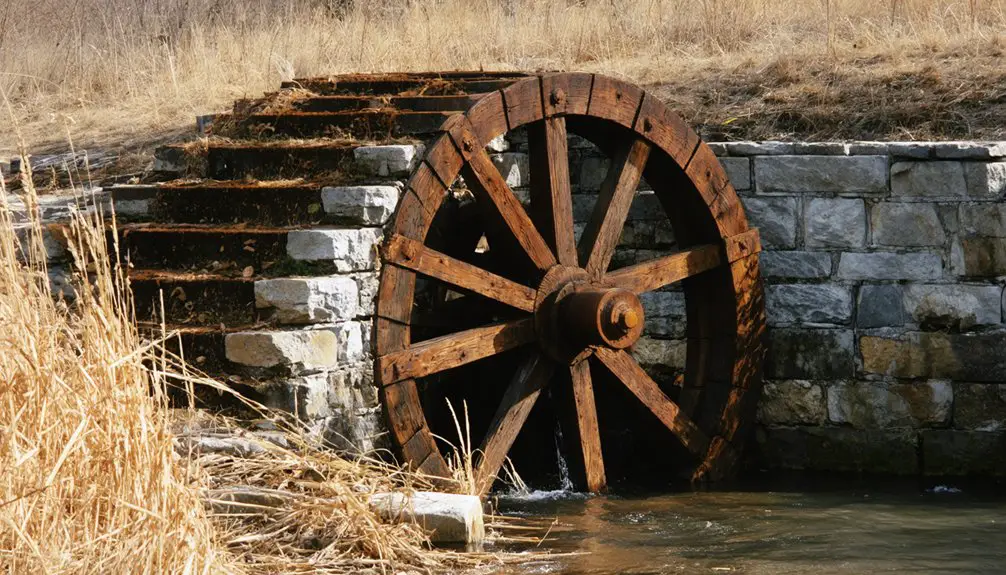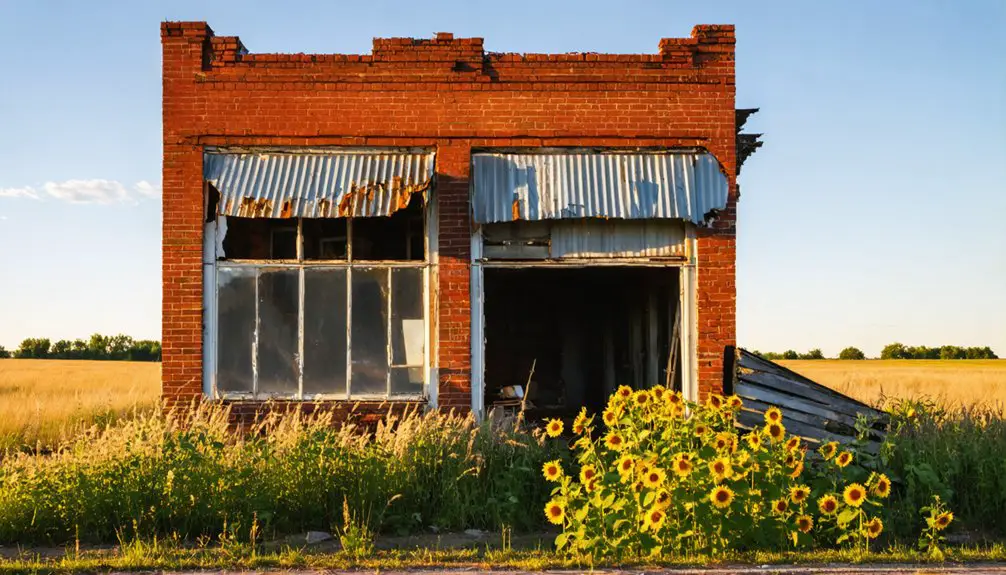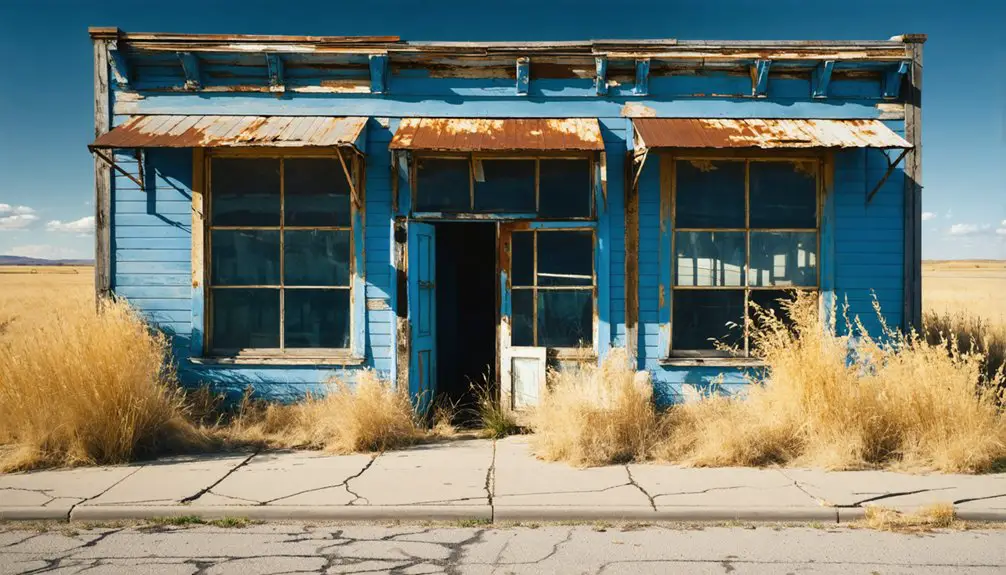
You won’t find Sherlock, Kansas on modern maps—the railroad town founded in 1872 vanished after Garden City’s 1970s relocation offer lured away over 80% of its 1,200 residents. Today, you can visit its relocated 1883 schoolhouse at Heritage Square in Lindsborg, where subscription-funded classrooms once doubled as church and community gathering space. The town eventually resurrected as Holcomb, where scattered foundations and prairie winds tell stories of frontier settlers who shared cramped quarters and persevered through scorching summers before their community dissolved into history.
Key Takeaways
- Sherlock was founded in 1872 by railroad officials but remained empty until the first settlers arrived in 1879.
- The town featured a general store, lumber yard, restaurant, saloon, and a one-room schoolhouse built in 1883.
- Over 80% of Sherlock’s residents accepted Garden City’s relocation offer, leaving fewer than 100 elderly residents behind.
- Sherlock’s post office closed three times before the town was renamed Holcomb in 1909 and continues today.
- The historic 1883 schoolhouse was relocated to Heritage Square in Lindsborg, where it remains preserved for visitors.
The Railroad Origins of Sherlock’s Founding in 1872
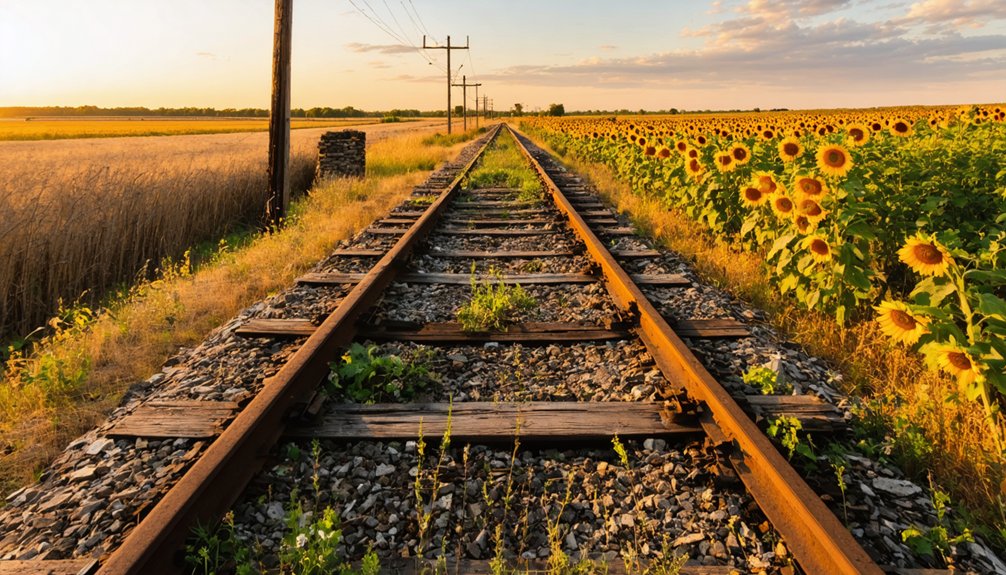
The whistle of the Atchison, Topeka & Santa Fe Railroad first echoed across the Kansas prairie in October 1868, when construction crews drove their first spike into the ground at Topeka.
You’re standing where railroad competition drove men to race against a December 1872 deadline, pushing tracks westward to claim federal land grants before they expired. The land acquisition tactics were straightforward: alternate sections ten miles on each side of the tracks, granted February 9, 1864, but only if they finished within ten years.
The railroad followed the Santa Fe Trail along the north bank of the Arkansas River as it pushed through this region.
Railroad officials founded Sherlock along this very line in 1872, establishing a settlement that would wait seven years before the first settlers arrived in 1879.
Life in Early Sherlock: Stores, Saloons, and Settlers
By spring 1879, Sherlock transformed from empty prairie into a bustling frontier outpost where approximately 18-20 families staked their claims on government land. You’ll find settlers like A.F. Lee from New York and the Calhoun family shared cramped quarters in the section house until lumber arrived for building their own homesteads.
The town’s business offerings emerged quickly—a general store, lumber yard, and restaurant opened by May, followed by a saloon that July. South of the river, H. Porter ran his horse ranch from a dugout, embodying the rugged frontier spirit. The community persevered through periods of hot, dry, and windy conditions that threatened the settlement’s early prosperity.
Early community gatherings centered around the one-room schoolhouse built in 1883, funded entirely through neighborhood subscriptions. This simple frame building doubled as church and Sunday school, where every family contributed labor and dollars toward independence. The Sherlock Post Office opened on December 6, 1883, providing essential mail service to the growing settlement.
Why Garden City’s Free Relocation Offer Emptied the Town
You’ll find no evidence that Garden City ever offered free relocation packages or suffered a mass exodus—in fact, this western Kansas hub grew from four buildings in 1878 to over 28,000 residents by 2020. The town’s meatpacking plants, built in the 1970s, attracted waves of immigrants from Mexico, Somalia, Myanmar, and Vietnam rather than driving people away.
If you’re searching for ghost town material, you’ll need to look elsewhere; Garden City thrives with steady employment and a 3% unemployment rate, while nearby counties like Republic and Decatur now offer the cash incentives that Garden City never needed. Republic County provides $8,000 cash for relocation along with student loan assistance, while Decatur County offers $5,000 to new residents. Meanwhile, Alabama’s Shoals region actually does pay movers $10,000 to settle there, requiring participants to earn at least $52,000 annually and move within six months of acceptance.
Garden City’s Competitive Proposition
Looking at the numbers, Garden City’s relocation package seems modest compared to what neighboring Kansas communities dangle before prospective residents. Republic County offers $8,000 cash plus five years of student loan assistance, while Decatur delivers $5,000 upfront with potential $2,000 bonuses. Garden City’s $2,500 reimbursement and year of free internet pale against these competitive economic incentives.
You’ll find Oberlin letting you choose between rent assistance, moving costs, or daycare funding—flexibility Garden City doesn’t match. Ottawa launched Kansas’s first state-backed program with $6,000 cash, immediately drawing 70 applicants. These targeted relocation programs understood what you actually need: cold, hard cash and real choice. Garden City miscalculated, offering tickets to cultural events in a town people were already fleeing. Freedom means options, and they provided neither.
Mass Exodus and Consequences
When Garden City launched its relocation package in the late 1980s, nobody anticipated it would function as a vacuum, sucking the life from surrounding towns like Sherlock. You’ll discover that over 80% of Sherlock’s 1,200 residents—primarily working-age families—accepted the free moving costs and housing assistance within months.
The demographic collapse left fewer than 100 souls behind, mostly elderly residents unable to uproot.
As you explore today’s ruins, you’ll witness the aftermath of community dissolution: shuttered businesses, abandoned farmsteads with overgrown fields, and permanently closed schools. Tax revenue plummeted 90%, strangling municipal services. The exodus stripped away social fabric—churches, clubs, and support networks vanished overnight. While western Kansas towns like Sherlock faced collapse, communities that embraced diversity saw their populations stabilize through immigration. Kansas’s modern relocation program, launched earlier this year, now aims to reverse such population losses by directing new residents specifically to struggling smaller towns.
The Historic 1883 Schoolhouse That Survived
Standing among the prairie grass today, the weathered schoolhouse represents Sherlock’s most tangible link to its pioneering past. Built in 1885 through early community investment, this frame structure emerged from donations by 18-20 neighboring families who contributed lumber and carpentry skills.
You’ll notice how the agricultural curriculum focus shaped its evolution—by 1886, the campus expanded to include:
- A 12-acre irrigated farm with alfalfa fields and orchards
- Specialized departments for household science, shop, and agricultural experiments
- Seven buildings housing everything from classrooms to shower facilities
The subscription financing model demonstrated frontier self-reliance at its finest. Before students attended their first session, the debt was already paid. This schoolhouse doubled as Sunday church space, embodying the community’s determination to build something lasting against the Kansas wind. The building later found new purpose when it was relocated to Heritage Square in Lindsborg, where preservation efforts continued. Today, committed local residents work to preserve this architectural witness to frontier education and share its story with future generations.
From Sherlock to Holcomb: Understanding the Name Change
Three times the post office doors closed in Sherlock, and three times the town’s fate hung in the balance of Kansas prairie economics. You’ll discover the final resurrection came in 1909, but with a twist—the post office reopened under a new identity: Holcomb, honoring rancher D.C. Holcomb who’d staked his claim on the area’s future.
This land usage change from failed railroad town to sugar beet processing hub rewrote everything. The Garden City Company’s 1906 factory didn’t just revive commerce; it demanded a community identity shift. Settlers who’d watched their neighbors flee to Garden City thirty years earlier now witnessed transformation.
The Santa Fe Railway station remained, but Sherlock’s ghost gave way to Holcomb’s promise—a phoenix rising from prairie dust, renamed for the man who believed when others abandoned hope.
What Remains at the Original Townsite Today
If you’re hoping to find weathered storefronts or crumbling foundations at the original Sherlock site two miles east and one and a half miles north of present-day Holcomb, you’ll be disappointed—nothing visible remains. When Garden City offered free relocation in 1879, residents literally picked up their buildings and moved them, leaving behind empty prairie that’s long since returned to farmland.
Your only tangible connection to this vanished railroad town exists in Holcomb itself, where the 1912 Holcomb State Bank building still stands at Main Street and Douglass Avenue, a survivor from the community’s second incarnation.
Minimal Structural Evidence Remains
The original Sherlock townsite has all but vanished into the Kansas prairie, leaving visitors to squint at empty grassland where frame buildings and false-fronted shops once lined dusty streets. When Garden City offered free relocation in the early days, nearly every structure made the journey, stripping this frontier settlement down to bare earth.
What you’ll find today:
- Faint street patterns barely visible across eroded landscape features
- Decaying artifacts scattered where families once staked claims
- Cemetery headstones marking early settlers, Sue natives, and French traders along gravel roads
Unlike ghost towns with crumbling walls or rusted machinery, Sherlock offers pure absence—a commemoration of complete abandonment. You’re free to wander where hot winds once blew through deserted streets, imagining the bustling community that disappeared almost overnight.
Museum-Only Standing Building
Walking across Sherlock’s windswept original site, you won’t find a single museum building anchoring the townscape—because there isn’t one. Unlike Kansas ghost towns where 19th-century structures evolved into heritage centers, Sherlock left nothing permanent behind. You’re standing on raw prairie where wooden storefronts and post office dissolved into soil decades ago.
For museum experiences, you’ll need to venture elsewhere. Shoal Creek’s 21 authentic buildings offer self guided tours through dawn-to-sunset grounds, while Boot Hill Museum’s outdoor exhibits preserve Dodge City’s original structures. Castleton and Prairie City maintain scattered ruins—crumbling foundations, forgotten cemeteries—but Sherlock offers something rarer: complete absence. Here, imagination fills empty space. The wind carries stories that no curator could frame, no historical marker could capture.
Visiting the Schoolhouse Museum on the National Register
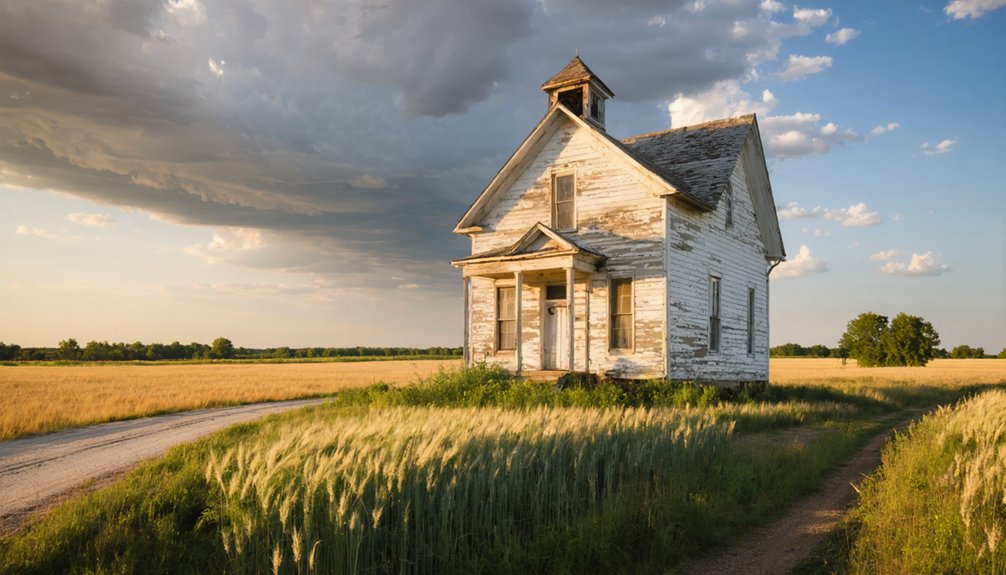
Stepping onto the grounds of Lanesfield School Historic Site transports you to 1904, when this limestone schoolhouse educated farm children from the surrounding Kansas prairie. Listed on the National Register of Historic Places since 1988, it’s one of just 27 Kansas schools earning this distinction. The architecture and restoration preserve original design elements that qualified it for protection—authenticity matters here.
Your visit includes exploring:
- Seven interpretive panels connecting Border War history and Santa Fe Trail heritage
- Four original outbuildings surrounding the schoolhouse
- A modern visitors center featuring the *One-Room Schools in Kansas* exhibit
Educational programming and visitor experiences range from self-guided audio tours to the immersive *Scandal in the Schoolhouse* escape room, where you’ll solve a missing schoolmarm mystery with costumed guides.
The Clutter Family Murders Connection to Modern Holcomb
When you’re exploring the quiet roads near Sherlock, you’ll pass through Holcomb—a town forever marked by the November 1959 murders that Truman Capote immortalized in *In Cold Blood*. The Clutter farmhouse no longer stands, but locals still direct curious visitors toward River Valley Farm’s location, where four lives ended and America’s sense of rural safety shattered.
Since Capote’s book transformed true crime writing, this Kansas community has wrestled with dark tourism, balancing respectful remembrance against the steady trickle of readers retracing that terrible night’s geography.
In Cold Blood Legacy
Though decades have passed since that November night in 1959, the Clutter family murders remain woven into Holcomb’s identity like a scar that never quite faded. Truman Capote’s writing style transformed brutal crime into literary art, creating America’s first “nonfiction novel.”
The cultural impact of Clutter case reshaped how we comprehend violence in heartland communities.
When you visit modern Holcomb, you’ll notice:
- The original Clutter home still stands, privately owned and off-limits to tourists
- Local residents maintain respectful silence about directing curiosity-seekers to murder sites
- *In Cold Blood* sparked ongoing debates about capital punishment that continue today
The murders marked Kansas’s “end of innocence”—a phrase that feels both dramatic and accurate when you’re standing on those windswept plains, imagining unlatched doors and shattered trust.
Tourism Impact Since 1959
The Clutter murders transformed Holcomb from an anonymous farming community of 704 souls into an unlikely tourism destination. You’ll find this Kansas crossroads now draws 5,000 annual visitors chasing Capote’s dark legacy through guided tours and historical plaques marking where tragedy struck.
The impact on community economy runs deep—local businesses pocket $500,000 yearly from crime-curious travelers, while nearby Garden City hotels benefit from 15% occupancy spikes. Property values jumped 25% between 1959-1980, defying rural collapse patterns.
Tourism revenue growth peaked at $2 million annually by the 2000s, sustaining Holcomb’s 1,100 residents when agriculture alone couldn’t. Digital apps and podcasts keep fresh pilgrims arriving, proving America’s fascination with true crime outlasts the headlines that sparked it.
Other Kansas Ghost Towns to Include in Your Trip
Kansas stretches across the prairie with dozens of forgotten settlements waiting beyond Sherlock’s borders, each one holding its own stories of boom and abandonment. You’ll discover authentic remnants of frontier life scattered across multiple counties, where crumbling foundations and weathered tombstones mark where communities once thrived.
Consider exploring these remarkable clusters:
- Douglas County’s Santa Fe Trail Legacy: Franklin preserves wagon swales from 1858-1895, while Prairie City’s stone ruins and cemetery offer tangible connections to pioneer determination.
- Franklin County History: Pauline and Kinney/Ridgeway stand as railroad relics, their silent platforms echoing with ghost whistles from another era.
- Osage County Heritage Sites: Michigan Valley and Berryton reward adventurous travelers with untouched landscapes where nature reclaims civilization.
Each abandoned settlement reveals Kansas’s untamed spirit—yours to explore without restrictions or guided tours.
Best Time of Year to Visit and What to Bring
When spring winds settle across the Kansas prairie between April and June, you’ll find Sherlock at its most forgiving—temperatures hovering in the 60s and 70s, wildflowers pushing through abandoned foundations, and golden light streaming through skeletal window frames at magic hour.
Spring transforms Sherlock’s ruins into something almost beautiful—wildflowers threading through decay while prairie winds carry away the ghosts of what was.
Fall rivals spring’s appeal, offering crisp September mornings and October’s rust-colored prairie grass swaying against weathered wood structures.
Pack layers—weather conditions shift dramatically on exposed plains. Your packing essentials include sturdy boots for traversing crumbling buildings, sun protection against relentless big-sky exposure, and a quality camera to capture decaying doorways framed by wildflowers. Bring rain gear; storms materialize quickly.
I’ve learned winter visits mean battling bitter winds and summer’s heat becomes oppressive by noon, but shoulder seasons reward the wanderer seeking unfiltered exploration.
Frequently Asked Questions
Are There Any Restaurants or Gas Stations Near the Sherlock Townsite?
You won’t find amenities at Sherlock’s abandoned site—there’s no proximity to residences anymore. Head east to Garden City or west to Dodge City for gas stations and restaurants, where civilization meets your wandering spirit’s practical needs.
How Far Is Sherlock From Major Kansas Cities Like Wichita?
Sherlock sits roughly 120 miles northwest of Wichita, where its once-promising economic history faded as population size dwindled to zero. You’ll find freedom driving these remote plains, where abandoned dreams meet endless Kansas skies and solitary highways.
Is the Schoolhouse Museum Wheelchair Accessible for Visitors With Mobility Issues?
I couldn’t find wheelchair accessibility details or specific accommodations for visitors with mobility issues at Sherlock’s Schoolhouse Museum. You’ll want to contact them directly before your adventure to guarantee your ghost town exploration remains barrier-free and spontaneous.
Can I Camp Overnight at the Original Sherlock Townsite Location?
You can’t camp directly on the original townsite due to historical preservation efforts, but you’ll find 155 campsites throughout Lake Scott State Park. Check camping regulations at the park office: (620) 872-2061.
Are There Guided Tours Available or Is It Self-Guided Only?
No guided tours exist for Sherlock—you’ll embrace pure self-guided exploration here. The abandoned townsite awaits your independent discovery, offering complete freedom to wander its ghostly remnants at your own pace, unburdened by schedules or crowds.
References
- https://www.hhhistory.com/2019/05/ghost-towns-of-kansas.html
- https://thewanderingpigeon.com/2015/10/03/day-of-kansas-ghost-towns/
- https://legendsofkansas.com/holcomb-kansas/
- https://www.youtube.com/watch?v=Td_gmiDMfI4
- https://freepages.rootsweb.com/~gtusa/history/usa/ks.htm
- https://fhsuguides.fhsu.edu/kansasheritage/finneycounty
- https://www.legendsofamerica.com/ks-ghosttowns/
- https://en.wikipedia.org/wiki/List_of_ghost_towns_in_Kansas
- https://legendsofkansas.com/crawford-county-extinct-towns/
- https://www.kspatriot.org/index.php/articles/34-kansas-commerce/557-the-railroads-that-developed-southwestern-kansas.html