Your ghost town road trip to Sherman, Wyoming, begins just 19 miles southeast of Laramie, where Interstate 80 climbs to 8,640 feet at Sherman Summit—coincidentally near where the original transcontinental railroad once crested at its highest point before relocating the tracks in 1901. You’ll discover the towering 60-foot Ames Monument, a granite pyramid designed by renowned architect Henry Hobson Richardson, standing sentinel over a historic cemetery with 53 graves marking where 1,500-2,000 hardy souls once called this wind-swept railroad hub home before abandoning it in 1918 when harsh winter conditions proved too brutal for operations—and there’s so much more to uncover about this fascinating mountain outpost.
Key Takeaways
- Travel 19 miles southeast from Laramie via Interstate 80 east to Vedauwoo exit at Wyoming Highway 329.
- Drive passes Sherman Summit at 8,640 feet, the highest point on Interstate 80 in the United States.
- Visit the 60-foot Ames Monument granite pyramid, a National Historic Landmark designed by Henry Hobson Richardson.
- Explore the historic cemetery with 53 remaining graves alongside the original 1918 railroad grade.
- Sherman thrived as a railroad hub at 8,062 feet elevation before abandonment in 1918 due to harsh conditions.
Getting to Sherman Ghost Town From Laramie
The journey from Laramie to Sherman Ghost Town carries you 19 miles southeast into the Laramie Mountains, where the original settlement once perched at a breathtaking 8,247 feet above sea level. You’ll take Interstate 80 east to the Vedauwoo exit at Wyoming Highway 329, though alternate travel routes along the Old Lincoln Highway offer a more authentic experience.
The drive passes Sherman Summit at 8,640 feet—I-80’s highest point—before you descend toward the ghost town site. Local businesses impact your planning since few services exist beyond Laramie, so fuel up before departing. The Ames Monument marks your destination, standing sentinel over the abandoned railroad grade where Sherman’s rough-and-tumble residents once thrived during the Union Pacific‘s heyday from 1867 to 1880. The town was named after General William T. Sherman, who played a significant role in western expansion during this era. A Sherman cemetery marker stone remains near the monument as a testament to the frontier community that once flourished here.
What Made Sherman a Thriving Railroad Hub
Upon reaching the Ames Monument, you’ll stand where Sherman once buzzed with the energy of America’s most ambitious engineering feat—the transcontinental railroad. At 8,062 feet, this highest point on the Union Pacific line demanded specialized infrastructure that drew 1,500-2,000 adventurous souls westward during the 1870s-1880s.
The economic influence was immediate—200 depot workers needed supplies, lodging, and entertainment, spawning saloons, hotels, and general stores. Workforce demographics reflected America’s entrepreneurial spirit: railroad managers, laborers, merchants, and families fleeing eastern constraints for opportunity.
The depot’s 50,000-gallon water tanks and machine shops served locomotives traversing the Sierra Madre Mountains, while freight operations moved cattle, timber, and minerals through this essential hub. Sherman represented freedom through mobility—connecting a nation’s eastern roots with western possibilities.
Why This Mountain Town Became Abandoned
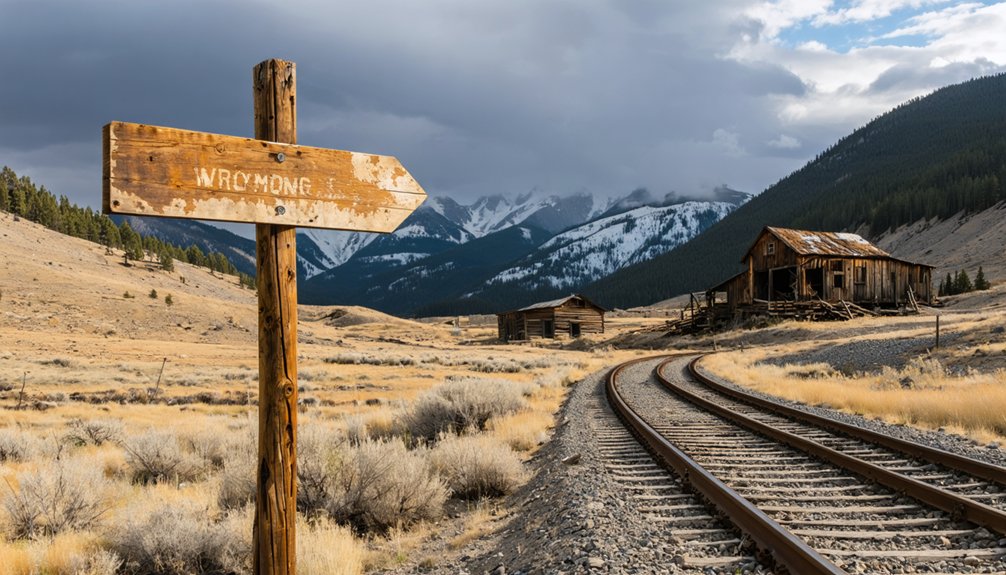
When engineering ambition collided with mountain geography, Sherman’s fate was sealed. You’ll discover that steep mountain terrain at 8,247 feet elevation created operational nightmares for the Union Pacific.
At 8,247 feet, Sherman’s extreme elevation proved too challenging for railroad operations, dooming the mountain settlement from the start.
Harsh winter weather patterns made maintaining this exposed station nearly impossible. The constant strong breeze and hard-packed snow made conditions particularly challenging for railroad operations.
The railroad’s decision to relocate tracks 3.42 miles south in 1901 spelled doom:
- Double-heading locomotives were required just to conquer the brutal grades from Laramie
- Dale Creek embankment construction shifted tracks several miles away from the original route
- Lower-elevation alternatives offered flatter, more economical paths through the Laramie Mountains
- Station closure in 1918 triggered immediate abandonment by the few hundred residents
Within months of the tracks moving, Sherman transformed from a bustling railroad hub into the windswept ghost town you’ll explore today. The town had sprung up remarkably fast, boasting various establishments within just 15 months of the railroad reaching Sherman Hill.
The Ames Monument and Historic Cemetery
You’ll encounter the stark 60-foot granite pyramid rising from the windswept summit at 8,247 feet—a monumental tribute designed by Henry Hobson Richardson and completed in 1882 to honor the Ames brothers’ role in the transcontinental railroad.
The rough-hewn blocks and nine-foot bas-relief portraits by Augustus Saint-Gaudens create an imposing presence against Wyoming’s vast sky. The granite blocks were quarried from Reeds Rock, located just one-half mile west of the monument site.
Just beyond the monument, you can explore the historic cemetery where weathered markers, including young Lester Hecker’s prominent 1883 headstone, tell stories of Sherman’s brief existence as a railroad town. Sherman once stood at the highest point on the transcontinental railroad until the line was relocated several miles south in 1918.
Monument’s Pyramid Design History
The granite pyramid rising from Wyoming’s windswept plains stands as one of America’s most distinctive railroad monuments. Richardson’s architectural influence transformed rough-hewn granite blocks into a 60-foot testament tribute to the Ames brothers’ railroad legacy. Saint Gaudens’ sculptural details—bronze medallions of Oakes and Oliver—anchor the structure’s east and west faces.
The monument’s creation story reveals impressive details:
- Local Materials: Workers quarried granite from “Reed’s Rock” just half a mile west
- Massive Investment: The Union Pacific spent $65,000 in 1882 dollars
- Architectural Prestige: This remains Richardson’s only commission west of St. Louis
- Strategic Location: Positioned at 8,247 feet, marking the transcontinental route’s highest point
You’re standing before what Richardson’s biographer called “the finest memorial in America”—a bold statement on freedom’s frontier. The structure earned recognition as a National Historic Landmark in July 2017, cementing its place in American railroad history. The railroad tracks themselves were relocated several miles south in 1901, leaving the monument in its isolated position on the plains.
Cemetery Access and Markers
Beyond the monument’s granite walls, a quarter-mile trail winds westward through sagebrush toward Wyoming’s most forgotten cemetery. You’ll find a weathered stone marker erected in 1958, declaring Sherman Cemetery’s brief existence from 1867 to 1880. The fenced plot spans just 6,048 square feet, holding 53 remaining graves—twelve women, forty-one men—nearly all unmarked except one heartbreaking headstone for Lester C. Hegkert, an infant who died in 1883.
Cemetery maintenance conditions reflect decades of abandonment. There’s no gate at the trampled entrance, and disturbed earth reveals grave locations through scattered rocks and struggling shrubs. The cemetery sits alongside what was once the original railroad grade, which the transcontinental tracks followed from the 1860s until 1918. Old gravestones documentation shows most bodies were relocated after Sherman’s railroad closure in 1918. What remains is authentically derelict—a windswept chronicle to frontier impermanence at 8,247 feet elevation.
What You Can Still See at the Site Today
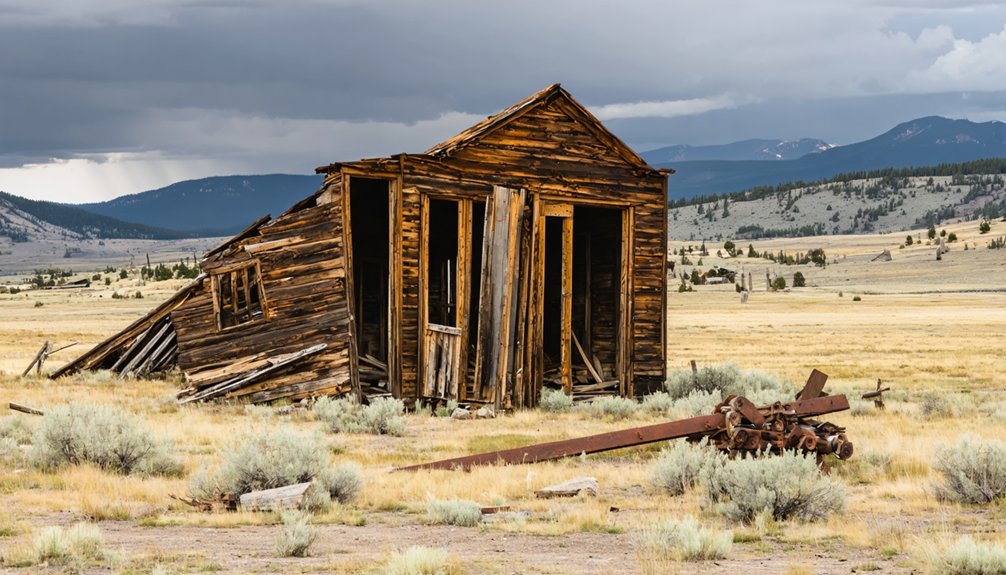
Standing solitary on the windswept Wyoming prairie, the 60-foot granite pyramid of the Ames Monument dominates the landscape as the site’s most dramatic survivor. You’ll find this remarkable structure designed by H.H. Richardson rising from the earth at 8,247 feet elevation, though weather and vandalism have damaged some features since its 1882 completion.
Here’s what remains at Sherman today:
- The Monument Itself – Bas-relief portraits by Augustus Saint-Gaudens on the pyramid’s faces, with memorial plaque features explaining the brothers’ railroad legacy. An interior passage runs alongside the perimeter of the base, offering visitors a unique architectural element.
- Pioneer Cemetery – 53 unmarked graves a quarter-mile north, including one headstone for HEGKERT
- Monument viewpoint perspectives – Sweeping vistas across the high plains from the railroad’s original highest point
- Empty Prairie – Zero town structures, just wind and grass where Sherman once thrived
Combining Your Visit With Vedauwoo Park
After exploring Sherman’s remnants, you’ll find Vedauwoo Park just minutes away along I-80, where 1.4 billion-year-old granite formations rise dramatically from Pole Mountain’s landscape.
This ancient wonderland offers everything from world-class rock climbing on weathered hoodoos to peaceful hikes through meadows where deer and moose roam beneath towering Limber pines. Plan to spend at least half a day here—the combination of ghost town history and Vedauwoo’s natural splendor creates an unforgettable Wyoming adventure that’s worth the extended stop.
For those seeking more excitement, there are numerous road trip destinations in Wyoming that showcase the state’s breathtaking landscapes and unique attractions. From the iconic Grand Teton National Park to the historic sites in Cody, each stop offers its own distinctive experience. Be sure to explore the wide-open spaces and charming towns that make this region truly special.
Nearby Recreational Activities Available
Just twenty minutes east of Sherman’s weathered ruins, Vedauwoo Recreation Area transforms your ghost town expedition into an outdoor adventure playground.
This 1.4 billion-year-old granite wonderland offers unrestricted exploration across its dramatic landscape:
- Rock Climbing Routes: Over 700 established climbs on Sherman Granite, from beginner 5.0 to expert 5.14, making it North America’s premier offwidth destination.
- Mountain Biking Trails: Navigate everything from smooth doubletrack through secluded prairies to technical singletrack winding through aspen groves and pine forests.
- Hiking Access: Trek the 3-mile Turtle Rock Loop or ascend Box Canyon Trail to Glen Dome’s panoramic Medicine Bow Mountain vistas.
- Camping Freedom: Claim one of 28 first-come campsites beneath towering rock formations for $10 nightly, with a generous 14-day limit.
You’ll encounter deer, moose, and raptors while exploring this high-altitude sanctuary.
Scenic Route Connection Points
The historic railroad corridor linking Sherman to Vedauwoo creates a natural loop that’ll maximize your exploration of Wyoming’s high country. Exit I-80 at Wyoming Highway 329, sixteen miles east of Laramie, then follow the graded road south toward Ames Monument. You’ll trace original grade contours visible on Google Earth, connecting these two remarkable destinations through the route Union Pacific abandoned in 1918.
The spur that once linked Sherman to Vedauwoo remains traceable across the landscape, offering adventurous souls a chance to discover railroad artifacts along the the forgotten right-of-way. This scenic integration lets you experience towering granite formations at Vedauwoo before traversing to Sherman’s ghostly remnants, creating an unforgettable journey through railroad history and Wyoming’s rugged Laramie Mountains terrain.
Suggested Time Allocation Tips
When planning your dual-destination adventure, budget four to five hours for a satisfying exploration of both Sherman’s ghostly railroad remnants and Vedauwoo’s granite wonderland. This timeline gives you freedom to wander without rushing through either location’s unique character.
Optimal time breakdown:
- Sherman exploration (1-1.5 hours): Navigate the Ames Monument’s pyramid, cemetery headstones, and windmill foundations while accounting for weather conditions at 8,247 feet
- Commute (40 minutes): Travel southeast on I-80 to Vedauwoo’s granite formations
- Vedauwoo adventures (2-3 hours): Hike Turtle Rock trails with photography opportunities among towering boulders
- Seasonal adjustments: Trim winter visits to three hours total; extend summer explorations when mountain conditions permit extended trail time
Start early morning for ideal lighting and manageable crowds.
Frequently Asked Questions
Is Camping Allowed Near the Sherman Ghost Town Site?
Camping isn’t specifically mentioned for Sherman’s ghost town site. You’ll want to explore nearby lodging options in the area, as developed camping amenities require permits at Wyoming state parks. Check local regulations before setting up camp anywhere.
The history of Sherman, Wyoming town reveals a rich past marked by early settlers and the challenges they faced in a rugged landscape. Many visitors are drawn to the remnants of this town to experience its unique stories and understand the significance of its role in the development of the region. Exploring the historic sites can provide a fascinating glimpse into the lives of those who once called this place home.
What Time of Year Is Best to Visit Sherman?
You’ll find the best visiting months are May through September when seasonal weather patterns cooperate with your adventure spirit. Summer offers full access to trails, while shoulder seasons deliver solitude and wildlife encounters without crowds cramping your freedom.
Are There Guided Tours Available for the Ghost Town?
No guided walking tours operate at Sherman’s ruins—you’ll explore independently. However, nearby Cheyenne offers virtual ghost town tours and haunted experiences. For structured visits, try Laramie Plains Museum’s docent-led tours or self-guided exploration at Ames Monument.
Do I Need a Four-Wheel Drive Vehicle to Reach Sherman?
You won’t need four-wheel drive for this adventure! Interstate 80 provides surprisingly easy access despite Sherman’s remote location. Most vehicles handle the route fine during summer, making difficulty accessing site virtually nonexistent under good conditions.
Can I Take Artifacts From the Sherman Ghost Town Site?
No, you can’t take artifacts from Sherman. Federal and state laws strictly prohibit collecting historical items or disturbing archeological sites on public lands. Violations carry hefty fines up to $10,000 and potential imprisonment, protecting these irreplaceable treasures for future generations.
References
- https://kids.kiddle.co/Sherman
- http://www.apcrp.org/Roads Less Traveled/SHERMAN_WY/Sherman_Mast.htm
- https://www.eastonmahistoricalsociety.org/bi-weekly-newsletters/bi-weekly-newsletter3376007
- http://www.wyomingtalesandtrails.com/sherman4.html
- https://www.trainorders.com/discussion/read.php?1,5438646,newer
- https://www.visitlaramie.org/listing/ames-monument/271/
- https://en.wikipedia.org/wiki/Sherman
- https://www.geowyo.com/vedauwoo.html
- http://www.wyomingtalesandtrails.com/sherman.html
- https://sites.rootsweb.com/~wytttp/ghosttowns.htm