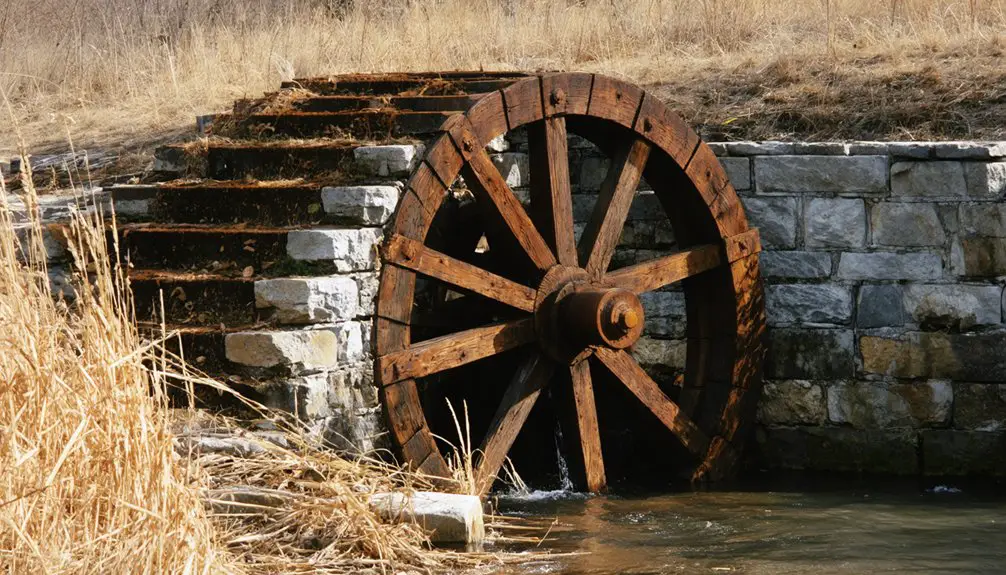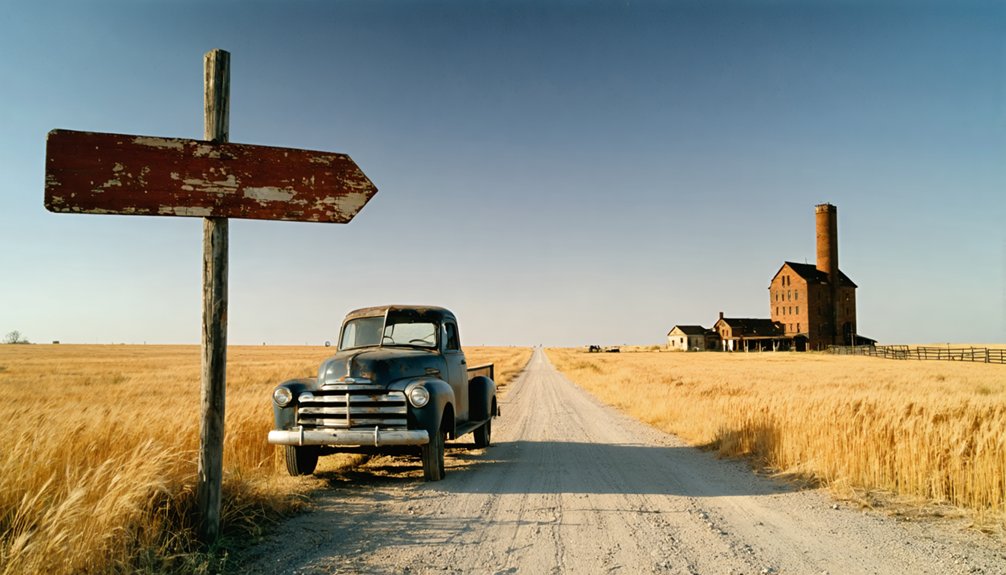
You’ll find Sibley about 5-7 miles north of Concordia in Cloud County, though there’s no public access to the privately-owned farmland where the town once stood. What remains are scattered ruins—a weathered stone marking 11-year-old Ezra Adkins’ 1869 death, crumbling schoolhouse walls, and a depression where Lake Sibley vanished long ago. The gravel roads leading here whisper of a settlement that dreamed of becoming county seat before losing everything to Concordia by just 36 votes, and the tragic stories etched into this landscape reveal why ghost town enthusiasts consider it haunted ground.
Key Takeaways
- Sibley is located 5-7 miles north of Concordia in Cloud County, accessible via gravel roads and farm paths.
- The townsite sits on private farmland with no public access, making trespassing illegal and viewing impossible from roads.
- Key historical markers include the Ezra Adkins stone memorial and schoolhouse ruins along nearby roads outside the property.
- Concordia, which defeated Sibley for county seat in 1870, offers a base for exploring the region’s pioneer history.
- The town’s remains are minimal—dried lakebed, working fields, and scattered markers—with little visible evidence of the settlement.
Getting to Sibley: Routes and Landmarks
The coordinates 39°36′54″N 97°42′5″W mark a place that barely exists anymore, a whisper of settlement in Cloud County’s farmland north of the Republican River. You’ll start from Concordia, five to seven miles south, following routes that wind northward through Sibley Township. Gravel road considerations become essential here—these aren’t highways but working farm paths that demand respect and a vehicle that won’t fail you.
The Ezra Adkins stone marker stands as your primary landmark, commemorating an eleven-year-old boy killed during an 1869 Indian attack. Look for Lake Sibley’s depression, though the water vanished long ago. The schoolhouse remains offer tangible proof someone once called this home. Founded in 1869, Sibley began with hopes of becoming county seat, but lost the competition to another town. The name Sibley appears across diverse contexts, from New York department stores to Michigan shoe retailers, though this Kansas ghost town shares only nomenclature with these commercial enterprises. Nearby attractions for visitors cluster around Concordia, but out here, you’re chasing shadows across privately-owned land.
What Remains of the Ghost Town Today
When you finally reach Sibley’s coordinates, you’ll find only working farmland where a hopeful town once thrived—the site remains privately owned, so you’ll need to view it from the roadside.
A weathered stone marker commemorates young Ezra Adkins, the eleven-year-old boy killed by Indians in 1869, standing as the most prominent memorial you can actually visit.
The schoolhouse ruins and a handful of historical plaques scattered along nearby roads offer the only tangible proof that hundreds of people once built their dreams here beside the vanished Lake Sibley. Like many Kansas settlements, Sibley fell victim to economic depressions that drew its residents toward larger, more prosperous cities. Exploring these remnants provides insights into the history of Kansas’s frontier settlement period and the challenges faced by early pioneers.
Private Farmland Access Only
Unlike Kansas ghost towns where crumbling schoolhouses still stand sentinel over prairie grass or weathered church steeples pierce the horizon, Sibley has vanished so completely you’d never know a town once thrived here. The coordinates 39°36′54″N 97°42′5″W mark exclusively private farmland where limited agricultural activities have erased every trace of the settlement that existed from 1868-1876.
The history of Sibley, Kansas ghost town is largely forgotten, as its existence has been reduced to mere whispers carried by the wind across the fields. Once a bustling community, Sibley was home to various businesses and families who contributed to its short-lived prosperity. Today, only the stories of its past remain, waiting to be rediscovered by those curious enough to explore the area’s rich but fleeting history.
You won’t find access to this ghost town because:
- Active farmland operations prohibit all trespassing on the converted townsite
- No public viewing areas or designated pulloffs exist along nearby roads
- Agricultural equipment and crops occupy the exact location where pioneers built homes
- Potential land donation remains unlikely given the property’s productive farming use
The dried-up Lake Sibley and scattered fields offer no glimpse into this vanished frontier settlement. While many Kansas ghost towns lie within a few hours’ drive of population centers, Sibley’s complete erasure makes it an exception to the state’s typical abandoned sites.
Exploring ghost towns near Williamsport Kansas can unveil stories of the past, where communities once thrived. Each site carries remnants of old structures and faded histories that invite exploration and contemplation. Despite the lure of these forgotten places, few compare to the stark absence left by the loss of Sibley, making the journey even more poignant.
Historical Markers and Memorials
Although the townsite itself remains inaccessible behind farm fences, two haunting remnants survive to mark Sibley’s brief existence on the Kansas frontier. The Ezra Adkins memorial stone stands as one of Kansas’s most sobering regional tributes—commemorating the eleven-year-old son of Homer and Hannah Adkins, killed by Indians on June 2nd, 1869. He was Cloud County’s last victim of Indian conflict.
Nearby, the crumbling schoolhouse ruins whisper of pioneer families who settled this township from 1860 onward, building educational infrastructure before the town vanished. These markers aren’t officially preserved sites—just weathered stone and collapsing walls on private farmland. Similar authentic log cabins containing antiques from the Santa Fe Trail era can be found at historical parks throughout Kansas, preserving the material culture of frontier life. In Missouri, the Missouri Daughters of the American Revolution placed twenty-nine granite markers along the original Santa Fe Trail route between 1912 and 1913, creating a permanent memorial to this vital commercial highway. Yet they’re powerful legacies to the violence, hope, and ultimate abandonment that defined so many frontier communities across the Great Plains.
The Rise and Fall of a Would-Be County Seat
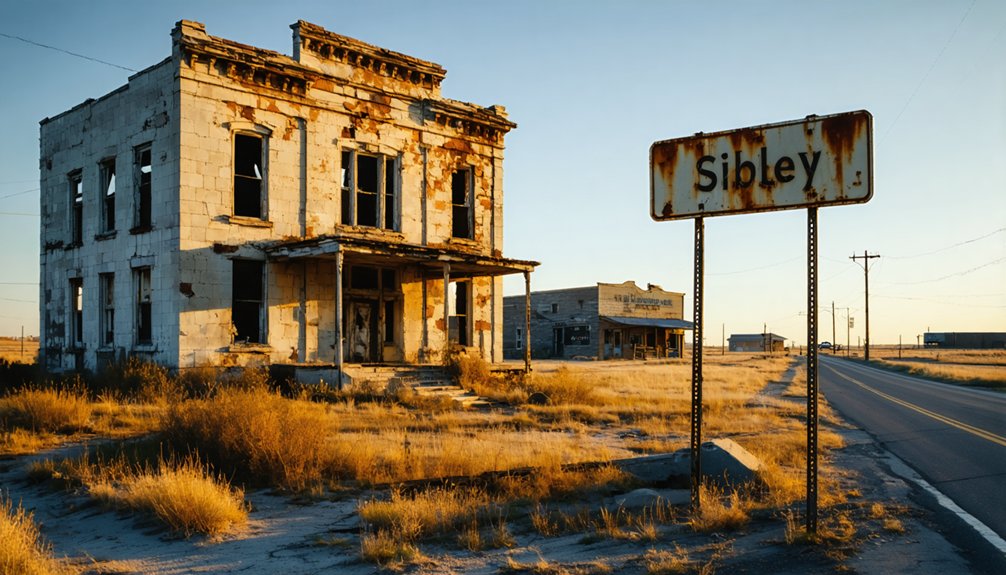
Standing in this empty Kansas field, you’re witnessing the exact spot where ambition died in 1870. Sibley’s founders dreamed of government offices, courthouses, and bustling commerce—a vision that crumbled when Concordia won the county seat election by a margin that sealed this settlement’s fate.
What might’ve become a thriving regional hub instead became a cautionary tale about how a single vote could determine whether a frontier town flourished or faded into prairie grass.
Sibley’s Ambitious County Seat Bid
When homesteaders first staked their claims along Lake Sibley’s shores in the late 1860s, they envisioned more than another prairie settlement—they dreamed of building Cloud County’s administrative heart. Sibley’s political ambitions burned bright, fueled by the town’s geographic advantages near the Republican River’s strategic corridors.
The aspiring county seat boasted compelling credentials:
- Prime location along established river routes connecting frontier communities
- Growing infrastructure including a post office and commercial district
- Strong agricultural base with Swedish, Norwegian, and English homesteaders
- Early establishment in 1866, positioning it as a settlement pioneer
You can still sense that frontier optimism walking the empty grasslands today. These determined settlers saw themselves competing directly with Concordia, confident their thriving community would become the region’s administrative powerhouse. The town’s namesake, George Champlin Sibley, had explored these same Kansas lands decades earlier, leading expeditions that helped establish the Santa Fe Trail. They’d bet everything on a future that never materialized.
The 1870 Election Defeat
December 1869 brought Cloud County’s settlers to a crossroads that would reshape the prairie’s destiny. You’ll discover how Sibley faced Concordia and Clyde in that first contested election, with no town claiming the decisive majority needed.
The stakes intensified when organizers scheduled a January 4, 1870 runoff between Sibley and Concordia, eliminating Clyde from alternate county seat proposals.
When ballots were counted, Concordia secured 165 votes against Sibley’s 129. That 36-vote margin sealed Sibley’s fate forever. The victors hastily erected a modest 16-by-20-foot courthouse, though commissioners abandoned it after just two meetings for Clyde’s superior facilities.
Meanwhile, Sibley’s dreams crumbled. Businesses began their exodus toward Concordia, leaving behind empty storefronts where ambitious merchants once envisioned a thriving county hub. By 1870, Concordia’s first buildings were constructed and a post office opened, cementing the new county seat’s permanence while Sibley faded into obscurity. The victorious town’s name honored Concordia, the Roman goddess of agreement in marriage and society, a fitting choice for a community forged through electoral consensus.
Concordia’s Victory, Sibley’s Demise
The courthouse victory that January morning extinguished Sibley’s future like a lantern snuffed in prairie wind. Concordia’s strategic planning had outmaneuvered every hopeful settler who’d staked claims along Lake Sibley’s shores. You’ll find nothing but wheat fields where ambition once burned.
Sibley’s demographic shift unfolded with brutal efficiency:
- Government offices centralized in Concordia, draining administrative purpose from rival settlements
- Merchants followed the county seat, abandoning storefronts for guaranteed customer traffic
- Families relocated within months, seeking schools and services only county headquarters could sustain
- Lake Sibley dried to cracked mud, removing the water source that justified the town’s existence
Lake Sibley: The Vanished Waterway

Nestled in the center of Cloud County’s northern tier, Lake Sibley once spread its semi-circular waters just north of the Republican River, a mere five miles from where Concordia would rise to claim the county seat. You’d have found natural habitats around the lake teeming with wildlife in those early days, when the town’s post office served settlers heading west toward the Dark Meadows.
The Republican River sealed the lake’s fate in 1902, shifting course and absorbing those waters through boundary changes. By 1953, official records confirmed what locals already knew—the lake had drained completely. Today, you’ll search in vain for that waterway. Only private farmland remains where pioneers once established ferries and dreamed of greatness.
Tragic Tales and Local Legends
Like most frontier settlements, Sibley accumulated its share of tragedy alongside hope. You’ll discover tragic family histories woven into the landscape itself—stories that fuel Sibley’s haunted reputation among Kansas ghost town enthusiasts.
The most chilling tales include:
- Ezra Adkins’ Death – An eleven-year-old boy became Cloud County’s last Indian raid victim near town. A stone marks where he fell, though his remains rest on the family homestead.
- The Nelson Cabin Raid – Indians ransacked this dwelling before attacking the Adkins family home, using it as their staging ground.
- Ladies of the Lake – Spinster schoolteachers Adell and Hannie Poore walked hand-in-hand into the lake in 1889, fearing tuberculosis. They left their wills in a cracker box.
- Lost Dreams – The 1870 county seat loss to Concordia shattered residents’ ambitions forever.
Fort Sibley and Early Settlement Sites
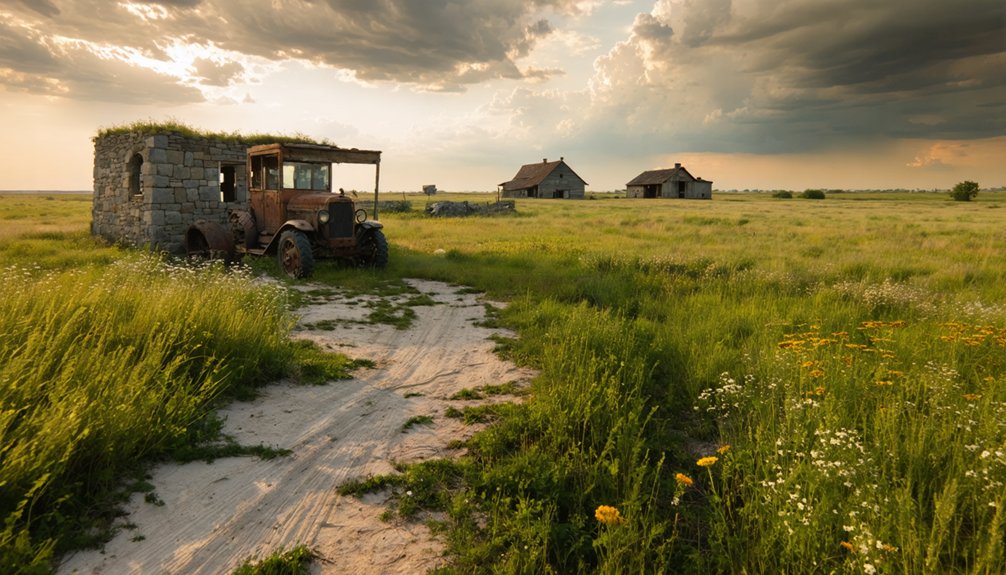
Before Sibley, Kansas became a ghost town, it began as Fort Sibley—a rough cluster of sixteen log houses on the Republican River’s north bank where settlers huddled together against the threat of raids. You’ll find where Scandinavian and English homesteaders carved out early settlers’ lives starting in 1860, staking claims at Lake Sibley despite frequent encounters with Otoe and Pawnee bands. The Schaefer cabin burned during an 1863 Cheyenne battle—testament to the violence that shadowed their agricultural enterprises.
Best Time to Visit and What to Bring
When should you explore the windswept remnants of Sibley? Weather considerations point toward late May through mid-September, when temperatures climb above 83°F and the prairie comes alive. Mid-July brings scorching 93°F highs—perfect for those who don’t mind heat radiating off abandoned foundations.
Late May through mid-September offers ideal conditions, with temperatures soaring above 83°F as the Kansas prairie awakens from its slumber.
Your clothing recommendations depend on timing:
- Summer explorers need lightweight, breathable fabrics and wide-brimmed hats for protection against relentless Kansas sun
- Spring adventurers should pack layers and rain gear—April through early September brings unpredictable storms
- Winter wanderers require serious cold-weather gear when temperatures plunge to 23°F
- Year-round essentials include sturdy boots for uneven terrain and sunscreen for those 230 brilliant Kansas days
Wind gusts averaging 11-14 mph will accompany your journey regardless of season.
Nearby Attractions in Cloud County

Your boots will carry dust from Sibley’s forgotten streets into Concordia, where Cloud County’s living history stands in stark contrast to the ghost town’s silence.
Touring Cloud County’s museums reveals stories too stubborn to fade—the National Orphan Train Complex holds 250,000 children’s journeys within its depot walls, while a 1908 Carnegie Library shelters a Lincoln-Page biplane and Martha Washington’s own words from 1793.
Cloud County’s historic buildings wear their scars proudly: the five-story Nazareth Convent pierces the prairie sky with seven-story towers, and Camp Concordia’s fields remember German POWs who worked Kansas soil.
Between them stretches the nation’s longest sculpted brick mural, 140 feet of sunflowers and trains rendered in 6,400 bricks—a monument to persistence.
Respecting Private Property While Exploring
The crumbling threshold between public curiosity and private domain demands your attention long before you step from your vehicle. Kansas’s abandoned structures still belong to someone—respecting local ordinances and adhering to private property laws protects both your freedom and theirs.
Abandoned doesn’t mean unowned—Kansas’s decaying structures remain private property demanding your respect before satisfying your curiosity.
Essential boundaries to honor:
- Survey from roadways only—trespassing on unoccupied land remains illegal regardless of decay’s romantic allure
- Recognize posted signage—faded “No Trespassing” warnings carry full legal weight after decades
- Contact owners directly—county records reveal property holders who often grant permission when asked respectfully
- Document without entering—telephoto lenses capture architectural ghosts without crossing fence lines
Sibley’s skeletal remains whisper stories accessible without transgression. Your wanderlust needn’t compromise another’s rights, even when those rights guard nothing but wind-hollowed shells and splintered memories.
Frequently Asked Questions
Are There Any Guided Tours Available for Exploring Sibley’s History?
No guided tours exist for Sibley’s exploration. You’ll discover this ghost town through self-guided walking tours across private farmland, where informative local signage remains scarce. You’re free to wander independently, piecing together history through weathered remnants and imagination.
Can I Camp Overnight Near the Former Sibley Town Site?
You won’t find public camping facilities nearby at the former Sibley site itself, raising potential trespassing concerns. Instead, you’ll need to venture to Tuttle Creek State Park’s campgrounds, where freedom meets legal overnight stays under Kansas stars.
Where Can I Find Historical Documents or Photographs About Sibley?
You’ll discover authentic Sibley photographs and documents at Cloud County Historical Museum’s archives in Concordia. Their local library collection preserves pioneer interviews, original maps, and newspaper accounts that bring this vanished prairie settlement’s story vividly alive.
Are There Any Annual Events Commemorating Sibley’s History?
You’ll find the Cloud County Museum’s Sibley History Program each April, where historical reenactments bring vanished Fort Sibley to life. While cultural festivals focus on regional heritage, these intimate gatherings celebrate your freedom to explore forgotten frontier stories.
What Safety Precautions Should I Take When Visiting the Area?
The wilderness here swallows cell signals whole—you’ll vanish without a trace. Bring reliable communication devices, multiple backups. Avoid isolated areas after dusk when crumbling structures become death traps. Pack emergency supplies like you’re preparing for apocalypse survival.
References
- https://kids.kiddle.co/Sibley
- https://lostkansas.ccrsdigitalprojects.com/sites/lostkansas/files/private_static/2022-12/LT_CD_Sibley_Woellhof.pdf
- https://bladeempire.com/stories/uncovering-the-history-of-sibley
- https://legendsofkansas.com/cloud-county-extinct-towns/
- https://krex.k-state.edu/items/b686a787-b9b9-41cc-a027-73ff64d9930c
- https://en.wikipedia.org/wiki/Sibley
- https://everafterinthewoods.com/abandoned-ghost-towns-in-kansas-that-still-hold-stories-of-the-past/
- https://en.wikipedia.org/wiki/List_of_ghost_towns_in_Kansas
- https://commons.wikimedia.org/wiki/File:Map_highlighting_Sibley_Township
- https://legendsofkansas.com/douglas-kansas-county-extinct-towns/