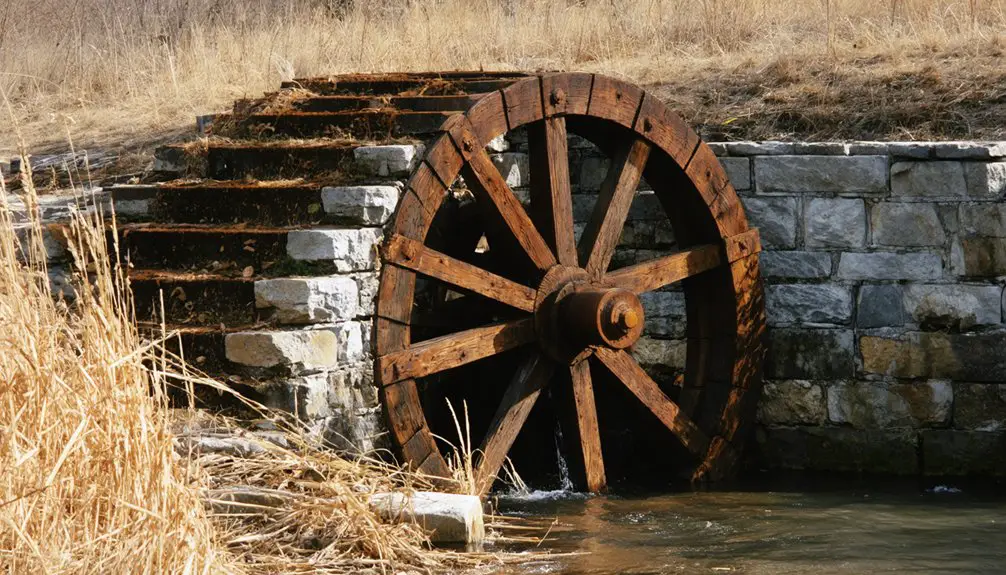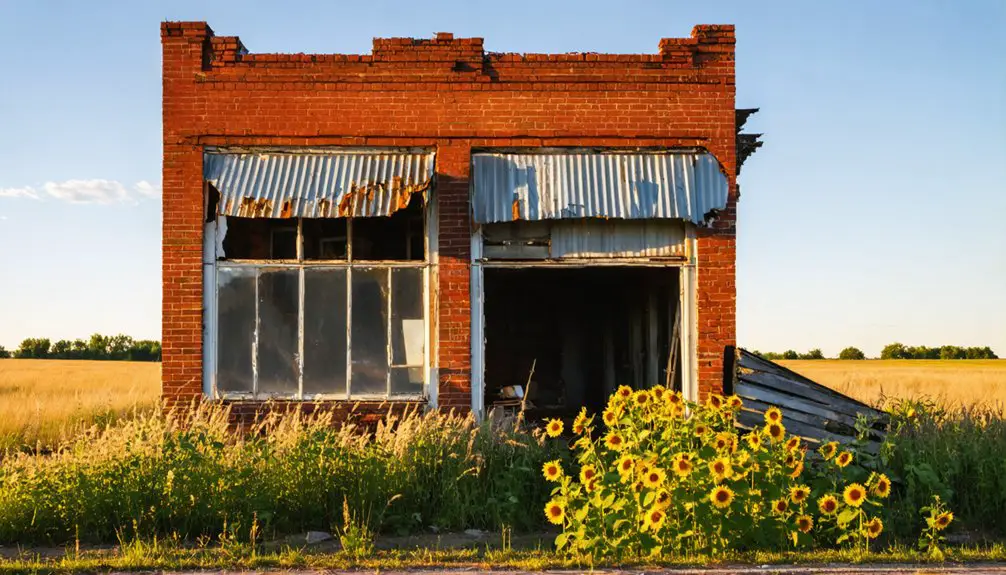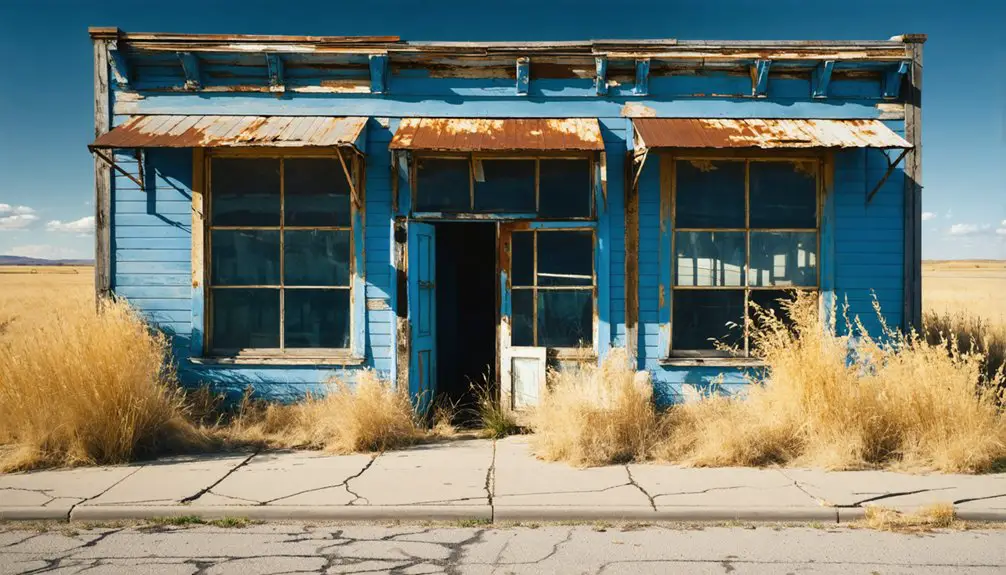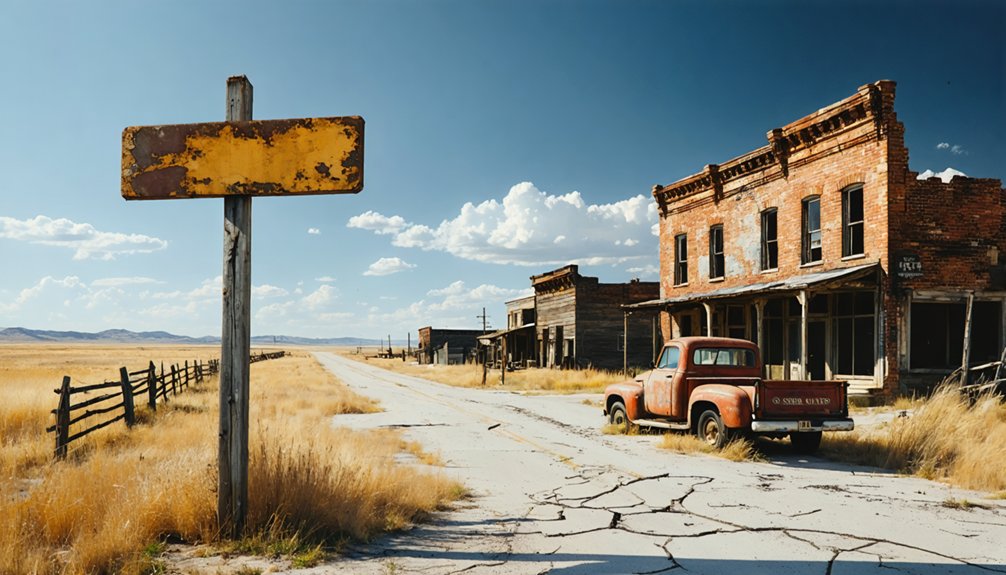
You’ll find Sidney’s crumbled foundations scattered across rattlesnake-infested prairie in Finney County, where 1880s boom turned to dust. Take I-80 to the Panhandle, then venture off-road to explore Ravanna’s weathered schoolhouse ruins and courthouse archway, or search for Eminence’s scattered remnants. The Finney County Historical Society offers annual ghost town tours, though you’ll need patience traversing unsigned routes. White Woman Creek’s mournful legends still echo across the dry creekbed, and there’s much more to uncover about this vanished railroad settlement’s mysterious past.
Key Takeaways
- Access Sidney via Interstate 80 and U.S. Route 385, with Denver International Airport being the nearest major commercial hub.
- Visit Fort Sidney’s historic site, once a vital supply depot commanding the 267-mile Sidney-Black Hills Trail through 1878.
- Explore nearby Finney County ghost towns Eminence and Ravanna, featuring 1880s ruins including schoolhouses and courthouse archways.
- Join Finney County Historical Society’s annual ghost town tours for guided exploration of unmarked, road-less historic sites.
- Investigate White Woman Creek legends at the convergence of three counties, where ghostly apparitions reportedly appear.
Understanding Sidney’s Railroad and Military Heritage
The whistle of steam locomotives once echoed across the Kansas prairie where Sidney took root, part of a railroad boom that reshaped the entire state in less than two decades.
You’ll discover that the railroad construction timeline here mirrors Kansas’s explosive growth—from the first track laid in 1860 to the completion of multiple transcontinental routes by 1872. The economic impacts of railroads transformed empty grassland into thriving settlements almost overnight.
Sidney’s military connection to Fort Riley made it a strategic junction point, where supplies and soldiers moved westward. You can still trace the old rail beds today, imagining that first locomotive “Albany” chugging past. These iron rails didn’t just carry freight—they carried dreams of independence and opportunity.
The Rise and Fall of Fort Sidney
Danger rode the rails westward in 1867, compelling the Union Pacific to demand military protection for its track-laying crews who faced constant raids from Cheyenne and Sioux warriors defending their hunting grounds. Sidney Barracks answered that call, its original purpose evolving dramatically as frontier needs shifted.
Born from railroad peril, Sidney Barracks evolved beyond its original mission as the frontier’s needs transformed across decades.
By the mid-1870s, you’ll discover Fort Sidney transformed into something far more ambitious than a railroad guard post. Its supply depot operations commanded the 267-mile Sidney-Black Hills Trail, feeding:
- Fort Robinson’s garrison protecting Red Cloud Indian Agency
- Deadwood’s gold-hungry prospectors flooding the Black Hills
- Freight wagons and stagecoaches threading through hostile territory
The 1878 Cheyenne pursuit marked the fort’s final crescendo. When threats vanished, so did necessity. By 1894, the fort closed—its buildings sold, its mission complete.
Getting to Sidney in Nebraska’s Panhandle
You’ll find Sidney where Interstate 80 cuts across Nebraska’s western plains, meeting U.S. Route 385 at an interchange that’s served road-weary travelers for decades—I’ve pulled off here countless times, watching eighteen-wheelers refuel beneath that endless prairie sky.
If you’re flying in, the closest major airport is Denver International, about 162 miles southwest, though Sidney’s own municipal airport sits just three miles south of town with two runways long enough for most private planes.
From Cheyenne, Wyoming, it’s a straight ninety-minute shot east on I-80; from North Platte, two hours west on the same interstate ribbon of asphalt.
Major Highway Access Routes
Cruising westward across Nebraska’s vast grasslands, you’ll find Interstate 80 serving as your ribbon of asphalt lifeline to Sidney, slicing through the Panhandle where the horizon stretches endlessly in every direction. This transcontinental highway delivers you to transportation hub opportunities where U.S. Route 385 intersects southeast of town, creating prime conditions for trucking and commercial development.
Your route options include:
- I-80/US-385 Junction – Direct access from the interstate, positioning you nine miles from Colorado’s border
- U.S. Route 26 – A 150.76-mile Panhandle traverse from Wyoming, paralleling BNSF Railway through Scottsbluff
- N-61 Connection – Southern approach linking through Ogallala, crossing the South Platte River
With 22 million people within a day’s drive, these highways reveal endless possibilities for exploring Nebraska’s forgotten corners.
Nearest Regional Airport Options
While Sidney Municipal Airport (SNY) sits just three miles south of town with its 6,600-foot concrete runway stretching across the prairie, don’t expect commercial flights to whisk you here—this 732-acre facility handles 4,100 annual operations that’re almost entirely general aviation and private aircraft.
For real airport connectivity options, you’ll need Western Nebraska Regional in Scottsbluff (60 miles northwest) or push toward Denver International, 125 miles south, where buses run directly to Sidney for around $44. Cheyenne Regional sits 96 miles away if Wyoming’s your entry point.
The municipal airport infrastructure works perfectly if you’re piloting your own plane, but road-trippers flying commercial should book through Denver or Scottsbluff, then embrace that wide-open highway freedom into Nebraska’s Panhandle.
Exploring Nearby Finney County Ghost Towns
Western Kansas prairie stretches endlessly around Sidney, concealing the crumbled remnants of two significant ghost towns that once thrived during the 1880s boom years. You’ll discover Eminence and Ravanna, where county annexation impact stripped these settlements of their viability, scattering 300 and 700 residents respectively across the windswept landscape.
Two forgotten Kansas settlements vanished into prairie grass after 1880s annexation battles displaced a thousand hopeful settlers seeking frontier fortune.
What You’ll Find:
- Ravanna’s crumbled schoolhouse ruins feature walls reduced to corners, plus a courthouse archway and maintained cemetery marking the former county seat
- Eminence’s scattered foundations spread across rattlesnake-infested prairie with low brick walls persisting as silent witnesses
- No roads or signs guide your journey—you’re traversing pure prairie where railroad dreams died
The Finney County Historical Society offers annual ghost town tours, helping adventurers locate these unmarked sites where freedom-seeking pioneers once staked their claims.
White Woman Creek Legends and Local Lore
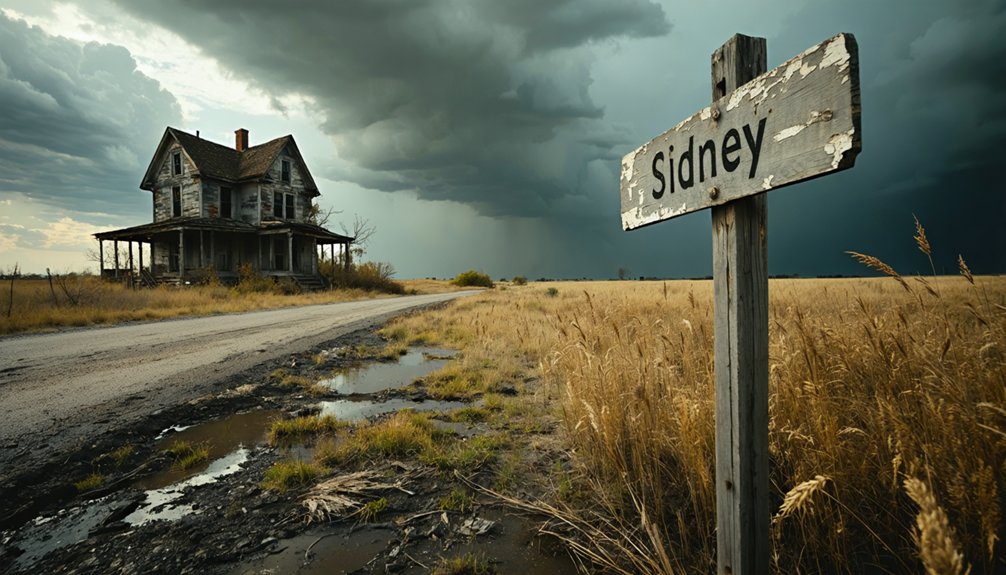
Along the parched tributaries cutting through the prairie near Sidney, you’ll encounter one of Kansas’s most persistent ghost stories—the White Woman of the Creek. Since the late 1800s, ghostly apparition sightings have drawn wanderers to this desolate landscape where Greeley, Wichita, and Scott counties converge.
As you traverse this haunting terrain, consider exploring the history of iowa point to uncover more tales of loss and mystery. This area has been shaped by both its natural beauty and the chilling legends that echo through its valleys. Each story adds another layer to the rich tapestry of the region, inviting adventurers to seek out its secrets.
The legends vary wildly. Some say Anna-Wee, captured by Cheyenne raiders in the 1860s, married Chief Tee-Wah-Nee before losing everything in an Army attack. She died defending her adopted people. Others tell grim suicide legends—a kidnapped woman who chose hanging over torture, her body swinging from cottonwoods along the creek bank.
On still nights under bright moons, locals claim you’ll hear mournful singing drifting across the dry creekbed—a spectral woman mourning lost family and vanished tribes.
What Remains: Ruins and Historic Sites to Visit
Few ghost towns surrender completely to the prairie—most leave behind skeletal traces you can still touch. Around Sidney, historic farmstead preservation efforts have left tangible connections to Kansas’s settlement era, though many sites showcase cultural landscape restoration challenges where nature reclaims what pioneers built.
Time hasn’t erased these prairie settlements entirely—their bones still break through the grasslands, waiting for those willing to search.
You’ll find these substantial remains:
- Eminence’s limestone schoolhouse stands intact west of the townsite, now serving as farm storage near an 1887 cemetery where crumbling markers dot fields beside the dry Pawne River bed
- Ravanna’s brick pillars rise from the grasslands—courthouse archways and schoolhouse corners waiting for your exploration without roads or signs to guide you
- Pierceville’s Wolf Elevator three miles north, accessible via Lowe Road, plus a settlement cemetery with prominent headstones marking Depression-era departures
The Finney County Historical Society leads annual tours connecting these scattered monuments.
Essential Tips for Your Ghost Town Adventure
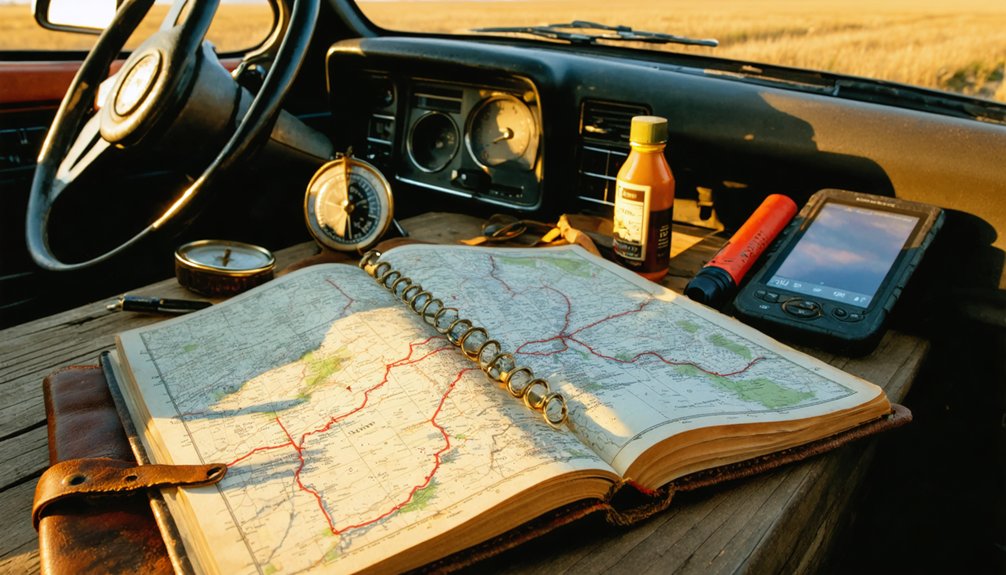
Before you load up the car for Sidney’s vanished settlements, understand that success here demands different preparation than your typical Kansas road trip. You’ll need a constantly full gas tank—those lonely midnight roads between the 20 ghost towns within 25 miles of Lawrence won’t forgive an empty gauge. Pack your camera for photobombing spirits and GPS for remote routes where cell service vanishes like the towns themselves.
Seek immersive overnight stays in vintage motels where hosts share stories of unusual property events. Hunt for offbeat roadside oddities that reveal Kansas’s forgotten character.
Check weather forecasts religiously—prairie storms transform dirt roads into impassable mud. Most importantly, respect boundaries: photograph preserved structures, but never wander into abandoned buildings where floors collapse without warning.
Frequently Asked Questions
Are There Any Restaurants or Lodging Options Near Sidney Ghost Town?
You’ll find no nearby dining options or available lodging accommodations directly at Sidney ghost town. Head 20 miles to Phillipsburg for local diners and affordable inns, or try Kensington’s small cafes for your essentials.
What Is the Best Time of Year to Visit Sidney?
Spring season offers your best window for Sidney exploration. You’ll discover mild temperatures perfect for wandering abandoned streets, while avoiding summer’s scorching heat and winter’s bitter cold. April through June brings ideal conditions for your ghost town adventure.
Do I Need Special Permits to Photograph the Historic Sites?
You won’t need photography permits for Sidney’s abandoned buildings—Kansas doesn’t require state-level permits. Just respect historic preservation guidelines by not disturbing structures. Shoot freely, but check with local authorities if you’re planning commercial work.
How Long Should I Plan to Spend Exploring Sidney?
You’ll need just 1-2 hours to explore historical buildings and spend time wandering Sidney’s crumbling foundations. Like tumbleweeds drifting through abandoned streets, you’ll discover the cemetery, Adobe Museum, and prairie remnants at your own pace before moving on.
Is Cell Phone Service Available in the Sidney Area?
Cell phone service in Sidney’s area is extremely limited due to sparse cell tower locations. You’ll likely find minimal coverage reliability in this remote ghost town, so download maps and information before venturing into Kansas’s backcountry.