Your Silver Canyon ghost town adventure requires careful navigation, as multiple Nevada locations share this name. You’ll want to focus on the Lincoln County valley, bringing USGS topo maps since cell service vanishes past Devil’s Gate. Pack four liters of water daily and fuel up completely before leaving pavement—the washboard gravel tests even experienced desert drivers. Blair’s massive mill foundations and Rhyolite’s photogenic ruins anchor your route, while local legends whisper of Paiute subterranean kingdoms and spectral encounters that await discovery along the way.
Key Takeaways
- Silver Canyon requires careful route planning as multiple Nevada ghost towns share this name; use USGS topo maps for accurate navigation.
- Visit nearby ghost towns including Blair’s mill foundations, Belmont’s preserved 1860s buildings, and Rhyolite’s iconic concrete bank ruins.
- Pack four liters of water daily, fuel up completely before leaving pavement, and maintain proper tire pressure for gravel roads.
- Travel in groups of three with GPS devices, as cell service vanishes in remote desert areas past Devil’s Gate.
- Download offline maps and traffic apps like Waze before departure, and bring physical maps as backup navigation tools.
Silver Peak’s Mining Legacy: From Silver Ore to Lithium Extraction
The spring-fed valley that would become Silver Peak first drew prospectors in 1863, when glints of gold and silver in the surrounding ridges sparked Nevada’s latest rush.
You’ll find remnants of stamp mills that crushed ore throughout the 1860s, followed by John Chiatovich’s pioneering cyanide mill in 1893—one of America’s first. By 1907, Blair’s 100-stamp operation dominated the landscape as Nevada’s largest.
Historical shifts in mining techniques transformed this district from simple stamp processing to sophisticated cyanide extraction, producing low-grade ores that kept operations viable for decades.
Today’s lithium extraction continues Silver Peak’s mineral legacy, though the environmental impact of lithium extraction raises questions about balancing modern energy demands with preserving this rugged, timeworn landscape you’re exploring.
Getting There: Route Planning Through Nevada’s Remote Desert
Planning your route to Silver Canyon requires careful attention to which ghost town destination you’re actually targeting—Nevada’s desert holds multiple places bearing this evocative name, and mixing them up could strand you hundreds of miles from your intended destination. The Lincoln County valley sits in remote landscape characteristics requiring USGS topo maps, while Silver City’s ghost town lies near Virginia City via State Route 342, just four miles north of U.S. Route 50.
Each location presents challenging driving conditions through narrow canyons carved from metamorphic rock. Devil’s Gate marks historic territory where miners built stone forts during frontier conflicts. Download real-time traffic apps like Waze before losing cell service. Bring physical maps—your smartphone becomes useless when batteries die in Nevada’s backcountry.
Must-Visit Ghost Towns Near Silver Peak
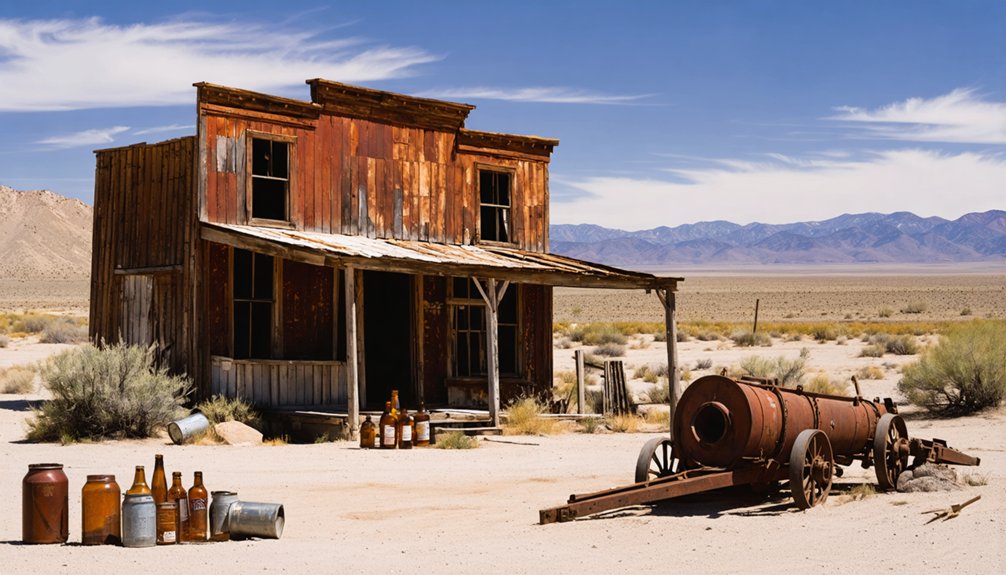
Weathered stamp mills and crumbling stone foundations dot the desert landscape surrounding Silver Peak, where Nevada’s mining heritage reveals itself through a constellation of ghost towns within easy striking distance.
Blair sits closest—just a mile up that graded dirt road—where massive mill foundations stretch down the hillside like industrial ruins reclaimed by sagebrush.
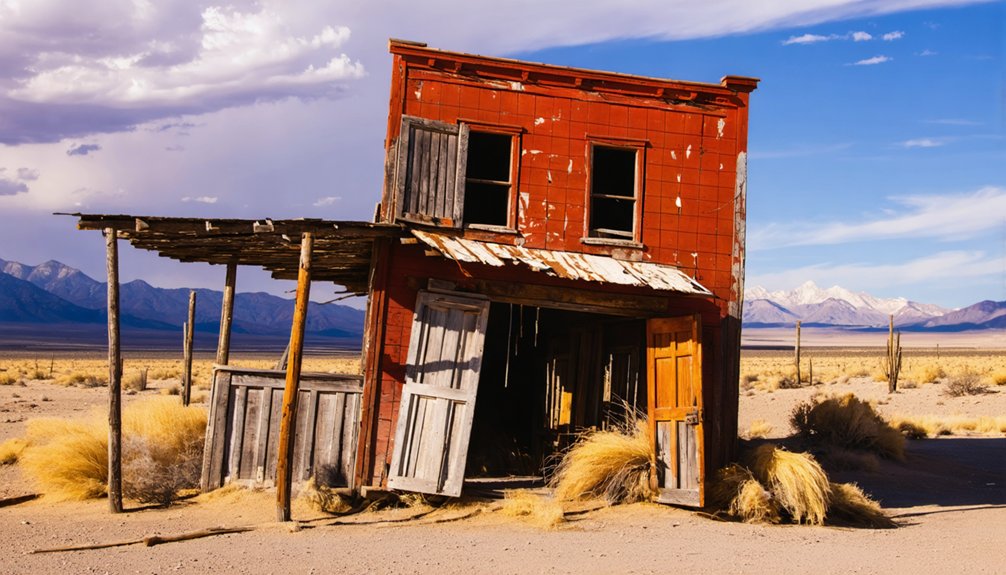
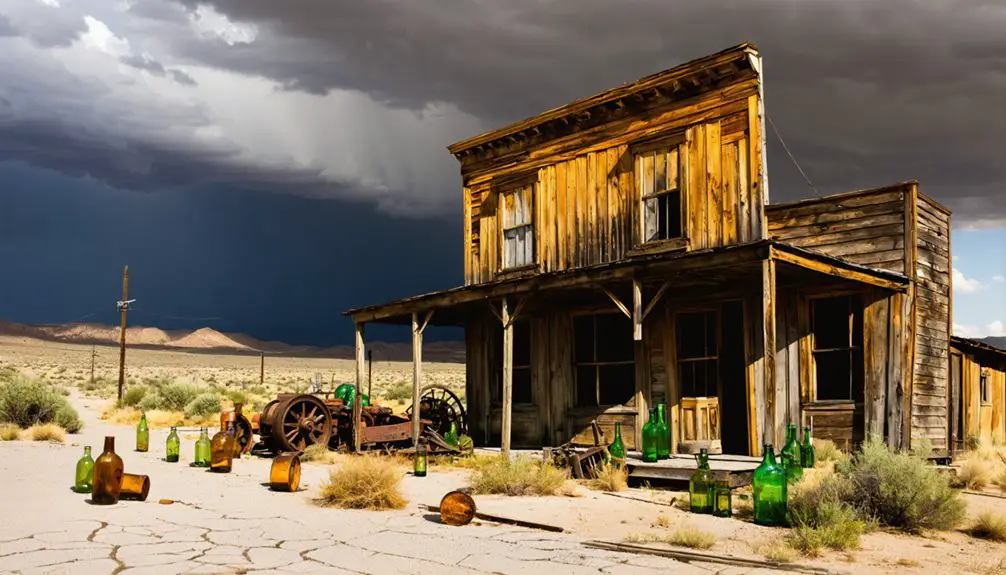
You’ll find Belmont’s well-preserved 1860s buildings showcasing remarkable architectural preservation, while Rhyolite’s three-story concrete bank and bottle-encrusted saloon make it Nevada’s most photographed ghost town.
Goldfield offers haunting cultural heritage landscapes where 30,000 souls once prospected, now reduced to fewer than 300.
Each site tells its own boom-and-bust story, and you’re free to explore them all at your own pace, camera ready, imagination running wild.
Local Legends and Supernatural Stories of the Region
Beneath Silver Peak’s sun-scorched valleys, whispers of Shin-au-av—a subterranean kingdom from Paiute oral traditions—have echoed through centuries, long before any prospector’s boot left prints in this alkali dust. These Ancient Paiute tunnels supposedly house mummies and catacombs, stories 1920s miners swore matched their own discoveries underground.
You’ll find these legends woven through Shoshone and Washoe traditions too, grounding mystery in something older than statehood.
Drive north to experience Goldfield Hotel hauntings firsthand—paranormal investigators flock to this shuttered monument from Nevada’s 1902 boom. Meanwhile, Pioche’s Overland Hotel & Saloon offers authentic spectral encounters featured on “Ghost Adventures.” Even outlaw Jack Longstreet fled here, dancing with Wovoka’s Ghost Dance movement before vanishing into Ash Meadows’ springs. The desert keeps its secrets close.
Essential Tips for Desert Ghost Town Exploration
Before you turn your ignition key toward Silver Canyon’s rust-colored horizons, understand that desert ghost towns don’t forgive amateur mistakes—I learned this the hard way when my radiator boiled over twenty miles from the nearest ranch, leaving me rationing bottled water beneath a tamarisk’s thin shade while vultures circled overhead.
Desert ghost towns punish the unprepared—my boiled radiator and circling vultures taught me that brutal lesson twenty miles from anywhere.
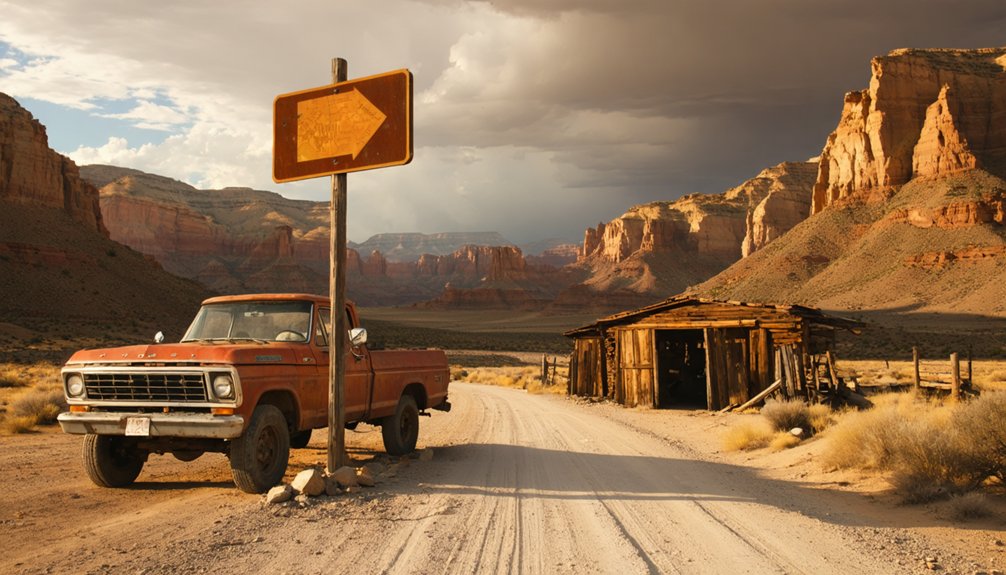
Pack four liters of water daily and fuel up completely before leaving pavement. Your 4WD vehicle needs proper tire pressure for washboard gravel leading to these 1860s ruins.
Visitor safety considerations demand traveling in groups of three, carrying GPS devices since cell towers vanish past Devil’s Gate, and monitoring for rattlesnakes near crumbling foundations.
Desert ecosystem preservation requires you follow Leave No Trace principles—pack out everything, stick to established trails, and never pocket artifacts. These sunbaked relics belong to everyone seeking wildness beyond civilization’s reach.
Frequently Asked Questions
What Accommodations Are Available for Overnight Stays in Silver Peak?
You’ll find nearby campsites like Virginia City RV Park offering clean facilities and stargazing freedom, while local lodging options include budget-friendly motels in Fallon and Carson City. Both provide comfortable beds and essential amenities for your ghost-town adventure.
Are There Any Restaurants or Food Services in the Area?
Silver Peak lacks restaurants, so you’ll need food supplies from your vehicle. The nearest local eateries are 50+ miles away in Tonopah or Goldfield. Pack a cooler with meals, snacks, and plenty of water for your adventure.
What Is the Best Time of Year to Visit Silver Peak?
You’ll find the less-crowded months most rewarding—shoulder season visitation in April and May offers ideal weather conditions around 60°F, clear skies, and minimal rain, letting you explore Silver Peak’s ghost town freely without summer’s scorching heat or winter’s harsh bite.
Do I Need Special Permits to Explore the Ghost Towns?
You won’t need permits for most Nevada ghost towns on public land, but watch for access restrictions and private property concerns. Always respect posted signs—trespassing charges can end your adventure fast and cost you serious freedom.
While exploring the historical significance of Huntville Vermont, you’ll discover remnants of its past that reflect the resilient spirit of the early settlers. These stories are intertwined with the landscape, offering a unique glimpse into the life and challenges faced by those who once called this area home. Planning your visit during the fall can enhance this experience, as the vibrant foliage sets a stunning backdrop to the historic sites.
Is Cell Phone Service Available in Silver Peak and Surrounding Areas?
Like a pioneer’s campfire fading at dusk, you’ll find limited cell coverage in Silver Peak’s wilderness. Check nearby cell tower locations before departing—T-Mobile and Verizon offer your best shots at connection, though signals remain unpredictable in these untamed lands.