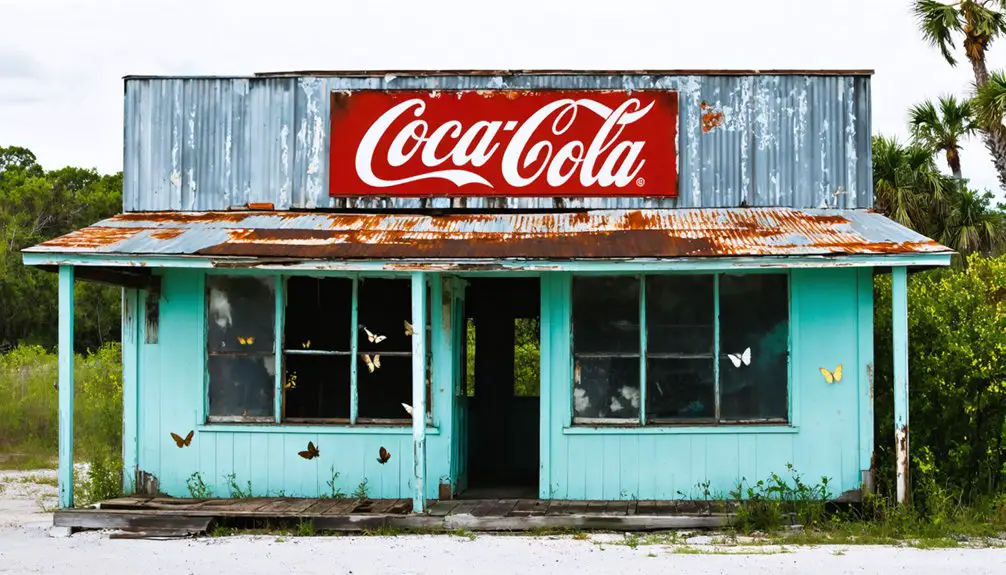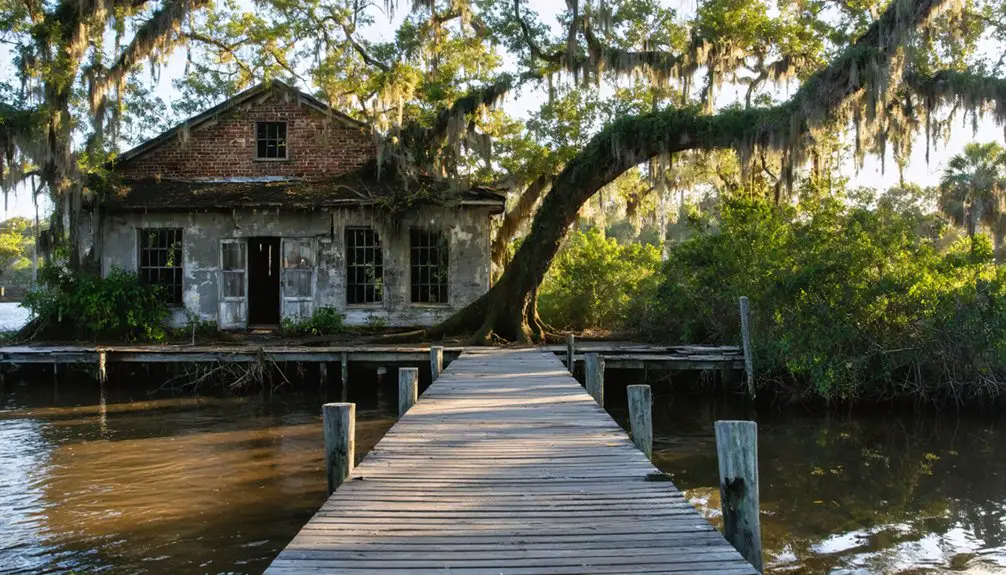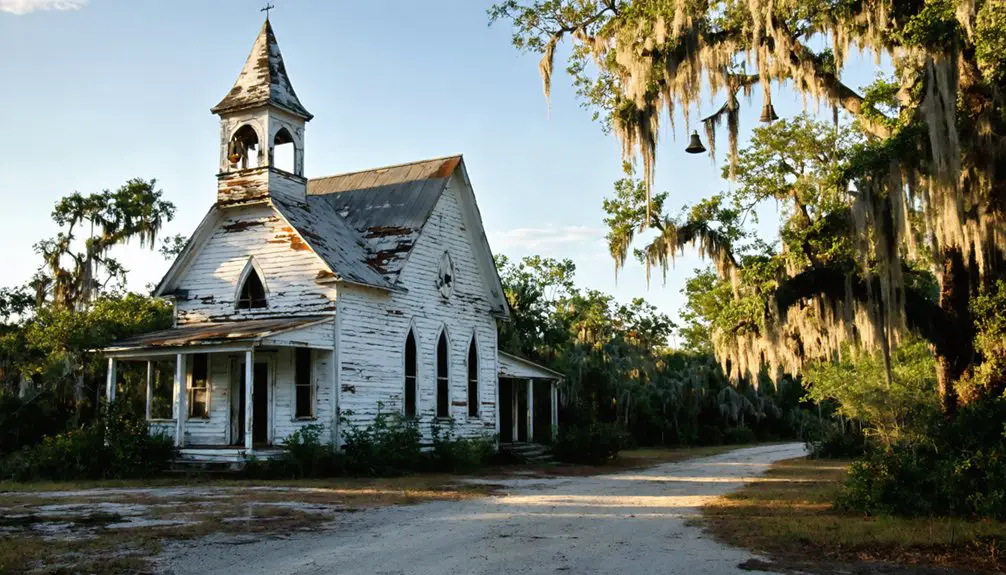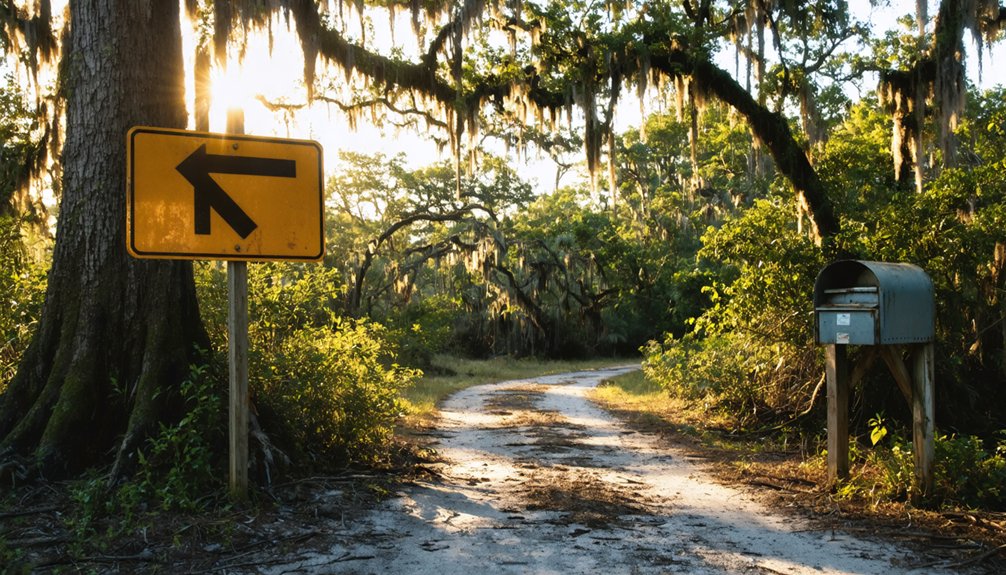
You’ll find Snake Bight’s ghost 5.4 miles north of Flamingo Visitor Center, where a modest pull-off marks your gateway to Florida’s vanished fishing past. Plan your visit between November and February when mosquitoes retreat and winter light illuminates scattered boardwalk fragments and canal traces from the once-thriving E.T. Knight Fish Company. The 1.6-mile trail winds through mangrove-strangled remnants where wooden docks and processing camps stood until hurricanes swept them into memory, and the path ahead reveals secrets buried beneath salt hay and overgrown vegetation.
Key Takeaways
- The trailhead is located 5.4 miles north of Flamingo Visitor Center with a modest pull-off on Main Park Road.
- Visit during winter months (November to February) for optimal conditions, fewer mosquitoes, and better wildlife viewing opportunities.
- The 1.6-mile trail features remnants of the abandoned E.T. Knight Fish Company, including old boardwalk fragments and canal traces.
- Trail is accessible by foot or off-road bike, taking approximately 20 minutes to reach the historic boardwalk area.
- Bring aggressive mosquito repellent and prepare for limited trail maintenance with overgrown vegetation and minimal infrastructure.
Getting to Snake Bight in Everglades National Park
The trailhead to Snake Bight lies 5.4 miles north of Flamingo Visitor Center, where a modest pull-off on the right side of Main Park Road marks your gateway into one of the Everglades’ most remote corners. You’ll pass Coot Bay Pond and Mrazek Pond during your drive—landmarks that signal you’re entering untamed territory.
Park accessibility here favors the self-reliant: there’s space for vehicles, but trailhead conditions reflect the wild character of this place. The wide path remains navigable despite limited maintenance, preserved as critical habitat for Cape Sable thoroughwort. Vegetation, branches, and roots claim the unpaved trail, demanding careful navigation.
If you’re cycling, note the boardwalk at trail’s end prohibits bikes. Those craving complete solitude can kayak directly to Snake Bight via Florida Bay.
What Remains of the Abandoned Settlement Today
Where a bustling fish camp once thrived, nature has reclaimed nearly every trace of human ambition. You’ll find Snake Bight stripped bare by storms and time, leaving only whispers of its 1940s heyday when E.T. Knight’s Fish Company operated here.
Nature devours what commerce built—Snake Bight stands as proof that wilderness always wins the final round.
Remaining historical artifacts you might discover:
- Fragments of the old boardwalk clinging to the trail’s edge
- Barely visible roadway traces beneath overgrown vegetation
- The ghost of a canal carved in the early 1900s
Untold community narratives haunt these mosquito-thick mangroves—stories of Flamingo residents, Calusa predecessors, and airboat fishermen chasing fortune across shallow flats. The processing plant? Erased. The camps? Vanished. You’re walking through Florida’s rawest form of freedom: complete dissolution into wilderness.
Best Time to Visit and What to Expect
You’ll want to time your Snake Bight expedition for the crisp winter months when mosquitoes retreat and the shallow flats teem with sharks, dolphins, and shorebirds wheeling under peregrine falcon wings.
Even in cooler weather, come armed with industrial-strength repellent—the trail’s 1.5-mile stretch through overgrown hammocks still harbors enough bloodthirsty mosquitoes to explain why settlers once burned smudge pots day and night.
Don’t expect much beyond mud, mangroves, and maybe a distant flamingo; the settlement itself has surrendered entirely to the Everglades’ relentless reclamation.
Winter Months Are Optimal
When November’s crisp air settles over Florida’s wild backcountry, Snake Bight transforms into a hauntingly beautiful landscape that’s far safer to explore than during the sweltering summer months. You’ll discover ideal wildlife viewing conditions as temperatures dip below 60°F, sending snakes into brumation while migratory birds claim the marshes.
Winter’s dry season—November through February—delivers your best chance at adventure:
- Reduced risk of snake encounters as cold-blooded reptiles burrow away from chilly winds
- Clear trails and accessible paths without the oppressive humidity that defines Florida’s infamous summers
- Dramatic sunrises illuminating abandoned structures against winter’s golden light
The panhandle’s occasional cold snaps keep venomous species dormant in hollows and logs, freeing you to wander this forgotten domain.
Prepare for Mosquitoes
Even winter’s cold snaps won’t save you from Snake Bight’s most relentless predators—clouds of mosquitoes that descend the moment you step from your vehicle. This Everglades ghost town sits in Southern Florida’s mosquito capital, where year-round breeding transforms every puddle into a launching pad for Aedes aegypti and Asian Tiger mosquitoes carrying dengue, Zika, and West Nile virus.
Your survival depends on aggressive mosquito prevention methods: drench yourself in DEET, cover every inch of skin with long sleeves and pants, and move quickly through peak feeding hours. Consider mosquito monitoring strategies used by local control districts—check wind patterns and recent rainfall before your visit. Those microclimates shift dramatically within miles, turning paradise into purgatory. Come prepared to wage chemical warfare, or these bloodsuckers will claim victory before you glimpse Snake Bight’s desolate beauty.
Expect Minimal Remains
The Snake Bight Trail delivers disappointment to treasure hunters expecting crumbling walls or weathered foundations—nature has reclaimed nearly everything. Hurricanes systematically erased E.T. Knight’s fish processing plant, worker huts, and boardwalks that once thrived here. What remains won’t satisfy your explorer’s appetite:
- A narrow, overgrown trail replacing the former road—barely recognizable as man-made
- Scattered fragments of old boardwalk, nearly invisible beneath encroaching vegetation
- The haunting aura of former settlement lingering where Calusa Indians and 1940s fishermen once worked
These fading archaeological remnants tell more through absence than presence. The coastal prairie swallowed civilization whole, leaving only whispers of human ambition.
You’ll find freedom in this erasure—proof that wilderness ultimately wins, that structures meant to dominate eventually surrender to salt, wind, and time’s relentless march.
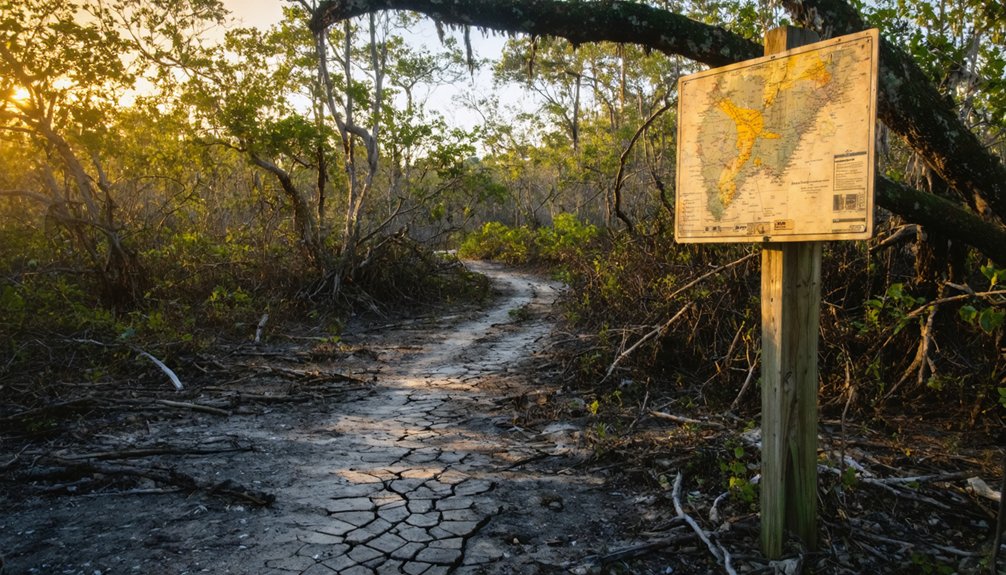
Finding your way to Snake Bight begins with a straight shot north from the Flamingo Visitor Center, where you’ll clock roughly four to five miles along Main Park Road before spotting the trailhead’s pull-off on your right.
The 1.6-mile journey transforms beneath your feet—what starts as a raised roadbed carved from coastal wilderness morphs into cement-hard marl before surrendering to soft salt hay carpeting. Despite the Park Service halting maintenance to protect endangered Cape Sable thoroughwort, the trail’s generous width keeps overgrowth at bay.
Terrain challenges remain minimal, perfect for off-road bikes that’ll deliver you to the boardwalk in twenty minutes flat. Wildlife sightings intensify as civilization fades behind you, rewarding those who embrace the untamed path stretching toward Florida Bay’s forgotten shores.
The Rise and Fall of Snake Bight’s Fishing Industry
Standing at the canal’s edge, you can almost hear the rhythmic thrum of the E.T. Knight Fish Company‘s processing plant that hummed here from 1940 until nature reclaimed it. The wooden structures that once supported hundreds of local families through commercial fishing operations now lie scattered beneath decades of storm-driven overgrowth, their pilings jutting from the water like skeletal reminders of prosperity.
Hurricane after hurricane battered this coastal outpost until the company finally surrendered to the elements, leaving behind only the whisper of what was once Snake Bight’s economic heartbeat.
E.T. Knight Fish Company
The Punta Gorda Fish Company’s evolution traced a path of calculated acquisitions:
- Absorbed West Coast Fish Company after its 1939 fire
- Relocated operations to the railroad wharf when Henry Plant abandoned his rails in 1897
- Expanded through family partnerships, with son-in-law W.H. Munson assuming presidency in 1940
You’ll find the Knights’ legacy scattered across Florida’s coast—from Samuel’s Seminole Fish Co. ventures to Robert’s Bokeelia operation surviving until 1995’s devastating net ban.
Hurricane Destruction and Abandonment
When workers dug the canal from Snake Bight to the main road in the early 1900s, they couldn’t have imagined the cyclical violence that would ultimately reclaim their achievement. Hurricane after hurricane battered the E.T. Knight processing plant, each storm peeling back corrugated metal and splintering wooden pilings. The shallow waters that once promised prosperity became nature’s weapon, driving surge after surge through the facilities.
You’ll find little evidence of the fish company’s operations now. Hurricanes accelerated what regulations began—an economic decline that scattered families and silenced the nets. Vegetation swallowed foundations. Salt air corroded what storms didn’t topple. The land reclaimed itself, an unintentional environmental restoration that transformed commercial bustle into pristine wilderness. Nature doesn’t respect man’s property lines.
Wildlife Encounters and Nearby Flamingo Ghost Town
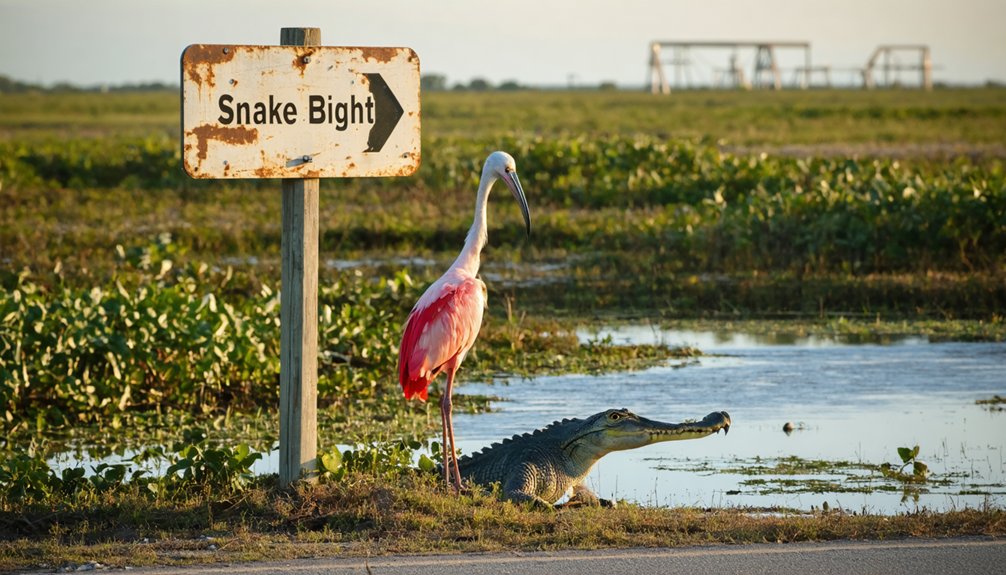
Ironically, flamingos—those brilliant pink sentinels that gave this settlement its name—vanished from Florida’s southernmost coast more than a century ago. The plume hunting impact devastated wading bird populations, as hunters slaughtered egrets, herons, and flamingos for fashionable hat feathers. The last major flock graced these shores in 1902.
When you explore the original townsite four miles west of today’s campground, you’ll discover:
- Weathered coquina foundations where smudge pots once burned against mosquito swarms
- The 1928 Geodetic Marker standing sentinel over vanished lives
- Whispers of Guy Bradley’s 1905 murder—the ultimate price for protecting birds
Today’s seasonal wildlife sightings bring hope: a few American flamingos have returned to haunt their namesake shores, reclaiming territory their ancestors abandoned.
Frequently Asked Questions
Are There Any Facilities Like Restrooms or Drinking Water at Snake Bight?
No facilities exist at Snake Bight—you’ll face accessibility challenges on this wild trail. Bring your own water and prepare for seasonal weather conditions. The nearest restrooms sit four miles south at Flamingo’s weathered visitor center.
Do I Need a Permit or Entrance Fee to Visit Snake Bight?
You’ll need Everglades National Park’s entrance fee—no separate permit required. With 1.5 million acres of park accessibility awaiting your exploration, there aren’t seasonal restrictions holding you back from discovering Snake Bight’s wild, mosquito-laden shores whenever adventure calls.
Is Camping Allowed Near Snake Bight or Along the Trail?
No overnight camping opportunities exist directly at Snake Bight’s scenic viewpoint accessibility. You’ll need to secure wilderness permits for designated backcountry sites nearby, or choose frontcountry camps like Flamingo, where freedom meets Florida Bay’s wild horizons.
What Insect Repellent Strength Is Recommended for the Mosquitoes There?
You’ll need maximum-strength DEET repellent—think 30% minimum—since Snake Bight’s mosquitoes swarm savagely. Pack permethrin-treated proper clothing attire and recommended mosquito repellent brands like Sawyer or Ultrathon. These bloodthirsty bugs’ll make you miserable without serious protection.
Are Guided Tours Available for Snake Bight and Surrounding Areas?
Yes, you’ll find guided kayak tours and boat-assisted eco-tourism opportunities throughout Snake Bight’s surrounding areas. These adventures offer exceptional wildlife photography options as you glide past pelicans and wading birds in their untamed Florida Bay habitat.