Your ghost town road trip to Soldier starts with downloading offline maps—cell service vanishes beyond paved highways in these remote Boise Basin highlands. Pack extra fuel, water, and emergency supplies for the gravel roads, though 2WD vehicles handle the journey fine from June through August when temperatures hover around 62-74°F. You’ll find the converted bank building and boarded-up Goff’s Hall standing as weathered monuments to the 4,900 residents who abandoned this once-thriving community after the 1911 railroad bypass sealed its fate, and there’s much more to discover about the surrounding mining territories.
Key Takeaways
- Visit June through August when temperatures reach 62-74°F and roads are accessible, avoiding winter’s harsh 10-inch snow dumps.
- Download offline maps before departing since cell service is unavailable in remote mining territories beyond paved highways.
- Explore the converted First National Bank building and boarded-up Goff’s Hall, Soldier’s only remaining historic structures from its 1910 peak.
- Bring emergency supplies, extra fuel, water, and rain gear for unpredictable conditions on primitive gravel roads requiring 2WD vehicles.
- Combine your visit with nearby ghost towns like Silver City, Bayhorse, and Custer for a comprehensive Idaho mining history experience.
The Rise and Fall of Soldier on Camas Prairie
Long before Soldier emerged as a settlement on Camas Prairie, Hudson Bay Company trappers carved paths through this high-desert landscape, using it as their corridor to reach the beaver-rich waters of the Big Wood and Little Wood rivers.
By 1862, Tim Goodale’s trail detour brought Oregon-bound pioneers directly through this terrain, transforming it into a bustling thoroughfare for prospectors seeking fortune in surrounding mountains.
The community impact peaked dramatically in 1910 when 4,900 people called Camas Prairie home, with Settlers Day drawing 200 celebrants to Soldier alone. Yet this prosperity proved fleeting.
When Union Pacific’s 1912 spur line positioned itself two miles south for political maneuvering, Soldier’s cultural legacy began fading. Today, only a converted bank building and boarded-up Goff’s Hall stand as weathered monuments to this vanished frontier community.
What Remains: Exploring Soldier’s Historic Buildings
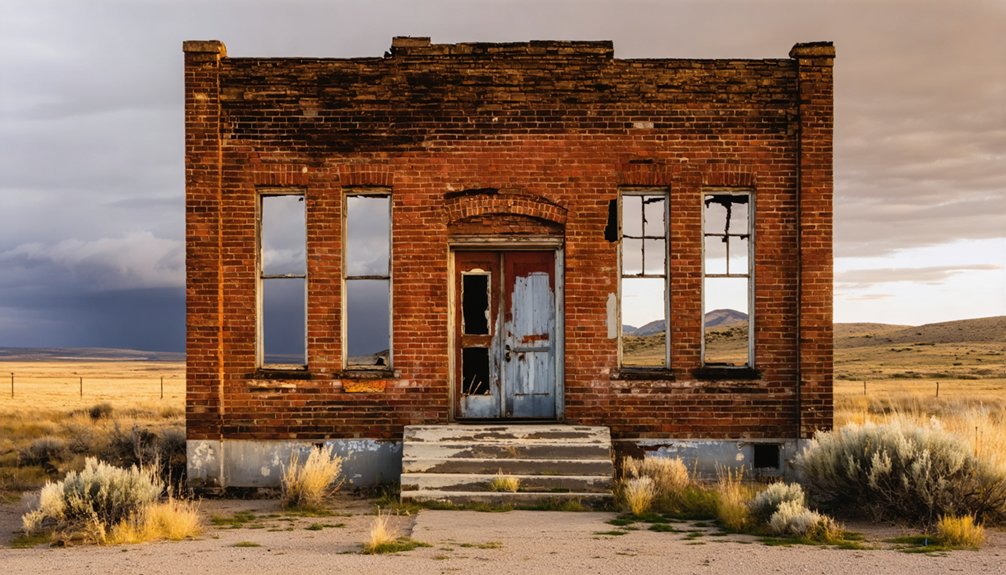
When you arrive in Soldier today, only two buildings stand to greet you from the prairie grass—the old bank, now someone’s quiet home, and the boarded-up shell of Goff’s Hall.
I’ve driven past that bank three times on different trips, always struck by how ordinary it looks as a residence until you remember depositors once lined up inside during the mining boom.
The hall sits darker and more mysterious, its windows sealed tight, protecting whatever memories remain stored in its shadows.
The Standing Bank Building
Among the weathered remnants scattered along Soldier’s dusty main street, the old First National Bank building stands as the town’s most substantial survivor from its prosperous early 1900s heyday. You’ll recognize its brick construction immediately—built to project financial stability when miners and merchants needed somewhere trustworthy for their hard-earned money.
What makes this structure remarkable isn’t deliberate architectural preservation but sheer durability. Those brick walls witnessed Soldier’s transformation from boom to bust, then adapted when the building became an improvised schoolhouse after most families relocated to Fairfield. This wasn’t community preservation through grand restoration efforts; it was practical adaptation to changing needs.
Today, alongside Goff’s Hall, it’s one of two substantial buildings still standing—a testament enduring symbol to builders who constructed permanent infrastructure when they believed Soldier’s prosperity would last forever.
Goff’s Hall Opera House
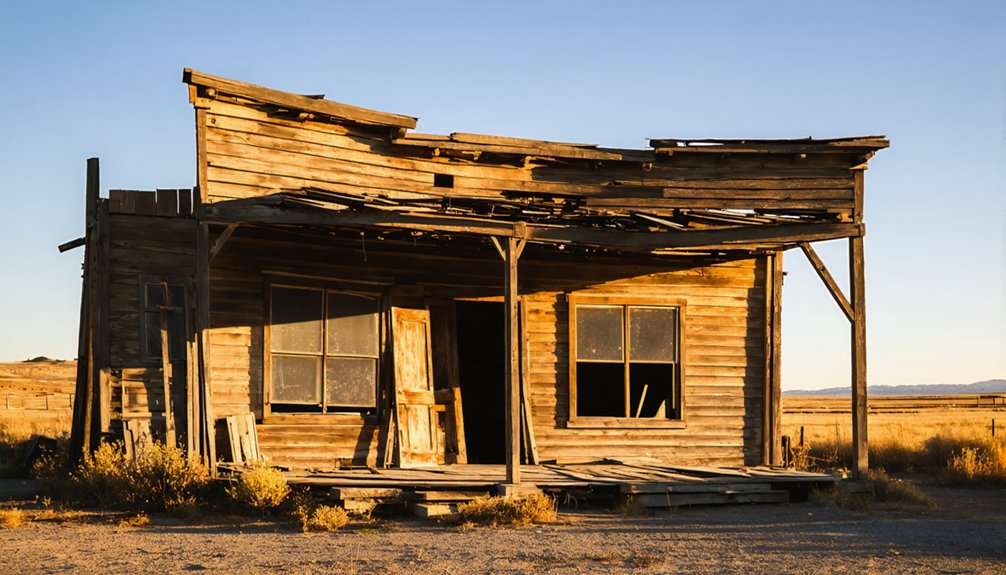
The weathered facade of Goff’s Hall stands beside the bank building, its boarded-up windows concealing what was once Soldier’s cultural heart. During the 1910-1911 boom years, Russell and Parker operated this entertainment venue where you could’ve caught a play or dance for just 10 to 15 cents. Saturday nights drew crowds for box socials, where men bid on decorated food baskets prepared by local women.
The hall hosted everything from Lyceum meetings to theatrical performances, embodying the town’s vibrant social spirit before decline set in.
Today, this structure serves as storage, though it once had a former use as surveyors’ stake making plant, shipping to Pocatello. It remains among the ghostly remnants of mining town community—a manifestation of dreams that faded with Soldier’s prosperity.
Understanding the Railroad’s Impact on Soldier’s Decline
When the railroad chose a route eleven miles north in 1911, you can almost picture the sinking feeling in Soldier’s shopkeepers as they watched their future slip away to Fairfield. The businesses didn’t hesitate—they packed up their storefronts and followed the tracks, leaving behind empty buildings that still stand today as monuments to that single, devastating decision.
Without the railroad’s lifeline connecting it to markets and supplies, Soldier became exactly what isolation makes inevitable: a town that people remembered but stopped returning to.
Railroad Bypassed Soldier 1911
Before 1911 closed, Soldier’s fate was sealed when the Oregon Short Line Railroad chose a route two miles south of town. You’ll understand how quickly frontier fortunes shifted when you consider what happened next:
- Fairfield’s rise began immediately as the new railroad stop became the regional center
- Freight services shift meant businesses couldn’t survive without direct rail access
- The Idaho Hotel packed up and relocated to where the trains actually stopped
- The Camas County Courier newspaper followed the economic opportunity southward
Peak prosperity in 1910 turned to gradual abandonment by 1911. You’re looking at a community that couldn’t adapt when transportation patterns changed. The railroad didn’t care about established towns—it prioritized efficiency and direct routes, leaving Soldier stranded.
Businesses Relocated to Fairfield
Between 1911 and 1915, Soldier’s commercial district emptied like water draining from a bathtub. You’d have watched Fowler’s Auto Garage change hands in 1914 before becoming the Soldier Auto Company, where George Perkins earned $1.75 weekly selling Ford cars.
Then the exodus began—the Idaho Hotel physically relocated to Fairfield, followed by the Camas County Courier newspaper.
Isolation Led to Abandonment
As the Oregon Short Line Railroad carved its path two miles south of Soldier in 1911, the town’s fate was sealed with the precision of a surveyor’s stake. You’ll witness isolation’s isolationist effects throughout this ghost town, where transportation infrastructure’s critical role became brutally apparent:
- Immediate severance – Two miles might as well have been twenty when goods and passengers stopped flowing through town
- Business exodus – Owners packed up operations and rolled toward Fairfield’s promise
- Government retreat – Even the Ranger Station abandoned ship in 1953 after forty-four years
- Final curtain – The Koonze family’s 1958 departure left only wind-worn buildings
Goff’s Hall transformed into a stake-making plant—iron stakes shipped to Pocatello while wooden dreams decayed on Camas Prairie.
Essential Idaho Ghost Towns Near Soldier Worth Visiting
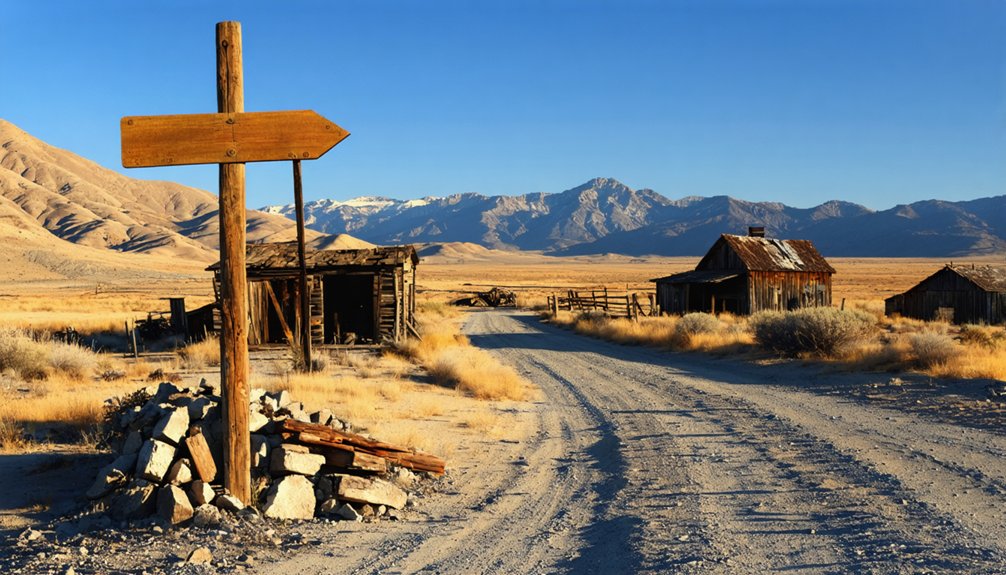
The rugged mountains surrounding Soldier, Idaho cradle some of the West’s most authentic ghost towns, where weathered timber frames and crumbling stone walls tell stories of boom-and-bust mining cycles that shaped the region. Soldier’s strategic location puts you within striking distance of Bayhorse’s remarkably preserved mill site, where stone buildings and charcoal kilns stand frozen in time.
You’ll find Silver City’s 300 homes and 75 businesses sprawling across hillsides, while Custer offers guided tours through restored structures and the massive Yankee Fork Gold Dredge. The historical significance of Soldier’s schools connects to nearby Gilmore, where 40 buildings await exploration and caretaker Dan Lerwill shares firsthand knowledge.
Each site rewards your independence with unrestricted wandering through authentic Western history, no crowds or commercialization required.
Idaho’s Mining Boom Legacy in Abandoned Towns
Fortune seekers poured into Idaho’s mountain gulches starting in 1862, transforming remote wilderness into roaring boomtowns almost overnight. You’ll discover the enduring pioneer spirit etched into these abandoned settlements, where mining families’ lifestyle revolved around harsh conditions and remarkable resilience.
Idaho’s 1862 gold rush transformed untamed wilderness into thriving boomtowns, leaving behind testaments to pioneers who braved unforgiving frontiers for fortune.
The boom’s scale remains staggering:
- 20,000 miners flooded Boise Basin by 1863-1864, establishing the Northwest’s largest mining region
- $3.4 billion in minerals extracted from Idaho between 1860-1969, funding territorial development
- 600+ tons of ore shipped by wagon during initial boom years, creating crucial trade networks
- Chinese migrants comprised nearly half the population in towns like Idaho City
The 1893 silver crash devastated these communities, leaving hastily-built cabins standing as memorials to fortune-chasing dreams and the independent souls who pursued them.
Planning Your Route Through Idaho’s Ghost Town Country
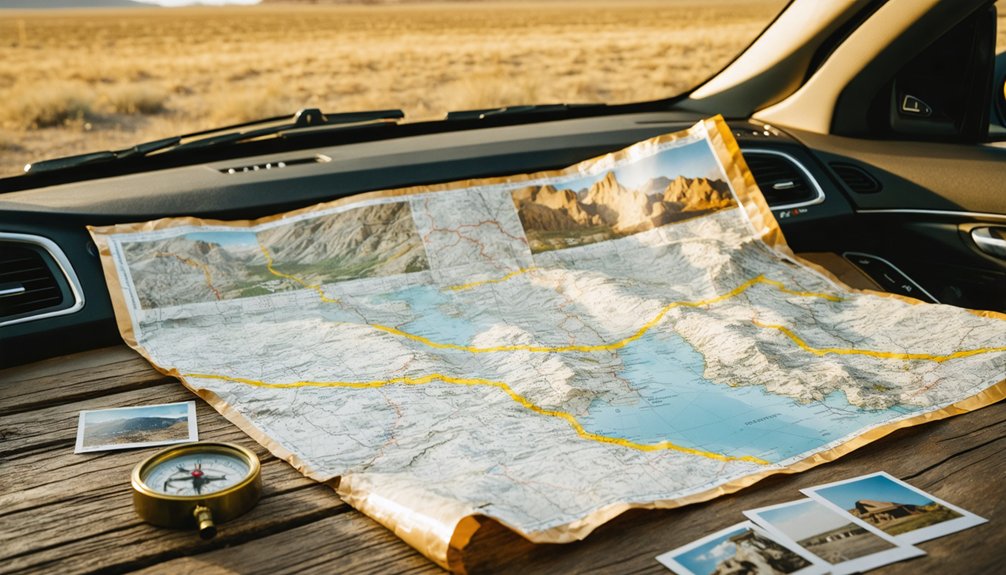
Mapping out your journey through Idaho’s remote mining territories demands careful preparation, especially when Soldier sits tucked away in the rugged Boise Basin highlands. You’ll navigate primitive transportation networks that haven’t changed much since miners abandoned these settlements decades ago. I’ve learned the hard way that downloading offline maps is essential—cell service vanishes quickly once you leave paved highways.
Each ghost town along your route holds unique historical significance, from Silver City’s remarkably preserved buildings to Burke’s dramatic canyon location. Plan for unpredictable road conditions; spring snowmelt and summer thunderstorms transform dusty tracks into impassable mud. Carry extra fuel, water, and emergency supplies. These aren’t Instagram-ready destinations with visitor centers—they’re genuine remnants of frontier life where self-reliance isn’t optional.
As you venture into the ghost towns of Idaho to explore, keep an eye out for relics that tell the stories of the pioneers who once thrived there. Each site offers a glimpse into a bygone era, inviting you to imagine the lives lived amid these now-silent landscapes. Be prepared to capture the eerie beauty and timeless allure of these forgotten places, as they hold secrets waiting to be uncovered.
Supernatural Encounters at Idaho’s Most Haunted Ghost Towns
When darkness settles over Idaho’s abandoned mining camps, the boundary between historical fact and supernatural folklore becomes unsettlingly thin. You’ll discover phantom miner sightings aren’t just campfire stories—they’re woven into the fabric of these ghostly settlements where lingering Civil War tensions still echo through empty streets.
Most-Reported Supernatural Encounters:
- Leesburg’s Confederate-Union Rivalry Spirits – Visitors describe seeing uniformed apparitions near hydraulic mining sites, remnants of the town’s divided past between warring veteran prospectors.
- Mount Idaho’s Battle Phantoms – The old hospital area produces consistent reports of wounded cavalry soldiers materializing near the former stockade.
- Midnight Record Raid Echoes – Poltergeist activity concentrates around Mount Idaho’s former courthouse site.
- Soldier’s Railroad Despair Shades – Mournful figures reportedly wander between the abandoned bank and Goff’s Hall after sunset.
Best Time to Visit and What to Bring
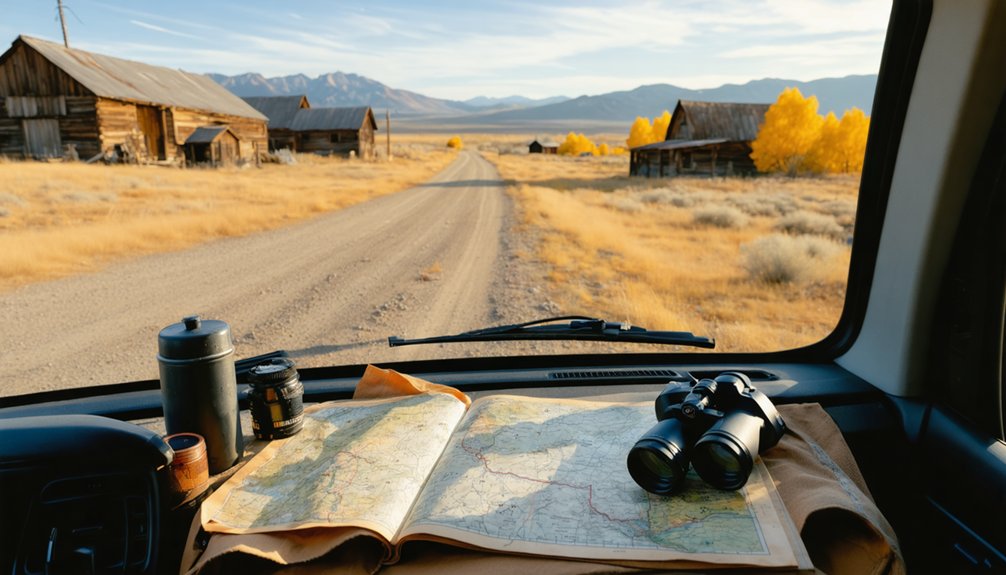
Whether you’re chasing phantom miners or simply exploring frontier history, your Soldier ghost town adventure demands proper timing and preparation. June through August offers ideal seasonal weather, with temperatures hovering around 62-74°F—perfect for wandering among weathered structures without battling Idaho’s brutal winter.
I’ve learned that packing for varying conditions separates comfortable explorers from miserable ones. Summer’s deceptive; you’ll need layers for cool mornings and wind-resistant gear against those 15 mph gusts. Winter visits? Pack serious snow equipment—early January dumps 10 inches regularly, and December temperatures plummet to 21°F.
Since residents occupy some buildings year-round, you’re free to visit anytime, but bring rain protection for spring’s 1.06-inch downpours. Your 2WD vehicle handles Soldier’s gravel roads fine, though emergency supplies remain essential.
Frequently Asked Questions
Are There Any Restaurants or Food Services Available in Soldier?
You’ll find Soldier Creek Brewing Company as your primary nearby dining establishment, serving local cuisine options from breakfast through dinner. Chef Chris crafts homemade soups, fresh Alaskan seafood, and pizzas in this laid-back bar atmosphere perfect for adventurous travelers.
Do I Need Special Permits to Explore Abandoned Buildings in Soldier?
No specific permits exist for Soldier’s buildings, but you’ll face serious legal implications entering structures on private property. Safety considerations matter too—collapsed cabins and unstable mines make exploration dangerous. Always respect posted boundaries and trespassing warnings.
Is Camping Allowed Near Soldier and Surrounding Ghost Towns?
You’ll find freedom in primitive campsites near Soldier, unlike restricted urban zones. BLM lands offer 14-day stays under primitive camping conditions—just stay 200 feet from water sources and relocate 25 miles afterward for another adventure.
What Cell Phone Coverage Can I Expect in Soldier Area?
You’ll find minimal cell signal strength in Soldier’s remote terrain—Verizon offers your best shot, though data connectivity remains spotty. Pack offline maps and embrace the digital detox; this wilderness rewards those who unplug from the grid.
Are the Roads to Soldier Paved or Require Four-Wheel Drive?
You’ll navigate dirt roads through challenging terrain requiring four-wheel drive—no smooth pavement here. I’ve traversed these rugged paths myself; high clearance vehicles handle the rocky, uneven surfaces best. Freedom means embracing adventure, but prepare accordingly for backcountry conditions.