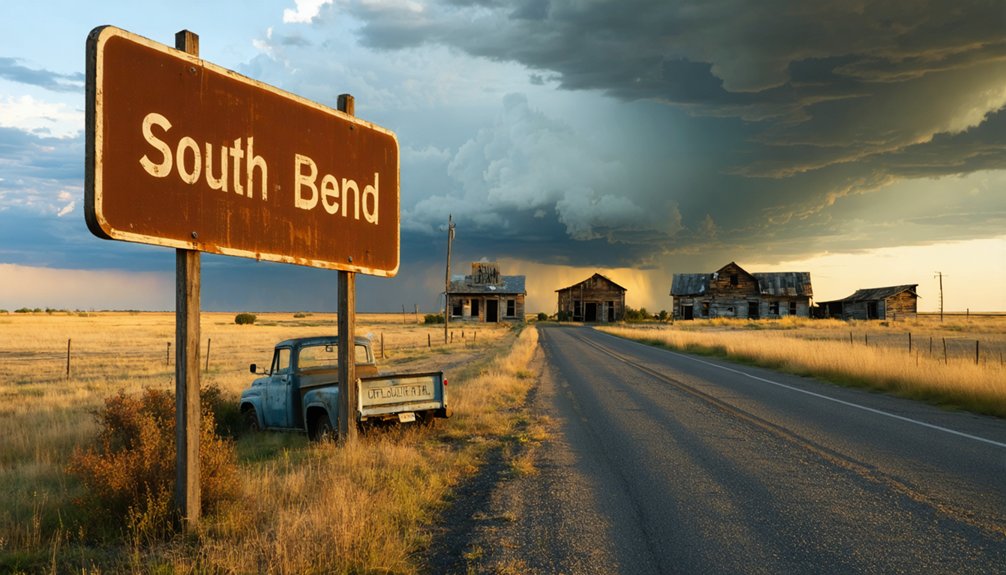
Plan your ghost town adventure to South Bend by driving 17 hours from Rapid City across 990 miles of Great Plains terrain, though you’ll want to break this journey with stops in Nebraska’s Sandhills. Once you’ve arrived in the Black Hills, explore the Black Hills Loop Byway and Highway 16 Mining Corridor to discover weathered foundations and skeletal headframes marking where gold fever once raged. Beyond South Bend’s crumbling structures, nearby camps like Rochford and Spokane reveal additional chapters of this region’s untamed past.
Key Takeaways
- South Bend emerged during the 1875 Black Hills gold rush but declined by 1880 when placer deposits receded.
- The ghost town site features scattered mining structures, skeletal headframes, crumbling foundations, and rusting legacy equipment.
- Drive 990 miles from Rapid City across the Great Plains, a 17-hour journey requiring intermediate stops in Nebraska’s Sandhills.
- Black Hills Loop Byway and Highway 16 Mining Corridor offer scenic routes to multiple ghost towns near South Bend.
- Dakota Gold plans a $400 million open pit operation transforming the site by 2029, so visit soon.
The Rise and Fall of South Bend During the Black Hills Gold Rush
When Lieutenant Colonel George Armstrong Custer’s expedition stumbled upon gold glittering in French Creek’s waters during the summer of 1874, they ignited a fever that would transform the Black Hills into a chaos of canvas tents, mud-churned gulches, and fortune-hungry prospectors.
By November 1875, Deadwood Gulch exploded with discoveries that triggered one of history’s most electrifying mining town economic booms. You’ll find South Bend emerged among these wild camps, clinging to creeks where single spade turns unearthed fortunes.
Between 1876-1877, thousands defied treaties and federal warnings, staking every available inch. But freedom’s price came due quickly. Receding placer gold deposits strangled South Bend’s lifeline by 1880, while Lead’s Homestake Mine swallowed smaller operations whole, leaving behind only weathered foundations and wind-whispered memories. The Homestake would eventually produce over 40 million ounces before closing in 2001, dwarfing the output of individual camps like South Bend. The government’s fixed price of $20.67 per ounce squeezed profits as labor and supply costs climbed relentlessly upward.
What Remains at the South Bend Mining Site Today
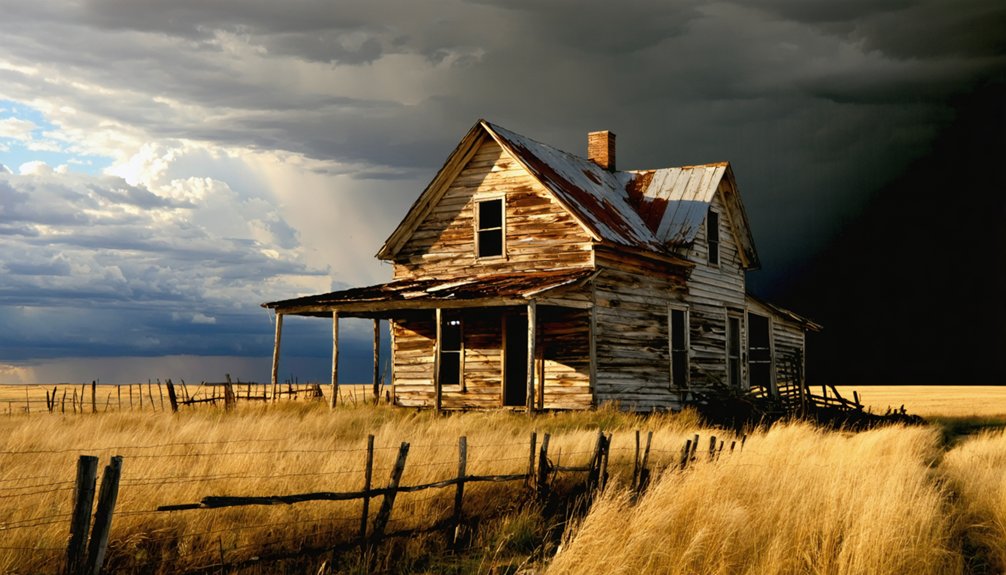
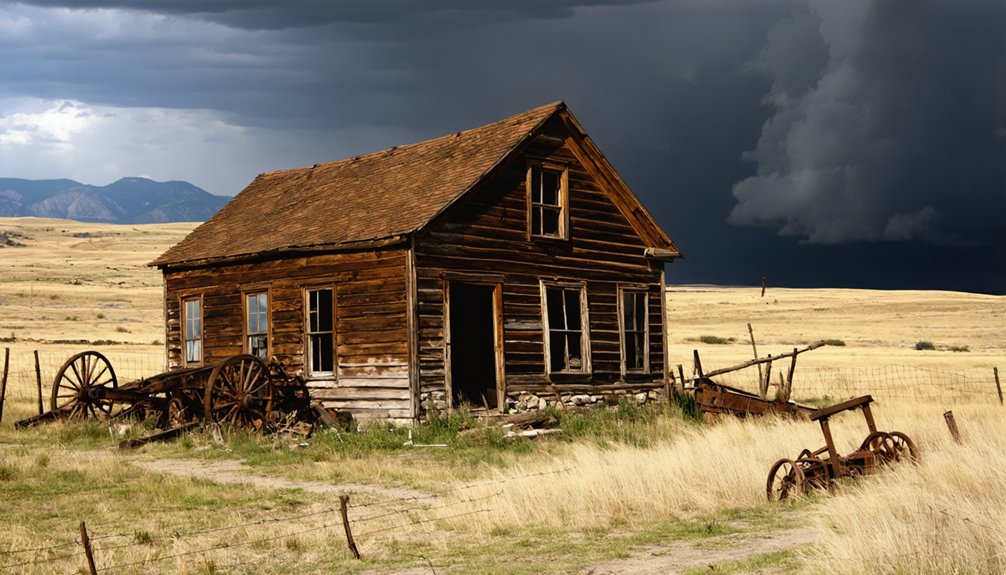
Where weathered timber frames once echoed with picks striking stone, South Bend’s mining site now stands as a haunting threshold between gold rush memory and controversial rebirth. You’ll find scattered surviving mining structures dotting the landscape—skeletal headframes and crumbling foundations that whisper tales of fortune seekers who once claimed this ground.
Legacy mining equipment rusts quietly among sage and wildflowers, physical remnants of an era when cyanide leaching and shaft drilling defined progress.
Yet this isn’t merely a historical preserve. Dakota Gold’s planned open pit operation will transform these silent relics into active extraction zones by 2029. The company promises 250 jobs and $400 million in state revenue, while environmental groups warn of repeating past mistakes—the nearby Homestake closure and Wharf mine’s 200 chemical spills serve as cautionary markers along your exploration route. Before extraction begins, operators must post reclamation surety that increased dramatically in 2024, with new commercial mining operations now requiring $3,850 per acre compared to the previous $500. The region’s appeal extends beyond mineral wealth, as officials’ permissive approach to mining has made South Dakota particularly attractive to extraction companies seeking new opportunities.
Mapping Your Route From Rapid City to South Bend
Your journey from Rapid City to South Bend spans roughly 990 miles across the Great Plains—a 17-hour drive that transforms rugged Black Hills terrain into the rolling farmlands of Indiana.
Along the way, you might want to explore the ghost town attractions in Fountain City, where remnants of the past tell stories of the pioneers who once thrived in the area. These hidden gems offer a unique glimpse into history, inviting curious travelers to uncover the mysteries of abandoned buildings and deserted streets. Additionally, vibrant local festivals often celebrate the rich heritage, adding a lively twist to your road trip.
This cross-country trek covers nearly 1,000 miles of America’s heartland, bridging dramatic mountain landscapes with Midwestern agricultural plains.
Google Maps and MapQuest deliver real-time navigation with route planning alternatives that adjust for road conditions and construction zones. You’ll want AAA TripTik for plotting up to 25 waypoints, perfect for ghost town detours and historical markers.
Split this expedition across two days. Intermediate stop recommendations include Nebraska’s Sandhills region, where fuel stations grow sparse and planning matters. Your navigation app shows gas prices and lodging options ahead, letting you chase the horizon without uncertainty. If you’re considering air travel instead, the flight distance between South Bend and Rapid City measures approximately 863 miles.
Every 200 miles demands a refueling stop. Chart your course with flexibility—these prairie highways reward spontaneous exploration while keeping civilization’s conveniences within reach. For travelers seeking alternatives to driving, bus service from Rapid City to South Bend takes approximately 24 hours with various transfer points along the route.
Best Scenic Byways and Highways for Ghost Town Exploration
Your journey to South Bend ghost towns begins along the Black Hills Loop Byway, where US-Highway-385 winds through pine-covered ridges past forgotten mining settlements like Galena and Rochford.
As you continue your adventure, consider exploring the ghost town attractions in Montana City, where remnants of the past tell tales of pioneers and prospectors. Each stop along the way unveils unique stories, from crumbling structures to relics of a vibrant history. Take your time to soak in the atmosphere and imagine what life was like in these now-silent locales.
Exploring ghost towns to visit in South Dakota can lead you to fascinating places like Lead and Deadwood, where the echoes of the gold rush still linger. These towns offer a glimpse into a time when adventurers sought their fortunes, and their fascinating histories await discovery. As you wander through their streets, you’ll unearth the stories of resilience and hope that characterized life during those bustling eras.
You’ll trace the remnants of gold rush fever through Tinton and Preston, their weathered structures standing sentinel among the ponderosa pines.
The Highway 16 Mining Corridor reveals a different story—roadside businesses and melodrama theaters in Rockerville that withered after highway expansions redirected travelers away from their once-bustling storefronts. Head about an hour east of Rapid City to discover Cottonwood, where a town hall and former bank building mark what remains of a community that formed in 1907. Further east, you’ll find Okaton, a deserted railroad town that briefly operated as a ghost town attraction before its final abandonment.
Black Hills Loop Byway
Winding 72 miles through the heart of Black Hills National Forest, the Black Hills Loop Byway delivers you straight into South Dakota’s mining-era past, where over 600 abandoned settlements dot the landscape like silent monuments to the 1874 Gold Rush. You’ll navigate forest roads paralleling US 385, accessing sites like Spokane—where rusted cars and a root cellar mark the 1890 quartz boom—through short trails beneath Ponderosa pines.
As you continue your journey, you’ll find yourself exploring historic everts ghost town, where the remnants of time stand still amidst the whisper of the trees. Each building tells a story of those who once inhabited the area, inviting curiosity and reflection. Keep your camera ready, as the haunting beauty of this ghost town offers countless photo opportunities that capture the essence of the Wild West.
Galena’s gaping mine shafts and eroded tailings sprawl across badlands terrain, while Rochford’s sawmill foundations whisper of logging operations long silent. The town added essential amenities including a theatre, drugstore, restaurants, hotels, and blacksmiths as it expanded along Little Rapid Creek. Along your route, watch for General Custer’s initials GAC carved into rock faces, enduring reminders of the 7th Cavalry’s historic presence in these hills. Scenic viewpoints reveal old stage ruts carved in 1878, and you can pair your exploration with guided tours from Deadwood for mining legends. Exit I-90 at Boulder Canyon for immediate immersion into this unrestricted frontier history.
Highway 16 Mining Corridor
Stretching southwest from Rapid City toward Custer, Highway 16 carves through a 40-mile mining corridor where elevation gains of 2,000 feet reveal ghost towns clinging to canyon walls and ridgelines.
You’ll discover Etta just five minutes from Keystone, where tin extraction gave way to lithium mining operations before abandonment claimed another Black Hills settlement. Spokane’s remnants mark the 17-minute journey deeper into gold rush territory, its once-profitable mines yielding silver, lead, and copper until economic challenges shuttered everything by 1940.
Rockerville survived through reinvention as a 1950s tourist stop before Highway 16’s rerouting stripped away its lifeline. Each switchback climbs higher through ponderosa forests where abandoned mine shafts puncture mountainsides, record of fortunes won and lost in this unforgiving terrain leading toward Jewel Cave National Monument.
Rockerville and Other Abandoned Mining Camps Near South Bend
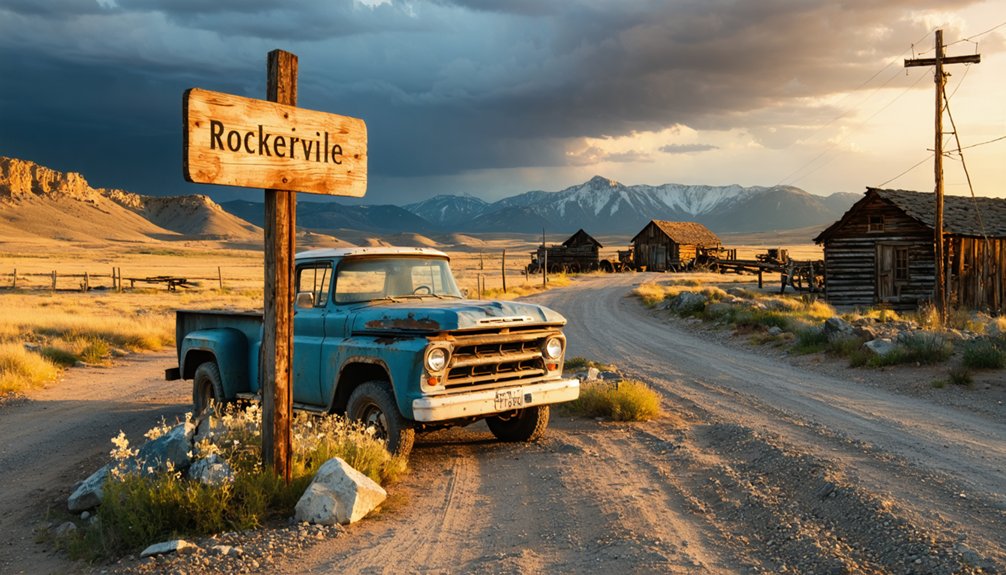
Along the rugged corridors between Rapid City and Hill City, Rockerville stands as one of the Black Hills’ most intriguing ghost town transformations. Born from December 1876 gold strikes, this camp once housed a thousand fortune-seekers who constructed an ambitious 17-mile flume system for hydraulic mining operations.
You’ll discover Rockerville’s complex timeline through its layers:
- 1877-1880 boom: $150,000 gold yields despite water shortages, hundreds of abandoned buildings
- 1950s-1960s tourist era: melodrama theatre, museum exhibits, and quirky roadside attractions
- Modern phoenix: Recent revival with new hospitality venues after 2016 safety demolitions
Only Cortland Rush’s cabin chimney survives from the original settlement. The town’s three highway exits mark where placer deposits once yielded fortunes, and where entrepreneurs later capitalized on Mount Rushmore traffic before abandonment claimed most structures.
Military History Along Your Journey Through Pennington County
As you wind through Pennington County’s backcountry toward South Bend, you’ll pass sites where military history shaped the Black Hills frontier. Camp Crook sprang up in 1875 to protect prospectors flooding the region, while Fort Meade’s cavalry troops patrolled these remote gulches and ridges throughout the Indian Wars.
Red Canyon’s military presence eventually faded into abandonment, leaving only weathered traces of the soldiers who once guarded these treacherous mountain passages.
Camp Crook’s 1875 Origins
While prospectors hungered for Black Hills gold in the summer of 1875, General George Crook’s cavalry established a military outpost near what’s now Pactola Lake—a strategic base designed to enforce federal law and push illegal miners off Lakota treaty land. You’re tracing the footsteps of cavalry expeditions that operated in a region caught between treaty violations and gold fever. Crook’s soldiers initially expelled intruders who’d flooded in after Custer’s 1874 discoveries, though the miners soon overwhelmed these efforts.
The outpost’s legacy reveals the clash between frontier enforcement and unstoppable human ambition:
- Camp Crook served as one of multiple temporary bases Crook established during Black Hills operations
- The cavalry briefly succeeded in removing prospectors before being outnumbered
- By late 1876, 300 miners had reclaimed the site, transforming military ground into mining territory
Fort Meade Protection Role
Your route through Pennington County leads to Fort Meade, where brick officers’ quarters and stone cavalry barracks still stand along Bear Butte Creek—a monument to the military muscle that transformed prospector camps into permanent towns. Established in 1878, this Seventh Cavalry headquarters deployed troops to shield Deadwood’s gold mines from Sioux resistance.
The fort meade military buildup brought over $1,000,000 in Army investment, replacing frontier structures with permanent installations that outlasted every regional post. You’ll trace history from the 1890 Wounded Knee campaign through 1906 Ute uprisings—operations that secured travel routes and prevented range wars.
Red Canyon Military Abandonment
Five miles north of Edgemont, where Red Canyon opens onto the Cheyenne River, you’ll find traces of the Black Hills’ first permanent military post—a 125-foot square palisaded fort with corner blockhouses that protected gold-rush traffic during the violent summer of 1876.
Captain Collier’s infantry companies marched from Fort Laramie that June, establishing garrison operations after the Metz party massacre. For one intense year, soldiers safeguarded the 150-mile stage route while Lakota resistance flared across the territory.
Troop withdrawal details reveal the fort’s brief but critical existence:
- All supplies transferred to Camp Hat Creek, Wyoming in 1877
- Route abandoned due to continued Indian hostilities
- Visible wall traces and corner bastions remain near Jim Boll Ranch
You’re standing where genuine frontier warfare shaped Dakota’s future.
Legends and Haunted Tales From Black Hills Ghost Towns
Why do the abandoned mining camps of the Black Hills still echo with whispers from another era? You’ll discover forgotten prospectors’ tales woven through Galena and Rochford, where gold fever died but spirits didn’t.
At Mount Moriah Cemetery, Wild Bill Hickok and Calamity Jane rest side-by-side—visitors report shadowy figures near their graves, perhaps reliving that fatal 1876 poker game.
Deadwood’s ghost tours reveal untold mining tragedies: widows searching abandoned shafts, footsteps echoing through historic saloons where gunfights over claims ended lives abruptly.
Venture to Tinton or Preston, where mine tailings mark sites of eroded dreams and alleged hauntings. Even Pactola’s submerged town structures, 150 feet below water, harbor stories of a drowned past.
These spectral encounters transform your road trip into something beyond history—you’re witnessing the Black Hills’ restless soul.
Essential Safety Tips for Exploring Mine Shafts and Tailings
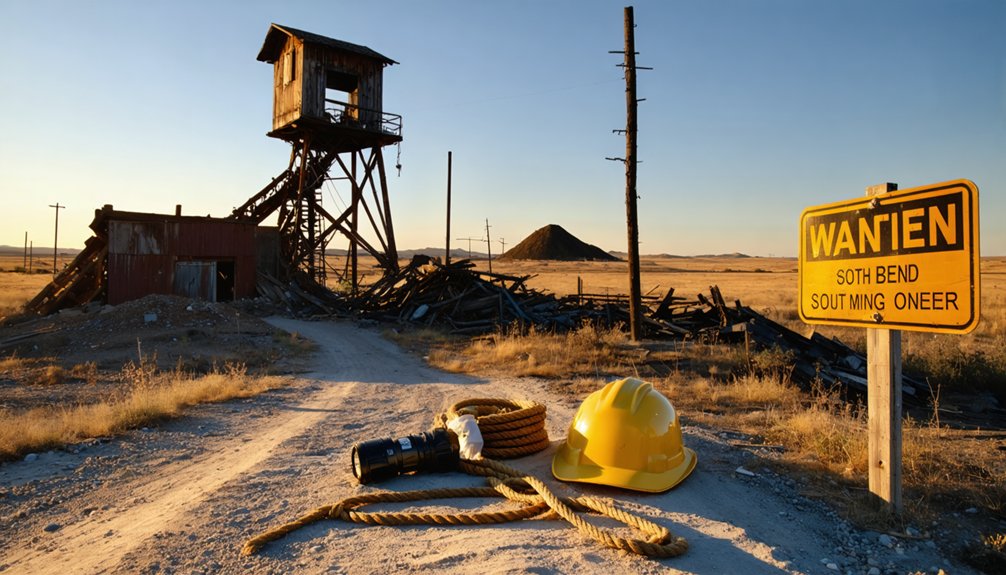
Before you venture near those weathered mine openings dotting South Bend’s hillsides, understand that abandoned shafts aren’t historical curiosities—they’re death traps disguised by time and prairie grass. Vertical tunnels conceal loose debris and undermined edges, while vegetation masks openings that predate modern closure regulations. You’re responsible for your own survival here.
Critical precautions before approaching any mining remnant:
- Stay beyond 50 feet of timbered areas where structural failure accelerates
- Avoid tailings piles containing cyanide residues from historical gold operations
- Never enter sites lacking personal protective equipment protocols or current site restoration processes
Fire, smoke, and toxic gases spread rapidly through underground networks. South Dakota requires permits for mechanized exploration, but your hand tools won’t protect you from chemical leaching or unstable overhangs. Trespassing voids all premises liability protections—warning signs exist for legitimate reasons.
Connecting South Bend to the Deadwood Gold Rush Circuit
You’ll find South Bend’s story woven into the broader tapestry of the Black Hills gold fever through weathered wagon roads that once hummed with prospectors heading to Deadwood’s gambling halls and assay offices. These historic trail routes carried supplies, dreams, and disappointments between remote mining camps, creating a network of commerce that sustained the entire region’s hunger for gold.
As you trace these connecting paths today, you’re following the same rutted tracks where fortune-seekers carved their legacy into the hillsides, linking forgotten settlements to Deadwood’s glittering promise of wealth.
Historic Trail Routes Connected
The Black Hills Gold Rush trails converged on Deadwood like spokes on a wheel, and South Bend sat along one of those dusty arteries that carried fortune-seekers into the heart of the mining district. You’ll trace routes where prospectors traveled 200 miles across creeks and prairies, following paths marked by quarter-mile snow posts whose ruts remain visible through historic trail preservation efforts.
The connection networks included:
- Fort Pierre Railroad routes linking southwestern ghost towns like Boughton to Deadwood’s northern approaches
- Military trails from Fort Meade and Camp Sturgis securing eastern passages into Lawrence County mining camps
- Placer camp networks from Germania district operations along Hay and Elk Creeks feeding into South Bend’s circuit
Archaeological site surveys continue documenting these forgotten arteries where stages once rolled past Brashville and Quartz City toward Deadwood’s legendary goldfields.
Deadwood’s Mining Legacy Links
Following those wheel-spoke trails into Deadwood means arriving at ground zero of the Black Hills gold fever—the epicenter that pulled South Bend and dozens of satellite camps into its gravitational orbit. You’ll trace the path from Ross and McKay’s 1874 French Creek discovery to the placer-rich gulches that yielded $6-8 million by 1880.
Stand where mining corporations like Homestake transformed wildcat prospecting into industrial empire—George Hearst’s $70,000 gamble became America’s largest gold producer. The mineral discoveries that sparked South Bend’s brief existence connect directly to Deadwood’s sustained boom.
Walk Deadwood Creek’s ground-sluiced bedrock, now quiet after a century of extraction. These streets remember when freedom-seeking prospectors defied treaties, staked impossible dreams, and chased the Mother Lode that made this canyon legendary.
Planning a Multi-Day Black Hills Ghost Town Adventure

Since the Black Hills harbor over 600 ghost towns scattered across rugged terrain and winding canyon roads, you’ll want to dedicate at least three days to properly explore these remnants of the 1876 Gold Rush era. Base yourself along Highway 44 and US-385 corridor to access clusters like Mystic, Rochford, and Galena efficiently. You’ll encounter seasonal flora and fauna while hiking between sites, and Deadwood offers immersive living history at Mount Moriah Cemetery.
plan your road trip to oak flat to discover its stunning landscapes and unique attractions. This region is known for its vibrant wildlife and breathtaking views, perfect for those looking to embrace the great outdoors. As you journey through oak flat, be sure to check out local spots that offer a taste of the area’s rich history and culture.
Structure your expedition around these zones:
- Day 1: Galena via Vanocker Canyon, then Deadwood’s Boulder Canyon route
- Day 2: Mystic’s restored schoolhouse and Rochford along George Frink Road
- Day 3: Spokane via Iron Mountain Road (N43.840657, W103.376041) and Cambria’s beehive ovens
Respect private property boundaries while documenting mining remnants along the historic mineral belt Range 3 East.
Frequently Asked Questions
What Permits or Permissions Are Needed to Explore South Bend’s Abandoned Mines?
You’ll need mine permits from DANR before exploring abandoned workings. Dangers of unauthorized entry include unstable shafts and potential environmental hazards like toxic gases. Contact (605) 773-4201 first—freedom means respecting both safety and legal boundaries in these historic passages.
Are There Guided Ghost Town Tours That Specifically Include South Bend?
You’ll hit a dead end searching for organized excursions to South Bend—no guided tours venture there. Instead, embrace the freedom of self-guided tours through Black Hills ghost towns, where you’ll chart your own path through forgotten history.
Exploring ghost towns near Bernardsville, South Dakota, offers a unique glimpse into the past, where remnants of old structures whisper stories of bygone eras. As you wander through these desolate streets, you’ll encounter fascinating artifacts that speak to the lives once lived there. Each town has its own character, drawing you deeper into the mysteries of history waiting to be uncovered.
If you’re looking for a similar adventure, you might want to explore ghost towns near Snoma, where the remnants of the past lie just waiting to be discovered. The eerie silence of these abandoned places invites you to imagine the stories behind their abandoned buildings and empty streets. Whether it’s the crumbling facades or rusted relics, each site promises a hauntingly beautiful experience that will ignite your curiosity.
What Cell Phone Coverage Exists in the South Bend Area?
Cell phone signal strength weakens markedly near South Bend’s remote location. You’ll find limited cellular data speeds from major carriers due to the area’s rural terrain and sparse population. Download maps offline before exploring this isolated ghost town destination.
Can Artifacts or Mining Relics Be Legally Collected From the Site?
You can’t legally collect artifacts or mining relics from South Bend—they’re protected by federal law recognizing their historical significance. Instead, you’ll experience sustainable preservation through observation, photographing these treasures while respecting their cultural legacy for future explorers.
Where Are the Nearest Lodging and Fuel Options to South Bend?
You’ll find nearby gas station availability in Hot Springs, roughly 20 miles away, while local bed and breakfast accommodations await at Highmore’s Hydeout or Pierre’s options. Stock up before venturing into South Bend’s remote freedom.
References
- https://www.sdpb.org/rural-life-and-history/2023-08-21/some-black-hills-ghost-towns-and-their-origins
- https://en.wikipedia.org/wiki/List_of_ghost_towns_in_South_Dakota
- https://www.powderhouselodge.com/black-hills-attractions/fun-attractions/ghost-towns-of-western-south-dakota/
- https://www.blackhillsbadlands.com/blog/post/old-west-legends-mines-ghost-towns-route-reimagined/
- https://openprairie.sdstate.edu/etd/4061/
- https://www.atlasobscura.com/places/spokane-ghost-town
- https://www.youtube.com/watch?v=De3wGn9KDkg
- https://blackhillsvisitor.com/learn/history/the-black-hills-gold-rush/
- https://www.ebsco.com/research-starters/history/black-hills-gold-rush
- https://blackhillsatvdestinations.com/gold-rush/