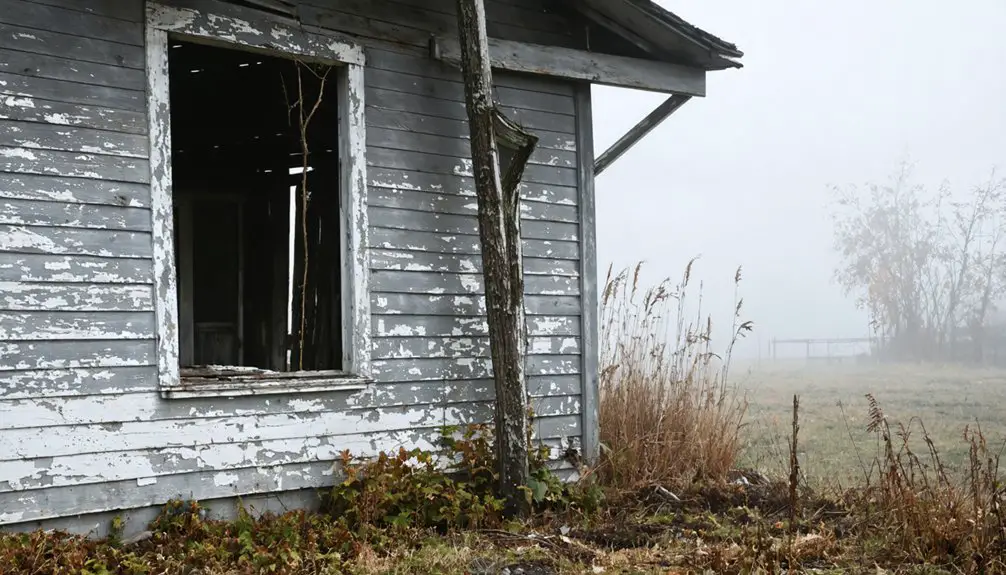
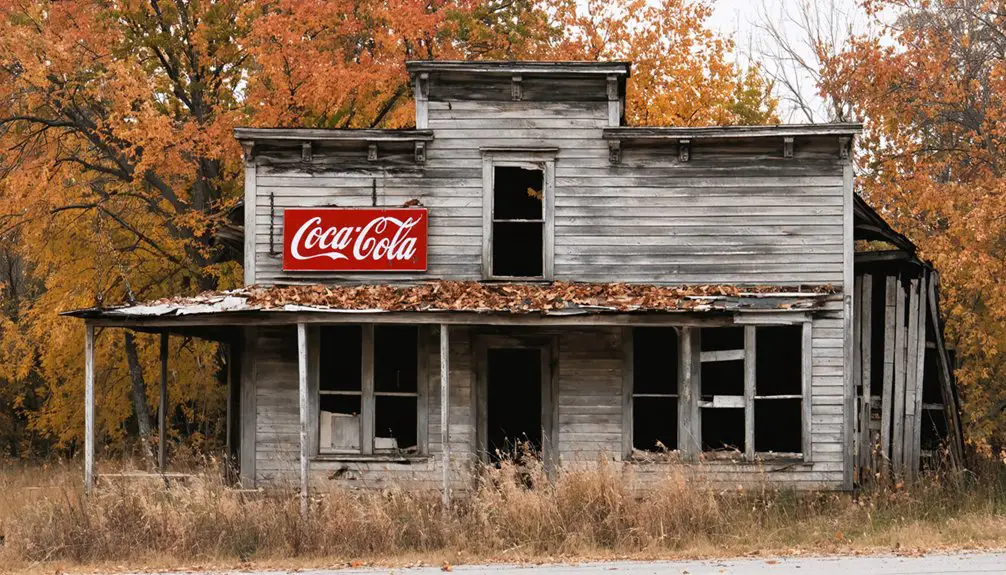
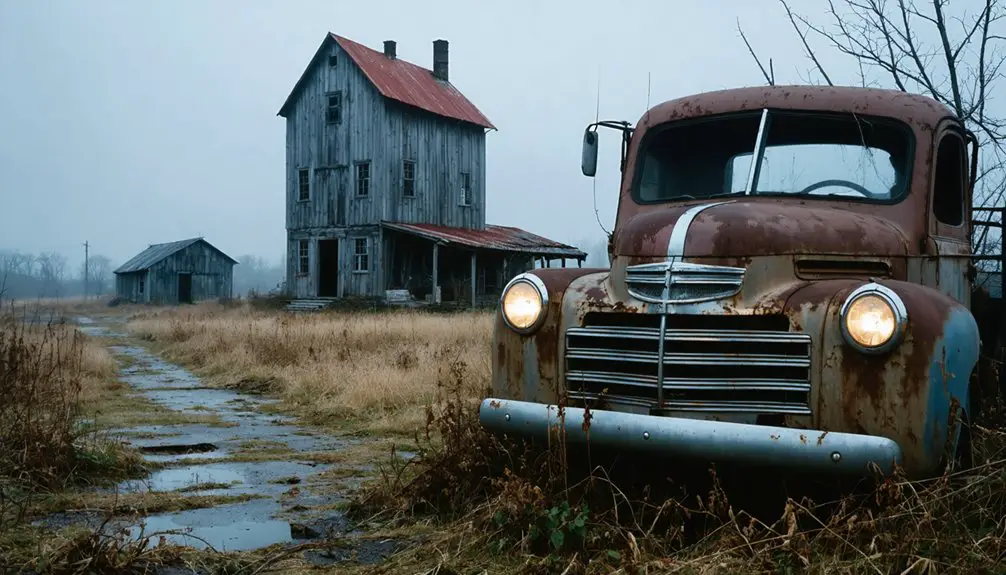
You’ll find South Boardman’s haunting remnants about 30 miles southeast of Traverse City, roughly a 40-minute drive through northern Michigan’s forests. This once-thriving lumber town of 400 residents vanished after a devastating 1923 fire consumed its entire business district and the white pine forests ran dry. Today, you can explore the historic post office, museum artifacts from the 1872 founding, and weathered foundations where sawmills once roared. The quiet intersection reveals layers of forgotten prosperity beneath the pines.
Key Takeaways
- Drive 22-33 miles southeast from Traverse City via CR 611, taking 35-45 minutes through scenic farmland and forest.
- Visit the historic museum preserving artifacts from 1872 and the operational post office serving remaining residents.
- Explore remnants at the US-131 and Boardman Road intersection, including preserved buildings and old railroad grade.
- Learn about the devastating 1923 fire that destroyed the entire business district and turned South Boardman into a ghost town.
- Discover the logging industry’s rise and collapse, from 1883 boom years to complete deforestation by 1930.
The Rise and Fall of a Michigan Logging Town
In 1870, pioneers carved a settlement from the northern Michigan wilderness, staking their claims in what would become Boardman Township. By 1872, South Boardman took shape where the railroad met the South Branch Boardman River.
Hamilton Stone’s water power innovations transformed the area—his 1877 dam powered a saw-mill by 1878, while T.P. Shuerts added a grist-mill in 1880. You’ll find the real boom started in 1883 when massive steam saw-mills arrived. The town’s economic reliance on lumber pushed the population to 400 by 1918, supporting multiple mills, hotels, and churches.
But as forests disappeared, so did opportunity. What thrived as a lumber center couldn’t survive without trees—South Boardman’s fate was sealed.
What Destroyed South Boardman’s Business District
Standing among the weathered structures today, you’ll find it hard to imagine that a single catastrophic fire in 1923 reduced South Boardman’s entire business district to ash and memories. The flames consumed every shop, hotel, and mill in a town already reeling from the logging industry’s collapse, as the massive white pines that had fueled the local economy had been cut down to stumps.
What you’re witnessing isn’t the result of one disaster but the compound effect of depleted timber forcing mills to relocate and fire finishing what economic decline had started.
The Devastating 1923 Fire
Just five years after South Boardman’s population peaked at 400 residents, flames tore through the entire business district in 1923, reducing the town’s commercial heart to ash and ruins. You’ll find no records of fire prevention measures existing back then—no department, no equipment, nothing to stop the inferno as it consumed all five saloons, both hotels, the flour mill, and every shop lining the streets.
The long term community impact was swift and brutal. Residents who’d built their livelihoods around logging watched their economic lifeline vanish overnight. The town became deserted almost immediately, transforming from a bustling lumber hub into Michigan’s most authentic ghost town.
Today, you’ll see only scattered remnants—a museum, the post office, and old structures converted into homes.
Logging Industry’s Collapse
While the 1923 fire delivered the final blow to South Boardman’s commercial district, the town’s fate was already sealed by something far more predictable: Michigan’s timber barons had systematically stripped the surrounding forests bare.
The clear cutting practices employed here were ruthlessly efficient. Between 1870-1890, loggers wielding only axes removed the majority of Michigan’s white pine—that “green gold” they’d purchased for $1.25 per acre. By 1918, South Boardman’s three mills had nothing left to process.
The economic impacts of depletion hit hard. Those 400 residents watched their prosperity vanish as accessible timber disappeared by 1930. What logging wealth remained fled to fund Detroit’s automotive empire, leaving northern Michigan with wastelands where virgin forests once stood. Today, only 49 acres of old-growth survive statewide.
Getting to South Boardman From Traverse City
You’ll find South Boardman about 22-33 miles southeast of Traverse City, an easy 35-45 minute drive depending on which route you choose. The quickest path follows CR 611 through rolling farmland and patches of dense forest, with the small town of Kingsley marking your halfway point.
I’d recommend taking the slightly longer scenic route if you’re not in a rush—the back roads through Grand Traverse County offer glimpses of weathered barns and old homesteads that hint at the region’s logging past.
Route and Distance Details
Starting from Traverse City, the journey to South Boardman stretches northwest across 24 miles of northern Michigan terrain—a compact adventure that’ll consume about 45 minutes of your afternoon. You’ll appreciate the route efficiency of the primary path, though an alternative via CR 611 adds nine extra miles if you’re feeling exploratory. Distance variations exist between sources—some report 22 miles, others 24—but your GPS won’t lead you astray.
Kingsley marks your halfway point, a convenient landmark when you’re gauging progress. I’ve made this drive countless times chasing abandoned settlements, and the straightforward navigation means you’ll spend less time consulting maps and more time anticipating what awaits. No time zone juggling required; both towns share EDT, keeping your schedule beautifully uncomplicated for this ghost town expedition.
As you plan your next road trip destination in Arizona, don’t forget to include the stunning landscapes and unique geological formations that dot the route. Each stop offers a glimpse into the rich history of the area, making the journey as exciting as the final destination. With plenty of scenic viewpoints along the way, be prepared to capture unforgettable moments that will make your trip truly memorable.
Scenic Stops Along Way
Before your wheels even leave Traverse City’s limits, Boardman Lake Loop Trail beckons as the perfect warm-up to your ghost town expedition. This 4-mile circuit delivers instant gratification with its lakeside recreation opportunities and scenic viewpoints that’ll make you wonder why you’re rushing anywhere.
Three stops worth your time:
- Eastern Boardwalk Segment – Wind through heavily wooded trails where pavement metamorphosizes to elevated boardwalk, offering prime vantage points over calm waters.
- Southern River Bridges – Two crossings over the Boardman/Ottaway River frame your departure, with extended boardwalks stretching into quiet coves.
- Western Lookout Piers – Launch kayaks or cast lines from fishing decks before hitting the open road.
The trail’s completely accessible, connecting seamlessly to TART’s broader network if you’re craving more miles.
Historic Buildings and Structures Still Standing Today
Though fire ravaged South Boardman’s business district in 1923, a handful of structures survived to tell the story of this once-thriving logging settlement. You’ll find the historic museum collection at the junction of US-131 and Boardman Road, preserving artifacts from the 1872 founding and logging boom years.
The well preserved post office still operates, serving the few dozen residents who call this shadow town home. Near the railroad tracks, an old Legion post occupies what resembles a former depot. As you explore the streets, you’ll spot former shops converted into homes after the fire, standing alongside newer residences.
These weathered buildings offer tangible connections to when 400 people lived here, back when five saloons lined these same streets you’re walking today.
Must-See Stops in Downtown South Boardman
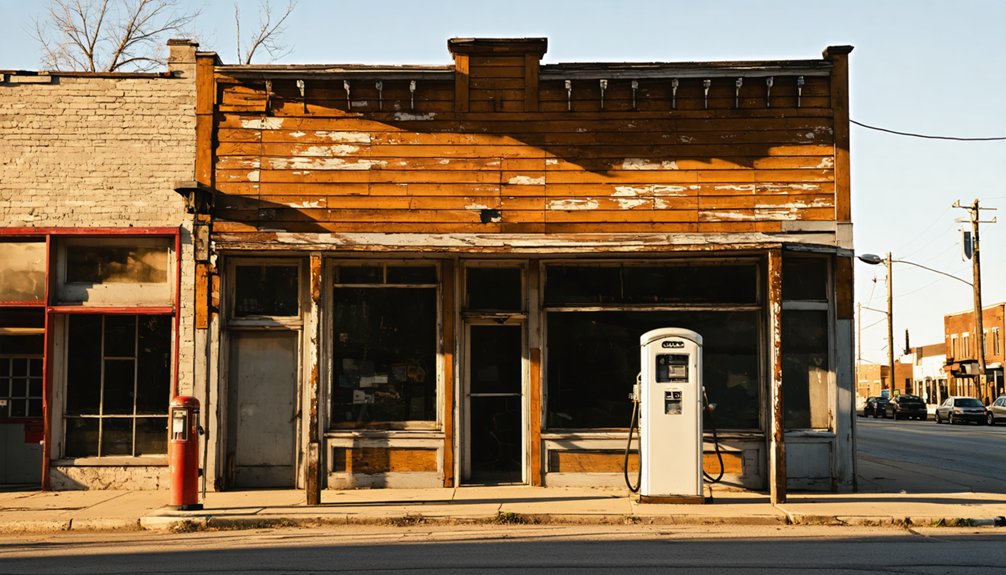
When you arrive at the quiet intersection where US-131 meets Boardman Road, you’re standing at the heart of what remains of South Boardman’s downtown. The commercial district has largely faded, but you’ll find traces of its past if you know where to look.
Stand at this crossroads long enough, and the echoes of South Boardman’s commercial past begin to materialize through the quiet.
Key spots worth exploring:
- Remnants of former shops along the main corridor—weathered foundations and partial walls hint at the bustling trading post this once was
- Preserved downtown buildings scattered near the intersection, including structures that served lumberjacks and railroad workers in the 1800s
- The old railroad grade running parallel to the highway, where timber once moved through this critical junction
Take your time wandering. There’s no tourist infrastructure dictating your pace—just authentic exploration.
Best Times to Visit This Kalkaska County Ghost Town
After you’ve walked the silent streets and photographed the crumbling storefronts, timing becomes your next consideration. Seasonal weather patterns dictate your experience here—September through October delivers ideal exploration conditions with 40-65°F temps, brilliant fall colors illuminating old foundations, and fewer crowds blocking your shots.
Spring’s late March thaw opens logging trails without summer’s tourist traffic, though you’ll need patience for muddy roads. June through August offers 75-80°F warmth and extended daylight for documentation, but expect company from US-131 travelers. Winter’s 100+ inches of snowfall fundamentally closes access, transforming South Boardman into a true ghost town.
Stock supplies beforehand—grocery scarcity hasn’t changed since 1923. The railroad remnants and Legion Post wait year-round, but autumn grants you the freedom to explore uninterrupted.
Other Northern Michigan Ghost Towns Worth Exploring
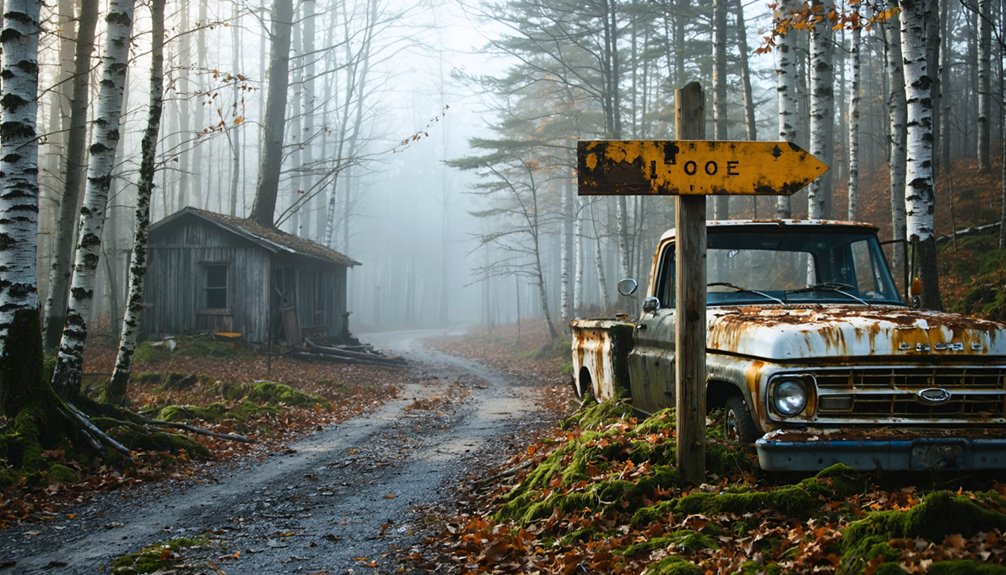
Beyond South Boardman’s weathered foundations, Michigan’s north country harbors dozens of abandoned settlements where you’ll find stories etched in rusted equipment and doorframes leading nowhere.
Three Must-See Ghost Towns Within Two Hours:
- Port Oneida Village – Explore America’s largest rural preserved historic district spanning 2,000 acres along Sleeping Bear Dunes. You’ll discover 121 buildings including barns and a schoolhouse from the lumber boom era.
- Central Mine – Walk self-guided tours through this Keweenaw copper town where 1,200 residents once lived. The visitor center reveals how historic abandoned industry shaped these remote peninsulas.
- Kilmanagh – Photograph the restored 1940s gas pump at the shuttered general store, then attend Sunday services at St. John Lutheran Church where locals still gather.
Each site offers unrestricted wandering through Michigan’s industrial past without crowds or commercialization.
Frequently Asked Questions
Are There Any Restaurants or Places to Eat in South Boardman?
You’ll find Yankee Boy Restaurant serving hearty comfort food right on Highway 131—your main local diner option. During summer, seasonal food truck vendors occasionally appear, though choices stay limited in this quiet ghost town crossroads.
Is South Boardman Safe to Explore With Children?
Yes, South Boardman’s low crime rates make it child-friendly for exploration. You’ll want basic personal safety precautions around abandoned structures, though nearby emergency services in Traverse City provide reassurance. Daytime visits offer the safest family adventure experience.
Can You Go Inside the Old Buildings or Just View Exteriors?
You’ll mostly view exteriors due to interior access restrictions—these aren’t abandoned ruins. The museum welcomes visitors inside, but historical preservation concerns mean renovated homes and shops remain private. You’re free to photograph streetscapes and architecture from public areas.
Where Can I Find Accommodations Near South Boardman for Overnight Stays?
You’ll find budget motels nearby like Yankee Motel and Kingsley Motel offering clean, comfortable rooms. For families, consider family friendly Airbnb rentals or Vista Green RV Resort. I’ve found these spots perfect for adventurous travelers seeking affordable freedom.
Are There Guided Tours Available or Is It Self-Guided Exploration Only?
You’ll find self-guided tours available exclusively, since no formal tour companies operate here. This freedom lets you discover abandoned building exploration opportunities at your own pace, though only 25 residents remain from the original 400-person community.