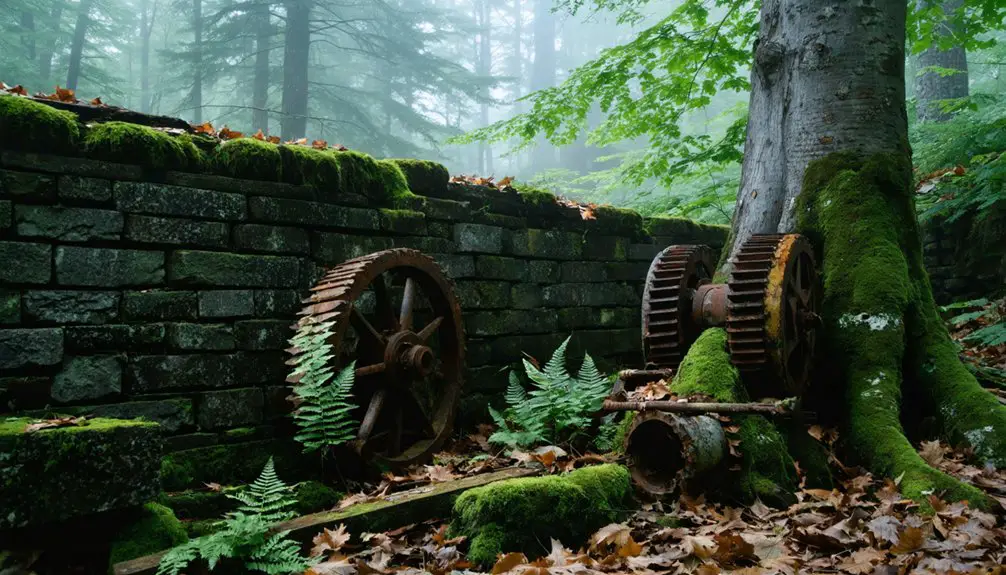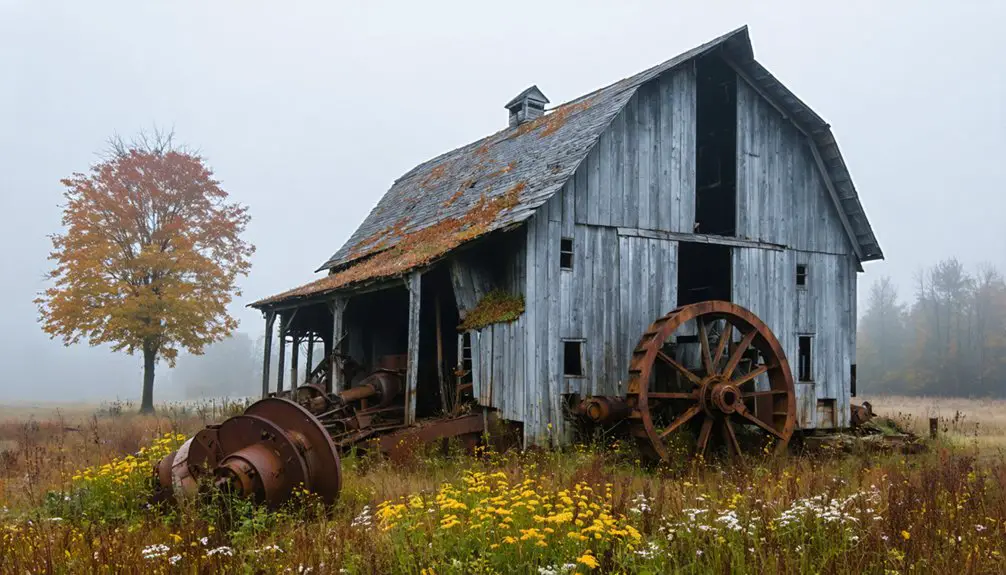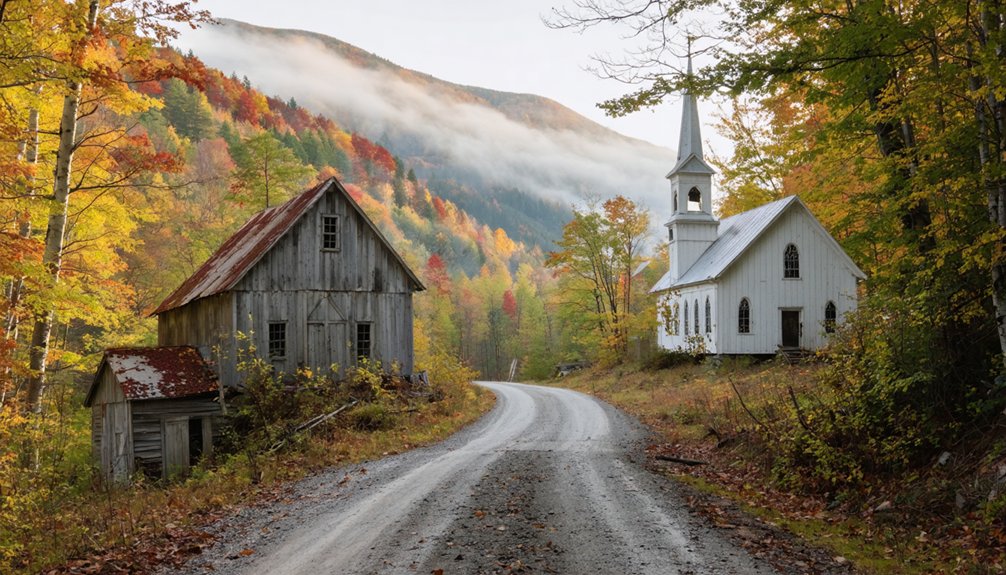
Exit I-91 at Sheffield/Wheelock and head north on Route 122, where you’ll wind past bubbling brooks toward a settlement that once housed 881 souls. The gravel crunches beneath your tires as you approach the 1871 Town Hall overlooking a semicircular common, then cross to the three-quarter-acre cemetery where Hannah Bradley’s 1827 grave marks the beginning. Down by Millers Run, you’ll search for traces of the vanished gristmill and distillery, though the wilderness has reclaimed what ambitious settlers carved from these valleys centuries ago.
Key Takeaways
- Exit I-91 at Sheffield/Wheelock (exit 24), turn north on Route 122, and pass Wheelock Common Historic District.
- Visit the 1871 Greek Revival Town Hall at 1192 Route 122 where Sutton Road branches northeast.
- Explore the three-quarter-acre cemetery across from the common, featuring graves dating back to Hannah Bradley’s 1827 burial.
- The abandoned mill district on Millers Run has no visible remnants of the original 1792 gristmill or distillery.
- South Wheelock thrived as a mill village until the 1860s, never exceeding 881 residents before becoming a ghost town.
The History Behind South Wheelock’s Abandoned Mill District
Long before South Wheelock became a whisper of Vermont’s industrial past, the thundering waters of Millers Run drew ambitious settlers to carve mills from the wilderness. You’ll discover that by 1792, entrepreneurs harnessed these falls with a gristmill, followed by sawmills and four strategic dams powering everything from tanneries to a threshing machine factory.
Prominent business owners like Erastus Fairbanks transformed Wheelock Hollow into a thriving village by 1830, where notable mill technology drove woolen factories, carding mills, and cabinet shops along the stream’s edge. This wasn’t just industry—it was freedom forged in water and wood.
Yet the population never exceeded 881 souls, and by the 1860s, the dream began fading into the ghost town you’ll explore today. When researching the area’s history, visitors often encounter disambiguation pages that help clarify which Wheelock location they’re investigating, as the name appears across multiple New England sites.
Getting to South Wheelock on Vermont Route 122
When you’re chasing Vermont’s forgotten places, Route 122 becomes your gateway to South Wheelock’s abandoned dreams. Exit I-91 at exit 24, marked Sheffield/Wheelock, and turn north onto this two-lane ribbon of asphalt. You’ll cross Squabble Hollow Brook first, then wind past Mathewson Brook as the road delivers you toward ghost town exploration territory.
Watch for 699 Route 122 on your left—you’re closing in. The highway threads through Wheelock Common Historic District, where even the living structures feel touched by time’s passage.
These haunted roads carry you past the Town Hall at 1192, then deeper into valleys where Miller Run whispers secrets to abandoned foundations. Continue past the Bread and Puppet Theater as you follow Route 122 through this rural landscape. The route begins at the intersection with US 5 just north of Lyndonville, launching your journey into Vermont’s backcountry. Fifteen miles of freedom stretch from Lyndon to Glover, but South Wheelock’s shadows wait somewhere between.
What Remains at the Original Grist-Mill and Distillery Site
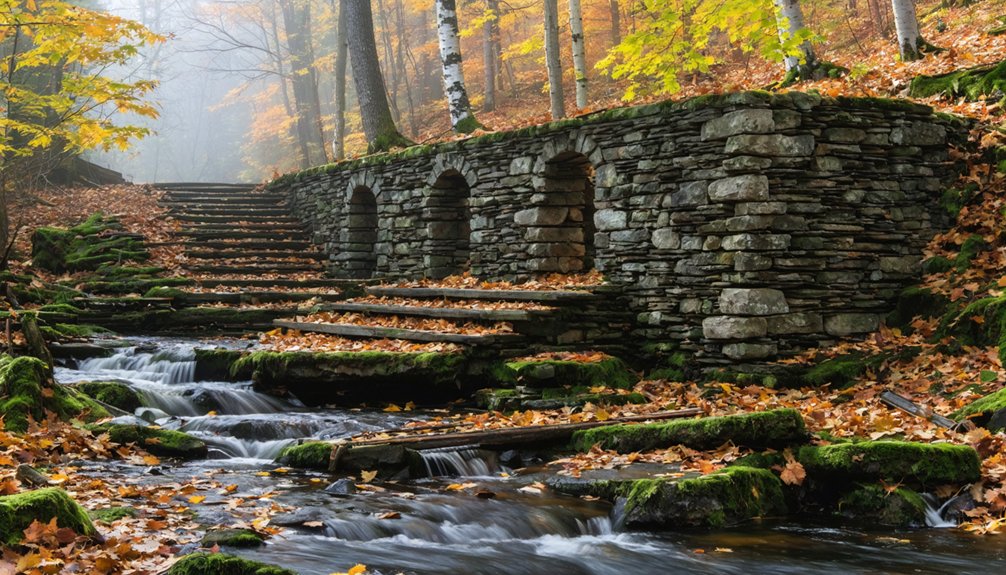
The ghost of Mr. Chamberlin’s pioneering enterprise lingers only in records now. When you arrive at the corners of roads 51 and 50, you’ll find the original grist-mill and distillery have vanished completely. No stone foundations peek through the undergrowth near the pond feeding West Brook. No remnants of distilling equipment rust beside the waterway.
Archival documentation gaps make pinpointing the exact location challenging, though you know it preceded Isaac Stanton’s 1795 mill on this same site. The current sawmill operation employing three men represents the third iteration here, focusing solely on lumber. Where grain once ground and spirits flowed, remaining architectural features are nonexistent—just whispers of Vermont’s industrial past and your imagination filling the empty spaces. Unlike the Manchester grist mill that was carefully restored in the 1970s, this site bears no trace of its milling heritage. Like many early American operations, the profitability of the distillery depended entirely on the tireless labor of those who worked the equipment day after day.
Exploring Wheelock Common and Its 1871 Town Hall
At Wheelock’s heart sits a modest two-acre district that captures Vermont’s 19th-century civic pride better than grander monuments elsewhere. You’ll find the 1871 Town Hall standing where Sutton Road branches northeast—a deliberate statement when townspeople shifted their civic center from industrial Wheelock Hollow to this mineral springs village. The Greek Revival and Italianate structure overlooks a quarter-acre semicircular common that Thomas Jefferson Cree donated in 1880, transforming this community gathering space into something permanent. The 1-1/2 story building features a distinctive square belfry that marks the skyline of this traditional town center.
Walk the cemetery’s 1827 markers, then stand where Route 122 meets the common. This architectural preservation effort, recognized nationally in 2007, lets you experience Vermont governance stripped to essentials: one hall, one grassy semicircle, one community that refused Dartmouth’s tenancy for local autonomy.
The Cemetery With Graves Dating Back to 1827
Across Vermont Route 122 from the semicircular common, pine shadows stretch over three-quarters of an acre where Wheelock’s earliest residents rest beneath marble and slate. You’ll find Hannah H. Bradley’s 1827 grave marking the cemetery’s official beginning, though Revolutionary War veteran Benjamin Carter and Sarah Woodman were reinterred here from earlier sites.
The burial plot layout tells its own story—thirty-one Bradley family members cluster together while six green slate stones with weeping willow motifs occupy the far western side. Grave inscription legibility varies; mid-to-late nineteenth-century marble headstones remain readable, while the slate markers from 1827-1843 weather differently under the pines. Among the notable burials is Julia A. Wheelock, who died in 1897 at age 70 and rests in a nearby Leicester cemetery, representing the widespread Wheelock family presence throughout the region. Volunteers have documented 234 memorials here, with photographs preserving most of these historical markers for future generations.
This isn’t just Vermont history preserved—it’s freedom’s earliest settlers choosing their final resting place in these mountains.
Supernatural Tales Connected to the Wheelock Area
The Wheelock name carries weight in Vermont’s supernatural circles, particularly after Deacon Jonathan Wheelock met his grisly end in 1842—a violent accident that allegedly triggered poltergeist activity in his 1789 farmhouse.
You’ll find the paranormal threads extend beyond South Wheelock to nearby Cavendish, where the historic Green Tavern (now Golden Stage Inn) reportedly hosts an annual Christmas Eve gathering of regional spirits who rehearse their haunting techniques. These interconnected tales suggest the Wheelock area sits at the heart of a broader network of Vermont ghost lore, where family names, tragic deaths, and century-old buildings create lasting impressions on the landscape. Visitors have reported waking to find objects moved between rooms, items inexplicably falling from shelves, and even witnessing opaque shadow forms lurking in doorways. The region’s ghostly reputation extends to Lyndon’s Cahoon Farm, another historic property known for its resident spirits that add to the area’s supernatural legacy.
Jonathan Wheelock’s Violent Death
Deacon Jonathan Wheelock met his end on August 13, 1842, in what historical records describe only as a “violent accident”—a vague phrase that’s haunted researchers and ghost hunters for generations. The remarkable detail? He was approximately 115 years old, having penned his will while “weak and feeble in body but sound in mind and memory.” The violent death circumstances remain frustratingly obscure in town records.
What you’ll discover at the farmhouse:
- Shadow figures lurking in windows where the Deacon once watched over his visible empire of family farms
- Objects relocating between rooms without explanation, suggesting supernatural manifestations tied to unfinished business
- Opaque human forms appearing to drowsy witnesses, interpreted as Jonathan’s continued vigilance
- Poltergeist activity directly linked to his mysterious violent end
Green Tavern Séance History
When spiritualism swept through New England in the 1850s, John Bean’s former tavern became an unlikely epicenter for contacting Wheelock’s restless dead.
You’ll find this Greek Revival structure near the mills at South Wheelock, where locals gathered for something darker than town meetings. Spirit manifestations reportedly occurred in the upstairs rooms, where travelers once slept after long journeys. Witnesses claimed to hear phantom footsteps echoing through the halls long after Bean’s death.
The tavern hauntings intensified following Jonathan Wheelock’s violent demise, with séance participants reporting cold spots and unexplained knocking. Today, the building stands within the Wheelock Common Historic District, its windows watching over the village like hollow eyes. You can still visit this preserved slice of paranormal history, though current residents remain tight-lipped about recent encounters.
Regional Ghost Lore Connections
Beyond Bean’s haunted tavern, South Wheelock’s phantoms connect to a vast network of supernatural sites scattered across Vermont’s Northeast Kingdom. You’ll discover these spirits aren’t isolated incidents—they’re woven into regional Native American folklore connections that predate colonial settlement. The indigenous peoples considered certain areas cursed long before settlers documented their own encounters with the unexplained.
Your ghost-hunting circuit should include:
- Cahoon Farm in Lyndon – where children independently report spirits, and even realtor warnings can’t keep the phantoms quiet
- Stowe’s Green Mountain Inn – home to Boots Berry, the heroic horseman whose tapping echoes across rooftops during snowstorms
- Cavendish’s legendary sites – where Christmas Eve gatherings bring together spirits practicing their haunting techniques
- Bennington Triangle territory – linking colonial supernatural folklore to modern disappearances near cursed Glastenbury Mountain
Best Times to Visit This Forgotten Vermont Settlement
You’ll find South Wheelock most welcoming during fall’s peak foliage season—those crisp September and October days when temperatures hover around 50-65°F and the dirt roads are finally dry enough to navigate without sinking axle-deep in mud.
I’ve learned the hard way that timing matters here: arrive during March or April’s mud season, and you won’t make it past the main route, while deep winter transforms South Wheelock Hollow into an isolated, snowbound landscape accessible only to the most determined explorers.
Summer offers the clearest window for cemetery exploration and wandering the historic district, though you’ll trade easy access for mosquitoes and the occasional black bear encounter in those overgrown fields.
Seasonal Weather and Accessibility
South Wheelock’s remote location means timing your visit around Vermont’s dramatic seasonal shifts can make the difference between an accessible adventure and an impassable ordeal. Seasonal weather considerations directly impact your ability to reach this forgotten settlement, with mud season (March-April) creating treacherous conditions on unmaintained roads.
Winter demands proper preparation—103 inches of annual snowfall and temperatures dropping to 14°F require winter tires and four-wheel drive.
Road accessibility challenges by season:
- Summer (June-August): Ideal conditions with dry roads, 80°F temperatures, and extended daylight for exploration
- Fall (September-October): Reliable access with stunning foliage backdrops and comfortable temperatures
- Winter (December-February): Requires serious preparation; heavy snow limits passage
- Spring (March-May): Most challenging period; melting snow creates impassable mud
Historical Event Anniversary Dates
While weather determines whether you *can* reach South Wheelock, the settlement’s historical calendar reveals when your visit carries deeper resonance. Though the area lacks the historic anniversary festivals common in more populated Vermont towns, you’ll find significance in quieter dates.
Mark June for reflection on Wheelock’s 1785 charter—when Dartmouth College claimed these remote acres. The cemetery’s 1827 establishment offers another touchstone for contemplation during summer visits.
Unlike communities hosting annual commemorative events with crowds and fanfare, South Wheelock’s milestones exist only in records and landscape. This absence creates freedom: you’re not constrained by event schedules or tourist calendars. You explore on your terms, connecting with history through solitude rather than ceremony—exactly how abandoned places should be experienced.
Combining Your Trip With Nearby Glastenbury Ghost Town
Planning a ghost town road trip across Vermont reveals just how vast the state’s abandoned settlement history truly is. You’ll cover 150-200 miles between South Wheelock in the northeast and Glastenbury in the southwest, making this journey perfect for exploring contrasting town profiles.
In addition to your adventure in Vermont, consider adding some variety to your itinerary by planning to explore ghost towns near Fairbanks. This unique experience not only offers breathtaking Alaskan landscapes but also a glimpse into the state’s rich history. Each town you visit has its own story, revealing the remnants of a once-thriving community waiting to be discovered.
As you wander through abandoned sites in South Wheelock, you may come across crumbling structures and overgrown paths that tell tales of the past. Keep your camera ready, as these hauntingly beautiful remnants provide the perfect backdrop for photography enthusiasts. Each corner of this ghostly landscape invites you to imagine the lives once lived here and the stories that remain untold.
Glastenbury, chartered in 1761, peaked at the same time as Wheelock in 1880 before industry collapsed. You’ll discover local artifacts among mill foundations and overgrown industrial sites that tell stories of Vermont’s boom-and-bust cycles.
Your route naturally passes additional ghost towns worth exploring:
- Ricker Basin – Submerged village in Little River State Park with accessible hiking trails
- Copperfield – Former copper mining powerhouse, now a Superfund site
- West Castleton – 25 slate quarry sites showcasing Welsh immigrant history
- Jonathan Wheelock farmhouse – Haunted Cavendish location from 1842
Frequently Asked Questions
Are There Any Restaurants or Gas Stations Near South Wheelock?
You’ll find limited local dining options in South Wheelock itself, but Lyndonville and East Burke offer restaurants like Wildflower Restaurant & Pub nearby. For nearby convenience stores and gas stations, you’ll need to drive to these neighboring towns for supplies.
Is Overnight Camping Allowed at the Historic Mill Site?
Coincidentally, overnight camping isn’t explicitly permitted at the historic mill site. You’ll need to contact Vermont Fish & Wildlife directly about suitable camping locations and potential hazards for overnight stays before planning your wilderness escape here.
Do I Need Special Permits to Explore the Abandoned Areas?
You won’t need special permits for South Wheelock’s abandoned areas, but you’ll want to respect trespassing laws on private property. Liability concerns mean staying on public roads and documented trails keeps your exploration both legal and safe.
Are the Ghost Town Sites Accessible During Winter Months?
Like forgotten paths reclaiming their wildness, Vermont’s ghost towns welcome winter wanderers with seasonal accessibility challenges. You’ll find inclement weather effects transform steep trails into snowshoe routes, though collapsing structures and isolation demand your respect and self-reliance skills.
What Cell Phone Coverage Can I Expect in This Area?
You’ll find spotty coverage in South Wheelock—Verizon’s single cell tower provides the most reliable cell signal strength, while other carriers struggle. Cell tower locations are sparse here, so download maps offline before venturing into this remote ghost town territory.
References
- https://www.vermonter.com/vermont-ghost-stories/
- https://sites.rootsweb.com/~vermont/CaledoniaWheelock.html
- https://en.wikipedia.org/wiki/Wheelock_Common_Historic_District
- https://www.youtube.com/watch?v=ScW-H7A8yL8
- https://preservationinpink.wordpress.com/abandoned-vermont/
- http://www.nvda.net/pdf/Towns/Wheelock/TP.ZB.Maps/WheelockTP11.1.01.PDF
- https://www.findmall.com/threads/vermont-ghost-towns.250417/
- https://storage.googleapis.com/juniper-media-library/154/2024/10/Wheelock-Common-Historic-District-nomination.pdf
- https://cabotvt.us/wp-content/uploads/2023/05/04-ClarksSawMillHRA2017-04-03.pdf
- https://nvda.net/town_files/Wheelock_Town Plan_May 21