Planning your road trip to Spring Lake and Artesian City requires dedicated research through Meade County records and topographic maps, as these 1880s settlements left minimal traces after the Missouri Pacific Railway bypassed them. You’ll navigate unmarked gravel roads through southwestern Kansas wheat fields, searching for Spring Lake’s concrete foundations and Artesian City’s shallow well shafts—officially vacated in 1893. Pack offline GPS coordinates, respect private property boundaries, and prepare for limited infrastructure in this remote territory where careful exploration reveals the archaeological remnants of Kansas’s abandoned frontier.
Key Takeaways
- Spring Lake (1885) and Artesian City (1887) are abandoned Meade County settlements, vacated after the Missouri Pacific Railway never arrived.
- Access FamilySearch and local genealogy centers for historical records documenting the towns’ brief existence and 1893 official vacation.
- Visible remains include concrete foundations, stone pilings, shallow well shafts, and scattered artifacts like ceramics and glass shards.
- Plan routes accounting for gravel roads, seasonal flooding, and limited infrastructure; carry offline maps and respirators for safety.
- Respect private property boundaries, inform local contacts of plans, document findings with GPS, and practice leave-no-trace principles.
Understanding the Mystery of Spring Lake and Artesian City
Two forgotten Kansas settlements share a peculiar bond across the windswept plains of Meade County. You’ll discover that Springlake emerged first in 1885, chartered by enterprising directors who envisioned prosperity on open prairie.
Within two years, unexpected settlement shifts reshaped this landscape when F.M. Davis laid out Artesian City just southeast, absorbing Springlake’s post office while keeping its name—a peculiar footnote in faded town histories.
You’re tracing a story of ambition crushed by circumstance. Artesian positioned itself perfectly along the proposed Missouri Pacific Railway route, accumulating two stores, a hotel, and essential services. But the railroad never arrived. Without those promised iron tracks connecting settlers to markets and opportunity, the town couldn’t survive. By 1893, Kansas Legislature officially vacated the townsite, leaving only traces of dreams abandoned.
Essential Research Before Your Journey
FamilySearch and local genealogy centers hold Meade County records documenting the 1887 emergence of Artesian, platted by F.M. Davis on forty acres. Understanding how the Missouri Pacific’s failed northern route doomed both settlements—leading to legislative vacation in 1893—converts your exploration from mere sightseeing into archaeological detective work across Kansas’s forgotten frontier.
Mapping Your Route Through Kansas Ghost Towns
Your journey through Kansas’s abandoned settlements requires strategic planning around geographic clusters, particularly in the state’s central and western counties where ghost towns dot the prairie landscape most densely. You’ll want to identify essential waypoints that offer both historical significance and photographic opportunities while accounting for the realities of gravel roads, seasonal flooding, and limited infrastructure in these remote areas.
The key to a successful expedition lies in understanding which sites remain accessible year-round and which landmarks will help you navigate between forgotten communities where GPS signals falter and road signs have long since disappeared.
Regional Cluster Planning Strategy
Kansas divides naturally into four ghost town hunting territories, each packed with dozens of abandoned settlements that’ll keep you exploring for days.
Northern counties like Mitchell, Norton, Osborne, Phillips, and Smith form your densest cluster—over 50 abandoned towns resulting from population decline factors like railroad rerouting and agricultural consolidation.
Central Kansas offers Marion, Rooks, Rush, and Russell counties with 40+ sites along historical regional transportation patterns.
Western territory spreads wider between Clark, Finney, Grant, and Sumner counties, requiring longer drives but rewarding you with pristine ruins.
Eastern Kansas provides accessible weekend trips through Atchison, Linn, Shawnee, Douglas, and Republic counties.
Plan multi-day loops within each territory rather than crisscrossing the state—you’ll cover more ground and discover hidden cemetery markers, stone foundations, and weathered structures that tell Kansas’s untamed frontier story.
Essential Stops And Landmarks
- Pawnee Rock State Historic Site – Scale this Dakota Sandstone precipice where Santa Fe Trail travelers marked their westward journey’s midpoint
- Marais des Cygnes Massacre Site – Walk the grounds where Bleeding Kansas violence claimed five lives in 1858, now interpreted through trails and the future Hadsall House museum
- Cottonwood Ranch – Explore 1880s frontier life through limestone buildings and authentic ranch structures
- Spring Valley Historic Site – Experience Junction City’s cultural heritage interpretation through preserved architecture
Each location provides context for understanding why nearby settlements thrived or vanished.
Road Conditions And Access
Before you venture onto gravel county roads searching for abandoned homesteads and forgotten town sites, you’ll need reliable intelligence on what lies ahead. KanDrive’s interactive map delivers live traffic updates across Kansas highways, while their 511 system keeps you informed through simple phone calls. Download their mobile app before losing signal in remote areas.
Weather forecasts become critical when exploring Spring Hill’s isolated terrain. The Road Weather Information System provides Kansas-specific conditions, showing surface temperatures and visibility along your route. Highway cameras offer real-time footage, though Spring Hill itself lacks coverage.
Plan detours around construction zones using dynamic message signs. Monitor conditions through SafeTravelUSA for broader routes. Your ghost town expedition demands preparation—these digital tools prevent unwanted adventures becoming genuine emergencies.
What Remains at Spring Lake and Artesian City Today
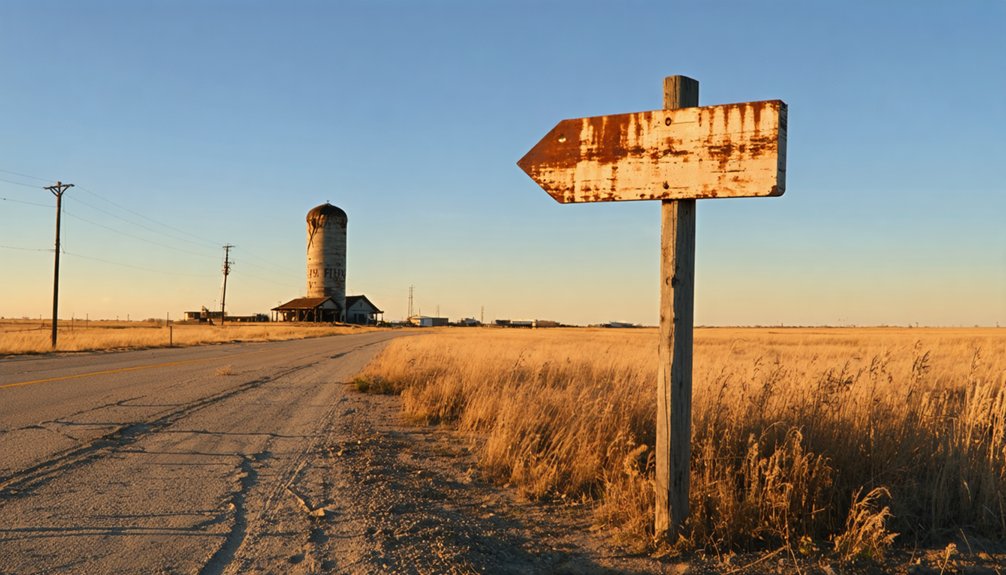
When you venture into the Morris County countryside near K-4 Highway today, Spring Lake and Artesian City offer little more than whispers of their ambitious past. The landscape challenges urban explorers with seasonal vegetation obscuring most features, creating on-site photography challenges that demand patience and timing.
You’ll discover scattered remnants across both locations:
- Spring Lake’s concrete foundations and stone pilings marking the former hotel site
- Overgrown lake bed containing wooden dock fragments and rusting farm equipment
- Artesian City’s shallow well shafts and rock outlines barely visible in converted farmland
- Broken ceramics and glass shards from the saloon era
Careful excavation recommendations apply here—respect private property boundaries and tread lightly. Without historical markers, these sites rely entirely on oral tradition and your willingness to read the land’s subtle story.
Nearby Ghost Town Sites Worth Adding to Your Itinerary
Your ghost town exploration doesn’t end with Spring Lake and Artesian City—Kansas conceals dozens of abandoned settlements within easy driving distance. From mining camps that flickered out when ore veins dried up to railroad towns that vanished after corporate consolidations shifted routes, each site tells a distinct story of boom and collapse.
The Dust Bowl era left its own haunting legacy across the plains, where entire communities surrendered to relentless wind and drought.
Southeast Mining District Ruins
The abandoned mining settlements scattered across southeast Kansas tell a darker story than Spring Lake’s agricultural decline—these are communities poisoned by their own prosperity.
The Tri-State Mining District’s lead pollution impact transformed thriving towns into toxic wastelands. You’ll find mining community legacies etched in contaminated earth:
- Empire City Ruins – Once housing 1,000 miners, this 120-acre site was forcibly evacuated in 2012 after government testing confirmed fatal lead poisoning levels throughout the settlement.
- Treece – EPA buyouts cleared this ghost town by 2012; only two defiant residents remained among demolished buildings and pervasive contamination.
- Minersville – Thirty lignite mines operated for 76 years before decline, leaving dugout foundations and stone houses on private land.
- West Mineral – Big Brutus stands as a monument to extraction’s price near this dying coal town.
Railroad Feud Consolidation Sites
While mining toxicity created Spring Lake’s southeastern ghost town neighbors, railroad ambition carved different ruins across Kansas—communities born from corporate warfare and abandoned when the tracks determined winners and losers.
You’ll find Cottonwood Station’s remnants near Strong City, where Atchison, Topeka, and Santa Fe deliberately bypassed the county seat. The railroad line rivalries split towns into competing versions—North versus South, railroad versus government.
At Cherokee Outlet sites, Rock Island refused stops at official settlements, strangling government-approved towns while feeding its speculation properties.
Fort Scott survived its Border Tier loss to Katy, but countless hopeful settlements didn’t. Regional transportation monopolies wielded absolute power—refusing depot access meant economic death.
These corporate battlefields reveal freedom’s illusion when infrastructure dictated survival. The tracks wrote Kansas history in ghost towns.
Dust Bowl Abandonment Locations
Corporate railroad battles weren’t the only force that erased Kansas communities from the map. Nature itself reshaped settlement patterns when the Dust Bowl devastated pre Dust Bowl farming patterns across the plains. You’ll find these human environment adaptations ultimately failed:
- Russell Springs watched waves of residents flee westward as drought transformed fertile land into choking dust, leaving abandoned homesteads as testimony to environmental limits.
- Saffordville vanished through gradual depopulation—no single disaster, just the quiet logic of unsustainable agriculture eroding community viability.
- Valley Brook dissolved when 1930s storms proved farming communities couldn’t outlast nature’s hostility without modern irrigation systems.
- Englewood became unnecessary after mass outmigration left infrastructure serving ghosts rather than families.
These sites document freedom’s harsh cost: pursuing dreams on unforgiving land.
Best Practices for Exploring Abandoned Settlements
Before you step into the skeletal remains of Spring Lake’s abandoned storefronts and crumbling homesteads, you’ll need to approach these sites with equal parts curiosity and caution. Essential safety protocols include carrying a respirator for dust and mold, packing offline maps to navigate without signal, and never exploring alone.
Walk the perimeter first, evaluating structural risks and exit routes before entering. Stay near walls and support columns, avoiding collapsed centers where floors might fail. For proper documentation, bring your camera but leave everything else untouched—take nothing but photos, leave nothing but footprints.
Respect private property boundaries, and always inform a trusted contact of your route plan and expected return time. These ghost towns reward the prepared explorer.
Documenting Your Discoveries in Lesser-Known Kansas Territory

Capture these essential elements:
- Original platted boundaries filed March 31, 1886, including Block A and both additions
- Missouri Pacific Railway corridor that shaped Artesian’s absorption of Springlake’s post office
- Architectural remnants reflecting the pioneering initiatives of F. M. Davis’s 1887 development
- Topographical features explaining the 1893 legislative vacation
Your fieldwork unveils forgotten narratives of territorial ambition. GPS coordinates, detailed sketches, and contextual notes create archives for future explorers seeking Kansas’s abandoned commercial dreams.
Frequently Asked Questions
What Permits or Permissions Are Needed to Explore Private Ghost Town Property?
You’ll need explicit written permission from landowners before exploring these abandoned sites. Private property laws strictly protect ghost towns, and trespassing considerations include criminal charges and hefty fines. Always research ownership records and contact owners directly for access.
Are There Local Guides Available Who Specialize in Kansas Ghost Town Tours?
Yes, you’ll find local historical societies offering ghost town expertise and private tour operators like Haunted Taxi Ghost Tours specializing in Kansas’s abandoned locations. They’ll guide you through forgotten streets, sharing authentic stories while respecting your independence to explore freely.
What Emergency Services Are Available in Remote Kansas Ghost Town Areas?
You’re literally in the middle of nowhere, but county emergency medical services availability covers these remote areas, though local law enforcement response times can stretch considerably. Always contact sheriff departments beforehand and carry emergency supplies for self-reliance.
Can Metal Detectors Be Legally Used at Kansas Ghost Town Sites?
You can’t legally use metal detectors at Kansas ghost town sites on public land without permits, and detecting historic artifacts over 100 years old is prohibited. You’ll need written landowner permission on private property, avoiding trespassing issues.
Which Months Offer the Best Weather for Ghost Town Road Trips?
September and June deliver your ideal conditions—seasonal temperature patterns stay moderate, best precipitation levels remain low, and crowds thin out. You’ll experience comfortable exploration weather, extended daylight, and that perfect freedom to roam Kansas’s forgotten places unrestricted.