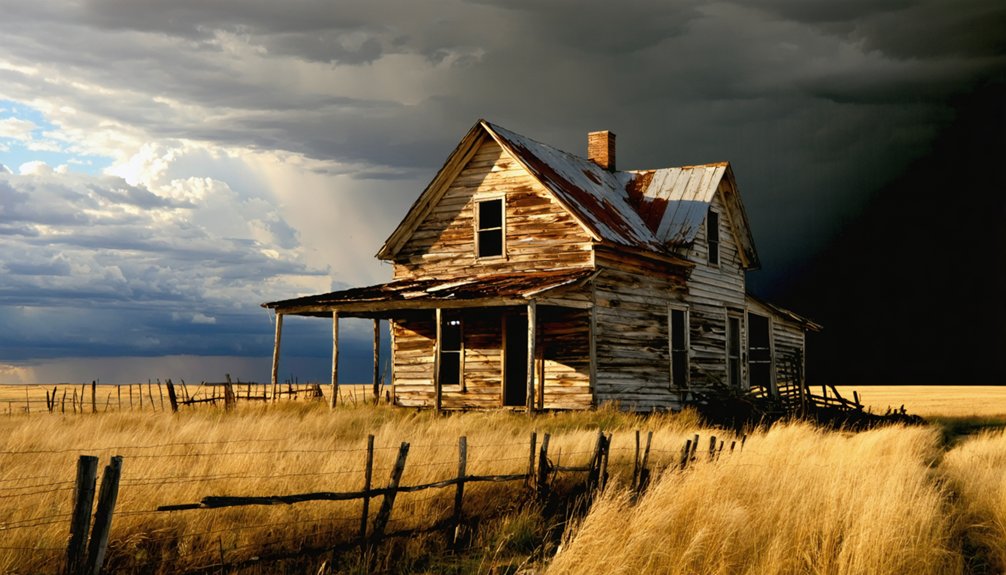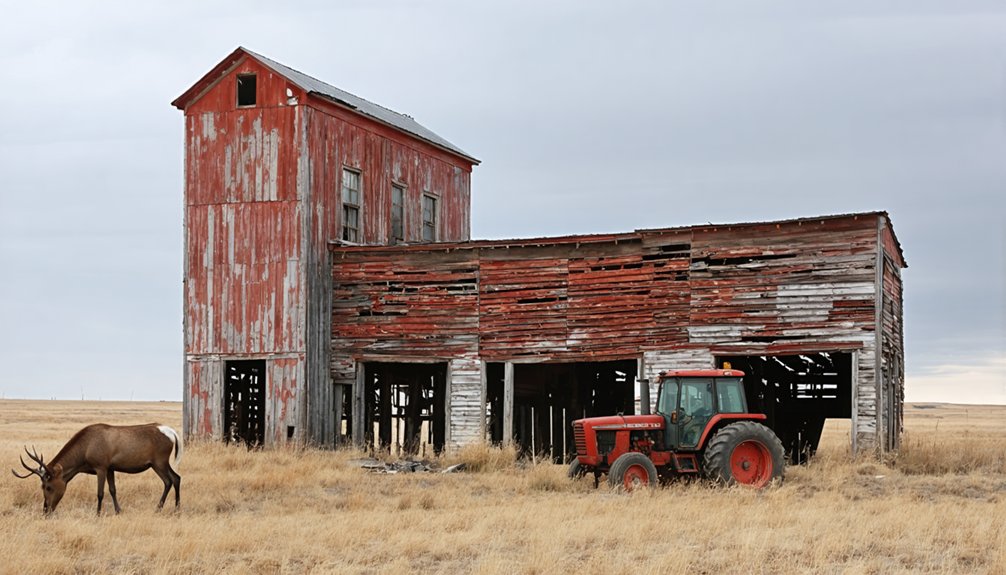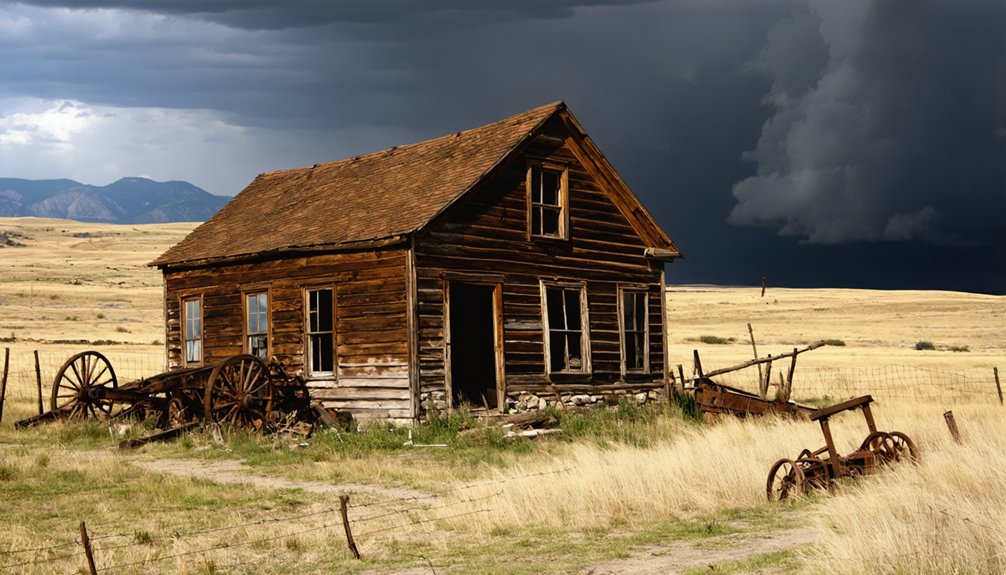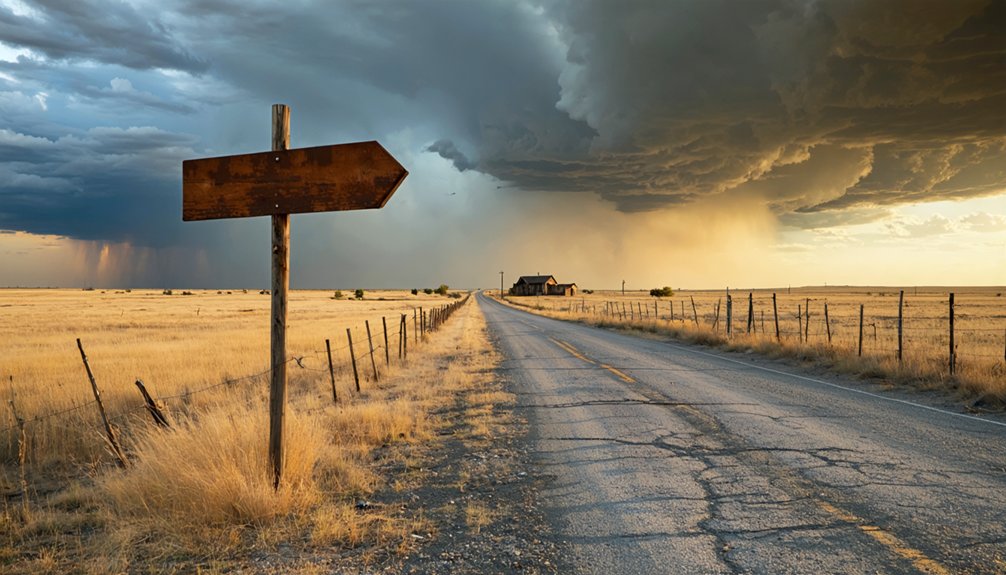
Your ghost town road trip to Stamford, South Dakota starts with a reality check: there’s no Stamford in the Black Hills. Instead, you’ll find Rochford, where five hardy souls still call home, and the Moonshine Gulch Saloon pours drinks like it did 140 years ago. Plot your 122-mile journey along Highway 385, downloading offline maps before cell service vanishes into the ponderosa pines. The route connects five authentic mining camps where weathered headframes and forgotten stage stations tell stories that survive beyond the pavement.
Key Takeaways
- US Highway 385 provides 122-mile access through Black Hills ghost towns, though cell service disappears quickly requiring offline maps.
- Rochford features year-round residents, the operating Moonshine Gulch Saloon, authentic cabins, and the Rochford General Store for visitors.
- Galena offers rental sites at mile markers 21399 and 21443 with direct UTV access to 3,500 miles of off-road trails.
- White Rock showcases railroad-era remnants including depot infrastructure, Highland Avenue’s business district, grain elevators, and a historical marker.
- Plan for varying terrain requiring four-wheel drive capability, check construction updates, and slow from 75 mph speeds for exploration.
Stamford CT: A Modern Urban Ghost Town Beneath the Interstate
Tucked beneath the roar of Interstate 95, on a forgotten stretch of Manhattan Street, lies one of Connecticut’s most unlikely ghost towns. You’ll find boarded-up buildings with broken windows, rusted fences strangling overgrown vegetation, and abandoned facilities that once housed Yale & Towne’s thriving lock manufacturing empire. This desolate atmosphere contrasts sharply with Stamford’s gleaming corporate towers just blocks away.
The former working-class neighborhood—trapped between the Stamford Canal and Rippowam River—feels frozen in time. Weed-covered lots surround empty restaurants and decayed houses. A faded sign still marks the father-and-son furniture store. Though exteriors remained viewable through June 2020, demolition loomed by August 2021. You’re witnessing Connecticut’s “Lock City” fade into history, shadowed by thundering traffic overhead.
The Rise and Fall of Lock City’s Working-Class Neighborhood
During the late 1800s, the Yale & Towne Lock Manufacturing Company transformed Stamford’s south end into a self-contained industrial empire. You’ll find traces of this forgotten industrial legacy along Manhattan, Garden, and Pacific Streets, where the company once employed one in every sixteen residents.
One in sixteen Stamford residents once drew paychecks from Yale & Towne’s sprawling industrial empire along these streets.
Historic immigrant communities from Ireland, Poland, Italy, and beyond built their lives here, creating ethnic enclaves around churches like St. John’s on Meadow Street.
Picture what remains today:
- Boarded-up tenement buildings where families once gathered after factory shifts
- Faded storefront signs reading “operated by father & son”
- Weed-covered lots replacing bustling workers’ housing
- Empty structures awaiting demolition beneath I-95’s concrete shadow
When production moved overseas and the factory closed in 1959, Lock City’s working-class heart stopped beating, leaving only ghosts.
What Remains of Manhattan, Garden, and Pacific Streets Today
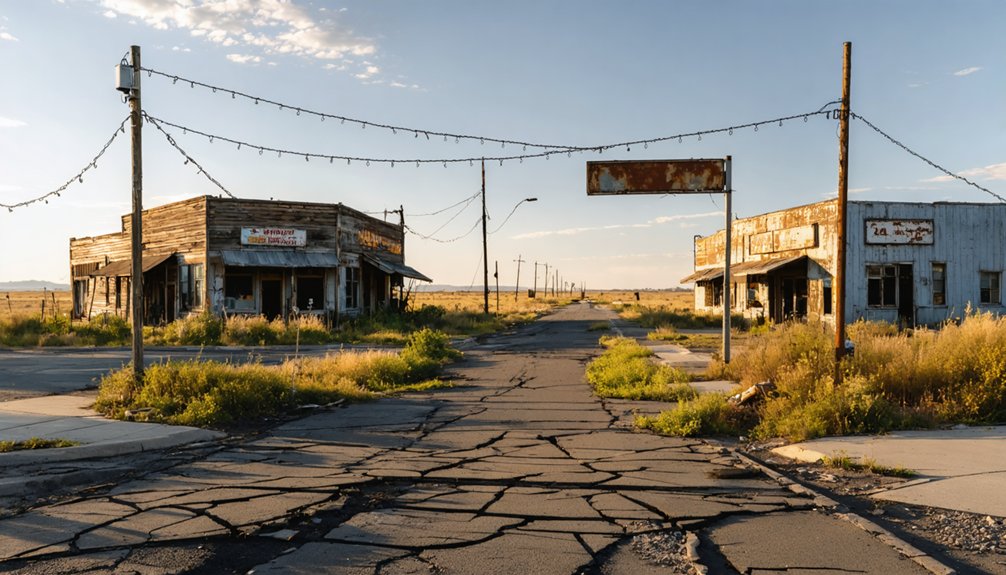
A handful of weathered buildings still cling to existence along Manhattan, Garden, and Pacific Streets, though they’re living on borrowed time. You’ll find boarded-up structures half-hidden beneath I-95’s shadow, their exteriors still viewable despite the collective urban decay consuming them. The old furniture store stands out—its faded “operated by father & son” sign a legacy to abandoned industrial heritage that once thrived here.
Weed-covered lots outnumber buildings now. This forgotten neighborhood south of the canal reflects what happens when factories close and corporations move on. By August 2021, demolition crews had their marching orders. You can still trace the street grid that housed Yale Lock workers, but you’re essentially exploring a miniature ghost town. No residents remain, no businesses operate—just empty shells waiting for the wrecking ball.
Journey to South Dakota’s Black Hills Ghost Town Territory
The Black Hills rise from South Dakota’s prairie like a promise of secrets kept. You’ll find haunting mining relics scattered across canyons where fortunes were chased and lost. Remote cabin ruins emerge from pine forests like weathered monuments to dreams abandoned.
Your route cuts through territory where five ghost towns tell stories worth hearing:
- Camp Crook sleeps 150 feet beneath Pactola Lake’s surface, where summer boaters drift unknowingly above 1875’s mining camp
- Silver City’s Diana Lode once employed 300 souls—now silence fills the Western Railroad corridor
- Galena’s schoolhouse stands guard in Vanocker Canyon, photographed by those who brave the ATV trails
- Spokane welcomes riders near Elk Heaven, its trails forgiving to novices seeking adventure
Each site demands different approaches—some require four-wheel drive, others just determination and curiosity.
Rochford: The Friendliest Ghost Town in the Black Hills
Gold fever transformed M.D. Rochford’s solitary cabin into a bustling town of 1,000 souls by 1878. You’ll find his legacy etched into every weathered plank of this mountain settlement, where miners once hauled ore from the Standby Mine and the 60-stamp mill thundered through the gulch.
Today’s year round population hovers around five hardy souls who’ve claimed what gold rushers abandoned. You can still belly up to the Moonshine Gulch Saloon‘s bar, same as those fortune-seekers did 140 years back. The tourism offerings remain genuinely authentic—no manufactured nostalgia here, just genuine cabins, miners’ graves, and the Rochford General Store.
Black Hills bicyclists and hikers discover this haven along Mickelson Trail, proving freedom-seekers still answer the mountains’ call.
Gold Rush History and the Montezuma Hill Discovery
When Lieutenant Colonel George Armstrong Custer’s 1874 expedition stumbled upon gold glinting in French Creek’s waters, they ignited a human stampede that would scar the Black Hills with over 600 abandoned settlements. You’ll find Montezuma Hill’s landscape among these forgotten prospects, where fortune-seekers descended on placer claims near Hay and Elk Creeks’ junction in 1881.
Picture the scene that awaited prospectors:
- Cave post offices carved into Bear Rock’s limestone walls
- Dance halls echoing with 300 miners celebrating fresh strikes
- Stage stations connecting isolated camps to civilization
- Gaping shafts and waste piles marking hard rock claims
The Montezuma district’s post office operated barely sixteen months before mining operations depletion forced everyone elsewhere. By 1882, you’d have found nothing but wind whistling through abandoned frameworks—freedom’s price paid in fool’s gold.
Exploring 600+ Ghost Towns Along the Black Hills Mining Trail
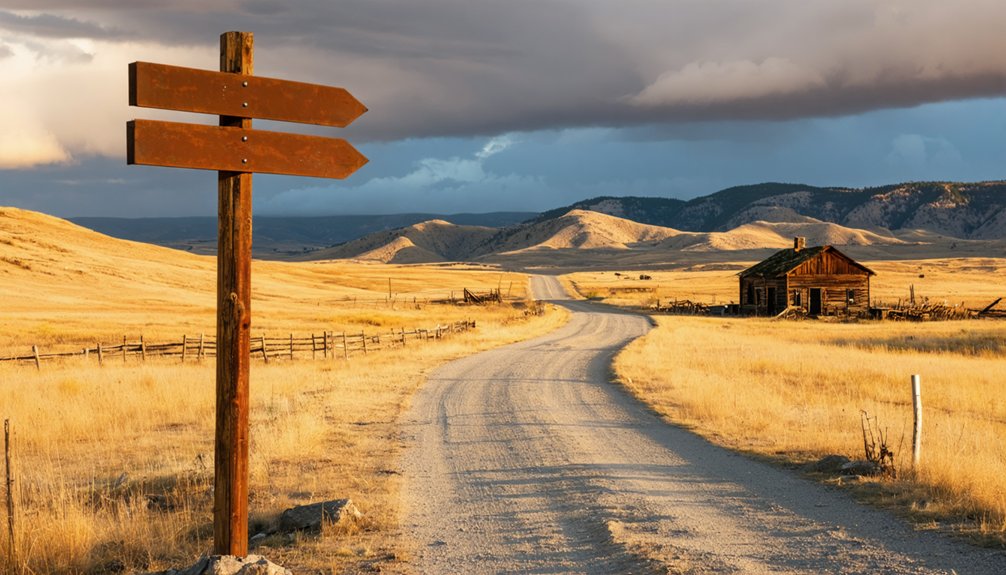
You’ll find the skeletal remains of mining camps scattered like breadcrumbs along Route 385, each weathered building whispering stories of fortunes won and lost during the 1870s gold fever.
The highway cuts through the heart of what locals call the Mining Trail, where hand-stacked stone foundations and collapsing mill works mark the spots where thousands once pickaxed their dreams into hillsides. I’ve counted at least a dozen accessible sites within an hour’s drive, from Rochford’s still-standing saloon to Pactola’s submerged cemetery that surfaces when reservoir levels drop.
Historic Mining Camp Origins
Deep in the pine-clad gulches of the Black Hills, more than 600 ghost towns mark the frenzied trail of fortune seekers who transformed wilderness into bustling camps practically overnight. Rochford’s gold rush settlement began in February 1877 when M.D. Rochford built the first cabin, followed by rapid early town development after prospectors struck gold on Castle Creek.
By December 1878, you’d have found yourself amid:
- 500 inhabitants crammed into 100 log cabins scattered along Little Rapid Creek’s muddy banks
- Six general stores selling picks, flour, and whiskey at frontier prices
- Three rowdy saloons echoing with miners’ tales of near-misses and lucky strikes
- A working sawmill cutting fresh timber that still smelled of pine sap
Lots sold for $10 to $60—cheap entry for anyone chasing freedom and fortune in these untamed hills.
Route 385 Tour Highlights
Stretching 124 miles through the heart of Black Hills gold country, US Highway 385 serves as your gateway to more than 600 abandoned mining camps where fortunes were won and lost between pine-covered ridges. You’ll discover Bugtown three miles north of Custer, where 1880s optimism faded into forest silence.
Further north, exploring abandoned mining sites becomes effortless with 3,500 miles of off-road trails branching from the highway’s corridor.
Uncovering Galena’s historical significance reveals Sarah “Aunt Sally” Campbell’s pioneering spirit—the first woman to stake her claim. Eight miles east of Deadwood, this silver camp’s weathered Catholic church and Vinegar Hill Cemetery stand monument to boom-era ambitions.
Rental sites at mile markers 21399 and 21443 provide direct UTV access, letting you trace miners’ routes without pavement interruptions.
White Rock, Bear Rock, and Forgotten Stage Stations
You’ll find White Rock clinging to existence along the Bois de Sioux River, where the Fargo and Southern Railroad once breathed life into a town of 600 souls and seven grain elevators.
Just beyond, Bear Rock’s sandstone caves sheltered one of the region’s most isolated post offices, carved into cliffs that Native peoples had marked as sacred long before white settlers arrived.
Between these weathered landmarks lie the overgrown traces of stage stations that connected frontier communities before rail lines made them obsolete—stone foundations and wagon ruts barely visible in the prairie grass.
White Rock’s Railroad Era
Between 1883 and 1884, the Fargo and Southern Railroad punched its line south from Fargo, North Dakota to Ortonville, Minnesota, and White Rock sprang up along the route like dozens of other prairie towns betting their futures on the iron rails. The depot infrastructure anchored everything—your mail, your neighbors, your connection to the wider world.
Picture the scene:
- Dual tracks bracketing the depot where farmers haggled over grain prices
- Telegraph wires humming with coded messages from distant cities
- Steam locomotives hissing at the sidetrack while passengers stretched their legs
- Highland Avenue bustling as wagons hauled freight between depot and storefronts
You’d find the schoolhouse near the tracks, grain elevators towering nearby. But passenger services decline eventually strangled these prairie outposts, and White Rock joined the ghost town roster.
Bear Rock Cave Post Office
While White Rock depended on railroad tracks and telegraph wires, some Black Hills settlements made do with far less—like Bear Rock, where the region’s first post office operated from inside a cave. You’ll find this ghost town in Custer County, where 1870s miners desperate for mail delivery convinced authorities that cave features could substitute for a proper building.
The makeshift arrangement worked surprisingly well for post office operations, serving placer miners who’d struck it rich and needed to communicate with the outside world. The cave’s natural shelter kept letters dry and provided secure storage—frontier practicality at its finest.
When Bear Rock’s gold played out, the miners vanished and the cave post office closed, leaving behind one of the Black Hills’ most unusual postal service stories. No population remains today.
Historic Stage Station Stops
Scattered across South Dakota’s windswept plains, forgotten stage station operations like White Rock and Bear Rock once served as lifelines connecting isolated homesteaders to the wider world. These rural transportation networks emerged alongside railroad construction in the 1880s, when railway companies platted townsites and recruited settlers chasing land and independence.
You’ll find White Rock’s story preserved at Rosholt’s historical marker, where pictorial records capture its peak years:
- Main street bustling with farm families collecting mail and newspapers
- Grain elevators clustered near depot sidings
- Small schoolhouse anchoring the community center
- Highland Avenue’s business district serving the agricultural economy
Mapping Your Black Hills Route 385 Adventure
Before you set off toward Stamford’s abandoned streets, you’ll want to get acquainted with the 122-mile South Dakota stretch of US Highway 385—a route that weaves through the heart of the Black Hills like a ribbon connecting forgotten prairie towns to mountain hideaways.
Download Route Reimagined maps at the Black Hills Visitor Information Center in Rapid City for offline navigation—cell service vanishes quickly once you’re beyond the ponderosa pines. Currently, there’s minor construction work affecting a small section, so check for construction updates before heading out.
Your journey passes scenic route attractions like Crazy Horse Memorial, Wind Cave National Park, and O’Neill Pass’s dramatic elevation changes. The PDF attraction map marks landmarks you won’t want to miss. Just remember: rural stretches hit 75 mph, but slow down—ghost towns demand unhurried exploration.
Frequently Asked Questions
What Is the Best Time of Year to Visit Black Hills Ghost Towns?
Spring’s splendid solitude offers you ideal weather conditions between late April and June. You’ll discover mild temperatures, minimal seasonal crowds, and blooming wildflowers framing weathered buildings. Fall provides similar freedom with vibrant foliage enhancing your ghost town exploration adventures beautifully.
Are There Any Guided Tours Available for Rochford and Surrounding Ghost Towns?
You’ll find guided tours availability through GeoFunTrek and ToursByLocals, offering customizable Black Hills ghost town adventures including Rochford. These experiences support local heritage preservation efforts while letting you explore freely—though Rochford itself rewards independent discovery best.
In addition to Rochford, you’ll want to check out other ghost town attractions in South Dakota that showcase the rich history of the area. Each site offers a unique glimpse into the past, enriching your understanding of the region’s heritage. Make sure to bring your camera, as the hauntingly beautiful landscapes provide perfect backdrops for memorable photographs.
Where Can I Find Accommodations Near the Black Hills Route 385?
Your freedom trail leads to nearby lodging options like Spring Creek Inn and Quail’s Crossing along Highway 385. You’ll discover accommodation deals near route 385 offering cozy cabins and motel rooms, perfectly positioned for your ghost town adventures.
Do I Need Special Permits to Explore Abandoned Buildings in These Areas?
You’ll need to obtain landowner permission before exploring, as most buildings sit on private property. No formal permits exist, but liability insurance requirements may apply. Don’t climb structures—they’re dangerously decayed and you risk trespassing charges.
What Safety Precautions Should I Take When Visiting Remote Ghost Town Sites?
You’ll need proper attire like sturdy boots and emergency preparedness essentials—three days’ supplies, offline maps, and a trusted buddy. Most ghost town accidents happen to solo explorers, so never venture alone into these freedom-filled ruins.