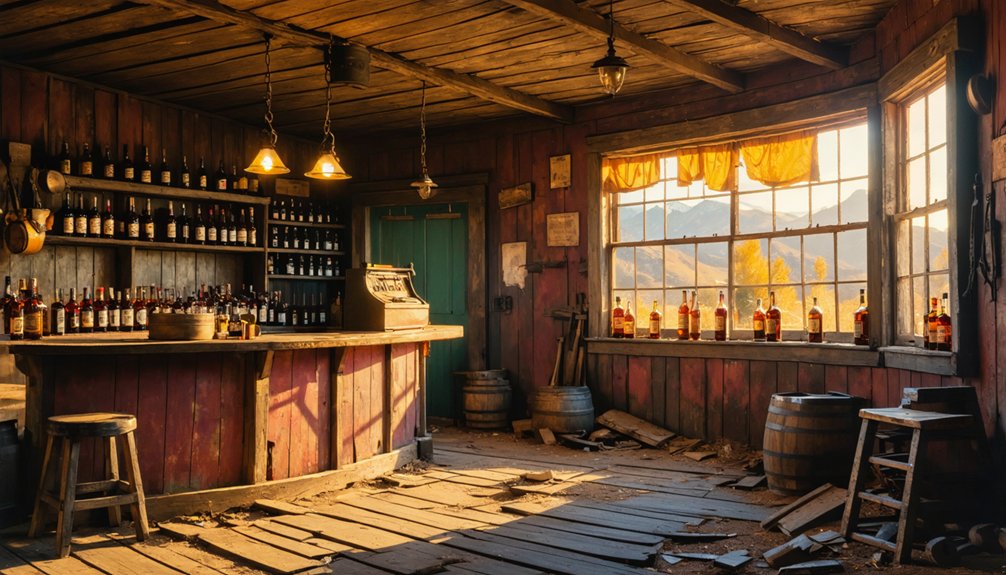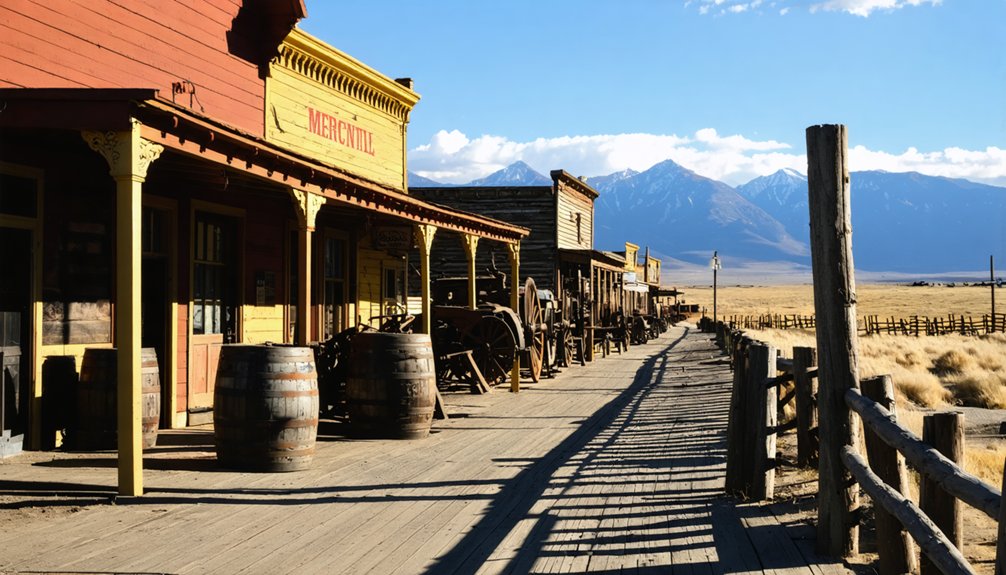
You’ll find Stewarts Flat 1.5 miles west-southwest of Penryn in Placer County, accessible via State Route 49 through Gold Country. Plan your visit for summer or fall when temperatures hover in the 60s-70s, and you’ll discover foundation stones, hand-dug mining ditches, and weathered cemetery markers scattered across red-scarred hillsides. Combine this stop with nearby Bodie State Historic Park or Randsburg’s living ghost town atmosphere for a complete Gold Rush experience that reveals California’s 400+ abandoned mining settlements and their stories.
Key Takeaways
- Stewarts Flat sits 1.5 miles west-southwest of Penryn in Placer County, accessible via Interstate 80 and State Route 49.
- Summer and fall offer ideal visiting conditions with moderate temperatures in the 60s to low 70s and minimal precipitation.
- Remaining features include foundation stones, hand-dug mining ditches, rusted equipment fragments, cemetery markers, and hydraulic mining scars.
- Obtain detailed driving directions from Placer County’s GIS mapping system or Planning Services in Auburn before departing.
- Extend your trip to nearby Bodie State Historic Park or Randsburg Mining District for additional authentic ghost town experiences.
Understanding Stewarts Flat’s Place in California Ghost Town History
When you stand among the red-scarred hillsides of Stewarts Flat today, you’re witnessing the physical remains of California’s gold fever compressed into one desolate landscape. This 1850s settlement represents mining history significance at its rawest—where Missouri prospectors chased placer deposits that once supported over 100 cabins, hotels, and even a Wells Fargo branch.
You’ll find cultural artifacts preservation in unexpected places: cemetery headstones marking childhood deaths, hydraulic mining tunnels carved beneath the earth, and the Wells Fargo ruins marked by Forest Service placards. Unlike sanitized historic sites, Stewarts Flat lets you explore freely among authentic remnants of boom-bust economics. It’s one of 400+ California ghost towns where nature reclaimed what hydraulic monitors destroyed, creating a landscape that refuses to forget its violent, ambitious past.
Getting to Stewarts in Placer County: Routes and Access Points
Your journey to Stewarts Flat begins where Interstate 80 slices through Placer County’s layered terrain—from Sacramento’s sprawling suburbs, past Roseville’s commercial sprawl, and into the pine-studded foothills near Auburn. You’ll navigate approximately 65 miles of evolving landscape, shifting from valley heat to elevation-cooled air.
State Route 49 provides your primary corridor through Gold Country, while Highway 99 offers alternative access points if you’re approaching from southern regions. The ghost town sits 1.5 miles west-southwest of Penryn, accessible through back roads that wind between mining claims and oak groves.
For detailed driving directions, consult Placer County’s GIS mapping system or contact Planning Services in Auburn. These resources reveal hidden routes that modern GPS often misses—critical intelligence for reaching abandoned settlements where pavement surrenders to dirt.
What Remains at Stewarts Flat Today
Though modern development has erased much of Stewarts Flat’s mining-era footprint, patient explorers still discover fragments of its nineteenth-century existence scattered across the terrain. You’ll need sharp eyes and determination to locate what remains:
- Foundation stones marking former cabin sites along hillside clearings
- Hand-dug mining ditches threading through overgrown vegetation
- Rusted metal fragments from equipment abandoned during the decline
- Cemetery markers weathered by decades of Sierra storms
- Depression scars where hydraulic operations reshaped the landscape
Historic artifacts surface occasionally after winter rains expose buried layers. Current preservation efforts remain minimal—no official protection exists for the site. You’re fundamentally exploring on your own terms, documenting what history left behind before nature reclaims everything completely.
Best Time to Visit and Weather Considerations
Summer and fall deliver the most forgiving conditions for exploring Stewarts Flat’s scattered remnants, when clear skies and moderate temperatures transform the site into an accessible outdoor museum. You’ll encounter highs in the 60s to low 70s, with precipitation chances hovering near zero during these prime months.
Spring offers similar temperatures but brings wind gusts reaching 35 mph that’ll whip dust across the abandoned structures. Winter’s your least favorable option—84% precipitation chances mean you’re likely traversing muddy trails and photographing ruins through persistent drizzle. The consistent northwest winds of 10-20 mph year-round keep the air crisp, though fall’s occasional 40 mph gusts remind you nature’s reclaiming this forgotten settlement.
Plan for layered clothing regardless of season, as temperatures drop markedly after sunset.
Nearby Ghost Towns Worth Adding to Your Itinerary
Your Stewarts journey opens doors to California’s richest concentration of ghost towns, each within a few hours’ drive. Bodie State Historic Park stands frozen in 1880s authenticity—weathered buildings still cluttered with bottles, tools, and furniture exactly where miners left them.
Head south to Randsburg’s dusty main street where 70 residents keep saloons and antique shops alive among crumbling foundations, creating that rare “living ghost town” atmosphere you won’t find in preserved parks.
Exploring ghost town history in California reveals stories of abandoned mines and bustling communities that once thrived. Each location holds its unique tales of boom and bust, reflecting the broader economic shifts of the region. Visitors can imagine the lives of those who sought fortune and adventure in the arid landscapes of the Gold Rush era.
Bodie State Historic Park
Located just 13 miles from Stewarts Point, Bodie State Historic Park stands as California’s most authentic gold rush ghost town, where over 110 weathered wooden buildings lean into the high desert wind at 8,379 feet elevation. Discover what 200,000 annual visitors experience through ghost town tourism at this perfectly preserved 1880s mining camp.
What Makes Bodie Unforgettable:
- Peak population of 10,000 miners in 1879, supported by 65 saloons along Main Street
- $38 million in gold and silver extracted between 1877-1882
- Arrested decay preservation maintains structures exactly as abandoned in 1950
- Original interiors intact with furniture, goods, and artifacts untouched
- National Historic Landmark status protecting against modern preservation challenges
Walk through genuine boomtown history where buildings remain stocked with century-old merchandise, offering pure Western authenticity.
Randsburg Mining District
Beyond Bodie’s windswept streets, the Randsburg Mining District beckons with Southern California’s richest gold legacy—a cluster of authentic ghost towns where $60 million in precious metals once flowed from the Mojave’s unforgiving earth.
You’ll discover Randsburg itself remains a living ghost town, where 51 residents preserve remnants from the 1895 Yellow Aster Mine discovery. The mine produced $25 million in gold before economic diversification brought tungsten and silver operations to neighboring Atolia and Red Mountain.
Drive Butte Avenue past operational saloons and supply stores, with tailing piles rising behind weathered structures. The district’s rare mineral deposits sustained multiple boom cycles—gold through 1918, Kelly Mine silver until 1929, and Depression-era resurgence.
Time your September visit for Old West Days: gunfights, gold panning, and freedom from modern constraints.
Essential Supplies and Safety Tips for Exploring Abandoned Sites
You’ll need proper protection before stepping into Stewarts’ crumbling structures—pack N95 respirators, heavy-duty gloves, and at least three flashlights with spare batteries.
The decaying floors and unstable ceilings demand slow, deliberate movement along walls and support beams, where you’ll test each step before committing your full weight.
Bring a buddy system of at least three people, offline maps, a first aid kit, and a charged phone so someone can call for help if aged timber gives way beneath your boots.
Essential Gear and Equipment
Before you set foot in Stewarts’ crumbling structures, you’ll need proper protective clothing to navigate the hazards lurking in every abandoned building. Your layered clothing selection should include long sleeves, durable pants, and dark colors that let you blend into shadows while protecting against cuts and toxins.
Proper footwear maintenance means inspecting your thick-soled boots before each adventure—they’re your first defense against nails and broken glass.
Pack these essentials:
- Cut-resistant gloves with grip for handling rusty debris
- Headlamp with spare batteries for pitch-black interiors
- Dust mask or respirator against mold and asbestos
- First aid kit with antiseptic wipes and bandages
- Multi-tool for unexpected situations
Your freedom to explore depends on respecting these ruins’ dangers while staying prepared.
The ground beneath your feet tells a story at Stewarts—every crack in concrete, every warped floorboard, every suspicious sag warns you what’s coming next. Walk slowly, scanning for nail patterns in roofing material that reveal supporting beams below.
These structural integrity considerations separate smart explorers from reckless ones. Watch where ceiling damage mirrors floor weakness—collapse happens in pairs. Recognizing stability indicators means studying how shadows fall across sagging sections, how dust patterns show recent movement, how your footsteps sound hollow over voids.
Keep your eyes upward for rotten beams and falling debris while your feet probe forward cautiously. Test questionable surfaces from solid ground first. When something feels wrong, trust that instinct. Alternative routes beat hospital visits. Your freedom to explore depends on respecting these ruins’ warnings.
Emergency Preparedness and Communication
Every abandoned site exploration hinges on what you’re carrying when something goes wrong. Your emergency protocols start before you leave—designate a trusted contact who knows your exact location and expected return time.
Build your three-person minimum team with clear evacuation planning that assigns specific roles: one carries medical supplies, another manages communications, and someone leads decision-making during crises.
Essential communication equipment includes:
- Cell phone and backup power banks fully charged before departure
- Radio equipment for maintaining contact when cellular signals fail
- Identification documents ready if authorities arrive
- Agreed check-in intervals with your designated contact
- Physical maps and satellite imagery for alternative route planning
When darkness falls or injury strikes, these preparations transform from precautions into lifelines that secure your path home.
Capturing Your Journey: Photography Guidelines and Historic Preservation
As morning fog lifts from Stewarts Point’s rugged coastline, you’ll want your camera ready to capture the haunting beauty where California’s lumber industry once thrived. Wide-angle lenses work best for expansive coastal views, while golden hour illuminates historic lumber chutes and redwood remnants. Bring your tripod for low-light shots of Fisherman Bay cove.
Respect historic architecture preservation by avoiding flash near fragile structures and never removing artifacts from scattered ruins. Exercise Native American cultural sensitivity around Kashia Band of Pomo sites—photograph Medicine Rock from a distance without disturbing this sacred boulder. Secure permissions before shooting on Stewarts Point Rancheria lands.
Follow no-looting regulations strictly. Your images can document these vanishing landscapes while preserving their integrity for future wanderers seeking authentic California history beyond tourist trails.
Frequently Asked Questions
Are There Any Guided Tours Available for Stewarts Flat Ghost Town?
You won’t find guided tours availability at Stewarts Flat—it’s abandoned private property requiring permission before exploring. The remote Sierra Nevada location means you’ll navigate weathered wooden structures and rusted mining remnants independently, respecting boundaries while discovering history on your own terms.
Can I Camp Overnight Near Stewarts in Placer County?
You’ll find primitive campsites at nearby Lodgepole Campground and Kingvale Resort, both offering freedom to explore. For nearest lodging options, consider Scotts Flat Lake’s year-round facilities or Folsom Lake’s full-hookup sites for comfortable basecamp adventures.
Is Cell Phone Service Available in the Stewarts Flat Area?
Cell phone service in Stewarts Flat area is extremely limited or nonexistent. You’ll find poor signal strength and minimal reception quality in this remote ghost town location. Plan accordingly—download maps offline and inform others of your isolated destination beforehand.
Are There Entrance Fees to Access Stewarts Ghost Town?
You’ll find no entrance fees at Stewarts Ghost Town—it’s completely free to explore. Unlike commercialized sites, preservation efforts for Stewarts Flat remain minimal, letting you experience the historical significance of Stewarts Ghost Town authentically and independently.
What Wildlife Might I Encounter While Exploring Stewarts Flat?
You’ll likely spot deer sightings among abandoned structures and grasslands. Watch for potential rattlesnake encounters in rocky areas and brush—they’re common here. Birds of prey circle overhead while small mammals scurry through the ruins.