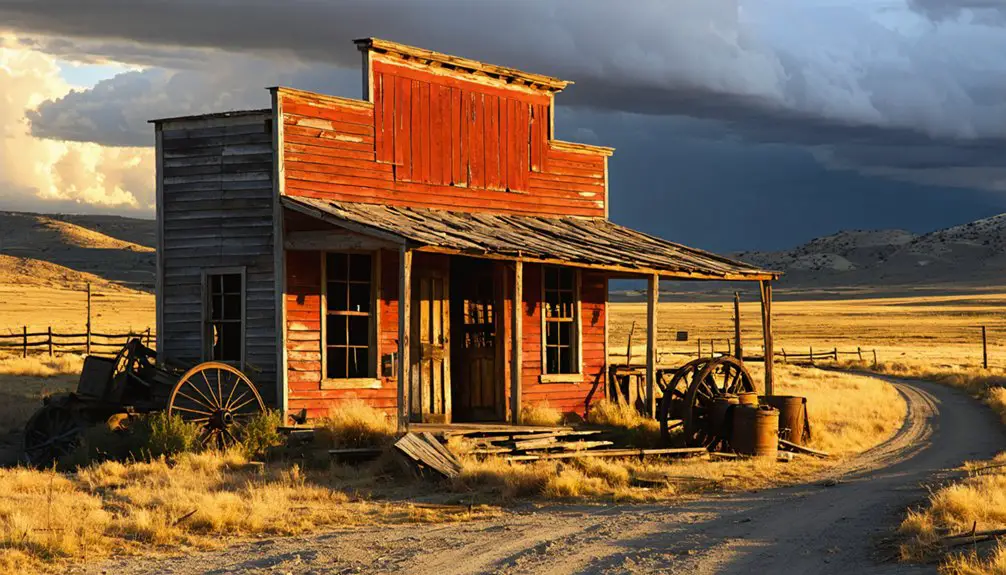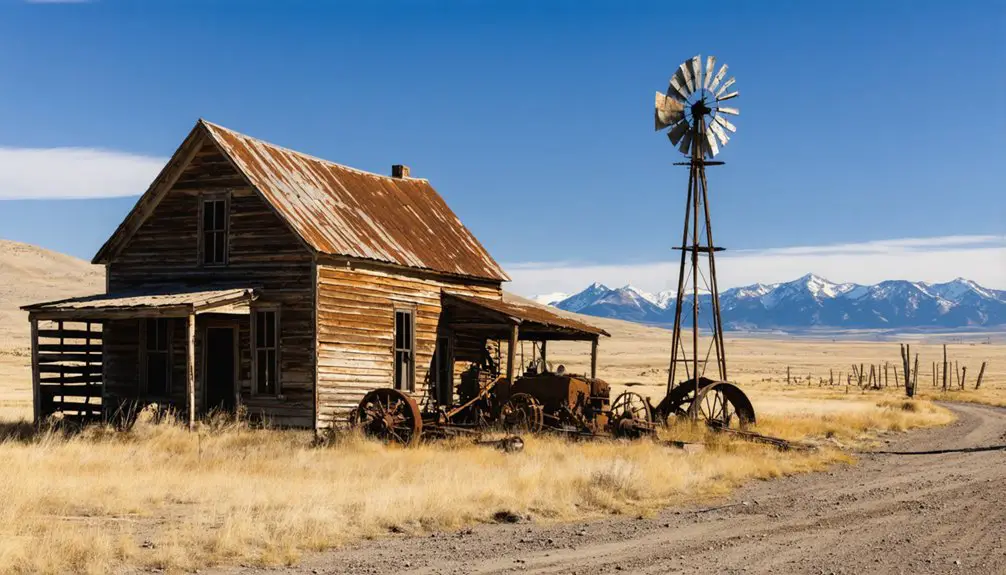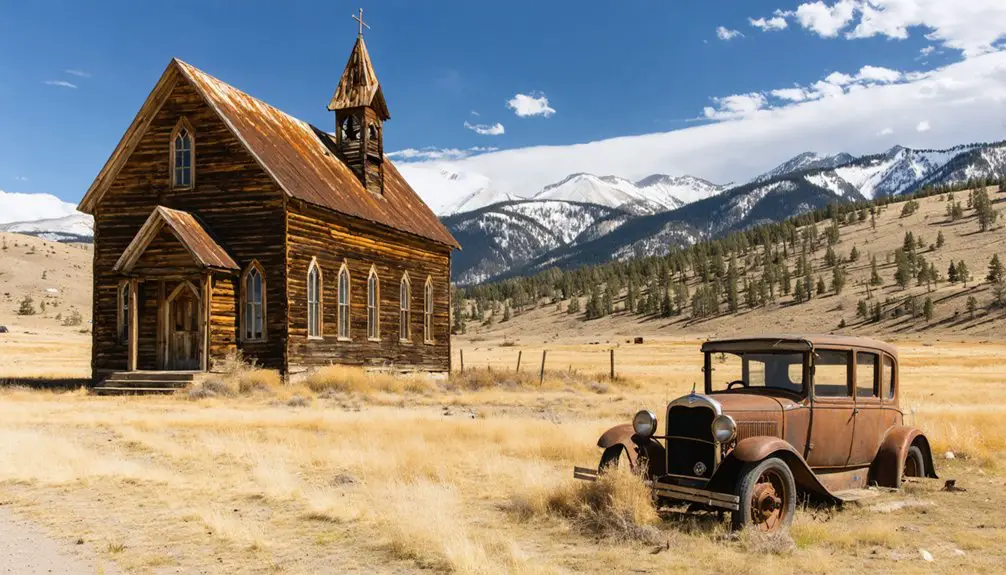
You’ll find Sunrise Ghost Town just one mile east of Hartville in southeastern Wyoming, accessible via U.S. Route 26 and WYO 270. Weathered brick facades from the 1898-1980 mining era still stand, including an impressive YMCA building funded by John Rockefeller Jr. and residences that once housed mining bosses. The site preserves over 7,000 artifacts spanning from Paleoindian times through the iron mining boom, with foundations and structures telling stories of Colorado Fuel and Iron Company‘s operations that shipped 800,000 tons of ore annually during peak years—discoveries await beyond these sun-bleached walls.
Key Takeaways
- Located in southeastern Wyoming’s Platte County, 1 mile east of Hartville at coordinates 42°19′55″N 104°42′11″W.
- Access via U.S. Route 26, exit 5 miles south of Hartville onto WYO 270, then follow WYO 318.
- Visit the YMCA building featuring Italian Renaissance Revival architecture, basement bowling alley, and theater spaces.
- Explore over 7,000 artifacts including Clovis points from North America’s oldest documented red ocher quarry.
- Tour weathered brick structures from the 1898-1980 Sunrise Mine operation, including mining bosses’ residences.
Getting to Sunrise Ghost Town in Platte County
Tucked into the windswept plains of southeastern Wyoming’s Platte County, Sunrise Ghost Town sits at coordinates 42°19′55″N 104°42′11″W, where sagebrush meets history along Wyoming Highway 318. You’ll find this abandoned mining settlement just one mile east of Hartville, connected by a quick drive on WYO 318.
For highway connections, take U.S. Route 26 and exit five miles south of Hartville onto WYO 270, which delivers you straight to your gateway town. From there, follow WYO 318 directly to Sunrise’s iron-stained ruins.
The regional accessibility makes this ghost town perfect for spontaneous detours—no complicated backroads required. Once operated by Colorado Fuel and Iron Company, this company town now welcomes explorers seeking authentic Western abandonment without wrestling remote wilderness access.
Beyond the scenic landscapes lies the haunted history of Elkmont Tennessee, where remnants of old cabins and railroads whisper tales of the past. Visitors are often captivated by the chilling legends that linger in the air, enhancing the eerie atmosphere of this once-bustling community. Exploring the ruins provides a glimpse into the lives of those who once called Elkmont home, making it a must-visit for anyone intrigued by the supernatural.
What Remains of the Historic Mining Settlement
The weathered brick facades of Sunrise’s industrial past rise from Wyoming’s iron-stained earth like monuments to American mining ambition. You’ll discover surprisingly intact structures from the Sunrise Mine’s 1898-1980 operation, including the YMCA building funded by John Rockefeller Jr. and brick residences for mining bosses. Unlike typical ghost towns, Sunrise’s abandoned mine remains survived through aggressive artifact protection strategies—after reclamation dozers nearly destroyed the site in 1986, alert preservationists halted the destruction.
Today’s owner converts buildings into AirBnBs while archaeologists excavate 16,000-year-old Paleoindian tools beneath your feet. Over 7,000 artifacts recovered here include Clovis points and evidence of North America’s only known Paleoindian red ochre mine. You’re standing where ancient peoples extracted pigments 13,000 years ago, long before iron ore fueled twentieth-century industry.
The Story Behind Colorado Fuel and Iron’s Company Town
Behind Wyoming’s iron-stained canyon walls, Colorado Fuel and Iron Company transformed a remote mineral deposit into one of the West’s most ambitious industrial experiments. After John C. Osgood purchased Sunrise Mine in 1904, company management decisions created an entire world—houses, schools, churches, hospital, even parks and playgrounds carved from Eureka Canyon’s harsh landscape.
The 1914 Ludlow Massacre sparked dramatic upgrades: brick homes replaced wooden shacks, modern utilities arrived, and community social life flourished around hotels and gathering spaces. By 1928, 547 workers called this red-earth town home, shipping 800,000 tons of ore annually down 375 miles of track to Pueblo.
For eight decades, Sunrise proved you could build civilization anywhere—until declining ore quality and market forces reclaimed it in 1980.
Exploring the Preserved YMCA Building
Rising from Sunrise’s dusty streets, Wyoming’s first YMCA still commands attention with its Italian Renaissance Revival brick facade—a 1917 monument to John D. Rockefeller Jr.’s post-Ludlow Massacre reconciliation efforts. You’ll discover historic preservation efforts have transformed this community centerpiece into something extraordinary.
Inside, interpretive museum exhibits showcase:
- Three-lane basement bowling alley with one original lane and manual pin setter intact
- Theater and cafeteria spaces where miners once gathered for entertainment and meals
- Paleoindian and mining artifacts cataloged by Dr. George Carr Frison, Wyoming’s first state archaeologist
- Main floor social rooms that hosted Americanization classes, political rallies, and Boy Scout meetings
Today’s museum, part of the National Register-listed Sunrise Mine Historic District, preserves the independent spirit of Wyoming’s mining frontier—where laborers bowled, debated, and built community on their own terms.
Ancient Paleoindian Archaeological Discoveries
Long before Rockefeller’s brick YMCA rose from Wyoming’s iron-rich earth, ancient hunters knelt on this same south-facing slope, mining blood-red hematite with bone and antler tools. You’re standing atop North America’s oldest documented red ocher quarry—16,000 years of human determination compressed into stratified layers beneath your boots.
Archaeologists have unearthed over 7,000 artifacts here, including 53 Clovis points and hundreds of thousands of stone flakes. What sets Powars II apart isn’t just age—it’s evidence of ritual artifacts and cultural practices. Unused Clovis points deliberately coated in sacred ocher suggest ceremonies predating your oldest roadmaps of human migration.
The site rewrites textbooks, proving humans roamed these High Plains millennia before conventional timelines suggested. Freedom’s oldest footprints lead here.
Best Time to Visit and What to Bring
Timing your ghost town pilgrimage means wrestling with Wyoming’s mercurial High Plains climate, where a single day can swing 45 degrees between sunbaked afternoon and bone-chilling nightfall.
July delivers favorable conditions—83°F highs, minimal precipitation, and extended daylight for outdoor activity options and wildlife viewing opportunities. Spring wildflowers and fall aspens tempt adventurers, but snow threatens both seasons beyond September 30 and before May 1.
Pack strategically for frontier conditions:
- Layered clothing from t-shirts to wind-resistant jackets
- Upgraded vehicle tires for sudden storms and drifts
- Sun protection and hydration against 75% summer sunshine
- Rain gear despite low precipitation averages
Winter’s relentless snow and spring’s volatile thunderstorms eliminate half the calendar, leaving summer’s golden window for exploring Sunrise’s abandoned streets.
Understanding the Iron Mining Operations That Shaped Sunrise
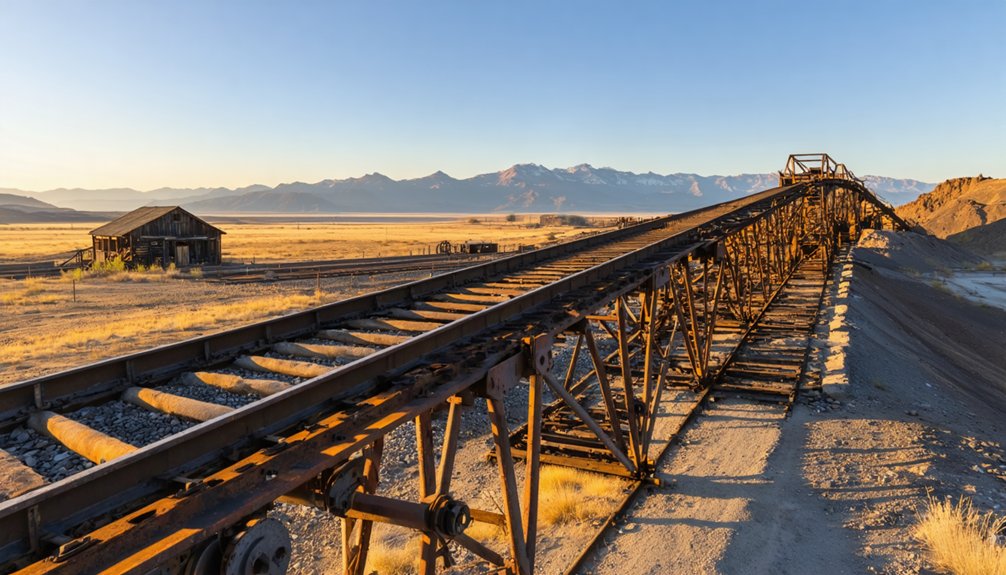
Beneath the rust-colored hills where pronghorn now graze undisturbed, the Colorado Fuel and Iron Company extracted over 40 million tons of iron ore across eight transformative decades. You’ll discover how CF&I pioneered mining techniques here—glory-hole and block-cave methods that revolutionized underground extraction.
The massive Glory Hole alone carved a 44-acre, 650-foot-deep crater into the earth. That towering 199-foot headframe still dominates the skyline, once America’s tallest steel structure of its kind.
The operation’s key economic contributions powered Western expansion from 1899 to 1980, forging railroad rails and fencing wire shipped 375 miles south to Pueblo. Peak wartime production in 1941 fed America’s industrial might.
Walk these grounds and you’ll understand how raw determination literally moved mountains.
Walking Through the Town Layout and Foundation Sites
Where Eureka Canyon‘s walls rise steeply on three sides, the ghost town of Sunrise sprawls across 225 acres of high desert floor, its compact grid still legible beneath sagebrush and scattered rubble. You’ll trace engineer William Porter’s 1900 design through surviving alleys and concrete gutters, where building remnants tell stories of company-town life.
As you explore, watch for:
- Terraced canyon walls of stacked rock defining the eastern boundary
- Concrete borders marking individual yards with iron fence poles still standing
- Clothesline poles anchoring yard interpretations throughout residential blocks
- Foundations, stairs, and roads revealing the original housing layout
Five brick houses stand sentinel among duplex ruins and the infirmary’s crumbling walls. Each foundation site whispers of miners’ families who carved gardens from harsh Wyoming soil, their fences still strung between weathered poles.
Photography Tips for Capturing the Ghost Town
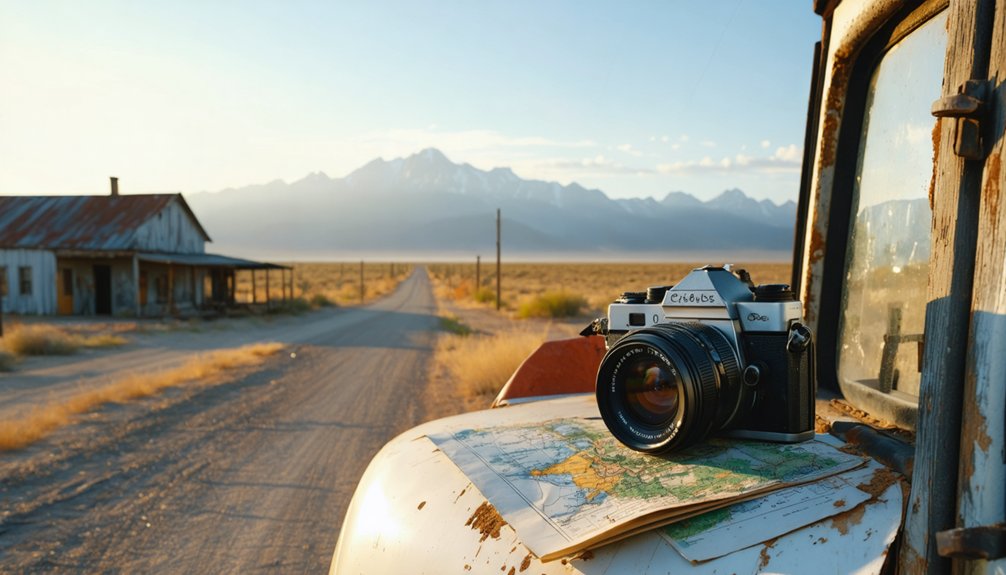
You’ll want to arrive at Sunrise’s weathered structures 30 minutes before dawn breaks over the 6,300-foot elevation, when soft golden light transforms crumbling walls into warm amber backdrops. Position your camera low to capture the dilapidated jail or saloon framed through splintered fence posts, placing the horizon in the bottom third while Wyoming’s explosive sunrise fills your upper frame.
Skip the harsh midday hours when shadows turn severe—instead, return for sunset’s second golden hour, using aperture settings between f/6 and f/10 to keep every weathered board and broken window razor-sharp from foreground to background.
Best Times for Lighting
While conventional photography wisdom steers you toward golden hour’s flattering glow, Sunrise’s weathered structures reveal unexpected character under harsh midday sun. Mid day light variations create dramatic contrast perfect for black-and-white compositions, where bleached wood textures pop against deep shadows. Scout your surroundings for natural reflector usage—light-colored building facades and water features soften intense rays without lugging extra gear.
Strategic lighting approaches:
- Position subjects in natural shade to balance exposure across your frame
- Exclude overexposed sky sections by composing tight on architectural details
- Leverage blue hour’s atmospheric glow for moody nighttime documentation
- Use your body to cast intentional shadows on foreground elements
Don’t let shooting schedules restrict your exploration. Every hour offers workable conditions when you adapt to available light and embrace creative problem-solving.
Framing Historic Architecture Shots
The skeletal remains of Sunrise’s buildings demand compositional choices that honor their historical weight while creating visually compelling images. Position your horizon in the bottom third to emphasize Wyoming’s expansive sky above weathered structures.
Apply the rule of thirds, placing the jail’s crumbling facade or saloon’s tilted doorway off-center for dynamic tension. Wide-angle lenses capture main street’s desolate sweep, while unusual architectural elements—twisted iron railings, collapsed rooflines—become powerful focal points.
Frame through foreground debris or fence posts to add depth. Set your aperture between f/6-f/10 for edge-to-edge sharpness across deteriorating details. If you’ve got drone capabilities, aerial compositions reveal Sunrise’s layout against the surrounding wilderness, showcasing how nature reclaims abandoned spaces.
Shoot both color and monochrome versions—each tells different stories of decay.
Nearby Attractions in Southeastern Wyoming
Beyond Sunrise’s weathered buildings, southeastern Wyoming unfolds as a treasure trove of scenic byways, natural hot springs, and frontier history. You’ll discover authentic Western experiences that reward your independent spirit:
Southeastern Wyoming rewards the independent traveler with authentic frontier experiences far from tourist-crowded destinations.
- Snowy Range Scenic Byway – America’s second national byway delivers alpine vistas and wildlife encounters from Memorial Day through late October
- Saratoga’s Hobo Pool – Free mineral hot springs offer roadside rejuvenation in natural rock formations
- Wyoming Frontier Prison – Rawlins’ forbidding stone fortress reveals frontier justice through guided tours
- Fort Laramie National Historic Site – Restored 1800s military post preserves Plains Indian Wars history
Historic walking tours through Carbon County’s downtowns connect you to regional heritage, while Vedauwoo’s granite formations provide climbing adventures. These accessible attractions let you chart your own course through Wyoming’s untamed landscape.
Frequently Asked Questions
Is There an Entrance Fee to Visit Sunrise Ghost Town?
No general admission fee exists—you’ll need an appointment to explore this private frontier outpost. Parking availability depends on your scheduled tour, while nearby South Pass City offers another ghost town adventure for just $8 admission.
Are There Restroom Facilities Available at the Site?
No restroom facilities exist at Sunrise’s remote location, so you’ll need to plan accordingly. However, you’ll find ample parking availability among the weathered ruins. Note that handicap accessibility is limited given the rugged, unimproved terrain of this authentic ghost town.
Can Visitors Enter the Buildings or Just View From Outside?
You’ll view Sunrise’s weathered structures from outside only—structural safety concerns prevent building entry. Guided tours let you explore designated areas legally, avoiding trespassing risks while experiencing authentic mining history. Schedule ahead: wild exploration meets responsible preservation.
Is Camping Allowed Overnight at or Near Sunrise Ghost Town?
Camping isn’t permitted directly at Sunrise Ghost Town due to its historical significance, but you’ll find nearby dispersed camping on surrounding public lands. Tourism’s impact means you should practice Leave No Trace principles while exploring this abandoned mining settlement’s weathered structures.
Are Guided Tours Available or Is It Self-Guided Only?
You’ll find a treasure trove of options: private tours available through Sunrise Historic and Pre-Historic Preservation Society with advance coordination, plus self-guided exploration options during daylight hours. You’re free to roam weathered trails at your own pace.