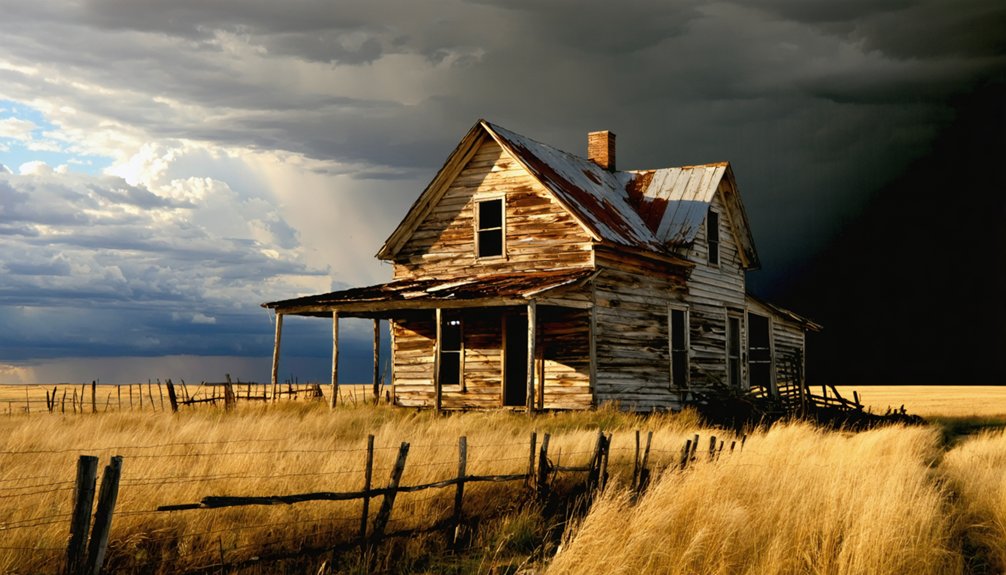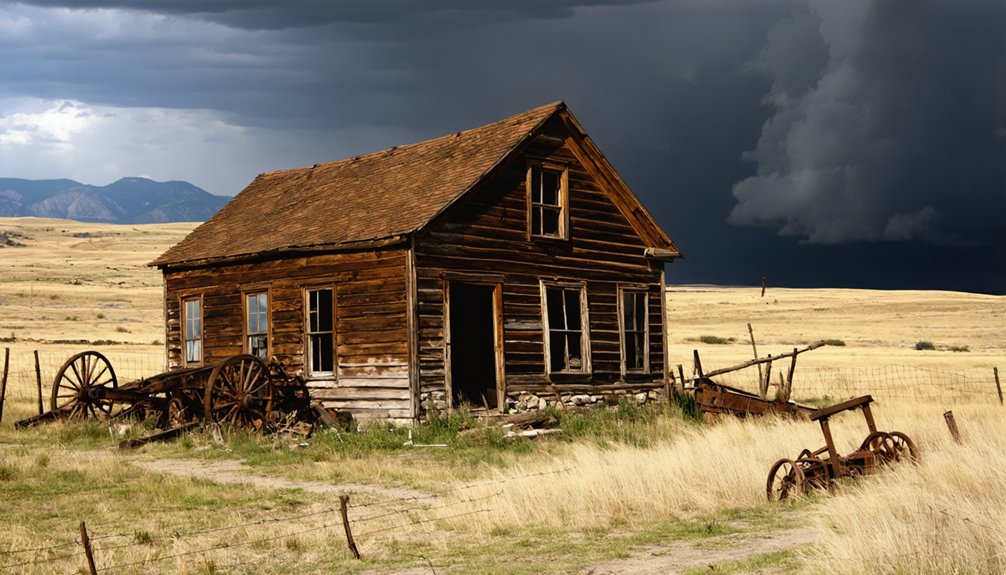
You’ll find Tinton clinging to Spearfish Canyon‘s slopes 13 miles east of Deadwood, accessible via a scenic 19-mile drive along US Route 14A from I-90. This remarkably intact ghost town preserves 25 weathered structures from its tin and lithium mining heyday during both World Wars, though you’ll need to respect private land boundaries and navigate 2018 tornado damage. The journey takes 30-60 minutes depending on stops at marked pull-offs, where you can safely explore South Dakota’s most authentic mining relic before it succumbs entirely to time and elements.
Key Takeaways
- Take US Route 14A through Spearfish Canyon from I-90 Exits 10 or 14; the 19-mile drive takes 30-60 minutes.
- Explore 25 weathered structures including the original post office, bank, schoolhouse, hotel, and company store from the 1902-1904 mining era.
- Respect private property boundaries and obtain landowner permission before accessing unmarked land surrounding the ghost town site.
- Navigate carefully around tornado damage from 2018, collapsed buildings, open mine shafts, fallen trees, and eroded tailings piles.
- Park only at marked scenic pull-offs and prepare for unpredictable conditions at 5,962 feet elevation near the South Dakota-Wyoming border.
Getting to Tinton in Spearfish Canyon
Your journey to Tinton begins along US Route 14A, a wide highway that winds through Spearfish Canyon‘s towering limestone walls on what was once an abandoned 1930s railroad grade. You’ll start from Spearfish—accessible via Exit 10 or 14 off Interstate 90—where Main Street becomes Colorado Boulevard before connecting to US-14 Scenic. The 19-mile drive southward takes 30-60 minutes, depending on your stops at designated scenic pull-offs.
Since this remains an active commercial highway, proper parking considerations are essential when exploring. Pull completely off the road at marked areas to safely venture toward Tinton’s historic mining remnants. You’ll find canyon floor trail access near the old ghost town site, where aspen-lined paths lead to limestone formations predating the Grand Canyon itself. For additional exploration, consider visiting nearby Spearfish Falls, which offers another perspective of the canyon’s natural beauty. Keep watch for white-tail and mule deer found throughout the drive, as they frequently cross this scenic corridor.
Understanding Private Land Access Requirements
The rugged beauty surrounding Tinton sits largely on private property, making respectful access knowledge as important as your hiking boots. You’ll need landowner permissions before stepping onto unmarked private land—South Dakota law’s crystal clear on this.
Private land dominates Tinton’s backcountry—secure landowner permission before exploring, because South Dakota law doesn’t bend on trespassing.
While public waters flow freely through the canyon, reaching non-meandering streams crossing private land requires explicit consent. Vehicle access restrictions apply strictly here; don’t assume that canyon road grants you passage onto adjacent lands.
If you’re exploring Walk-In Areas leased by Game, Fish, and Parks, you’re golden for foot travel during hunting seasons. However, private lands leased for public hunting access cannot be used for general recreational purposes. Archery deer hunters planning fall visits should note that free access permits are required for certain hunting areas, with the first draw deadline at July 1. Otherwise, knock on doors, make calls, and secure permissions beforehand.
This wilderness rewards those who respect boundaries while pursuing adventure. Your freedom depends on honoring others’ property rights.
What Remains of the Historic Mining Town
Twenty-five weathered structures stand sentinel across Tinton’s canyon slopes, making this South Dakota’s most architecturally intact ghost town despite decades of abandonment. You’ll discover the original post office, bank, mill, schoolhouse, hotel, and company store—all constructed with consistent building materials and architectural styles reflecting their planned company town origins.
The history of Tinton, South Dakota, is rich with stories of bygone days and community life. As you wander through the remnants of this town, you can almost hear the echoes of laughter and hard work from its early residents. Each structure tells a tale of resilience and adaptation, standing as a testament to the hopes and dreams that once thrived in this isolated landscape.
Windows gape empty, roofs have surrendered to gravity, and several buildings have collapsed entirely since a 2018 tornado tore through. Sparse preservation and restoration efforts mean you’re witnessing authentic decay rather than sanitized recreation. Located 13 miles east of Deadwood in Spearfish Canyon, the site once thrived on rich silver deposits discovered during the 1870s Gold Rush. The town sits on the South Dakota-Wyoming border at the very back of Spearfish Canyon.
Newspaper clippings over fifty years old still hide within wall cavities, while period furnishings scatter across accessible interiors. Dense forest and tree fall complicate exploration, but the extensive mining ruins and original townscape layout remain remarkably visible throughout this canyon wilderness.
The Rise and Fall of Tin Mining Operations
Standing among Tinton’s weathered ruins, you’ll witness the dramatic arc of a mining operation that transformed from gold rush disappointment to America’s most promising tin producer, only to collapse under the weight of global economics.
The town’s fortunes rose and fell with tin prices during both World Wars, experiencing brief reviews that brought temporary hope before market crashes and government shutdowns sealed its fate. Potato Creek Johnny Perrett became one of the notable figures associated with the area’s mining history.
From the discovery of tin in placer deposits in 1876 to the mill’s destruction by fire in 1953, Tinton’s seventy-seven-year journey encapsulates the precarious existence of single-resource mining communities in the American West. The War Production Board forced the closure of gold mining operations during World War II, contributing to the town’s ultimate demise.
Discovery and Early Operations
During the mid-1870s Black Hills Gold Rush, Edgar St. John discovered ore that would transform this rugged territory. While prospectors initially sought gold at Negro Hill in 1879, the real treasure lay hidden in plain sight.
Richard Pierce recognized cassiterite in placer deposits by 1876, though tin wasn’t found in place until June 1883 at the Etta mine.
The progression from discovery to operation followed these milestones:
- 1876-1877: Tin identified in placer gold from northern and southern Black Hills regions
- 1883: First in-situ tin deposit located near Keystone
- 1884: Pegmatite rock discovery revolutionized mine engineering techniques
- 1902-1904: Tinton Tin Mining Company constructed the town and mill, implementing advanced mineral processing methods
Wartime Revival and Lithium
The world’s largest tin mill hummed to life at Tinton as global conflict transformed this remote South Dakota outpost into a strategic stronghold. Japanese control over Pacific tin supplies thrust Tinton’s pegmatites into national prominence, their ore feeding America’s arsenal.
But beneath the tin lay something more valuable—lithium deposits discovered around 1940 would alter Tinton’s destiny.
The military significance of tin paled against lithium’s role in the Manhattan Project. You’re standing where Black Hills Tin Company extracted spodumene and amblygonite, shipping raw lithium oxide directly to atomic weapons contractors. Wartime lithium production ramped operations throughout the 1940s, while mechanized shovels clawed open-pit glory holes into the pegmatite-rich dome. The Tinton Tin Mining Company had built this entire operation after its formation in 1902, establishing the town just one year later. This wasn’t just mining—it was forging freedom’s edge during humanity’s darkest hour. Mining operations persisted after the war concluded, though activity gradually declined from its wartime intensity.
Final Decline and Abandonment
Prosperity slipped away from Tinton’s hillsides after 1911, when tin veins that once gleamed with promise began yielding diminishing returns. You’ll find the town’s demise unfolded through relentless economic blows and natural disaster.
The Black Hills Tin Company attempted failed business diversification into timber harvesting, but tin market pressures proved insurmountable.
The death spiral accelerated through these devastating milestones:
- 1943 mill fire razed the massive processing facility, eliminating the town’s economic backbone
- 1950 census recorded only 14 remaining residents clinging to abandoned dreams
- 1953 second fire destroyed remaining mill infrastructure beyond recovery
- 1955 post office closure officially severed Tinton’s connection to civilization
Exploring 25 Preserved Structures and Ruins
Scattered across a windswept hillside near the South Dakota-Wyoming border, approximately 25 weathered structures stand as silent witnesses to Tinton’s boom-and-bust mining era. You’ll discover miners’ houses lining Main Street, the company store bearing Black Hills Tin Company signage, and the Miners’ Assembly Hall where the first town wedding celebrated in 1903.
Despite collapsed roofs and missing windows from decades of exposure, the architectural diversity reveals careful company town planning—from two-room schoolhouses to boarding houses that once buzzed with 300 residents. The structures’ social importance echoes through empty walls that sheltered fraternities, ladies’ groups, and sports teams.
Tinton Enterprises’ ownership protects these South Dakota ruins from vandalism, preserving your chance to witness authentic Western history frozen in time.
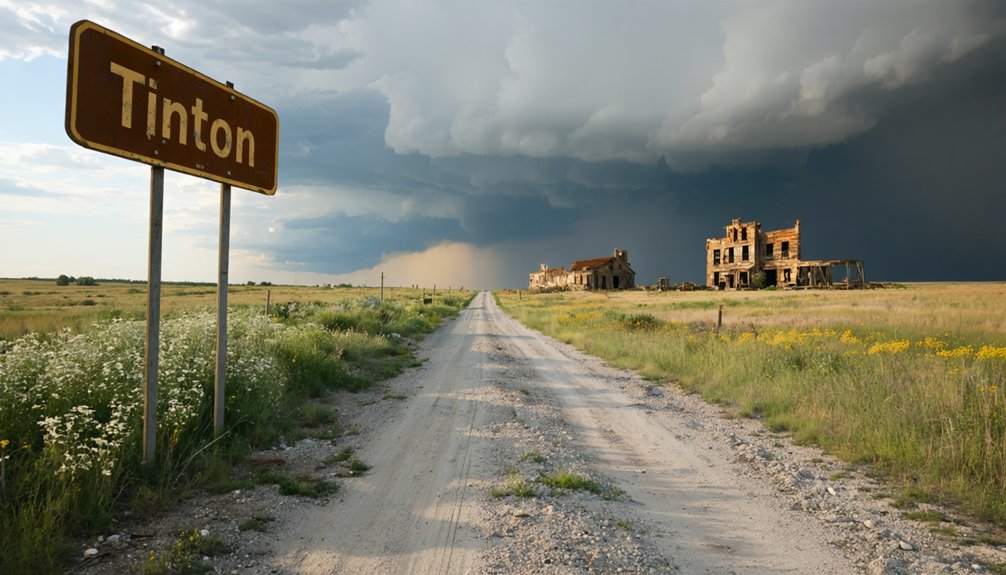
When summer storms swept through Spearfish Canyon in 2018, a tornado tore directly through Tinton’s already fragile structures, leaving behind a landscape of twisted metal, splintered timber, and hundreds of fallen trees that now complicate your approach to this remote ghost town.
You’ll navigate 5.9 miles of unpaved Forest Road 222 to reach the site, where environmental risks extend beyond storm damage.
Critical hazards demanding your attention:
- Unstable structures: Twenty-five tornado-damaged buildings threaten collapse
- Mining infrastructure hazards: Gaping shafts and eroded tailings riddle the valleys
- Dense debris fields: Fallen trees obstruct Main Street and surrounding trails
- Seasonal road conditions: Elevation of 5,962 feet creates unpredictable access
Watch your footing constantly—this backcountry destination rewards prepared adventurers who respect its dangers.
Combining Your Visit With Nearby Deadwood
After exploring Tinton’s weathered ruins, you’ll find Deadwood just 13 miles west offers a striking contrast—a mining boomtown that survived where others vanished.
Its preserved Main Street bustles with restaurants, modern casinos, and saloons occupying buildings that witnessed the Wild West’s most notorious characters. You can shift seamlessly from morning ghost town photography to an afternoon touring museums, then evening entertainment in establishments Seth Bullock himself once walked past.
Deadwood’s Historic Main Street
Since you’re already making the journey to the remote ghost town of Tinton, you’ll want to extend your trip to Deadwood’s Historic Main Street just fifteen miles northeast. This brick-paved thoroughfare stretches nearly the full length of Deadwood, showcasing authentic Victorian era architecture and historic building restorations from the 1870s gold rush.
Experience Main Street’s living history through:
- Daily Wild West shootout reenactments where gunfighters recreate frontier justice
- Wild Bill Hickok’s Trading Post marking the exact saloon location where he was shot dead in 1876
- Historic Deadwood Trolley tours offering narrated rides past preserved storefronts
- Saloon #10’s poker game reenactment recreating Wild Bill’s final hand
You’ll discover authentic Old West atmosphere without restrictions—walk freely through this National Historic Landmark district.
Casino and Dining Options
While Tinton itself stands frozen in time as an abandoned mining camp, Deadwood pulses with round-the-clock energy at its twelve licensed casinos. You’ll find over 280 slots at Lodge at Deadwood, high-stakes table games at Cadillac Jack’s, and state-of-the-art sportsbooks where you can wager on live action. The casino atmosphere ranges from Gold Dust’s weekend marathons to Deadwood Mountain Grand’s friendly dealers.
Your dining experiences extend beyond gaming floors. Sink your teeth into prime cuts at Mavericks Steaks & Cocktails, explore Grand Buffet’s endless spreads at Silverado-Franklin, or catch Midnight Star’s legendary Friday dinners. Most venues pour complimentary drinks while you play, and Club 76 Rewards grants discounts across properties. It’s your chance to balance ghost town solitude with full-throttle entertainment.
Best Times to Visit This Black Hills Ghost Town
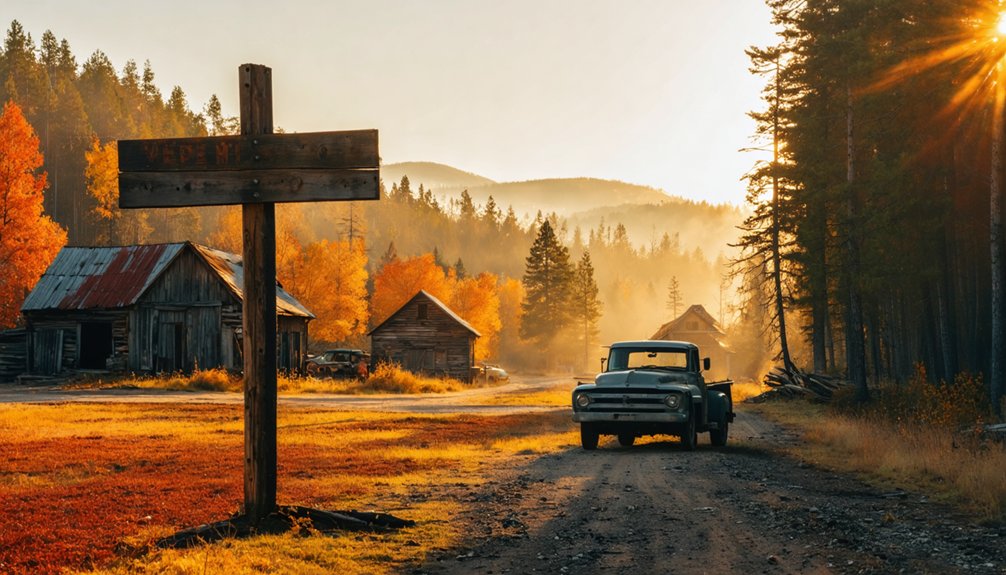
Each season transforms Tinton’s haunting landscape, offering distinct experiences for ghost town explorers willing to venture into the northern Black Hills.
Tinton’s abandoned ruins shift with the seasons, beckoning intrepid explorers to discover the Black Hills’ most atmospheric ghost town.
Optimal visiting windows:
- Winter (December-February): Experience off-season solitude among snow-covered ruins of 25 structures. You’ll find minimal visitors along Main Street’s remnants, though tornado-damaged trees from 2018 remain visible beneath white blankets.
- Spring (March-May): Melting snow reveals crumbling edifices framed by emerging wildflowers. Roads reopen after winter closures, but bring sturdy boots for muddy conditions.
- Fall (September-November): Spearfish Canyon’s vibrant foliage creates stunning backdrops for exploration. You’ll avoid seasonal crowds while enjoying crisp temperatures ideal for hiking to ore mill sites.
- Summer caution: Peak warmth enables extensive exploration, but expect increased traffic near Deadwood and heightened wildfire risks in surrounding terrain.
Frequently Asked Questions
Are There Guided Tours Available for Visitors Exploring Tinton’s Historic Sites?
No guided tours are available at Tinton—you’ll explore independently. Despite minimal historic preservation efforts, you’re free to wander among 25 remaining structures at your own pace, discovering this authentic ghost town without commercial restrictions or organized groups.
What Safety Equipment Should I Bring When Exploring Old Mines?
Your life absolutely depends on proper lighting equipment like headlamps and flashlights, plus sturdy protective gear including helmets, boots, and gloves. You’ll need gas detectors, first aid supplies, and communication devices for true exploration freedom and survival.
Can I Camp Overnight Near Tinton or Within Spearfish Canyon?
You’ll find dispersed camping opportunities on Mount Roosevelt Road near Tinton, but Spearfish Canyon itself prohibits overnight stays. Consider Hanna Campground nearby, though watch for seasonal trail closures affecting winter access to certain areas.
Are the Existing Structures Safe to Enter and Photograph Inside?
No, you shouldn’t enter Tinton’s structures. All 25 buildings lack roofs and are collapsing, creating serious structural integrity concerns. Crumbling walls and potential hazards from tornado damage make interior photography dangerous—shoot safely from outside instead.
What Wildlife Might I Encounter While Hiking Around the Ghost Town?
You’ll likely spot pronghorn antelope migrations across open terrain and possibly catch bald eagles sightings during dawn or dusk. Coyotes, white-tailed deer, and prairie dogs also roam freely through this untamed landscape surrounding Tinton’s abandoned structures.
References
- https://www.historynet.com/ghost-town-tinton-south-dakota/
- https://kids.kiddle.co/Tinton
- https://hikearizona.com/decoder.php?ZTN=21630
- https://www.sdpb.org/arts-life/vanished-south-dakota-in-the-moment
- https://westernmininghistory.com/towns/south-dakota/tinton/
- https://www.youtube.com/watch?v=jEZL_GLyfck
- https://en.wikipedia.org/wiki/Spearfish_Canyon
- https://www.mapquest.com/us/south-dakota/tinton-trail-446334448
- https://gfp.sd.gov/parks/detail/spearfish-canyon-nature-area/
- https://visitspearfish.com/things-to-do/spearfish-canyon