You’ll discover Washington’s “Triangle of Fire” isn’t a ghost town but three abandoned military fortresses—Fort Worden, Fort Casey, and Fort Flagler—forming a defensive network across Admiralty Inlet. Built in the 1890s to protect Puget Sound from naval invasion, these decommissioned installations now offer eerie concrete bunkers, underground ammunition magazines, and rusting gun emplacements to explore. Plan a 2-3 day loop visiting all three forts, where you can walk through tunnels, camp beside historic batteries, and witness the haunting remnants of America’s coastal defense era.
Key Takeaways
- Visit three historic forts—Casey, Worden, and Flagler—forming the Triangle of Fire defensive system around Admiralty Inlet.
- Explore underground bunkers, gun batteries, ammunition magazines, and vintage military buildings at each fort location.
- Fort Flagler offers 117 campsites with full hookups, making it an ideal base for multi-day exploration.
- Hike 5+ miles of trails connecting gun emplacements, searchlights, and old-growth forests with Puget Sound views.
- Tour Point Wilson Lighthouse at Fort Worden, featuring one of Washington’s only two working Fresnel lenses.
The Historic Triangle of Fire: Three Forts Guarding Puget Sound
In the dying years of the nineteenth century, military strategists peered across the gray waters of Admiralty Inlet and envisioned an impenetrable barrier. You’ll discover three fortresses—Fort Casey on Whidbey Island, Fort Flagler on Marrowstone Island, and Fort Worden at Port Townsend—forming what became known as the Triangle of Fire.
This military history marvel positioned crossfire to thwart any naval invasion threatening Puget Sound’s crucial arteries: the Bremerton shipyard, Seattle, and Tacoma. Construction began in 1897 under the Endicott Board’s modernization program, accelerating after the Spanish-American War ignited coastal defense urgency.
Fort Casey housed ten officers and 428 enlisted men, with vintage homes and barracks still standing today. Today, these defensive giants represent remarkable adaptive reuse, transformed from silent sentinels into state parks where you can explore gun emplacements, barracks, and the remnants of America’s coastal defense legacy without restriction. The Washington State Parks and Recreation Commission acquired these decommissioned military installations, preserving their historical significance for future generations.
Fort Worden: Exploring Underground Bunkers and Point Wilson Lighthouse
You’ll descend into Fort Worden’s concrete labyrinth where 41 guns once defended Puget Sound—a network of ammunition magazines, pillboxes, and tunnels built between 1898 and 1920 with Belgian cement and salt-free sand.
The crown jewel is a 200-foot-wide cistern that holds 2 million gallons and produces a haunting 45-second echo that’s drawn musicians like Wayne Horvitz to its depths. Building 225 features scaled-up dimensions that were designed to confuse the aim of gunners firing from ships.
At the fort’s northwestern tip, Point Wilson Lighthouse stands above the gun batteries, accessible via bluff paths that wind through blast doors, rusted ladders, and dark corridors frozen in time. It took 200 men almost three years to complete the excavation and concrete work for the massive gun emplacements that now lie silent.
Underground Bunkers and Tunnels
Beneath Fort Worden’s windswept parade grounds lies an extensive concrete labyrinth where soldiers once maneuvered through tight tunnel networks designed to protect against artillery bombardment and poisonous gas exposure. Multiple interconnected passages link barracks, bunkers, and the 41-gun complex through heavy blast doors and dark hallways.
You’ll discover secret storage spaces where artillery shells weighing up to 1,000 pounds waited in below-ground bunkers, protected from enemy fire. The ventilation system design channeled fresh air through confusing corridors marked by strange ladders and stairways.
Today, you can explore these open bunker areas freely—just bring rubber boots for water-filled passageways and flashlights for pitch-black conditions. The limestone-and-concrete construction, built between 1898 and 1920, remains remarkably intact for independent exploration. Communication tubes once connected Fort Worden with the other two forts in the Triangle of Fire defense system. Similar concrete structures can be found at Fort Ward on Bainbridge Island, where ammunition magazines and gun emplacements still stand as preserved historical artifacts.
Point Wilson Lighthouse Tour
Where Admiralty Inlet meets the Strait of Juan de Fuca, Point Wilson Lighthouse has guided vessels through treacherous waters since 1879, making it one of Puget Sound’s most critical navigational beacons. You’ll find this 51-foot octagonal concrete tower standing sentinel at Fort Worden State Park, its 1,000-watt light piercing through Pacific Northwest mists from what became the region’s tallest lighthouse when constructed in 1913-1914.
The tower houses one of only two working Fresnel lenses in Washington—a fourth-order gem from 1894 that still flashes its distinctive red beam. Recent lens restoration brought the original 1879 Fresnel lens back to life after decades of dormancy, underscoring ongoing lighthouse preservation efforts. You’re free to explore the keeper’s house and photograph this National Register landmark, though relentless erosion threatens its future existence.
The lighthouse’s first keeper, David M. Littlefield, was a Civil War veteran who went on to serve Jefferson County as sheriff, mayor, and Collector of Customs. Tours are available on Saturdays from May through September between 1:00 and 4:00 PM, with special tours offered upon request.
Fort Casey: Disappearing Guns and Admiralty Head Lighthouse on Whidbey Island
Perched on Admiralty Head’s ninety-foot cliffs, Admiralty Head Lighthouse stands as Puget Sound’s first sentinel, a white beacon that’s guided mariners through treacherous waters since 1861. You’ll discover the 1903 reconstruction—built with eighteen-inch stucco brick walls designed to withstand Fort Casey’s gun concussions—still commanding its strategic position overlooking Admiralty Inlet.
The lighthouse boasted Whidbey Island’s first indoor bathtub, heated by a coal-fired hot water heater that brought unprecedented comfort to isolated keepers.
Today you’re free to climb the spiral staircase to panoramic views spanning the Olympic Mountains and Puget Sound. The interpretive center showcases pristine Fresnel lenses from the 1800s, while volunteer docents share stories of keeper life. Though deactivated in 1922, this restored lighthouse remains your window into maritime history. From Point Wilson to Admiralty Head, lighthouses mark both sides of this vital entrance to Puget Sound’s inland waters. The grounds offer a scenic pathway connecting the lighthouse to Fort Casey, where visitors can explore the beach and enjoy sweeping views of the Salish Sea.
Fort Flagler: Miles of Trails and Beachfront on Marrowstone Island
You’ll find Fort Flagler‘s 1,451 acres sprawling across Marrowstone Island‘s northern tip, where ten intact gun batteries and original military buildings stand sentinel over Puget Sound.
The fort’s miles of hiking trails wind through coastal forests to reach both high bluffs and over a mile of accessible beachfront, connecting historic gun emplacements like the bluff-side Battery Thomas Wansboro and tunnel-laced Battery Henry Bankhead.
Beyond its preserved military infrastructure, the park now serves modern visitors with camping facilities, a boat launch, and conference spaces—transforming a once-active defensive installation into a recreational destination where history and outdoor adventure converge.
Historic Guns and Buildings
Ten massive gun batteries stand frozen in time at Fort Flagler, their concrete walls and steel mountings silent witnesses to a coastal defense system that once promised to rain 29 tons of explosives on any hostile fleet daring to breach Admiralty Inlet. Built between the 1890s and 1902, these fortifications showcased America’s warship defense capabilities through overlapping fields of fire with neighboring forts.
You’ll discover authentic military life through preserved structures:
- Battery Rollins – Reactivated in 1942 for anti-aircraft operations
- Battery Bankhead – Completed in 1902 with tunnel networks requiring flashlights
- Hospital Steward’s House – Available for overnight rental
- Officers’ Quarters – Surrounding the original parade ground
Despite meticulous gun maintenance procedures and 54 years of readiness, these weapons never fired in combat before the fort’s 1953 closure.
Extensive Trail System
Beyond the silent gun batteries, Fort Flagler’s trail system unfolds across more than 5 miles of diverse terrain where military history intersects with wild Pacific Northwest landscapes. You’ll navigate the primary 5-mile stony beach loop in 2.5 to 3 hours, climbing bluffs at the 2.25-mile mark for sweeping views of Port Townsend, Whidbey Island, and Puget Sound.
The West Searchlight trail cuts through old-growth Douglas fir forests to historic bunkers, while the Bluff trail threads between elevations where bald eagles soar overhead. Trail accessibility varies with tidal conditions—high water limits beach access considerably. Wind whips around Marrowstone Point, so layer your clothing. Trail amenities remain minimal, preserving the raw character of this coastal military outpost where black-tailed deer graze and harbor seals patrol offshore waters.
Recreation and Conference Facilities
Fort Flagler’s 3.6 miles of saltwater shoreline transforms this military memorial into a vibrant recreational hub where history meets hands-on adventure. You’ll find seasonal event programming concentrated during summer months when the Beachcomber Cafe, Little General Store, and guided bioluminescence tours bring the park alive.
Year-Round Recreation Access:
- Water Activities – Launch kayaks from easy-access gravel beaches, fish for salmon and flounder, or reserve one of three Cascadia Marine Trail campsites at $12/night
- Day-Use Facilities – Playground, basketball half-court, and open parade grounds perfect for games and kite flying
- Camping Options – 117 sites spanning wooded upper campground and beachside lower areas with full hookups for 50-foot RVs
- ADA Accessible Facilities – Eight shower buildings throughout park guarantee comfortable access for all visitors
Planning Your Loop Route Around Admiralty Inlet
When you’re mapping your 3.4-kilometer journey through this 86-acre preserve, you’ll want to start at the modest parking area on Engle Road, where a safe road crossing deposits you directly at the trailhead. Your 50-minute adventure unfolds through old-growth Douglas fir forests—some trees exceeding 250 years—before reaching the Admiralty Inlet viewpoint at the 1-kilometer mark. Here, unobstructed vistas stretch across the Salish Sea toward the Olympic Peninsula.
Continue along bluff-edge sections for wildlife observation opportunities featuring bald eagles and great blue herons. The wetland zone near 2 kilometers offers prime viewing. Navigate using the HiiKER app for real-time updates, and time your visit for May’s golden paintbrush bloom within the rare prairie ecosystem. This route combines historical preservation with raw coastal beauty.
Beyond the Forts: Northern State Ghost Town and Port Townsend Haunts
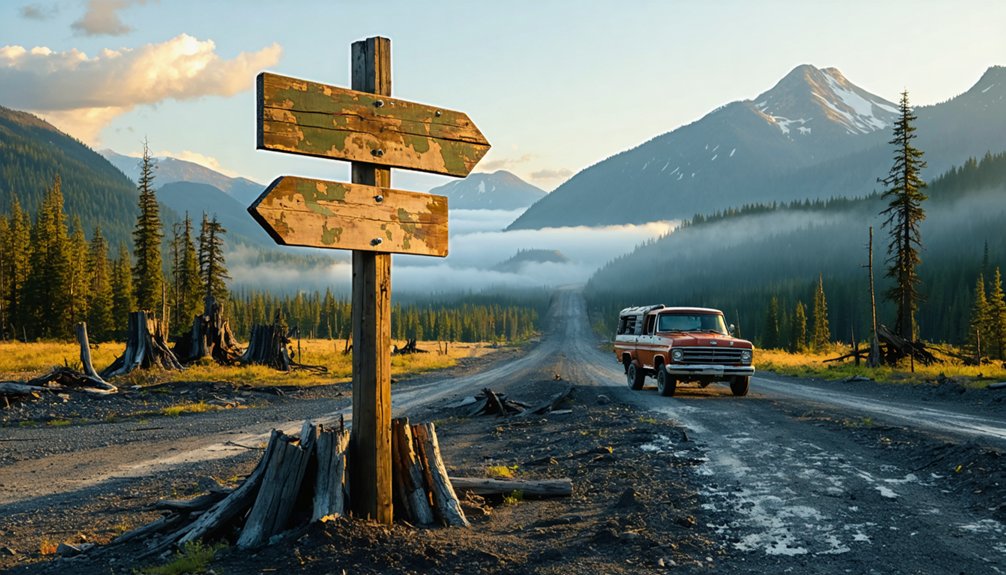
The haunting remains of Northern State Hospital sprawl across 800 acres at the foot of the Cascades near Sedro-Woolley, where thousands of patients once lived within a self-contained city designed by the Olmsted Brothers—the same landscape architects who shaped Central Park. Opened in 1912, this third Washington mental institution housed over 2,700 souls at its peak before closing in 1976.
The history of triangle of fire intertwines with tales of tragedy and loss, reflecting the struggles of those who sought help but found themselves trapped in a system that often failed them. As the years progressed, the echoes of their experiences reverberated through the corridors, leaving behind a legacy that cannot be easily forgotten. Today, remnants of that past serve as a reminder of the need for compassionate mental health care and the importance of remembering those who suffered.
Today’s 5-mile trail system reveals the institution’s dark legacy:
- Patient treatment facilities where experimental procedures occurred throughout the mid-20th century
- Crumbling barns, dairy operations, and canning buildings from the 700-acre farm
- An on-site cemetery with over 1,500 burials and a crematorium that operated into the 1950s
- Locked Spanish colonial buildings where shadows and whispers persist
Stick to marked trails—these grounds remember everything.
Frequently Asked Questions
Are the Forts Wheelchair Accessible for Visitors With Mobility Challenges?
Like traversing through history’s layers, you’ll find varying accessibility levels. Fort Worden offers the smoothest journey with wheelchair ramps available and accessible restroom facilities, while Fort Flagler requires assistance maneuvering stone steps into its fortress heart.
What Are the Entrance Fees for Visiting Each of the Three Forts?
You’ll need a $10 daily Discover Pass or $45 annual pass for admission costs at all three forts. Camping runs $22-57 nightly depending on hookups and seasonal schedules. No separate entrance fees beyond the pass required.
Can You Bring Pets to Explore the Fort Grounds and Trails?
Your furry companion’s finally more welcome than you at bureaucratic facilities! You’ll find extensive pet friendly amenities throughout Fort Worden’s trails and bunkers, though leash requirements apply. Two dogs can explore beaches, tunnels, and Victorian quarters—freedom with reasonable restraints.
What Are the Operating Hours for Touring the Underground Bunkers?
Operating hours vary seasonally across the Triangle’s fortifications—Fort Worden opens at 6:30 AM summer, 8 AM winter, both closing at dusk. Guided tours are offered at select times, with Fort Worden’s Artillery Hill tours running Friday-Tuesday, 11 AM-4 PM, April-October.
Are Guided Tours Available at the Triangle of Fire Forts?
Step into living history—you’ll find guided tour availability at Fort Flagler and Fort Casey with volunteer-led experiences, while Fort Worden emphasizes self-guided exploration options. Summer seasons offer the richest programming for your independent adventure through these coastal defense installations.
References
- https://www.wainnsiders.com/visit-washingtons-spooky-abandoned-ghost-towns/
- https://www.emeraldpalate.com/abandoned-places-in-washington/
- https://www.youtube.com/watch?v=forpD_x8SWo
- https://www.youtube.com/watch?v=YJJDYKl_PZU
- https://en.wikipedia.org/wiki/Fort_Worden
- https://www.historylink.org/file/7524
- https://www.abandonedwashingtonstate.com/military.html
- https://whatcomwatch.org/index.php/article/port-townsend-and-the-triangle-of-fire/
- https://whidbeycamanoislands.com/triangle-of-fire/
- https://en.wikipedia.org/wiki/Fort_Casey