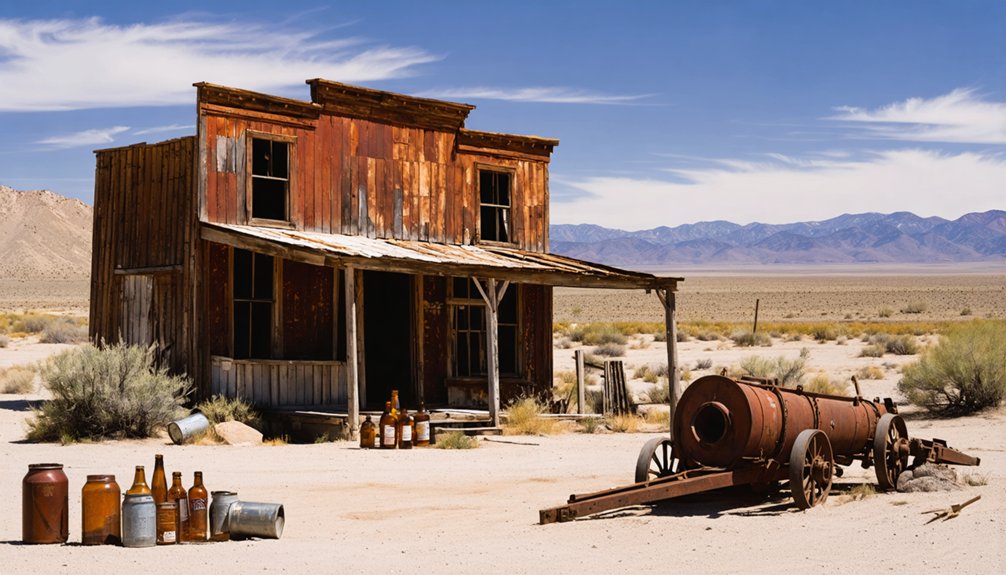
Your Tuscarora adventure begins 50 miles north of Elko, Nevada, where you’ll navigate State Route 225 for 27.9 miles before turning onto Route 226 through Independence Valley. You’ll need printed maps since digital coverage vanishes in this remote high desert, and you should verify road conditions before attempting the challenging 50-mile dirt route. Upon arrival, weathered structures, the 1877 Society Hall museum, Victorian-era chimneys, and Nevada’s second-largest Chinatown ruins await your exploration—each landmark revealing stories of silver rushes and vanished communities.
Key Takeaways
- Tuscarora is 50 miles north of Elko via Routes 225 and 226, requiring printed maps and vehicle preparation for dirt roads.
- Verify current road conditions before departure due to remote location with sparse digital coverage and no cellular service.
- Visit the 1877 Society Hall museum, Big Chimney, cemetery, and Chinatown remnants to explore historic mining structures.
- Expect weathered buildings, crumbling foundations, and abandoned stamp mills scattered across the mountainside landscape.
- Tuscarora remains a small living ranching community and artist sanctuary, not a completely abandoned ghost town.
Getting to Tuscarora: Routes and Travel Tips
Where exactly does one find Tuscarora in Nevada’s vast high desert expanse? You’ll navigate to Elko County, roughly 50 miles from Elko itself, perched at 5,997 feet on the Tuscarora Mountains’ eastern slopes. Your journey demands taking State Route 225 north for 27.9 miles, then heading west on Route 226 for another 24.6 miles through Independence Valley‘s sweeping terrain.
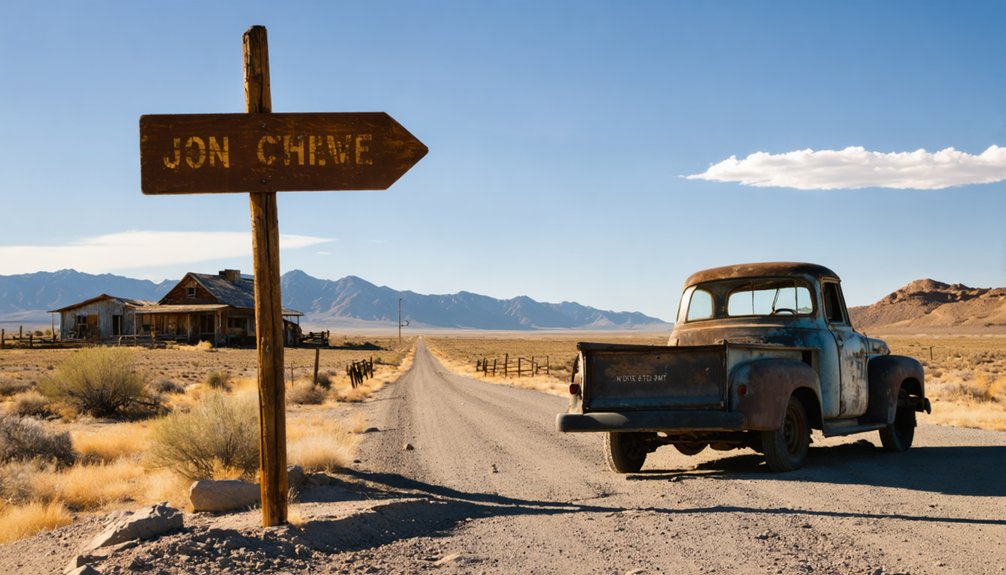
These remote access challenges require preparation—no Google Street View exists here, and blue road indicators signal sparse digital coverage. Modern vehicles replace the stage coaches that once rumbled these paths, though road maintenance considerations remain critical in this desert environment. Pack printed maps, verify current conditions, and guarantee your vehicle’s reliability. The 50-mile dirt route presents a difficult challenge that requires proper planning and vehicle preparation. Carlin lies 40 miles south as an alternative starting point for those seeking different approaches to this ghost town adventure. The town shares its name with multiple places across North America, reflecting the widespread influence of the Tuscarora people.
What to Expect When You Arrive
As your vehicle crests the final hill, Tuscarora materializes like a mirage—a scatter of weathered structures clinging to the mountainside where 4,000 souls once bustled through streets now reclaimed by sagebrush. You’ll spot the cemetery first, then the post office on your left—still staffed daily, serving the modern day ranching operations sprawling across the valley. Park anywhere; there’s no traffic here.
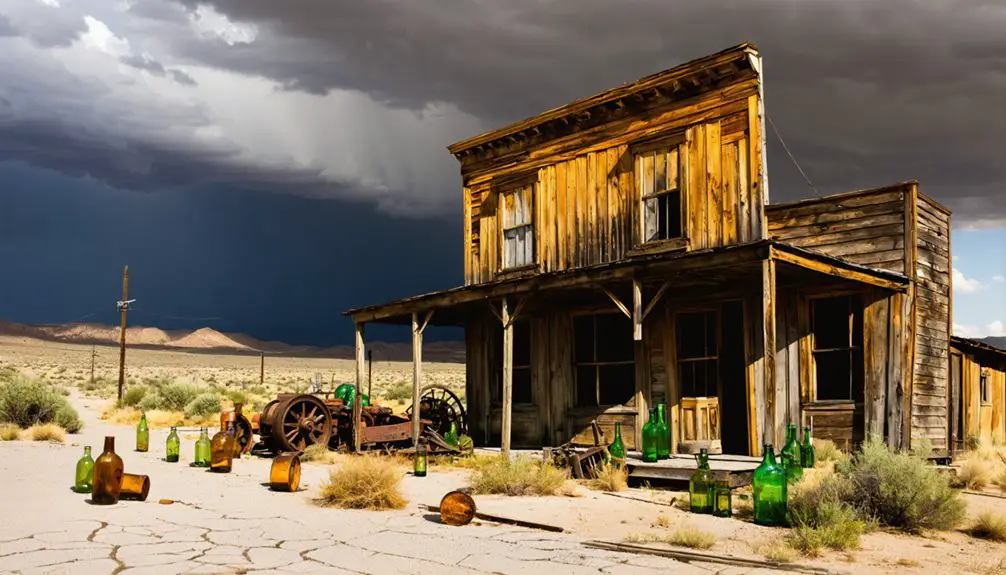
Wander freely among crumbling brick chimneys and remnant architectural details—tin fences jutting from lots, facing fireplaces exposing former room layouts. Rusted vehicles dot properties where grass swallows bed springs and glass shards. The museum opens Sundays, displaying Chinese coins and mining relics inside the 1877 Society Hall. The building originally housed both the District Recorders Office and the Silver Brick Saloon before fraternal organizations transformed it into their meeting place. Modern pickups parked beside century-old ruins remind you this isn’t fully abandoned—it’s alive, just quieter.
This ranching community also serves as home to world-renowned artists who have chosen Tuscarora’s isolation as their creative sanctuary.
Historic Sites and Landmarks You Can’t Miss
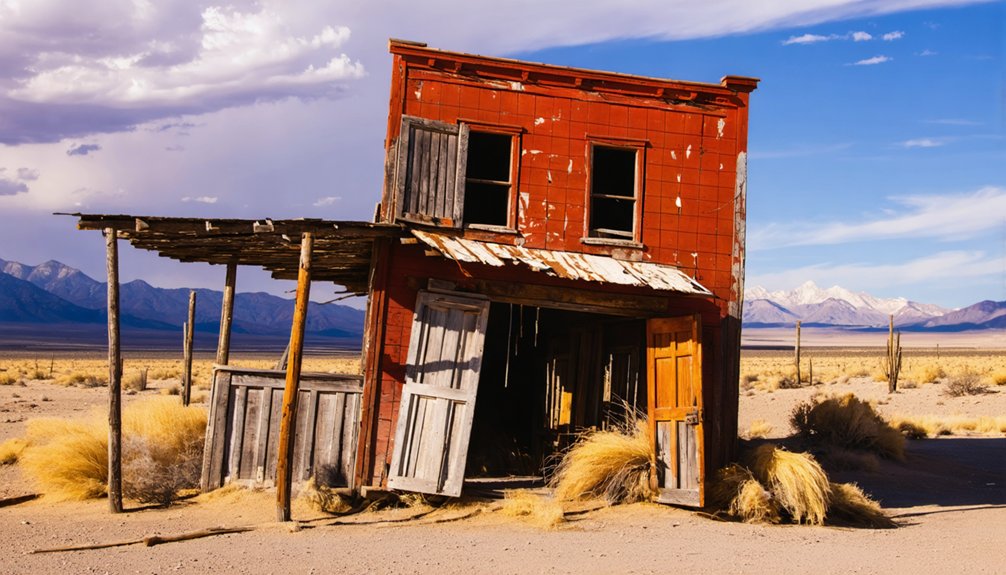
Walking Tuscarora’s decaying street grid feels like stepping through a sepia-toned photograph, where original mining camp structures lean at precarious angles and rusted artifacts peek through sagebrush. You’ll discover the town’s layered history in unexpected places—from the relocated Zweifel House where Tuscarora’s first murder occurred in 1877, to the overgrown terraces of Chinatown where Chinese laborers once lived during the silver rush.
The Big Chimney towers above it all like a sentinel, its Victorian-era stonework still intact after nearly 150 years of watching over these ruins. From this vantage point partway up Mt. Blitzen, you can take in breathtaking views of the valley below and understand why miners chose this elevated location after the massive silver strike of 1871. As you enter town, the cemetery greets you first with its weathered gravestones and iron fences marking the final resting places of early settlers and prospectors.
Original Mining Camp Structures
Standing among the weathered remnants of Tuscarora’s original mining structures, you’ll find yourself transported to an era when seven major mines commanded listings on the San Francisco Stock Exchange and thirteen massive mills consumed wagonloads of sagebrush to fuel their relentless ore processing.
The former mining structures reveal engineering evolution from primitive rope-and-bucket systems to steam-powered hoists by 1877. You’ll discover:
- Abandoned stamp mills scattered across the landscape, including the Windsor Mill brought by Grand Prize Company
- Dexter Mine remnants marking Nevada’s last active operation until 1903
- Original townsite foundations two miles from Beard Hill’s placer camp
At nearby Cornucopia, the Leopard Mill processed Tuscarora’s richest ore, while Chinese workers’ structures dot Old Town where $1 million emerged from forgotten placer deposits. The district’s remarkable boom period lasted from 1872 to 1884, when these facilities operated at their peak capacity. An adobe fort still stands as testament to the early settlers’ need for protection during the camp’s formative years.
Chinatown Remnants and Ruins
Beyond the main townsite, you’ll discover the scattered foundations of what was once Nevada’s second-largest Chinatown—a thriving community that swelled to hundreds of former Central Pacific Railroad workers after 1869. These industrious miners extracted an additional $1 million in gold from supposedly exhausted claims, proving their technical prowess where others saw only worthless rock.
Today, crumbling stone walls and depressions mark where opium dens, temples reflecting religious beliefs, and businesses once thrived. You’ll find subtle traces of social customs in the layout—communal spaces, carefully positioned structures, and remnants of vegetable gardens that fed thousands. The Chinese immigrants who settled here also sold tea and silks to the broader community, diversifying their economic activities beyond mining alone. The silver discovery in 1871 triggered an even greater boom that transformed Tuscarora into Elko County’s largest town by the 1880s. Archaeological fragments pepper Beard Hill’s basaltic slopes, whispering stories of a people who transformed discarded mines into fortune, then vanished when floods consumed the tunnels in 1886.
Victorian Era Social Buildings
When Tuscarora’s population swelled to nearly 4,000 souls during the 1877 silver bonanza, the mining camp shed its rough-and-tumble origins and embraced Victorian respectability with remarkable speed. You’ll find fascinating remnants of this thriving social organization scattered among today’s picturesque ruins.
The centerpiece was Plunkett’s Hall, a converted lodging house featuring an ingenious tilting floor that created amphitheater seating for operas and plays.
This bustling mining community supported:
- Multiple churches serving various denominations alongside fraternal Masonic lodges
- A public school enrolling over 200 students during peak prosperity
- Two newspapers (the Times and Review) that merged in 1878
The post office still operates daily, serving valley ranches—a living connection to Tuscarora’s Victorian heyday when Fourth of July celebrations drew thousands for parades, baseball games, and sledgehammer tosses.
The Story Behind Nevada’s Second Largest Chinatown
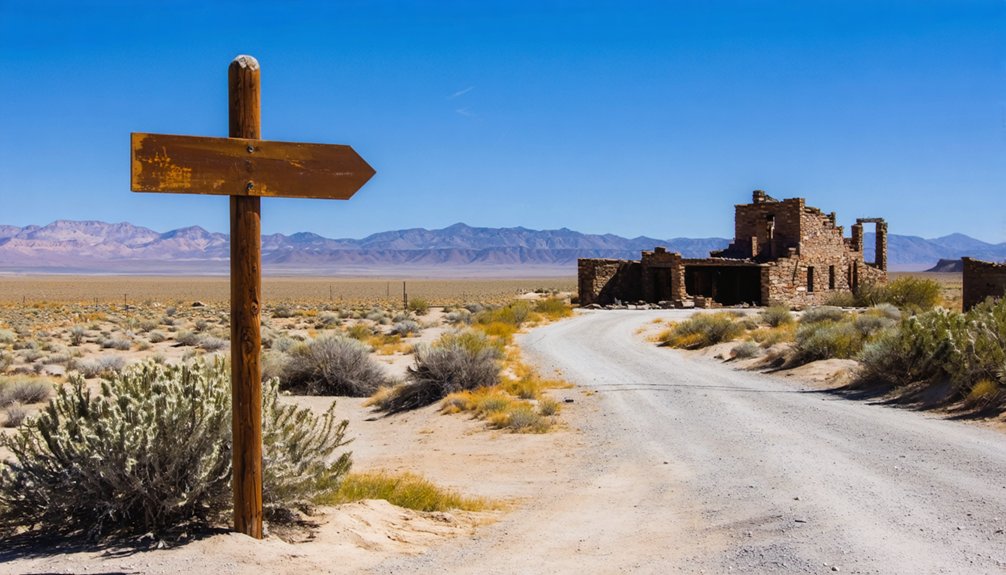
The thunder of sledgehammers and the ring of railroad spikes echoed through Truckee’s canyons as 12,000 Chinese laborers carved the western leg of the transcontinental railroad through the Sierra Nevada’s unforgiving granite. They called Nevada *yin shan*—Silver Mountain—building what became the Pacific Coast’s second largest Chinatown after San Francisco.
You’ll find only one building remains today at 10004 SE River Street, a silent witness to three deliberate fires in 1878 that destroyed everything. Chinese forest laborers armed themselves after the final blaze, but racial tensions in Truckee escalated into the notorious “Truckee Method”—a two-month boycott that expelled every Chinese resident by 1886. The town celebrated their departure with a parade, erasing a community that existed from 1867 to 1886.
Mining Heritage: From Boom to Modern Operations
Standing among Tuscarora’s weathered headframes and collapsed mill foundations, you’ll witness the physical timeline of Nevada’s mining evolution—from the 1872 boom when thirteen steam-powered mills processed ore worth millions, through the 1917 salvage operations that stripped the district bare, to the modern Dexter pit that yielded nearly 40,000 ounces of gold in just two years.
The rusted cables and rotting timbers aren’t just relics; they’re markers of an industry that employed 3,000 miners at its peak, fell silent for seventy years, then roared back to life with diesel excavators and cyanide leach pads. You can still trace the toll roads where freight wagons once hauled equipment up from Elko, their ruts carved permanently into the mountainside alongside fresh exploration trenches.
Historic Mining Boom Era
Gold fever struck hard in 1867 when prospectors from Austin stumbled upon placer deposits on what they’d name Beard Hill, launching Tuscarora’s transformation from empty sagebrush highlands to one of Nevada’s richest strikes.
By 1872, the district exploded after W.O. Weed discovered Mount Blitzen’s silver lodes assaying $600 per ton. Despite mining operations challenges like water scarcity at 6,200 feet, over 3,000 fortune-seekers flooded in.
You’ll discover three remarkable facts about peak years:
- Chinese workers extracted $1 million from supposedly exhausted claims, building America’s second-largest Chinese community
- Grand Prize Mine alone yielded $1.4 million its first year
- Thirteen mills processed ore while local cultural activities thrived—from opium dens to vegetable gardens
The Navajo claim epitomizes this era’s wealth: purchased for $10,000, it ultimately produced $3 million.
Decline and Equipment Salvage
Prosperity’s clock struck midnight for Tuscarora in the mid-1890s. You’ll find production plummeted below $50,000 annually while shipments crashed from $1.2 million to half that within two years.
By 1880, only ten mines and three mills served a dwindling population of 1,400. The Independence Mill’s sporadic operations reflected the camp’s struggles—closing repeatedly for repairs and water shortages. Company failures became routine as ore grades dropped and profitability vanished.
Small scale revival attempts flickered briefly but couldn’t resurrect the dying camp. When miners rushed south to the 1900s booms elsewhere, Tuscarora’s fate was sealed.
The final blow came in 1917 when most mining equipment sold for scrap, marking the end of operations until 1987. What remained was a ghost town preserved by abandonment itself.
Contemporary Mining Operations Resume
After seven decades of silence, Tuscarora’s mineralized ground attracted modern explorers again in 2016. You’re witnessing contemporary mining operations at a critical juncture—ICG Silver & Gold now controls the entire 8,000-10,000 acre district where Carlin and Independence Trends intersect.
What’s happening beneath your feet:
- 25,730 meters of drilling have probed the epithermal silver-gold system since exploration resumed
- 130 line-kilometers of geophysical surveys mapped hidden structures across these ridges
- Financial backing secured through oversubscribed offerings fuels Phase 1 exploration launching spring 2026
The technical team’s 3D geological models identify both shallow oxide targets and deeper feeder-style mineralization—potential source zones feeding historic bonanzas. You’re standing at ground zero where systematic exploration meets Nevada’s mining-friendly jurisdiction, transforming ghost town legend into tangible opportunity.
Best Time to Visit and What to Bring
When planning your ghost town adventure to Tuscarora, timing can make the difference between a comfortable exploration and a teeth-chattering ordeal. June and July offer prime visiting conditions, with moderate temperatures hovering around 60°F—perfect for wandering abandoned structures without breaking a sweat. Understanding weather patterns helps you avoid February’s brutal lows of 18°F or January’s harsh conditions.
For packing essentials, layer up with warm clothing capable of handling potential 15°F nights, even during shoulder seasons. Don’t forget sturdy boots for traversing rocky terrain and potential snow depth.
Summer visitors need sunscreen and wide-brimmed hats for 92°F peaks, plus extra water since precipitation remains minimal. A windproof jacket proves invaluable year-round in this unpredictable mountain climate, letting you explore freely regardless of conditions.
The Pottery School and Arts Community
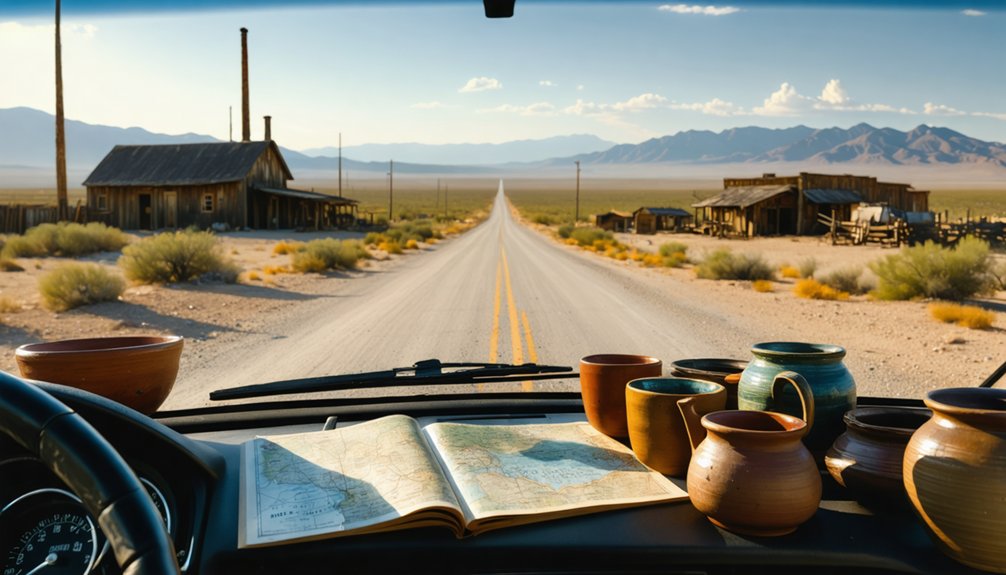
Hidden among the weathered buildings of this remote Nevada ghost town, an unlikely cultural renaissance took root in 1966 when Dennis Parks traded academic security for a dilapidated chicken coop. Today, you’ll discover influential instructors leading immersive workshops in converted mining-era structures, including a geodesic throwing dome and brick studio crafted from local Tuscarora soil.
The school’s community programs attract artists worldwide who gather for:
- Multi-day retreats where you’ll master wood and gas-fired kiln techniques
- Summer sessions hosting up to 15 students in two-week intensive periods
- Communal meals and storytelling in the historic Zweifel Rooming House
Support from the Nevada Arts Council and National Endowment for Arts guarantees this creative haven thrives, transforming abandoned spaces into working studios where freedom-seeking makers experiment alongside like-minded craftspeople.
Nearby Attractions in Independence Valley
Beyond Tuscarora’s weathered storefronts, Independence Valley unfolds as your gateway to Nevada’s vast northern playground—a region where ghost town expeditions blend seamlessly with wilderness adventures and living history.
As visitors delve into the history of Tuscarora, Nevada, they uncover stories of miners and pioneers who once thrived in this remote area. Each building stands as a testament to the challenges faced and the resilience of those who settled here. This rich past invites exploration, offering a unique perspective on the region’s cultural heritage.
As you continue your journey, consider visiting historical landmarks near Tonopah Nevada, where remnants of the mining boom still linger in the landscape. These sites provide a fascinating glimpse into the lives of those who sought fortune in the harsh desert environment. From well-preserved structures to informative plaques, each spot reveals a chapter of Nevada’s storied past, inviting further exploration and reflection.
You’ll discover wagon trail relics dotting the Golden Horseshoe byway, stretching from McDermitt south through scattered gold mines to Elko. Abandoned ranches punctuate the sagebrush landscape, their weathered boards whispering stories of harder times.
The Jarbidge Wilderness beckons horseback riders and anglers seeking solitude, while Humboldt-Toiyabe National Forest‘s two million acres offer everything from Lamoille Canyon’s alpine splendor to Ruby Mountains heli-skiing.
Stop by the California Trail Historic Interpretive Center to contextualize those pioneer routes you’ve been crossing, or cast a line at Wild Horse State Recreation Area where trout run cold and plentiful.
Frequently Asked Questions
Are There Any Restaurants or Places to Buy Food in Tuscarora?
Tuscarora has no permanent restaurants, but you’ll find food trucks for special events. The historic general store occasionally stocks basics, though local produce stands are scarce. For hearty meals, you’ll need to venture into nearby Elko’s dining scene.
Can You Camp Overnight Near Tuscarora or Stay in Town?
You’ll find free camping at Willow Creek Reservoir just outside town, though no private camping grounds exist in Tuscarora itself. Bed and breakfast inns aren’t available either, but nearby RV parks offer hookups for your adventurous ghost town exploration.
Is Cell Phone Service Available in the Area?
Cell phone coverage quality is limited in Tuscarora. You’ll find spotty cellular data connectivity, with Verizon offering the strongest signal at 66% coverage. Don’t count on reliable service—download maps offline before venturing into this remote ghost town.
Do You Need a Four-Wheel Drive Vehicle to Reach Tuscarora?
No, you won’t need a four-wheel drive vehicle—standard cars handle the Midas-Tuscarora route beautifully under normal road conditions. However, accessibility challenges arise during storms when snow or mud transforms those all-weather claims into genuine adventures requiring proper traction equipment.
Are Any Buildings Open to the Public for Interior Tours?
No buildings offer interior tours due to private property restrictions and limited historical preservation efforts. You’ll find the museum open Sundays only, while weathered structures remain off-limits. The relocated 1880s jail’s accessible at Henderson’s Clark County Museum instead.
References
- https://www.nevadaghosttownsandmininghistory.com/portfolio-2/tuscarora
- https://www.historynet.com/ghost-town-tuscarora-nevada/
- https://travelnevada.com/nevada-magazine/tuscarora/
- https://shpo.nv.gov/nevadas-historical-markers/historical-markers/tuscarora
- https://westernmininghistory.com/towns/nevada/tuscarora/
- https://www.nevadahumanities.org/blog/2022/7/13/tuscarora-nostalgia-and-an-enchantment-with-distance
- https://forgottennevada.org/sites/tuscarora.html
- https://ghost-towns.close-to-me.com/states/nevada/tuscarora-nv/
- https://en.wikipedia.org/wiki/Tuscarora
- https://landingaday.wordpress.com/2025/10/23/tuscarora-nevada-2/