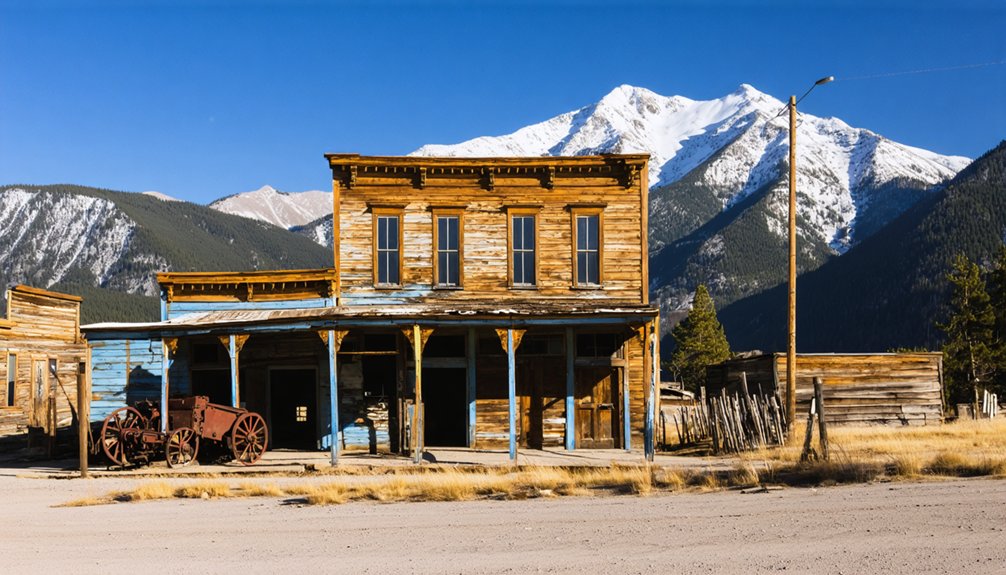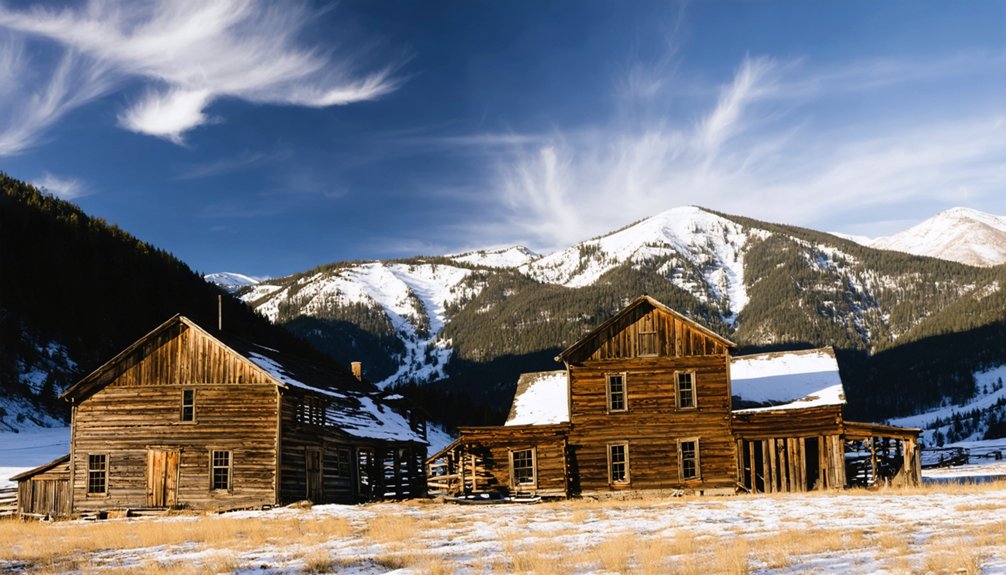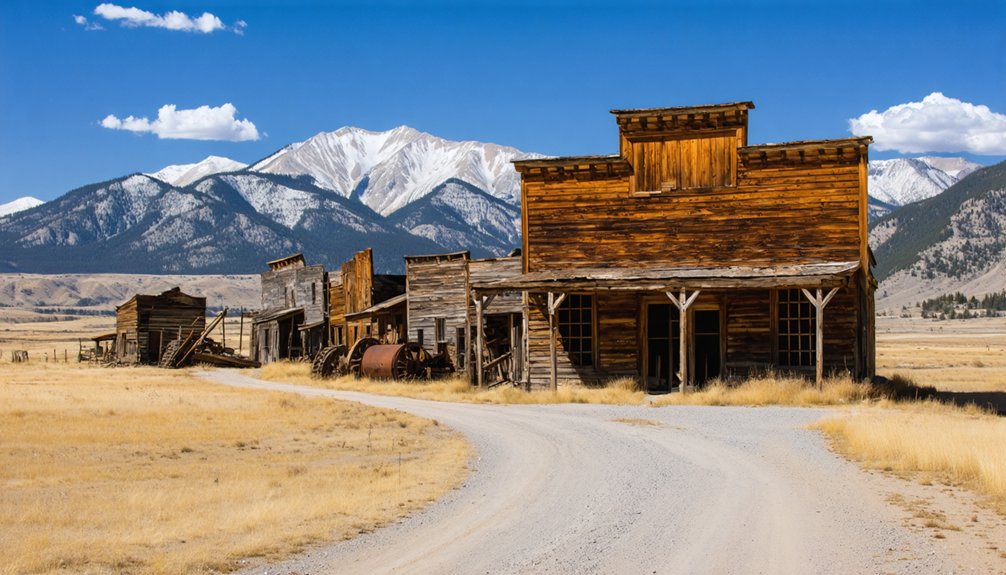
You won’t find Ula on any highway sign—this ghost town disappeared so thoroughly that only its cemetery remains. Located north of Westcliffe off County Road 170, Ula served as Custer County’s first seat in 1877 before losing everything to Rosita’s silver boom. The 1872 cemetery holds 840 graves beneath the Sangre de Cristo peaks, where German colonists and frontier legends like Moccasin Bill Perkins rest. Pack your GPS coordinates and prepare to discover what happens when wilderness reclaims history.
Key Takeaways
- Ula is located in the San Juan Mountains near Eureka at 9,863 feet elevation, accessible via demanding routes from Silverton.
- No physical remnants of Ula exist today; the town has been completely reclaimed by wilderness with no structures remaining.
- Ula served as Custer County’s first seat from 1877-1878 before losing status to Rosita during the silver boom.
- Visit Ula Cemetery at 2091 County Road 170 north of Westcliffe to see 840 memorial records dating from 1872.
- GPS coordinates are available in GPX format for navigation to the former townsite and nearby historic locations.
Getting to Ula: Directions and Coordinates
Tucked deep into the San Juan Mountains at elevations pushing 10,000 feet, Ula remains so obscure that you won’t find dedicated coordinates for it in standard ghost town registries—a fitting obscurity for a settlement that barely left its mark on Colorado’s mining history. You’ll navigate by proximity: aim for nearby Eureka (37.8797°N, 107.5651°W) at 9,863 feet, where limited historical records offer sparse clues to these remotely located ruins.
From Durango, drive 60 miles north on US 550’s dramatic switchbacks to Silverton, your last supply stop. Beyond lies 12 miles of demanding 4WD track toward Animas Forks. High-clearance vehicles aren’t optional—they’re survival. The route from Silverton to Animas Forks is passable by two-wheel drive vehicles during summer months, though caution is still advised. Plan your expedition between June and September when snow relents, because winter seals these ghost towns in absolute isolation. The coordinates can be downloaded in GPX format for easy importing into your GPS device or mapping software, ensuring you stay on track through this challenging mountain terrain.
What Remains of Ula Today
Unlike ghost towns that greet visitors with weathered cabins or crumbling mine headframes, Ula offers nothing but absence. All traces vanished—no foundations, no railroad ties, no cemetery markers. You won’t find this site listed alongside preserved Colorado camps like St. Elmo or Lulu City. It appears on no National Register, no museum tour routes, no hiking guides.
Where Floresta shows scattered coal-mining remnants and Jimmy’s Camp at least marks its location, Ula disappeared completely from both landscape and memory. No access feasible means exactly that: no roads lead there, no trails bear its name, no signage acknowledges it existed. Colorado’s most well-preserved ghost towns like Animas Forks feature distinctive structures such as the Duncan House’s bay window, but Ula left nothing comparable behind. In contrast, Bodie State Historic Park preserves log cabins and mining equipment that transport visitors back to its boomtown heyday. For those seeking the romance of exploration, Ula represents the ultimate frontier—a place so thoroughly reclaimed by wilderness that even finding where it stood becomes impossible. Some ghosts leave no bones behind.
The Accidental Naming of a Town
You’ll discover that Ula’s name exists only because someone made a clerical error back in 1871—the town was supposed to be called “Ure.” When officials registered the settlement, they accidentally recorded it as “Ula,” and the mistake stuck across every post office document, map, and county record for the next two decades.
What began as a simple misspelling became the ghost town’s permanent identity, locked into Colorado history by the ink-stained fingers of a frontier administrator. Similar naming mishaps occurred elsewhere, like when founder Stephen Tuttle Thompson’s proposed name “Arad” was misspelled as “Arab” in Alabama’s postal records. Today, Ula appears in place name disambiguation pages alongside other locations sharing similar names, a testament to how administrative errors can create lasting geographic identities.
From Ure to Ula
When Joseph Davis homesteaded land near Grape and Taylor Creeks in 1871, he couldn’t have imagined that a clerical fumble would permanently rename his town. You’ll find this story particularly amusing: town planners originally designated the settlement as “Ure,” a name meant to evoke Britain’s Paradise. But namers’ blunders transformed destiny when registration documents mistakenly recorded “Ula” instead.
The error stuck. From 1871 to 1891, the post office operated under this accidental moniker, and nobody bothered correcting it. Davis built his log cabin, general store, and hotel expecting one name—yet the community flourished under another. While Spanish expeditions mapped Colorado in the 1500s and railroads established towns with Spanish names in the 1870s, Ula‘s origin story reflects a different kind of naming tradition—one born from simple human error rather than cultural influence. Unlike Idaho Springs, where hot springs near Soda Creek reaching 100°F drew crowds of tourists and directly inspired the town’s descriptive name, Ula’s identity emerged purely by accident. This simple slip of the pen erased Ure from maps forever, replacing it with Ula’s lasting legacy. Sometimes freedom means accepting life’s beautiful accidents.
Historical Name Variations
The clerical mishap that christened Ula stands as one of Colorado’s most enduring bureaucratic blunders. When you trace the early town naming debate back to 1871, you’ll discover the settlement was meant to be called “Ure.” The reasons behind accidental naming remain straightforward: someone at the post office simply wrote it wrong. That single stroke of a pen transformed Ure into Ula forever.
Before this bureaucratic slip, locals knew the area as Britain’s Paradise—a name that captured the valley’s wild beauty better than any official designation could. The post office operated from Joseph Davis’s general store, where that fateful error became permanent. You’re standing where frontier documentation met human fallibility, creating an identity that stuck for generations despite being completely unintended. Unlike Ula’s peaceful naming confusion, some places face far more dramatic threats to their existence—lava flows have destroyed over 76 homes in Hawaii’s Royal Gardens subdivision since volcanic eruptions began in 1983.
Ula’s Brief Time as County Seat
You’ll find it hard to believe that this quiet ghost town once held the reins of county government, serving as Custer County’s first seat from 1877 to 1878. Picture the surveyors and clerks trudging through the valley to file their claims and probate records at makeshift offices in Ula’s simple buildings.
The honor didn’t last—Rosita’s silver boom drew the county seat away in 1878, leaving Ula to fade into the grasslands while its successor bustled with breweries, churches, and a cheese factory. Across Colorado’s history, an impressive 108 places have served as county seats for the state’s 64 counties, making Ula’s brief tenure part of a much larger pattern of shifting government centers.
Temporary Seat 1877-1878
Silver fever and political ambition collided in March 1877 when Colorado legislators carved Custer County from Fremont County‘s southern half and handed its first county seat to Ula.
You’ll find little trace now of the one-story log cabin that housed county operations during those frontier months. County commissioners made administrative choices from this rough-hewn structure, processing marriage licenses, land deeds, and probate records for miners staking claims across silver-rich mountains.
The temporary arrangement lasted just over a year before voters shifted power to Rosita in 1878.
Joseph Davis and other early settlers witnessed this brief moment when their small English community—named for Ute Chief Ouray—held governing authority over an entire county. Administrative choices made here shaped territorial boundaries you’ll still recognize today.
Lost to Rosita
Within a year of Ula’s appointment, restless voters turned their attention twelve miles northeast to Rosita, where silver discoveries had transformed a quiet ranching settlement into a booming town of nearly 2,000 residents. You’ll find that Rosita’s rise and decline tells the classic boom-bust story. In 1878, voters chose progress over sentiment, stripping Ula of its brief administrative glory.
Rosita’s rise brought genuine infrastructure—hotels, saloons, a weekly newspaper, even a cheese factory. The mining boom justified the move, as silver wealth poured from the Pocahontas and Humboldt mines. For eight years, Rosita held court.
But the impact of losing county seat devastated Ula permanently. While Rosita eventually faced its own decline, surrendering the seat to Silver Cliff in 1886, Ula never recovered from that 1878 rejection.
Early Settlement and Infrastructure Development
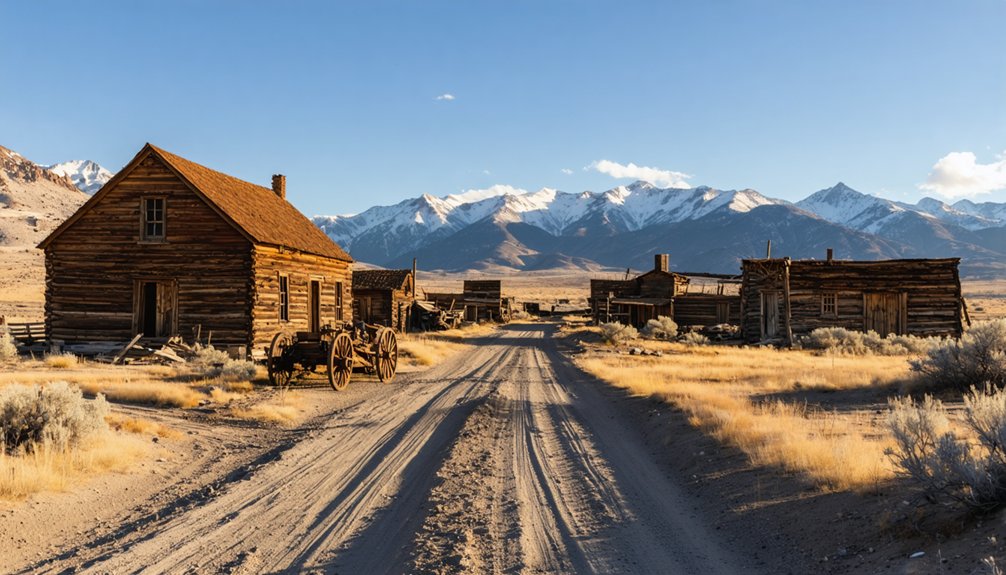
- 250 German colonists squatted on 160-acre plots, waiting for their promised federal land grant
- Joseph Davis constructed a strategic log cabin where Grape and Taylor Creeks merged
- Ula emerged as the valley’s English community center by 1871
You’ll find these confluences still mark where pioneers chose freedom over convention.
The Railroad That Came Too Late
By the time locomotives finally huffed their way up Clear Creek Canyon in 1872, Ula’s moment had already slipped past. The Colorado Central’s narrow gauge tracks reached Idaho Springs in June 1873, then Georgetown by August—but these destinations bypassed your ghost town entirely. While Black Hawk and Central City celebrated their December 1872 connection, Ula watched from the sidelines as the железная дорога carved through neighboring valleys.
You’ll find no railroad grade near Ula’s remains today. The community dissolution began when miners realized they’d picked the wrong canyon. By 1890, when the Colorado Central merged into the Union Pacific Denver & Gulf, Ula existed only in fading memories. The railroad decline that eventually shuttered those mountain lines never touched Ula—it had vanished decades before the trains stopped running.
Visiting the Historic Cemetery
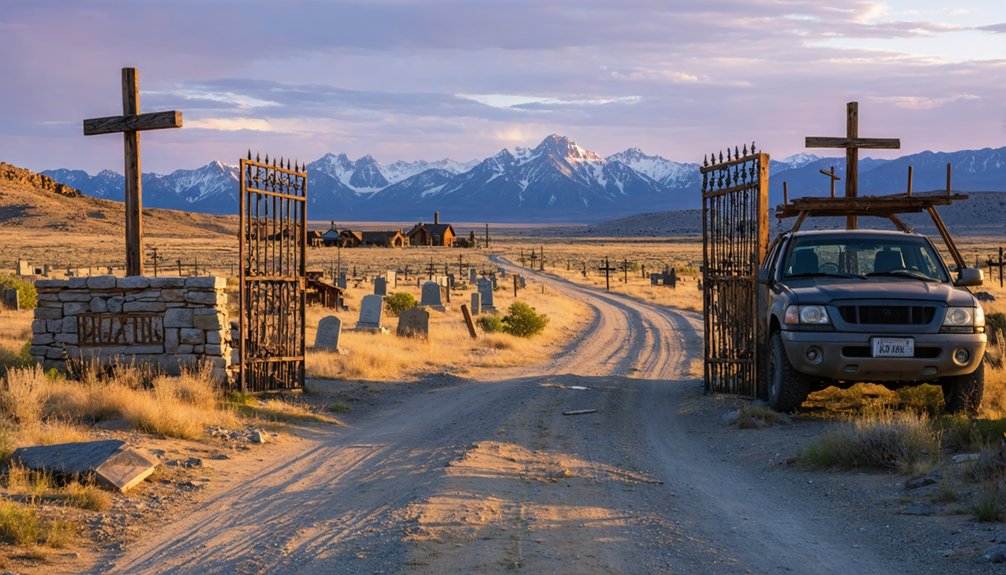
You’ll find Ula Cemetery at 2091 County Road 170, just north of Westcliffe, where lichgate arches of weathered wrought iron frame the entrance to consecrated ground older than the ghost town itself. Founded in 1872 on land the Kettle family donated, this pioneer burial ground holds Azor Palmer’s 1826 gravestone—the oldest marker in a cemetery where mountain wind whispers through prairie grass and Emily Dickinson’s words appear on weathered headstones.
Turn right from Main Street onto CO-69, and you’ll discover a place where rusted fences still protect the graves of ranchers and stagecoach drivers who carved their lives from these Colorado peaks.
Cemetery Location and Access
Finding Ula Cemetery requires a short but scenic drive northwest from Westcliffe, where the Sangre de Cristo Range towers over rolling hay meadows and working ranches. From Main Street, you’ll navigate through town onto Pines Road, covering roughly two miles before spotting the historic grounds on your right at 2091 County Road 170.
What you’ll find:
- Red, white, and blue stakes marking veteran burials across the property
- Land donated by the pioneering Kettle family in the 1870s
- Gravestones dating back to 1874, including Azor Palmer’s marker
The Ula Cemetery Inc nonprofit manages this sacred space, handling maintenance requirements like mowing, fencing, and road upkeep. With burial plot availability nearing capacity, they’ve established a perpetual care fund ensuring preservation for generations seeking this peaceful connection to Colorado’s frontier past.
Notable Burials and Markers
Look for the distinctive Woodmen of the World markers with their tree-shaped designs, axes, and motto “Dum Tacet Clamet”—though silent, he speaks. These symbolic headstone designs disappeared after the mid-1920s when costs became prohibitive.
The variation in gravestone materials tells its own story: simple wooden markers for infants like Dora Hugg (1899-1900) contrast with elaborate family monuments.
Preservation and Historical Significance
The Ula Cemetery stands as one of Colorado’s most significant historic burial grounds, predating the town itself by several years when it was established in 1872 on land donated by the Kettle family. You’ll find 840 memorial records here, with founding families like Kennicott, Menzel, and Falkenberg resting beneath the Sangre de Cristo peaks.
Today’s trustees face preservation challenges including:
- Maintaining fencing, roads, and aging memorials across the historic grounds
- Managing ongoing funding needs as the cemetery nears full capacity
- Balancing ranching heritage preservation with modern accessibility requirements
The Ula Cemetery Perpetual Fund addresses these maintenance costs, ensuring this freedom-loving community’s history endures. Four current trustees descend from founding families, keeping authentic Western traditions alive. Your tax-deductible donations support mowing, tree care, and memorial preservation for future generations.
Moccasin Bill Perkins and Local Legends
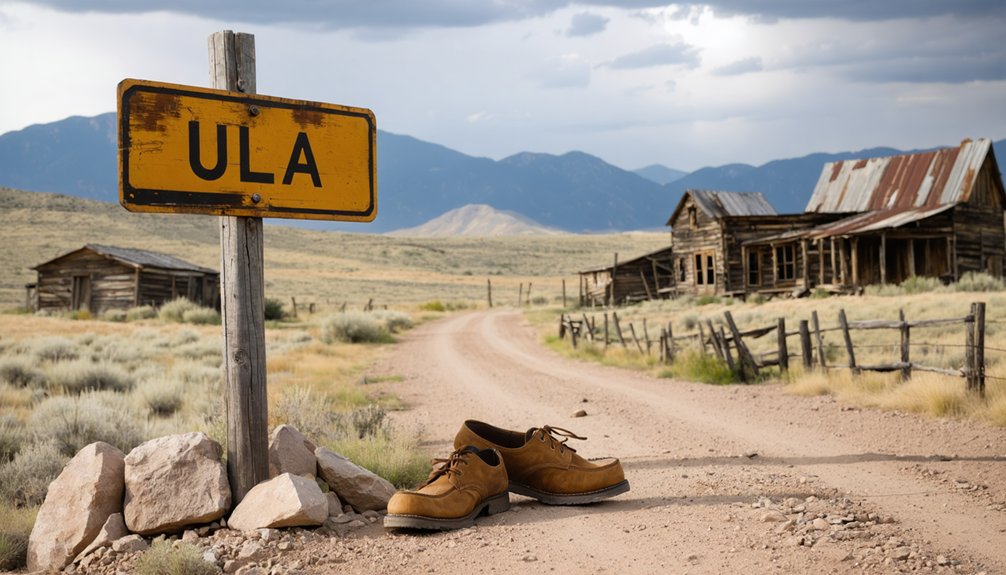
Wandering through Ula’s remnants, you’ll stumble upon tales of Moccasin Bill Perkins, a frontiersman whose legend looms as large as the bears he hunted across Colorado’s western slope. This Indiana-born wilderness seeker settled here by 1880, transforming the valley into his basecamp for expeditions that would cement his reputation.
Moccasin Bill’s big game hunts yielded 149 bears—including a 1,100-pound giant near Montrose whose hide toured St. Louis. He wasn’t just another tall tale, though. Records confirm his marksmanship trophies from county fairs and his five-year contract with Big Muddy Cattle Company, where he eliminated forty livestock-threatening predators.
Moccasin Bill’s Colorado adventures alongside Buffalo Bill Cody epitomized that vanishing frontier spirit—when men traveled solo into wilderness with nothing but a burro and unflinching nerve.
Best Time to Visit and What to Bring
Since Ula sits at high elevation in Colorado’s backcountry, you’ll find late spring through early fall (May through September) offers your best window for exploration.
Summer mornings deliver perfect light for the best photography spots—weathered cabins against wildflower meadows create unforgettable shots.
Pack essentials for unpredictable mountain weather:
- Layered clothing and waterproof gear for sudden afternoon thunderstorms
- Sturdy hiking boots for traversing rocky terrain and unstable structures
- Offline maps and emergency supplies since cell service disappears in these remote areas
Local dining options are nonexistent here, so bring ample food and water. I’ve learned the hard way that self-sufficiency matters in ghost town country. The isolation that drives you here demands respect and preparation.
Nearby Ghost Towns and Attractions to Explore
Your ghost town adventure doesn’t end with Ula—Colorado’s mining legacy sprawls across these mountains in dozens of abandoned settlements, each with its own tragic rise and dusty decline.
Rosita sits just minutes away, where Ula’s former rival once housed 1,500 souls and stole the county seat in 1878. You’ll find weathered storefronts and a brewery’s bones.
Head north to St. Elmo, Colorado’s best-preserved ghost town, where wooden buildings frame a Main Street straight from a Western film. These nearby historic sites offer more than crumbling cabins—the surrounding backcountry rewards you with hiking, ATV trails, and alpine lakes.
Recreational activities blend seamlessly with history here, letting you chase freedom through mountains that still whisper their silver dreams.
Frequently Asked Questions
Are There Any Camping Facilities Near Ula Ghost Town?
Your basecamp awaits in this mountain wilderness. While campgrounds availability near Ula remains limited, you’ll discover nearby amenities at dispersed sites requiring pack-in, pack-out freedom. Saint Elmo’s roadside camps offer the closest authentic ghost-town camping experience you’re craving.
Do I Need Permission From the Ranch Owner to Explore Ula?
You’ll need to research current landowner policies before visiting, as Ula’s access procedures depend on whether it sits on private or public land. Always respect property rights—contact local authorities or nearby ranches to confirm you’re exploring legally and freely.
Can I Metal Detect or Collect Artifacts at the Ula Site?
You can’t metal detect or collect artifacts at Ula without permits—metal detecting regulations protect Colorado’s ghost towns, and preservation concerns mean you’ll face serious fines. Stick to photography and exploration instead.
Are There Guided Tours Available for Ula Ghost Town?
No formal guided tours exist, but you’ll discover self-guided tours available through wandering Ula’s weathered remains independently. Historical signage throughout the site helps you piece together the town’s story while exploring at your own adventurous pace.
What Wildlife Should I Watch for When Visiting Ula?
You’ll encounter typical Colorado high-country wildlife near Ula—watch for elk, mule deer, and occasional bighorn sheep sightings on rocky slopes. Birdwatching opportunities abound with hawks, eagles, and mountain songbirds. Stay alert; you’re in their untamed territory.
References
- https://www.uncovercolorado.com/ghost-towns/rosita/
- https://en.wikipedia.org/wiki/Ula
- https://en.wikipedia.org/wiki/List_of_ghost_towns_in_Colorado
- https://www.coloradolifemagazine.com/printpage/post/index/id/172
- https://www.colorado.com/articles/colorado-ghost-towns
- https://www.youtube.com/watch?v=Ne9DH89C-nA
- https://visitwetmountainvalley.com/pioneer-cemeteries-of-custer-county/
- https://www.cpr.org/show-segment/as-the-blue-mesa-reservoir-dries-out-a-forgotten-small-town-reemerges/
- https://history.denverlibrary.org/sites/history/files/Place_Names_of_Colorado.pdf
- https://www.blm.gov/visit/animas-forks