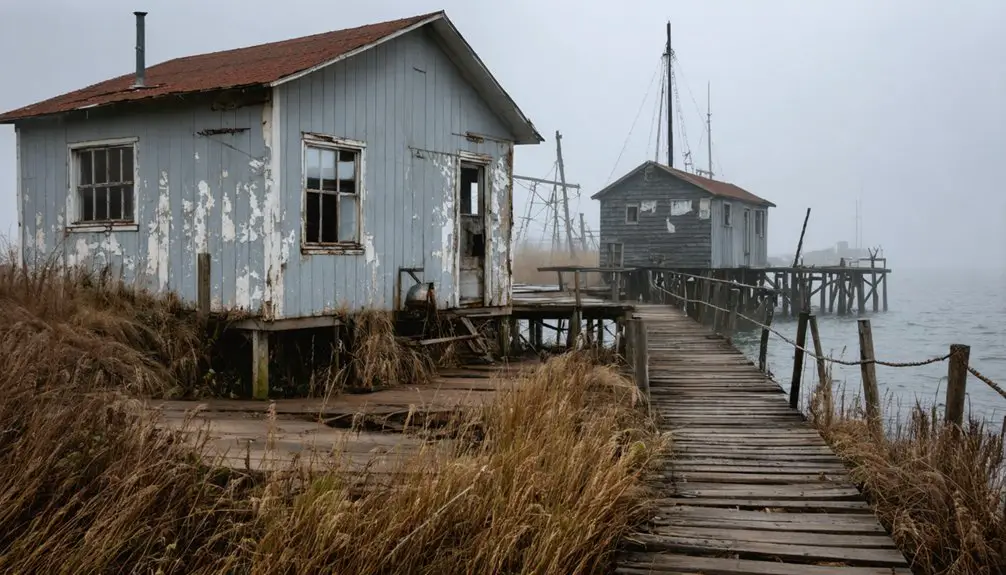
You’ll find Port Ulao along Lake Michigan‘s western shore, where James T. Gifford’s 1847 lumber empire once thrived on a thousand-foot wooden pier. Drive north from Milwaukee to discover weathered pilings jutting from the water and the cream city brick home where nine-year-old Charles Guiteau—future presidential assassin—witnessed this frontier town’s golden years. Coal-fired steamships and deforestation ultimately sealed Ulao’s fate, leaving behind skeletal remnants of Wisconsin’s vanished timber trade. The full story reveals engineering marvels and darker connections to American history.
Key Takeaways
- Ulao is located along Lake Michigan’s western shore, originally accessible via the first paved road to Grafton built in 1849.
- The ghost town’s main remnant is the skeletal remains of Gifford’s thousand-foot wooden pier extending into Lake Michigan.
- Visit the site where Charles Guiteau, President Garfield’s assassin, spent his childhood in a cream city brick home.
- Explore the steep bluffs where Gifford’s innovative log chute once transported cordwood down to waiting steamships at the pier.
- Plan for limited infrastructure; Ulao declined after coal-fired ships and Port Washington’s superior facilities made it obsolete.
The Rise and Fall of Port Ulao: A Brief History
When Captain Ulao’s namesake settlement took root along Lake Michigan’s western shore in 1847, few could’ve predicted the bustling port that would emerge from the dense Wisconsin wilderness. You’d have witnessed an economic boom as entrepreneurs constructed a thousand-foot wooden pier jutting into the lake, where steamships hungry for timber fuel docked regularly.
The community development accelerated with Wisconsin’s first paved road connecting Ulao to Grafton in 1849, followed by sawmills, grain elevators, and a post office serving residents through the 1850s. But freedom from obsolescence proved elusive. When steamships abandoned wood for coal after the Civil War and neighboring Port Washington built superior infrastructure, Ulao’s fate was sealed.
The forests vanished, the pier crumbled into Lake Michigan’s depths, and prosperity slipped away like sand through desperate fingers.
James T. Gifford’s Vision: Founding of a Lumber Town
When James T. Gifford arrived from Elgin, Illinois in 1847, he saw what others couldn’t—a heavily forested Indian village site that could transform into a thriving Great Lakes port. He moved with purpose, purchasing shoreline property and bluff land before constructing a thousand-foot wooden pier that jutted into Lake Michigan’s cold waters.
Within months, his operation was supplying cords of wood to passing steamers while a massive chute carried logs tumbling down the steep bluff from the inland forests above.
Establishing Port Ulao 1847
In 1847, James T. Gifford stood atop 140-foot clay bluffs and saw what others missed—a fortune in timber waiting to be harvested. You’d have recognized his genius immediately: European settlers desperately needed to clear their land, and wood-burning steamships crossing Lake Michigan needed fuel.
He established Port Ulao precisely where an old Indian village once thrived, creating a perfect exchange point. The lake bluff scenery provided natural harbor protection while the plateau above—flat as a carpenter’s bench—offered ideal space for operations.
Land clearing opportunities transformed into profit as farmers sold their timber and Gifford resold it as cordwood. He’d found freedom in entrepreneurship, building something from nothing on Wisconsin’s wild frontier.
Infrastructure and Early Operations
Gifford’s vision demanded infrastructure equal to his ambition. Within months of his 1847 arrival, he’d transformed raw wilderness into a functioning lumber port. You can still trace his investment timeline along the bluff—a thousand-foot wooden pier stretching into Lake Michigan’s depths, a gravity-defying log chute cascading down sheer cliffs, and Wisconsin’s first turnpike snaking westward.
His innovations conquered operational challenges that would’ve defeated lesser men:
- The pier provided direct steamship access for cordwood transactions
- The chute system delivered logs from bluff-top to lakeshore with remarkable efficiency
- The plank road connected interior forests to his lakeside enterprise
For three years, Gifford ruled this domain as patriarch and visionary. Then, mysteriously, he sold everything to Captain John Randolf Howe in 1850 and vanished from history.
The Guiteau Connection: From Ghost Town to Presidential Assassination
You’ll discover an eerie twist in Ulao’s history when you learn that Luther Guiteau arrived in 1850 to survey and plat the settlement for James T. Gifford, bringing his nine-year-old son Charles to live in a specially built cream city brick home.
The boy spent his formative years wandering these now-vanished streets until tragedy struck in 1855 when his mother died, prompting the family’s departure.
That child would grow up to become Charles Guiteau, the man who assassinated President James A. Garfield in 1881, forever linking this forgotten lumber town to one of America’s darkest political moments.
Luther Guiteau’s Survey Work
Standing at 782 Ulao Road today, you’re looking at the cream brick walls that sheltered one of American history’s most consequential childhoods. Luther Guiteau arrived here in 1850 from Freeport, Illinois, bringing land surveying techniques that would transform this wilderness into Port Ulao.
Hired by Gifford, he platted the addition that enabled the lumber empire’s expansion.
Luther’s surveying work created:
- A 1000-foot wooden pier jutting into Lake Michigan
- Carefully plotted lots for Port Ulao’s shipping hub
- Infrastructure supporting the region’s dominant lumber trade
This family influenced relocation brought nine-year-old Charles Guiteau to these shores. For five years, Luther’s surveys shaped the port’s destiny while his son absorbed the isolation. When Luther’s wife died in 1855, he abandoned everything—returning his children to Illinois and leaving behind the town his measurements had built.
Charles Guiteau’s Childhood Years
For five formative years, the cream brick house at 782 Ulao Road shaped the mind of a future assassin. Between 1850 and 1855, young Charles Guiteau attended the little schoolhouse here, displaying the psychotic tendencies he’d inherited from his mother Jane. Teachers noticed his excitable nature and inflated self-importance—traits that would eventually drive him to murder President Garfield.
When Jane died in 1855, she was buried in Ulao’s cemetery, and her fragile mental state passed like a dark inheritance to her son. Luther abandoned the town shortly after, taking nine-year-old Charles back to Freeport. An expert witness would later testify that Charles “was never anything but insane.” You’re standing where that madness took root.
Engineering Marvel: The Pier, Chute, and Wisconsin’s First Turnpike
While Great Lakes steamers belched black smoke across Wisconsin’s horizon in the late 1840s, James T. Gifford engineered an audacious timber to shore transfer system at Port Ulao. His thousand-foot wooden pier stretched into Lake Michigan’s depths, fed by a revolutionary trough-shaped chute cascading down the bluff’s face.
Gifford’s ambitious pier and gravity-fed chute revolutionized Port Ulao’s timber trade, bypassing Milwaukee’s treacherous sandbar through sheer engineering audacity.
You’d have witnessed:
- Farmers’ cordwood sliding downward through wooden channels
- Single steamers consuming 600 cords—ten acres’ worth
- Direct pier-side sales eliminating Milwaukee’s troublesome sandbar
The economic viability proved immediate. Gifford’s ambitions extended inland, too. He championed Wisconsin’s first turnpike, surfacing the roadbed with charcoal mixed with burned clay—a Roman technique he’d studied. That 1849 innovation connected Ulao westward through Grafton, transforming wilderness into commerce corridors where freedom-seekers could traverse unimpeded.
Why Ulao Disappeared: Coal, Deforestation, and Competition
Standing beside the weathered remnants of Ulao’s single pier, you’ll witness the physical evidence of the town’s fatal vulnerability—while coal-fired steamships rendered wood-fueled vessels obsolete in the late 1800s, severing Ulao’s economic lifeline at its source.
The skeletal infrastructure tells another story too: just miles north, Port Washington’s three massive piers created a shipping colossus that Ulao’s modest operation couldn’t match. Between technological revolution and brutal competition, this once-thriving timber port faced forces that would crush any frontier settlement built on a single, vanishing commodity.
Fuel Technology Shift
The ghost town you’re searching for vanished because the world stopped needing what it sold. Ulao thrived supplying cordwood to steamers crossing the Great Lakes, but coal’s arrival shattered that lifeline. You’ll find remnants of an era when wood to coal industry metamorphosis rewrote commerce overnight.
Consider what disappeared:
- Steamship fuel demand – Coal from Pennsylvania outcompeted local timber
- Charcoal production innovations – Kilns shifted toward chemical byproducts by 1902
- Regional timber resources – Deforestation left nothing to harvest or sell
The same forces that killed Ulao’s pier converted the Appleton Iron Company furnace in 1888. No wood meant no charcoal, no charcoal meant no business. Railroads carried coal cheaply from distant fields while Ulao’s forests stood empty, stripped bare by settlers and industry.
Port Washington’s Superior Infrastructure
Wood’s collapse as steamship fuel wasn’t Ulao’s only killer—geography sealed its fate. Port Washington built three massive piers that dwarfed Ulao’s single 1,000-foot wooden structure. You’ll find that superior harbor meant grain, passengers, and coal shipments bypassed Ulao entirely. The rail infrastructure shift favored Port Washington’s capacity over Ulao’s modest pier and beach chute.
Meanwhile, charcoal production decline gutted what remained of Ulao’s economy. Kilns along the Milwaukee, Lake Shore and Western Railway at Bear Creek and Marion fell silent by 1902—forests stripped bare, nothing left to burn. By 1888, Appleton Iron Company declared local timber “irreparable.” Port Washington’s modern facilities handled the future’s commerce while Ulao’s taverns, grain elevators, and dance halls stood empty, watching prosperity sail past.
What Remains Today: Five Surviving Structures
Scattered across what’s now Grafton, five weathered survivors from Ulao’s vanished era still stand as quiet witnesses to a community that once thrived along Lake Michigan’s shore.
You’ll discover these remnants of independence:
- The Guiteau Home at 782 Ulao Road—a brick structure harboring stories of original residents, including the family of President Garfield’s assassin, who fled after an 1855 tragedy
- The Grain Mill & Elevator—now transformed into Grafton Antique Mall, its architectural details of structures still revealing its railroad-era purpose
- Original farmhouse and dance hall—testaments to Ulao’s self-sufficient spirit
These buildings survived Port Washington’s commercial dominance, the railroad’s shifting economics, and Lake Michigan’s relentless erosion. They’re tangible proof that communities built on frontier grit leave marks time can’t completely erase.
Ghost Town Tavern: Dining Where History Lives
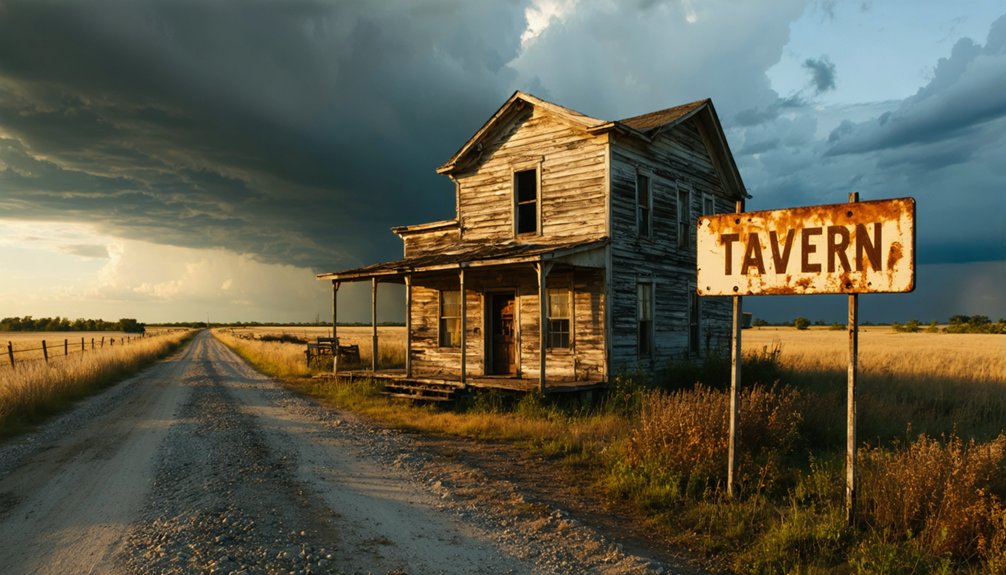
Where Ulao’s pulse once beat strongest—along those Chicago & Northwestern tracks that carried grain, gossip, and dreams—a 1902 tavern still pours drinks and serves Friday fish frys to anyone willing to venture down Ulao Road. Mike “Juice” Gannon’s establishment keeps Prohibition-era spirits alive, though nowadays the moonshine’s legal and the gambling’s just friendly banter.
The historic tavern decor tells stories: an 1878 plat showing Ulao’s vanished pier hangs beside artifacts from when Gifford paved Wisconsin’s first road with charcoal and clay. You’ll find seasonal menu highlights beyond those legendary fish frys—253 consecutive Fridays and counting. Call 262-376-9003 before you roll up to 990 Ulao Road, where Grafton meets Lake Michigan and ghost towns still feed the living.
Charles Guiteau’s Childhood Home and Other Historic Sites
Beyond the tavern’s Friday night fish frys and clinking glasses, Ulao harbors a darker thread in America’s tapestry—the cream city brick home at 782 Ulao Road where presidential assassin Charles Guiteau spent his formative years.
You’ll find this structure standing at the corner of Ulao Road and Highway C, one of five original buildings defying time’s erasure. The childhood home’s preservation offers a tangible connection to the high-strung boy who attended school here from ages nine to fourteen.
Ulao’s contribution to Guiteau’s life includes:
- Five formative years in this vanishing port town (1850-1855)
- The trauma of his mother Jane’s death and burial in Ulao
- His father Luther’s prominence in a doomed settlement
History doesn’t whisper here—it echoes through cream-colored brick.
Getting There: Directions and Route Planning From Milwaukee

The forty-mile journey north from Milwaukee to Ulao unfolds along Interstate 43, a ribbon of asphalt that traces Lake Michigan’s western shore through Ozaukee County’s rolling farmland.
You’ll exit near Port Washington, where contemporary transportation options to Ulao become limited—no buses, no trains, just your own wheels and determination. Follow County Highway LL eastward toward the lakeshore, where Ulao once thrived as a bustling pier community.
The historical context of Ulao’s development reveals why it’s vanished: shifting economic tides and harbor closures erased what locomotives and steamships built. Today’s GPS might struggle locating this ghost town, but local knowledge and historical maps guide you to where weathered foundations peek through wild grasses, whispering tales of prosperity lost.
Making the Most of Your Visit: What to See and Do
Standing at the crumbling threshold of Ulao’s past, you’ll find five weathered survivors from an era when steam whistles and sawdust perfumed the air. The Guiteau brick home stands sentinel on Ulao Road, its cream-colored walls harboring secrets of assassination and grief.
Ghost Town Tavern displays the 1878 plat map—tangible proof this wasn’t always wilderness reclaiming civilization.
- Grafton Antique Mall’s grain mill and elevator, where historic architecture merges with treasure hunting
- The dance hall and farmhouse, slowly surrendering to nature’s patient embrace
- Highway Q itself, Wisconsin’s first paved road, built from charcoal and clay
Community restoration efforts remain minimal here—Ulao belongs to wanderers seeking unvarnished truth rather than sanitized history.
Frequently Asked Questions
Are There Any Guided Tours Available of the Historic Ulao Sites?
No guided tours exist for Ulao’s historic sites, despite the historical significance of Ulao ghost town. You’ll explore independently, discovering local preservation efforts for Ulao sites through the five remaining structures, including Charles Guiteau’s childhood home, at your own pace.
What Are the Operating Hours for Ghost Town Tavern and Restaurant?
You’ll find Ghost Town Tavern welcoming you Monday-Thursday 2-9 PM, Friday-Saturday 11 AM-10/9 PM, and Sunday 11 AM-8 PM. Their restaurant menu offerings shine brightest with prime rib and seafood, served in an atmosphere where freedom meets flavor.
Is Parking Available Near the Beach to See the Pier Remnants?
You’ll find public parking options along Ulao Road near the scenic overlook views above the beach. The roadside provides freedom to explore, with Juice’s Ghost Town Restaurant offering adjacent parking for your pier remnant adventure.
Can Visitors Enter the Charles Guiteau Childhood Home for Tours?
You can’t tour Charles Guiteau’s childhood home—it’s privately owned. While preservation efforts maintain its historical significance as President Garfield’s assassin’s residence, you’ll need to contact Grafton officials to explore potential access arrangements for this cream brick landmark.
Are There Any Annual Events or Festivals Celebrating Ulao’s History?
No dedicated festivals celebrate Ulao’s vanished glory—though historic preservation efforts remain minimal. You’ll find the cultural significance of ghost town history preserved only through whispered tales and weathered remnants along Lake Michigan’s forgotten shore.