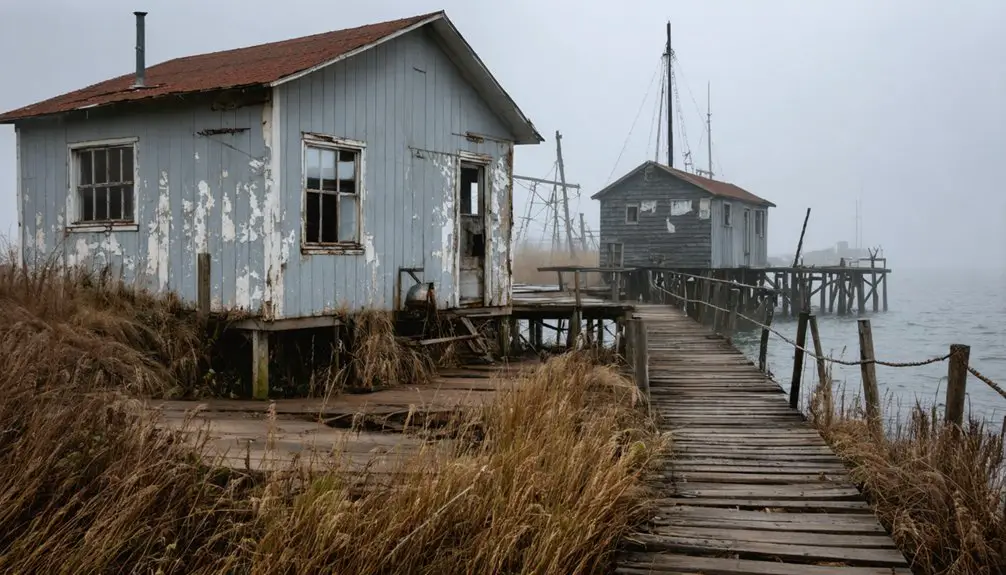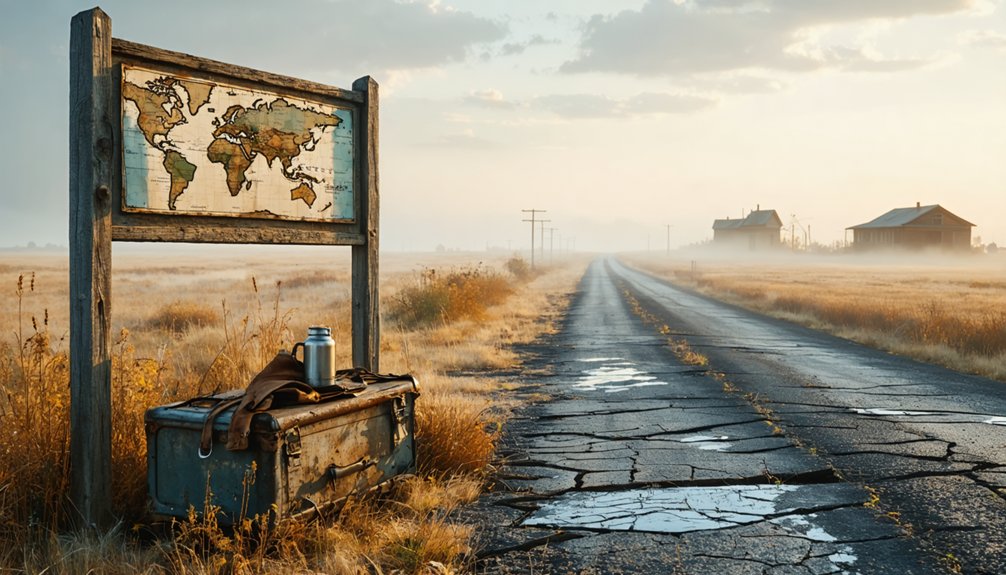
You’ll find Valley, Wisconsin on no official map, yet enough people remember its location along County Road F to suggest something once stood in those remote hills where the driftless region swallows forgotten settlements whole. From Madison, you’ll drive 120 miles through winding valleys before the pavement surrenders to gravel. High-clearance vehicles handle the final approach best, especially after spring floods reshape these seasonal roads. Your journey continues through Ridgeway’s haunted Military Road and deeper into Wisconsin’s most perplexing mysteries.
Key Takeaways
- Valley is located 120 miles from Madison in Wisconsin’s driftless region, accessible via County Road F turning to gravel.
- A high-clearance vehicle is essential for the remote gravel roads leading to Valley’s location.
- Spring floods and winter snow create seasonal challenges; plan your visit during summer or fall for better conditions.
- La Crosse is the nearest city at 35 miles away, providing a base for supplies and accommodations.
- Official records claim Valley never existed, so don’t expect marked sites or tourist infrastructure at the location.
The Mysterious Valley Ghost Town: What We Know and Don’t Know
Wisconsin’s ghost towns whisper stories of ambition and abandonment, but few vanish as completely from the historical record as Valley. You’ll find no census records, no land deeds, no newspaper archives—just fragments of memory passed down through oral histories. Unlike documented settlements such as Wildwood or Belmont, Valley exists in that unsettling space between fact and legend.
Some researchers compare it to the Doveland mystery, another unexplained phenomenon where witnesses swear they visited a town that official records claim never existed. What makes Valley particularly intriguing is the pattern: enough people remember it to keep the name alive, yet insufficient documentation exists to prove it. You’re left chasing shadows through Wisconsin’s cutover lands, where entire communities vanished after logging booms collapsed. The allure of these mysteries has drawn enigma enthusiasts seeking to unravel the truth behind towns that seemingly disappeared without a trace. Wildwood itself, a booming lumber town established in spring 1882, lasted only about 20 years before vanishing with very little evidence remaining today.
Getting There: Routes and Roads to Wisconsin’s Forgotten Places
Whether Valley truly existed matters less than the journey itself once you’ve committed to finding it. From Madison, you’ll drive 120 miles through Wisconsin’s driftless region via I-90 and WI-14, reaching Viroqua before turning onto County Road F.
The destination’s reality fades against the pull of the search—commitment transforms uncertainty into purpose worth following.
The final miles shift from pavement to gravel, where remote road conditions demand attention and high-clearance vehicles.
Seasonal driving challenges shape your adventure considerably. Spring floods close low-lying routes through Vernon County valleys, while November through April brings snow that renders county roads impassable without chains.
La Crosse offers the nearest approach at 35 miles, though fuel stations disappear past Westby. The route passes near Cheyenne Valley, a settlement known around 1855 that persisted into the 1930s before being incorporated into Dodgeville.
Historical maps from the Wisconsin Historical Society become navigation tools here, guiding you through terrain that’s deliberately remained forgotten. Wisconsin ranks among the top 10 states for ghost towns with hundreds of abandoned settlements scattered across its landscape.
Ridgeway’s Haunted Military Road: Your First Stop
Before Valley materializes from legend, your journey demands a stop where Wisconsin’s ghost stories anchored themselves in documented history. Ridgeway proudly claims “Home to the Famous Ghost” on its water tower—and paranormal activity details stretch back to the 1840s along Old Military Ridge Road. This wasn’t folklore invented around campfires; miners and travelers documented encounters with a shapeshifting entity that stole wagon wheels, rode backwards as a headless horseman, and reportedly murdered travelers.
Historical context significance runs deep here. When 10,000 immigrants yearly flooded southwestern Wisconsin’s lead mines, this wild frontier town hosted daily violence that overwhelmed understaffed law enforcement. Whether the ghost emerged from actual murders at Sampson’s Saloon or served as manufactured deterrent against troublemakers, you’ll drive the same route—now Highway 151—where witnesses reported sightings across 150 years. Welsh and Cornish lead miners who arrived in the area may have brought their own phantom legends from their home island, where contemporary reports of similar entities surfaced during the same period. The catastrophic 1913 fire that swept through downtown on May 1st caused $3 million in damage by today’s standards, yet the ghost stories persisted through Ridgeway’s rebuilding.
Wildwood Lumber Town: Tracking Down the Vanished Settlement
From Ridgeway’s spectral horseman, the narrative of Wisconsin’s disappearing places shifts northward to the vanished lumber camps where entire communities rose and fell within a single generation.
You’ll find Wildwood’s traces within the Wild Rivers Legacy Forest, where St. Croix Land and Lumber established operations in 1890. This wasn’t gentle harvesting—five sawmills devoured old growth forests at capacities reaching 45,000 board feet daily. Winter camps sent logs thundering down the Wolf River toward mills in Oshkosh.
Five sawmills consumed 45,000 board feet daily—industrial appetite that transformed primeval forest into memory within decades.
The environmental impact transformed 64,600 acres from primeval wilderness into cutover wasteland. The Wolf River’s importance as a driving stream enabled lumber operations to transport massive quantities of logs downstream, where they were sorted in Boom Bay before continuing to manufacturing centers. When the timber vanished, so did the town. Grand Plank Hotel, St. Ambrose Catholic Church, bustling meat markets—all abandoned by the Depression.
Today, you’ll need determination to locate foundation stones among regenerated forest where lumberjacks once walked. The northwoods economy revived through tourism after World War II, transforming these cutover landscapes into recreational destinations.
The Doveland Enigma: Investigating Wisconsin’s Strangest Disappearance
Unlike Wildwood’s documented sawmills and census records, Doveland presents researchers with something far more unsettling: a town that dozens remember visiting but which officially never existed. You’ll find no maps, no archives, no foundations near Clam Lake where it supposedly stood.
Yet personal accounts of Doveland’s existence remain remarkably consistent—visitors describe a close-knit community with local businesses, military families, and children playing in northern Wisconsin forests throughout the 1980s. Some even possess souvenir mugs and t-shirts. The phenomenon mirrors obedience to authority, where individuals’ perceptions and actions can be dramatically influenced by what they believe to be legitimate institutional guidance.
The competing theories on Doveland’s disappearance range from collective false memory to government erasure of a Project Sanguine support town. Skeptics note that historical mentions of Doveland only emerged after 2015, casting doubt on the town’s authenticity. Whether you’re investigating the Mandela Effect or tracking classified military operations, Doveland’s complete absence from official records makes it Wisconsin’s most perplexing ghost town mystery.
Belmont and the Mormon Settlements: Failed Dreams of Southern Wisconsin
You’ll find Wisconsin’s territorial ambitions collided with religious fervor in the 1830s and 1840s, when John Atchison’s Belmont failed spectacularly as a capital contender—legislators literally slept on floors in unfinished buildings before fleeing to establish Madison instead.
Meanwhile, James Jesse Strang was building his own empire at Voree near Burlington, where he unearthed brass plates under an oak tree in 1845 and declared himself Joseph Smith’s successor. His “Garden of Peace” became a polygamous kingdom with its own newspaper and temple plans, while George Miller’s Mormon loggers carved settlements along the Black River to float timber down the Mississippi for Nauvoo’s grand constructions.
Belmont’s Brief Capital Bid
When Wisconsin Territory’s legislators gathered in 1836, they made an ambitious gamble by selecting Belmont as their capital site. The decision reflected pure economic motivations—lead mining boomed here, and fortunes seemed inevitable.
You’ll find this capital failure unfolded quickly through several revealing moments:
- October 1836: First legislative sessions convened in Belmont’s hastily constructed capitol
- Green lumber construction: Builders used unseasoned wood, showing their rushed optimism
- Single legislative session: The temporary building hosted just one term before abandonment
- Rapid relocation: Legislators departed for Madison, leaving Belmont’s dreams behind
The lead region’s wealth couldn’t compensate for Belmont’s isolation and inadequate infrastructure. Today, you’re exploring remnants of territorial ambition—where politicians bet on mineral riches rather than sustainable governance, and lost everything.
Strang’s Voree Polygamy Kingdom
While Belmont’s politicians abandoned their territorial capital dreams, James J. Strang built his own kingdom at Voree near Burlington. This self-proclaimed prophet founded a settlement promising divine dispensation through translated plates he’d discovered under an angel’s guidance. You’ll find the Hill of Promise still marks where witnesses watched him unearth ancient records.
Initially opposing plural marriage, Strang reversed course in 1851, claiming divine revelation. Financial limitations kept polygamy rare—only five families practiced it among thousands. His authoritarian rule and controversial marriages sparked violence. Disaffected followers assassinated him on Beaver Island in 1856, ending his eight-year reign. The community dissolved quickly afterward, leaving behind another failed utopian experiment in Wisconsin’s contested frontier.
Northern Logging Towns: Dunville and Trout City Ruins
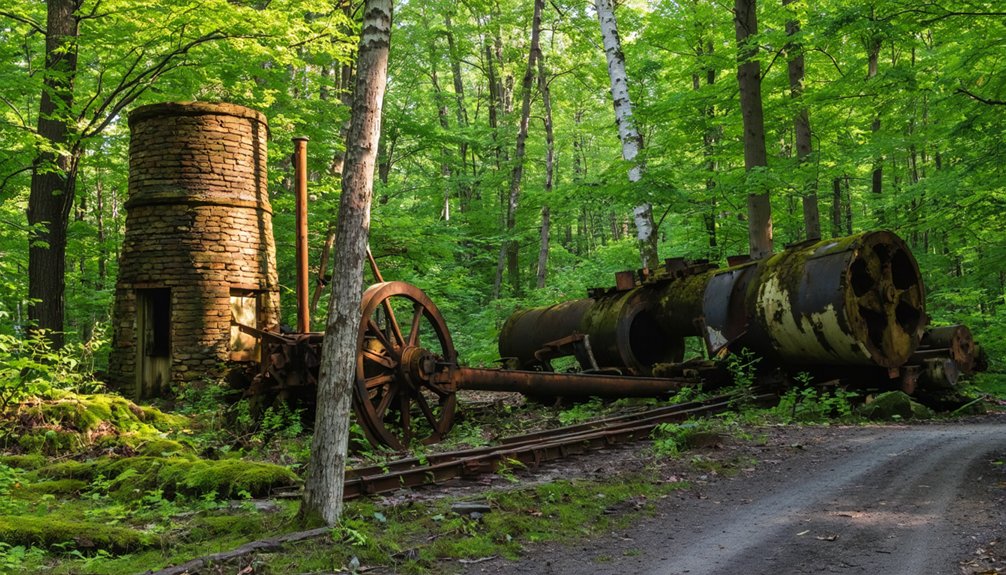
The towering white pines that once dominated Wisconsin’s northern forests drew thousands of loggers to remote camps where men worked brutal winter hours far from civilization. You’ll find archaeological excavations revealing lumber camp relics at sites like Dunville and Trout City, where entire communities vanished after the timber ran out.
These ghost towns left distinctive traces:
- Earthen berms outline where bunkhouses once stood, visible in aerial photographs
- Garbage dumps and outhouse pits yield bottles, tools, and pottery fragments
- Dunville’s population of 135 disappeared when Mississippi River Logging Co. closed operations
- Drag roads, dams, and spillways mark the infrastructure of Wisconsin’s 1840s-1900s pinery era
The cutover land reveals both Indigenous burial mounds and logging-era ruins—layers of history reclaimed by wilderness.
Essential Supplies and Safety Tips for Ghost Town Exploration
Before you set off for Valley’s abandoned streets and crumbling structures, you’ll need more than curiosity and a sense of adventure. These remote sites lack cell service, emergency facilities, and maintained pathways—what you bring determines whether you’ll walk away with photographs or injuries.
Your survival kit should address three critical concerns: protecting yourself from environmental hazards, traversing safely through unfamiliar terrain, and preparing for emergencies when help isn’t coming.
Essential Gear and Equipment
Exploring Valley’s abandoned structures demands specialized equipment that separates curious tourists from prepared adventurers. Personal protective equipment maintenance isn’t optional—it’s your lifeline when traversing unfamiliar terrain where rusted nails and crumbling floors await your next step.
Your essential gear checklist:
- Cut-resistant gloves and sturdy boots protect against hidden dangers lurking in debris-filled rooms where time has eroded all safety standards.
- Dual lighting systems including headlamps and backup flashlights ensure you’ll never face total darkness when exploring windowless interiors.
- Multi-tools and pruners clear overgrown pathways blocking century-old doorways to Valley’s forgotten spaces.
- Emergency supplies like water, energy bars, and space blankets provide independence when you’re miles from civilization.
Freedom demands preparation—pack accordingly.
Wilderness Safety Precautions
Your backpack holds the right tools, but Valley’s wilderness presents dangers no multi-tool can fix. Download offline maps before you lose cell service—GPS satellites don’t care about your adventure timeline. Carry a compass and physical maps as backup navigation techniques when technology fails you in Wisconsin’s backcountry.
Stock your first aid essentials: bandages for rusty nail punctures, antiseptic for cuts from broken glass, and that N95 respirator when you’re breathing decades of decay. Make noise on overgrown trails to avoid surprising black bears reclaiming Valley’s abandoned lots. Never explore solo—witnesses matter when floors collapse beneath you.
Tell someone your route and return time. The county Sheriff won’t search automatically if you vanish into history’s forgotten corners.
Best Times to Visit: Seasonal Considerations for Your Journey
When planning your expedition to Valley and Wisconsin’s forgotten settlements, timing proves as critical as your route selection. Each season shapes your access to these abandoned places differently.
Seasonal timing determines your path to Wisconsin’s ghost towns as much as any map or compass ever could.
Seasonal considerations for ghost town exploration:
- Summer (June-August) – You’ll find prime conditions with dry roads, long daylight hours, and mild temperatures perfect for photographing ruins without foliage obstruction.
- Fall (September-October) – Ideal fall foliage viewing transforms your journey into a spectacular drive, though prepare for shorter days as October wanes.
- Winter (November-March) – Many sites become isolated by snow and ice, requiring snowmobiles to reach remote locations along impassable dirt roads.
- Spring (April-May) – Spring mud season challenges create treacherous access, with flooded fields and pitted roads delaying exploration until summer arrives.
Frequently Asked Questions
Are There Any Guided Ghost Town Tours Available in Wisconsin?
You’ll find guided ghost tours throughout Wisconsin’s cities, but for authentic ghost *towns*, you’re better off exploring self-guided tours. Contact local historical societies—they’ll share the real stories and unmarked locations that organized tours won’t reach.
The best times to explore Wisconsin ghost towns are during the fall when the colorful foliage adds an eerie beauty to your adventures. Early mornings often provide a quiet atmosphere perfect for immersing yourself in the rich history of these forgotten places. Be sure to bring a camera; the haunting landscapes often offer stunning photography opportunities that bring these ghost towns back to life.
As you venture into ghost towns near Valley, Wisconsin, you’ll discover remnants of a once-thriving community. Abandoned buildings and overgrown paths tell tales of the past, inviting exploration and reflection. Each step in these quiet towns unveils secrets waiting to be uncovered, making it a truly unique experience for history enthusiasts and adventure seekers alike.
Can I Camp Overnight Near These Ghost Town Locations?
You’ll find excellent overnight camping near Wisconsin’s ghost towns, with campfires permitted at established sites and portable restrooms available. Kickapoo Valley Reserve and Wyalusing State Park offer convenient bases for exploring abandoned settlements throughout the Driftless region’s haunting landscape.
Do I Need Special Permits to Explore These Abandoned Sites?
You’ll need to research local regulations before exploring, as property ownership varies. While these sites hold historical significance, many remain private property. Always respect posted signs and seek permission—trespassing charges can limit your freedom to explore.
Are Any Buildings Safe to Enter at These Ghost Towns?
Want to explore safely? You’ll find Pendarvis offers guided tours through structurally sound buildings. Most Valley-area ghost towns lack standing structures entirely. Without proper structural integrity assessment and risk mitigation strategies, abandoned buildings remain dangerously off-limits.
What Photography Equipment Works Best for Ghost Town Documentation?
You’ll want a sturdy DSLR with a wide angle lens to capture Valley’s decaying structures and sweeping abandonment. Drone photography reveals the town’s ghostly layout from above, while prime lenses document intricate details of forgotten lives.
References
- https://www.ridgewaywi.gov/community/page/village-history
- https://westernwisconsin.news/ghost-town-the-wildwood-story/
- https://usghostadventures.com/haunted-stories/the-legend-of-doveland-wisconsin-the-vanishing-town/
- https://pbswisconsin.org/news-item/southern-wisconsins-ghost-towns-leave-behind-vital-stories/
- https://en.wikipedia.org/wiki/List_of_ghost_towns_in_Wisconsin
- https://www.uwsp.edu/wp-content/uploads/2023/11/leaf-changing-of-the-land-lesson-5.pdf
- https://grantcountyhistory.org/wp-content/uploads/2016/01/GhostTownsGrantCountyTLundeen.pdf
- https://wnanews.com/wp-content/2024BNC/2024_WNA_Foundation_Better_Newspaper_Contest/Reporting-Writing/13_Feature_Story_(Non-profile)_(E)/Third_Place_Sun_Argus_3/Attachment_01.pdf
- http://shunpikingtoheaven.blogspot.com/2016/05/a-wisconsin-ghost-town.html
- https://blog.batchgeo.com/ghost-towns/