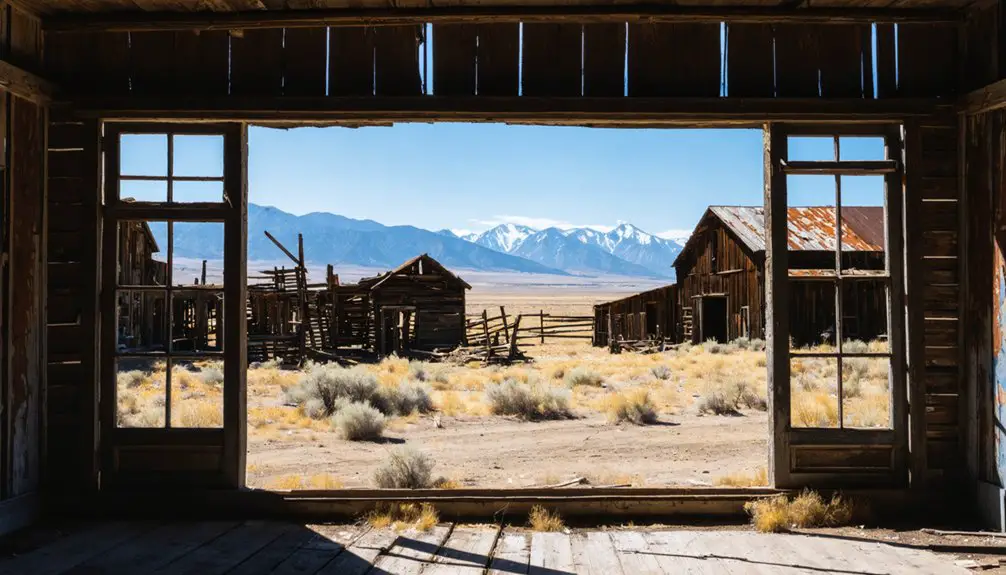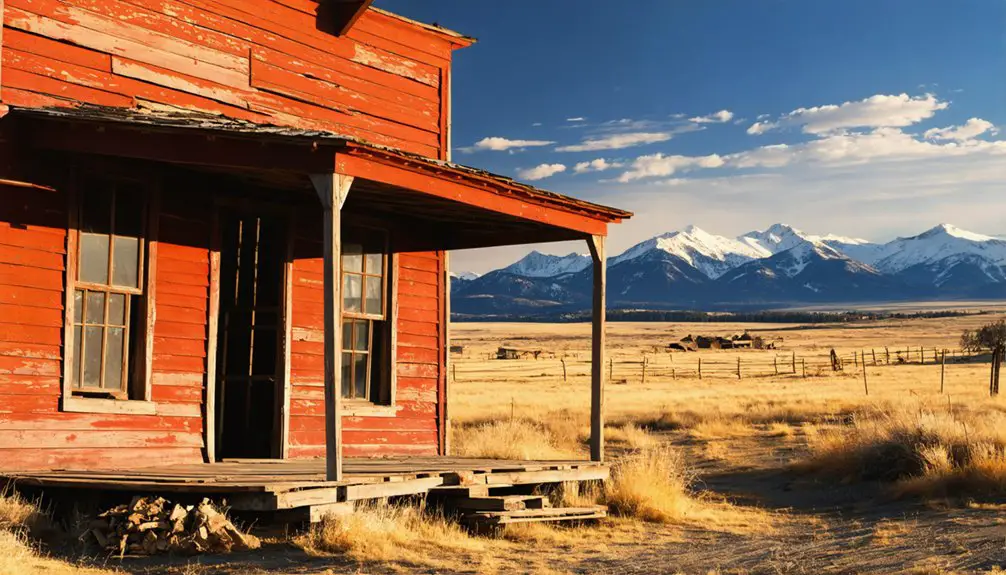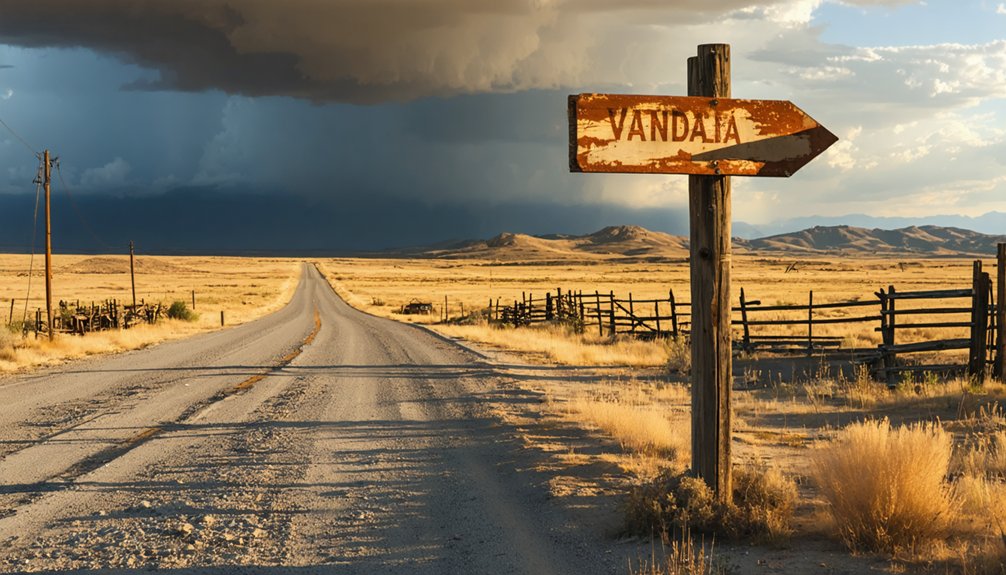
Planning your Vandalia ghost town road trip requires strategic navigation through Montana’s backcountry, as GPS systems won’t locate this submerged settlement beneath Canyon Ferry Dam’s waters. You’ll need to contact local ranchers or the historical society for current route information, then prepare for primitive two-track paths with emergency supplies. The ideal exploration window runs Memorial Day through Labor Day, when you can anchor your circuit at Bannack State Park before venturing to more remote sites where brick kilns once roared and frontier dreams collapsed.
Key Takeaways
- Vandalia doesn’t appear on modern GPS systems; contact local historical societies or nearby ranchers for current route information and conditions.
- Most of Vandalia lies submerged beneath Canyon Ferry Dam reservoir; only the 1913-1917 Bureau of Reclamation Dam remains visible.
- Road conditions vary dramatically by season; carry emergency supplies and expect primitive two-track paths rather than maintained highways.
- Combine Vandalia with preserved ghost towns like Bannack State Park, Virginia City, and Nevada City for a comprehensive circuit.
- Visit between Memorial Day and Labor Day when roads are most accessible and other Montana ghost town attractions are open.
The Forgotten Story of Vandalia’s Origins and Demise
When the Great Northern Railway pushed its Hi-Line across Montana’s northern plains in the early 1900s, it scattered settlements like seeds along its tracks—some took root, but most withered. Vandalia sprouted in 1904, possibly named after vandals who raided a railway survey camp. You’ll find it built its reputation on brick manufacturing, supplying materials for Montana’s public buildings.
The town peaked at 150 souls in 1930, but homestead failures crushed those frontier dreams. Settlers discovered horrible soil and insufficient water—conditions that doomed any agricultural decline was inevitable. By the 1920s, homesteaders bailed out. The population crashed to 66 by 1950. Today, you’re exploring what they left behind: abandoned schoolhouses, empty homes, and the stubborn remnants of a community that couldn’t overcome nature’s harsh verdict.
What Remains at the Vandalia Site Today
You’ll find precious little when you reach Vandalia’s former location—the Bureau of Reclamation’s Canyon Ferry Dam project fundamentally altered this landscape.
Where a bustling settlement once stood, the dam’s reservoir now submerges most traces of the town beneath its waters. Even the bridge that connected Vandalia to the surrounding area was removed during construction, erasing one of the community’s last physical links to the modern world.
Bureau of Reclamation Dam
Three miles west of where Vandalia once thrived, the Bureau of Reclamation Dam stands as the most substantial remnant of the area’s engineered past. You’ll find a reinforced concrete slab and buttress weir-type structure stretching 2,350 feet across the Milk River, its movable crest gates still controlling water flow after more than a century.
The dam’s construction details reveal ambitious early-twentieth-century engineering—built between 1913 and 1917, it rises 32 feet to redirect precious water resources across Montana’s arid landscape. Unlike the vanished settlement nearby, this infrastructure hasn’t surrendered to time. The dam’s ongoing operations continue diverting water for irrigation, maintaining its original purpose while you explore the silent traces of Vandalia’s disappeared community. It’s functional history you can witness firsthand.
Bridge Removal and Absence
While the Bureau of Reclamation Dam persists in its century-long duty, the 1910 steel truss bridge that once connected Vandalia’s scattered ranching community has vanished entirely from the landscape.
The Pennsylvania through truss that carried County Road 411 across the Milk River for 79 years met its end in 1989, replaced by modern infrastructure that rerouted transportation networks away from this historic crossing. Today, you’ll find no trace of the pin-connected spans that once facilitated agricultural commerce and linked isolated homesteads to valley resources.
This complete removal represents more than infrastructure modernization—it marks a profound loss of community identity. The disappearing bridge joins Vandalia’s schoolhouse, post office, and settler cabins in erasure, leaving only the dam as tangible evidence of this settlement’s brief existence.
Driving Directions and Route Options to Vandalia
Reaching Vandalia requires careful navigation through Montana’s backcountry, as this remote ghost town doesn’t appear on most modern GPS systems. You’ll need to rely on detailed topographic maps and local knowledge to find your way along unmarked county roads that wind through vast prairies and rugged terrain.
Road conditions vary dramatically throughout the year, transforming from dusty tracks in summer to impassable mud channels during spring thaw. Seasonal accessibility becomes your primary concern—winter snows can block routes entirely, while summer thunderstorms create treacherous washouts.
Your best approach involves connecting with nearby ranchers or contacting the local historical society for current route information. Expect primitive two-track paths rather than maintained highways, and always carry emergency supplies for this genuine wilderness adventure.
Bannack State Park: Montana’s Premier Ghost Town Destination
While Vandalia offers authentic solitude, nearby Bannack State Park presents Montana’s most celebrated ghost town experience, where over 60 original buildings stand frozen in time along weathered wooden boardwalks.
You’ll walk the same dusty Main Street where Sheriff Henry Plummer’s outlaw gang once operated before vigilante justice ended their reign in 1864, passing through structures that haven’t been restored but carefully preserved in their natural state of decay.
Each July, Bannack Days transforms the silent streets into a living history spectacle, where costumed interpreters demonstrate frontier skills inside the blacksmith shops, hotels, and saloons that miners abandoned when the gold ran out.
Historic Buildings and Structures
Approximately sixty weathered structures stand sentinel along Bannack’s main corridor, their log and frame construction sagging beneath Montana’s relentless skies. You’ll find most state-owned and unoccupied, meaning you’re free to explore without barriers or guided tours dictating your pace. These architectural styles span Montana’s formative years, from the 1876 Hotel Meade—originally the territory’s second brick courthouse—to structures built during the town’s decline.
Key structures you can’t miss:
- First Montana Jail – Original 1870s lockup with replica gallows
- Masonic Temple – Late-period architectural manifestation
- Hendricks/Apex Mill – Rare 1918 cyanide processing facility
- Methodist Church – Commemoration to fading hopes
Preservation rather than restoration defines Bannack’s philosophy, leaving restoration challenges visible. Walk deserted streets experiencing authentic decay—no sanitized Disney version here.
Bannack Days Living History
Each July, Bannack sheds its desolate silence for one explosive weekend when buckskin-clad reenactors, creaking wagons, and black-powder gunfights transform Montana’s premier ghost town into a thundering 1860s gold camp. You’ll witness pioneer cooking demonstrations over open fires, smell fresh-baked bread from Hotel Meade starting at 7am, and duck for cover during old west gunfight reenactments on Main Street.
Wander through Hangman’s Gulch where quilters work vintage looms, candlemakers dip wicks, and lace-makers demonstrate forgotten crafts. Gold panning lessons let you chase that prospector dream yourself.
Sunday morning brings an authentic church service echoing through weathered walls. The 2026 celebration marks fifty years of this living history tradition—held the third weekend each July from 9am until late afternoon both days.
Virginia City and Nevada City Living Museums
When gold erupted from Alder Gulch in 1863, fortune-seekers swarmed the area so rapidly that their settlements stretched fourteen miles along the creek, forming what locals called Fourteen Mile City. Virginia City became Montana’s territorial capital while Nevada City nearly vanished to dredge mining before the Bovey family tackled monumental preservation challenges starting in the 1940s.
Gold fever transformed fourteen miles of Montana creek into a boomtown capital, then near-ghost town, before dedicated preservationists rescued its frontier legacy.
Today you’ll discover authentic frontier life through:
- 100+ historic buildings housing artifacts rivaling the Smithsonian’s collection
- Resident interpreters demonstrating blacksmithing, baking, and Gold Rush-era trades
- Free museums displaying weapons, photographs, and geological specimens
- Sensory experiences with period music machines and hands-on exhibits
The Montana Heritage Commission now manages these living museums, where professionally trained historians help you explore settlements built atop $2.5 billion worth of gold.
Granite and Rimini: Silver Mining Ruins Near Helena
While Virginia City’s gold camps sprawled along valleys where thousands could stake claims, Montana’s silver boom sent miners scrambling up near-vertical mountainsides where fortunes hung suspended between clouds and catastrophe.
Granite exemplifies this vertical ambition. You’ll find detailed mining operations etched across these slopes—shafts plunging 1,500 feet deep, aerial trams stretching record distances, and a 100-stamp mill that once processed ore yielding 1,700 ounces of silver per ton. The town exploded to 3,000 souls supporting 18 saloons and even a bobsled run.
Then came the impact of silver crash in 1893. Population collapsed from 3,200 to 140 within twelve months. Today you’ll explore Miners Union Hall ruins and scattered foundations—monuments to dreams that evaporated when Washington repealed the Sherman Silver Purchase Act.
Creating a Multi-Stop Ghost Town Itinerary

Montana’s ghost town circuit demands strategic planning—these skeletal settlements scatter across 147,000 square miles of mountains, prairies, and badlands where a single wrong turn can add 200 miles to your odometer. Road trip planning for self guided explorations requires understanding terrain shifts and fuel availability between sites.
Essential Route Components:
- Southwest Loop Foundation – Anchor your journey at Bannack State Park (1862), then progress through Virginia City and Nevada City along Alder Gulch’s preserved boardwalks
- Mountain Detours – Navigate to Garnet Ghost Town at 6,000 feet via BLM-managed backroads, continuing to Granite Ghost Town State Park near Philipsburg
- Northern Extensions – Add Vandalia and Glentana through Valley County’s remote gravel networks off Highway 2
- Final Stop – Conclude at Marysville’s semi-ghost streets beneath Mount Belmont’s rugged silhouette
Best Times to Visit and What to Bring
The sweet spot for ghost town exploration arrives between Memorial Day and Labor Day, when Virginia City’s boardwalks bustle with interpreters in period dress and Bannack’s 50-plus structures stand open for self-guided wandering from 10 a.m. to 6 p.m. daily. These seasonal considerations matter—winter transforms Vandalia’s county roads into impassable snowdrifts requiring snowshoes or snowmobiles.
Pack equipment recommendations that match Montana’s temperamental mountains: layered clothing, sturdy hiking boots for crumbling foundations, and rain gear for surprise thunderstorms. Toss binoculars, flashlights for evening ghost tours, and navigation tools in your daypack. Your vehicle needs capability for rough backcountry routes. Bring sunscreen, water, snacks, and cash—Vandalia doesn’t have ATMs. Most importantly, pack respect for boundary signs protecting these fragile historical remnants.
Frequently Asked Questions
Are There Any Guided Tours Available Specifically for Vandalia Ghost Town?
No guided tours exist for Vandalia Ghost Town. You’ll find complete freedom exploring this remote site independently through self-guided walking tours. Unlike popular Montana ghost towns offering group tour options, Vandalia remains gloriously uncommercial and untamed.
What Camping or Lodging Options Exist Near the Vandalia Site?
You’ll find nearby campgrounds like Milk River Park just seven miles away, while Glasgow’s local bed and breakfasts offer cozy alternatives six miles from Vandalia. Free dispersed camping exists throughout the region for ultimate exploration freedom.
Is Permission Required to Access the Vandalia Dam and Surrounding Area?
Like forgotten keys opening hidden paths, Vandalia dam accessibility depends on Vandalia dam ownership. You’ll need permission for dam areas, but the Wildlife Management Area’s publicly accessible. Always respect posted signs and seek explicit landowner consent for unmarked lands.
What Wildlife or Safety Hazards Should Visitors Expect Around Vandalia?
You’ll encounter bears, mountain lions, and coyotes in Vandalia’s wild terrain. Watch for rattlesnake sightings near riparian areas and abandoned mine shafts from old homesteads. Chronic Wasting Disease affects local deer and elk populations, so stay alert and prepared.
Can Artifacts Be Legally Collected From Vandalia or Other Ghost Towns?
Like grasping at echoes of the past, you can’t legally collect artifacts from Vandalia. Relic preservation guidelines and private property concerns bind these ghost towns—respecting history’s fragile remnants safeguards freedom for future explorers to discover their stories.