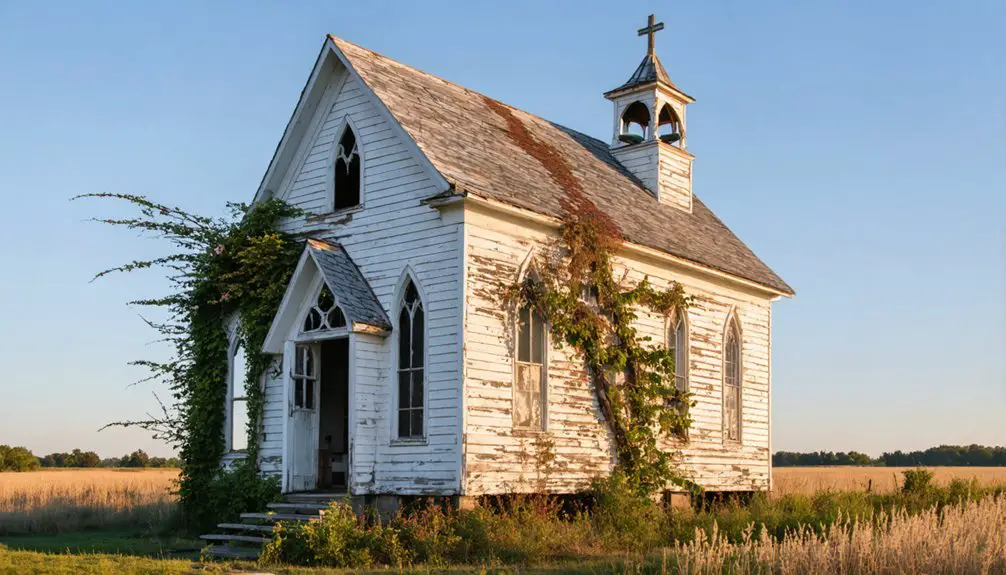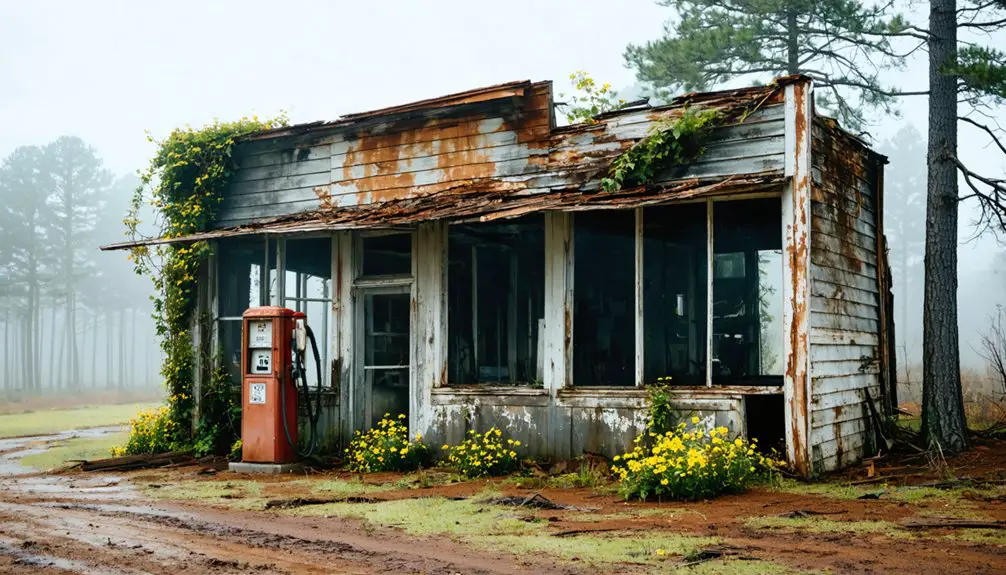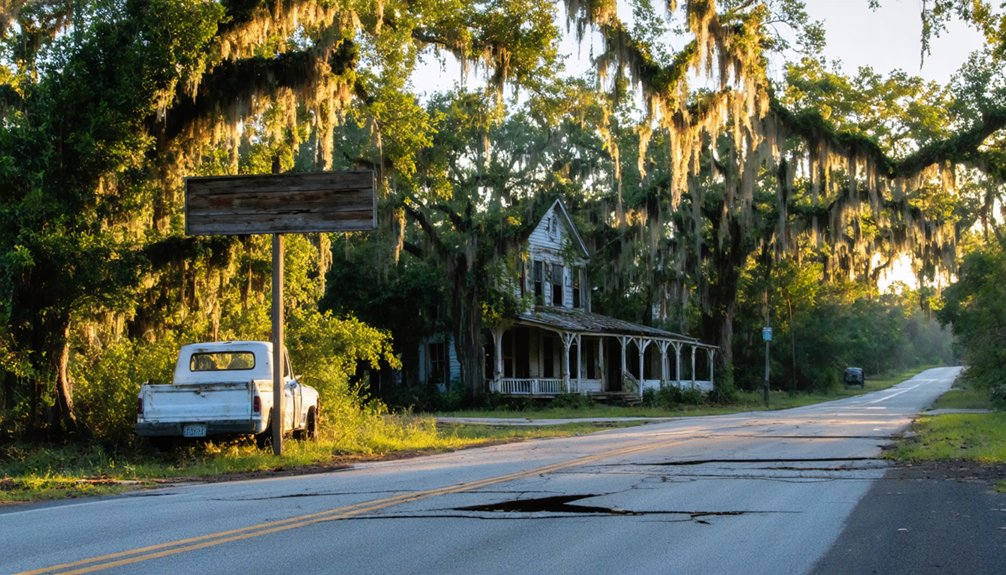
You’ll discover three distinct Victorias scattered across Mississippi, each telling a different ghost town story. Start with Bolivar County’s river-swallowed port town, then venture to Marshall County’s railway remnant where the 1925 Sunnyland derailment left its mark, and finish at Pontotoc County’s abandoned first settlement with its crumbling chimneys. You can extend your journey to Taylor’s fire-scarred foundations and yellow fever memories. Each site offers unique archaeological traces and haunting landscapes that reveal Mississippi’s forgotten past, with detailed access routes and safety considerations available below.
Key Takeaways
- Three Victoria ghost towns exist in Mississippi: Bolivar County (eroded by river), Marshall County (railway town), and Pontotoc County (first settlement).
- Bolivar County’s Victoria thrived as a Mississippi River port from 1840-1871 before erosion completely consumed all physical evidence.
- Marshall County’s Victoria survives along the railway route and witnessed the tragic 1925 Sunnyland train derailment that killed twenty people.
- Pontotoc County’s Victoria was established in 1832 with three hundred residents but abandoned when nearby Pontotoc offered better opportunities.
- Add Taylor to your route to explore foundations and cemeteries from a town devastated by Civil War, yellow fever, and fire.
Three Different Victorias: Understanding Mississippi’s Ghost Town Sites
The search for three distinct Victorias across Mississippi’s ghost town landscape reveals a surprising reality: only one Victoria actually exists in documented records. You’ll find this single site in Bolivar County along the Mississippi River, though it’s excluded from inland exploration routes. Specific ghost town databases from Wikipedia to Rootsweb consistently identify just this lone Victoria, despite the subtitle’s promise of three locations.
Potential name confusions might stem from similarly abandoned sites like Brewton, Electric Mills, or Bankston—each boasting dramatic histories and tangible ruins. Yet none carry the Victoria name. Your quest for multiple Victorias hits a dead end in Lafayette, Holmes, and Claiborne counties, where archival gaps leave you empty-handed. Like other Mississippi ghost towns, these former communities once had homes, shops, schools, and churches before residents moved away. The freedom to explore Mississippi’s ghostly past requires accepting this geographic truth. Reliable sources are needed to verify and expand the documented list of these abandoned settlements.
Victoria in Bolivar County: The Mississippi River Ghost Town
Along the muddy curves of the Mississippi River, roughly 2.4 miles west of present-day Gunnison, Victoria once thrived as a bustling port town before the river’s relentless current erased it from the map. From 1840 to 1871, mail carriers delivered correspondence through this settlement connecting Vicksburg to Memphis. Travelers found respite at its tavern while steamboats loaded cargo at Victoria Landing.
Then the river betrayed its partner. Throughout the late 1880s, caving banks devoured buildings, businesses, and homes. Within years, the entire town site collapsed into churning waters.
Today, you’ll find Victoria Bend marking where this community once stood—natural landscape changes having consumed all archaeological evidence. The Mississippi claimed its victim completely, leaving only historical records and a river curve as memorial to Victoria’s brief existence. Like other Victorias across the globe, from British Columbia’s capital to Australia’s southeastern state, this Mississippi settlement carried a name that honored Queen Victoria, though its fate proved far less enduring than her long reign.
Victoria in Marshall County: The Railway Community That Survived
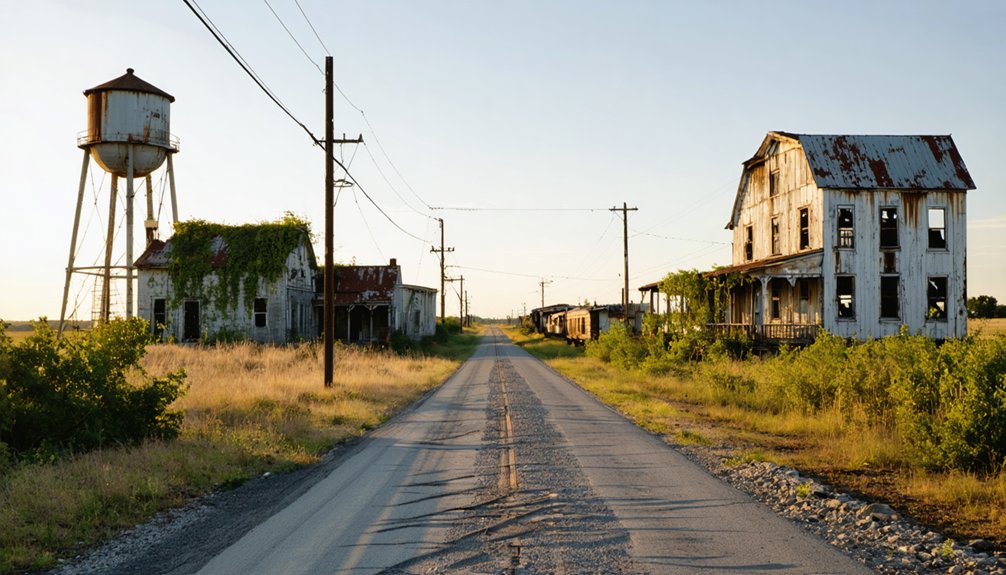
Unlike its doomed namesake that surrendered to the Mississippi’s appetite, Victoria in Marshall County carved its destiny alongside iron rails rather than muddy waters. When you visit this ghost town four miles northwest of Byhalia via Highway 178, you’ll trace railway operations that began January 22, 1886, evolving through five different railroad companies before becoming today’s BNSF line.
At its peak in 1900, thirty residents supported a church and maintained cotton industry presence through a working gin. The rails brought prosperity but also tragedy—in 1925, the Sunnyland passenger train derailed here, tumbling down an embankment and claiming twenty lives.
Unlike the river’s victim, this Victoria survived into the twentieth century, its post office serving travelers until the community finally surrendered to progress rather than nature’s fury. Located at milepost 516.3 from Springfield, Missouri, the town marked an important waypoint on the railway line. The Latin name origin of Victoria, meaning “victory,” proved ironic for a town that outlasted its river counterpart yet ultimately faded from the map.
Victoria in Pontotoc County: The Abandoned Settlement
Before Pontotoc found its permanent home, Victoria flourished one and one-half miles northwest as the county’s first ambitious settlement. You’ll discover this ghost town‘s historical significance near the Memphis-Pontotoc Road intersection, where three hundred souls once built their frontier dreams after the 1832 Chickasaw Treaty. McMackin moved the community from its original site around 1834, but Victoria couldn’t compete with Pontotoc’s superior positioning.
Today’s roadside archaeology reveals only scattered rock chimneys and old wells hidden among overgrown fields. You’ll find traces of prominent citizens like Squire Watt and teacher Jno. W. Thompson, whose ambitions dissolved when traffic abandoned the Pidgeon Roost Trail. Pontotoc’s land office first established operations in the area, drawing settlers away from Victoria’s less favorable terrain. The settlement’s abandonment wasn’t dramatic—residents simply drifted toward better opportunities, leaving Victoria’s foundations to crumble beneath Mississippi’s reclaiming vegetation. These substantial visible buildings once marked a thriving community before economic shifts rendered the town extinct.
Adding Taylor to Your Ghost Town Route
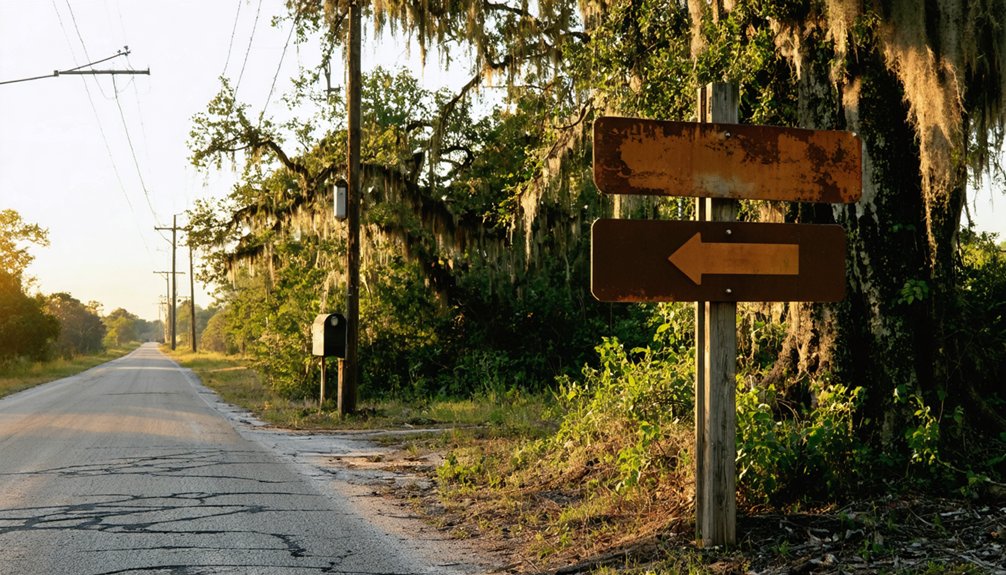
Your ghost town journey continues ten miles northeast of Victoria, where Taylor’s tragic history unfolds along Lafayette County’s quiet backroads. Once a thriving depot settlement, Taylor endured relentless catastrophes that stripped away its prosperity. Union troops occupied the town in 1862, leaving Civil War period destruction across local plantations. The devastation continued through decades of misfortune.
Stand where antebellum architectural remnants whisper stories of what was lost:
- The 1870 train wreck that plunged 21 souls into a 50-foot gully, making national headlines
- Yellow fever epidemics in 1879 and 1898 that transformed the depot into a ghost town
- The 1910 fire consuming 13 downtown buildings in a single catastrophic blaze
You’ll find Taylor’s resilience etched in scattered foundations and overgrown cemeteries—testaments to a community that refused surrender despite unimaginable hardship. Similar devastation struck Rodney, Mississippi, where a severe yellow fever epidemic in 1843 nearly depopulated the entire town. The town’s fortunes declined so severely that by 1970, its population had dropped below the incorporation threshold, and its charter was revoked in 1972.
Best Driving Routes Between the Victoria Sites
The ghost town of Victoria sits tucked along a Mississippi River bend where Victoria Hunting Club Road dead-ends into deltaic silence—3.8 miles west of Gunnison, your nearest landmark with amenities. Route optimization begins with avoiding confusion: Marshall County’s living Victoria lies 100+ miles northeast, a populated CDP you’ll skip entirely.
Your target occupies Bolivar County’s riverbank coordinates at 33°55′42″N 91°00′02″W, where driving time estimates clock under ten minutes from Gunnison’s Highway 1 junction. Victoria Hunting Club Road delivers you directly to the unmarked site near Lake Concordia’s southern reach. Navigate using GPS coordinates rather than signage—the river erased structures decades ago, leaving only Victoria Bend’s curve as evidence. The town’s visible remaining buildings have long since vanished, though faint road traces persist in aerial photographs.
Combine this stop with Bolivar County’s ghost town cluster for maximum exploration freedom across Mississippi’s Delta backcountry.
What to Look for at Each Location
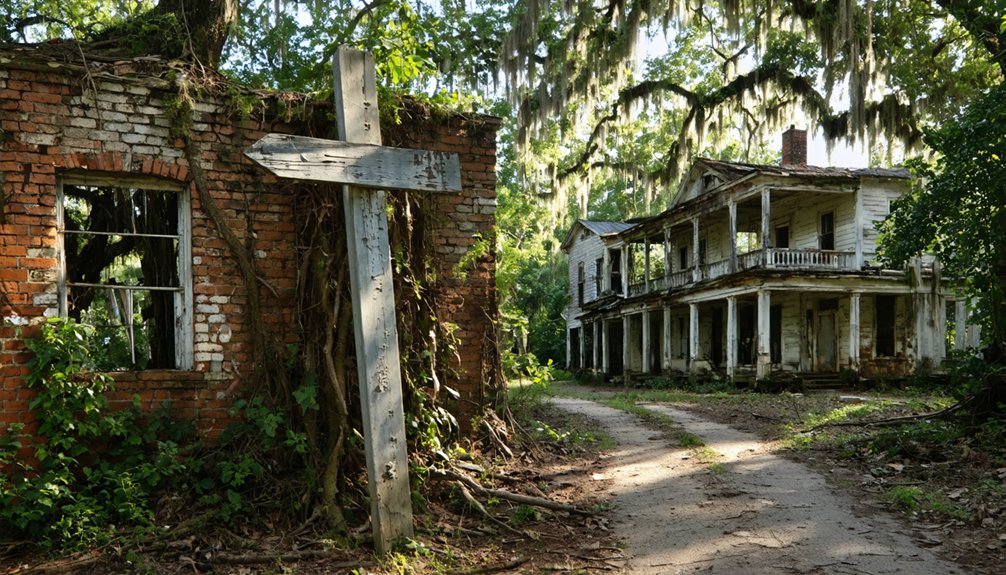
As you explore each crumbling site along your journey, you’ll discover layers of history written in weathered brick, fallen tombstones, and towering columns that refuse to surrender to time.
The architecture tells stories through a cannonball lodged in red brick, ornate woodwork that’s defied decades of abandonment, and Greek Gothic domes piercing the Mississippi sky.
Watch how the landscape has reclaimed what was once a thriving river town—curbs bordering muddy roads to nowhere, cemetery stones tumbling down bluffs, and cotton fields returned to forest around plantation ruins.
Historical Markers and Remnants
When exploring Victoria and other Mississippi ghost towns, physical markers often provide your only tangible connection to vanished communities. Victoria’s marker stands 3.8 miles west of Gunnison, where the Mississippi River’s shifting course erased this once-thriving port. The archaeological research conducted at sites like the Indian Burial Mound in 1934 reveals the historical significance beneath your feet—Choctaw remains rest just 102 yards from Highway markers.
You’ll discover freedom in these forgotten places:
- Stand where French expeditions launched at Cotton Gin Port, now marked along Highway 278
- Trace river bends that swallowed entire settlements like Victoria
- Touch markers commemorating 1,000+ vanished sites across Mississippi
These weathered signs and excavated grounds let you piece together stories that railroads and rivers tried erasing.
Architectural Features Still Standing
Two grand churches command Rodney’s overgrown streets, their contrasting styles telling distinct stories of antebellum ambition. The Baptist Church’s Greek Gothic silver dome pierces through encroaching vegetation, while intricate woodwork details inside remain remarkably intact despite decades of flood damage.
Across town, the Presbyterian Church’s red-brick Federalist design stands as Mississippi’s finest example, its well preserved bell tower holding a bell partially cast from 1,000 silver dollars. Look for the embedded Civil War cannonball in its exterior wall.
Beyond Rodney, Windsor’s twenty-three towering columns rise from pastoral fields, their Greek Revival forms blending Italianate and Gothic elements. You’ll find original brick walkways still visible, while cast-iron balustrades salvaged years ago now grace Alcorn State University’s campus—echoes of antebellum grandeur scattered across Mississippi’s landscape.
Natural Landscape Changes
Nature’s most dramatic transformation struck in 1870, when a massive sand bar formation forced the Mississippi River two miles west of Rodney’s Commerce Street, severing the town’s commercial lifeline overnight. This terrain transformation doomed Victoria entirely—the river’s relocation erased every trace of the settlement that once thrived at Victoria Bend.
You’ll witness vegetation reclamation’s relentless power at both sites:
- Moss-draped trees now shadow crumbling facades where merchants once hawked goods
- Muddy dirt roads wind through woods that consumed bustling streets
- Persistent flooding keeps ground perpetually waterlogged, deterring any return
From Rodney’s cemetery hilltop, you’ll spot the distant river only in winter—a four-mile gap symbolizing how nature overwhelmed human ambition. These river alterations weren’t gradual decay; they were swift geographical reshaping that rendered ports obsolete and communities ghostly.
Planning Your Visit: Access and Safety Considerations
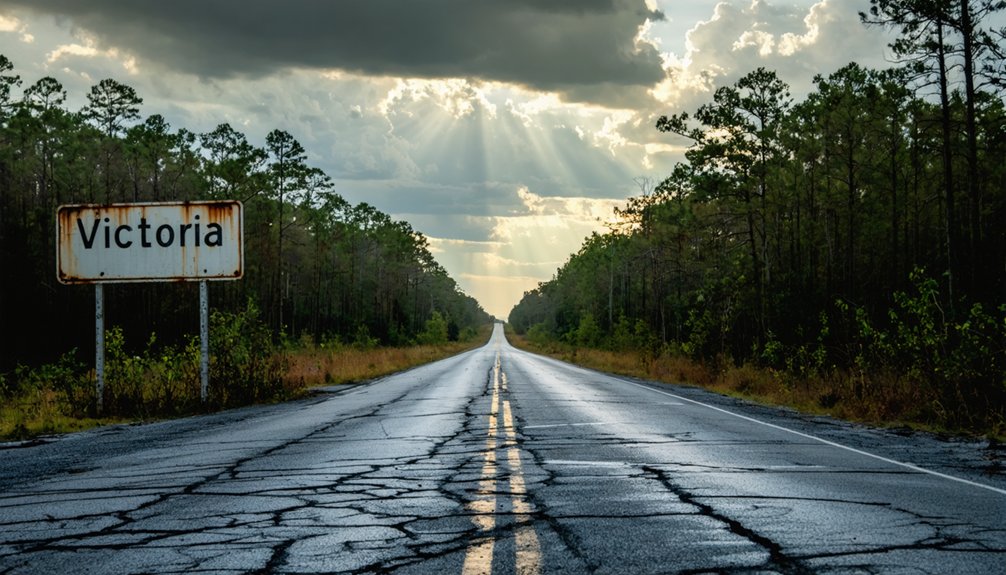
Your journey to Victoria requires careful preparation, as no maintained roads lead directly to this abandoned settlement 3.8 miles west of Gunnison. You’ll navigate through private hunting club territory and overgrown terrain where the Mississippi River’s shifting course has reclaimed what civilization once built.
Before departing, check weather conditions and inform someone of your plans—the site’s remote location along Victoria Bend offers no emergency services or marked trails if conditions turn dangerous.
Accessing Three Victoria Sites
Since Victoria qualifies as one of Mississippi’s most vanished ghost towns, you’ll find virtually no marked routes or signage directing you to its three scattered sites. You’re traversing secondary roads through Bolivar County where blacktop transitions to rutted dirt paths. Limited emergency services mean you’re genuinely on your own out here.
The terrain demands attention:
- Hairpin turns emerge suddenly through overgrown vegetation
- Potholes hide beneath muddy surfaces after rain
- Isolation stretches for miles without cell coverage
Restricted property access complicates exploration—remnants often sit on private land without clear boundaries. You’ll discover foundations, cemetery plots, and skeletal structures accessible only by foot once you’ve parked along whatever shoulder exists. Bring navigation tools, inform someone of your route, and respect boundaries while searching for Victoria’s fading traces.
Weather and Terrain Precautions
Delta weather shapes every aspect of your Victoria exploration, transforming accessible dirt roads into impassable mud troughs within hours. You’ll face potential weather hazards including sudden thunderstorms with 60% afternoon probability and gusty winds reaching 30 mph that can strand your vehicle.
Sunday brings particularly strong storms through mid-70s temperatures. Monitor air quality risks hovering at medium-high levels, especially if you’re sensitive to respiratory irritants during extended outdoor exploration.
Check morning conditions before departing—temperatures swing dramatically from mid-30s nights to lower 70s days. Pack layers for these extremes. Scout terrain during dry spells when dirt paths remain firm. Avoid afternoon visits when thunderstorms peak. Secure loose gear against persistent southwest winds.
The abandoned landscape offers ultimate freedom, but Delta conditions demand respect and preparation.
Frequently Asked Questions
Are There Any Guided Tours Available for Mississippi’s Ghost Town Sites?
No organized ghost town tours exist specifically for Victoria’s abandoned sites. You’ll need to explore independently through self-guided walking tours, discovering crumbling structures and overgrown streets at your own pace, creating your own haunting adventure through Mississippi’s forgotten landscapes.
What Photography Equipment Works Best for Documenting Abandoned Structures and Ruins?
You’ll want wide-angle lenses capturing cavernous spaces, plus sturdy tripod stability for long exposures in challenging natural lighting conditions. Pack backup flashlights, interchangeable lenses (16-35mm ideal), and a mirrorless camera body for unrestricted creative exploration through abandoned structures.
Can I Legally Metal Detect at These Ghost Town Locations?
You’ll need written permission before metal detecting at Victoria’s ghost town sites. Mississippi’s metal detecting laws strictly protect historical preservation concerns on public lands. Always secure landowner authorization first—it’s your key to legally exploring these forgotten treasures.
Which Nearby Towns Offer Accommodations for an Overnight Ghost Town Trip?
You’ll find comfortable stays in Byhalia, Olive Branch, Holly Springs, and Collierville—all within easy driving distance. Consider nearby historic bed and breakfasts for authentic charm, and ask about local haunted history tours to enhance your ghost town adventure.
Are There Other Mississippi Ghost Towns Worth Visiting in the Region?
You’ll discover Rodney, Rocky Springs, Grand Gulf, and Bruinsburg nearby—each offering haunting remnants worth documenting. These sites showcase preservation efforts through crumbling churches, overgrown cemeteries, and Civil War markers that’ll fuel your independent exploration spirit.
References
- https://taylorms.org/history
- https://nostoneunturnedadventures.com/2018/05/21/a-sunday-drive-and-history-lesson-victoria-texas/
- http://genealogytrails.com/miss/pontotoc/extinct_towns.htm
- https://en.wikipedia.org/wiki/Victoria
- https://www.modernhistorypress.com/2021/08/22/carolyn-wilhelm-reviews-carnival-lights/Old-Victoria-PB-p680126142
- https://www.youtube.com/watch?v=pinIgUFWDT0
- https://en.wikipedia.org/wiki/List_of_ghost_towns_in_Mississippi
- https://kids.kiddle.co/List_of_ghost_towns_in_Mississippi
- https://freepages.rootsweb.com/~gtusa/history/usa/ms.htm
- https://mississippifolklife.org/articles/haunted-by-a-ghost-town-the-lure-of-rodney-mississippi