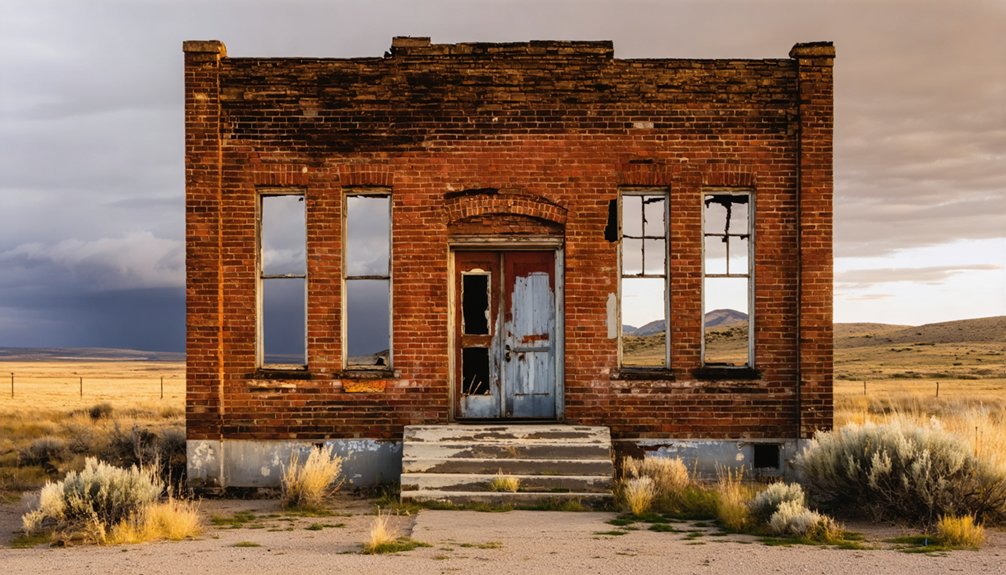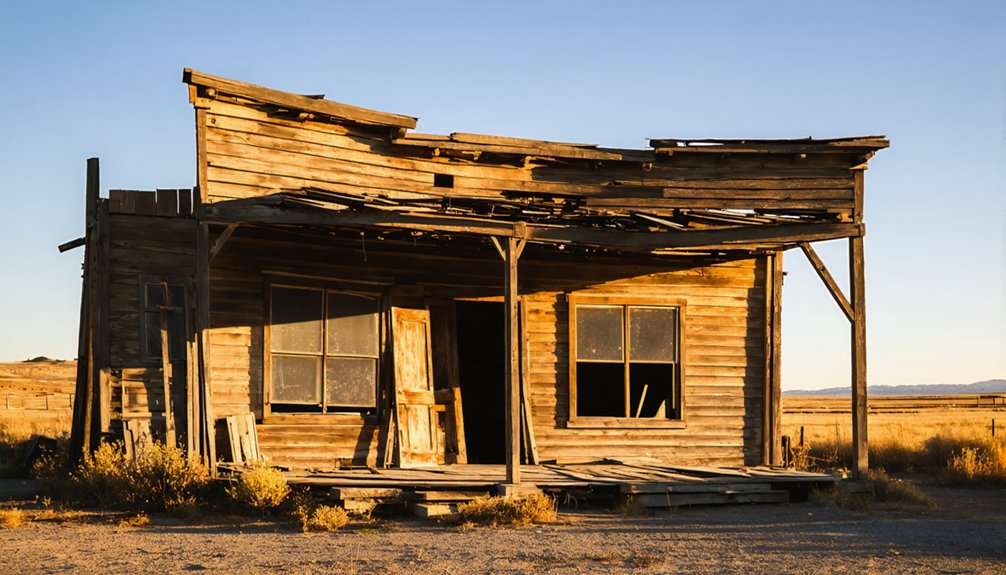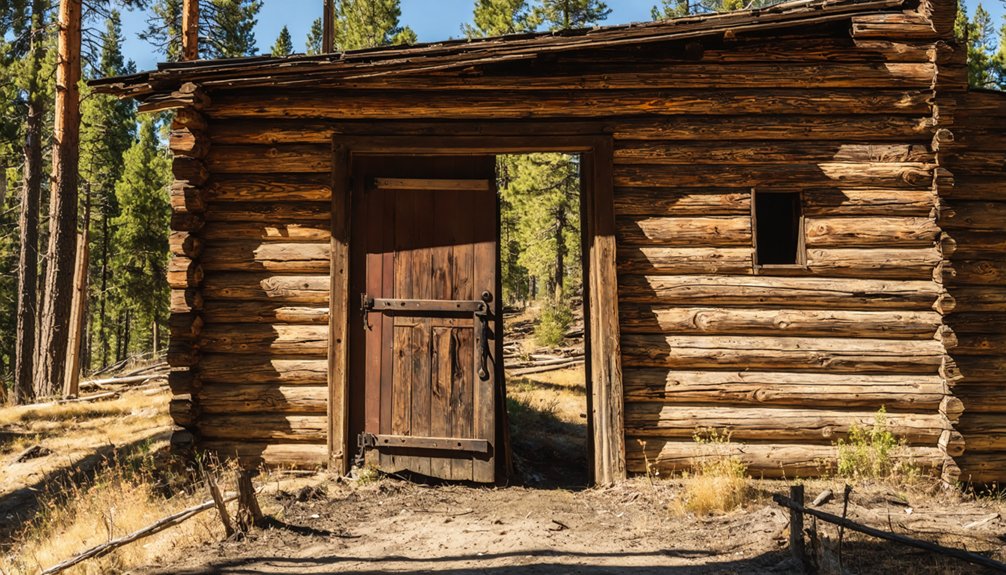
You’ll find Vienna’s ghost town remains near Smiley Creek at 8,200-9,000 feet elevation, accessible via dirt road from modern Vienna, Idaho (coordinates 43.9667, -114.7167). This 1879 silver camp once produced $500,000 in ore before lawsuits shuttered operations in 1887. Today, only scattered rock foundations peek through dense forest where wooden buildings once stood—consumed by 1920s fires. Your high-altitude journey demands proper vehicle preparation and essential gear for exploring this remote Sawtooth Mountain site where nature’s reclaimed what silver prospectors built.
Key Takeaways
- Vienna ghost town sits at 8,200-9,000 feet elevation near Smiley Creek headwaters, accessible via dirt road at coordinates 43.9667, -114.7167.
- Sawtooth City serves as the nearest town for accessing the remote Vienna site through forest roads.
- Only rock foundations remain visible through dense undergrowth after 1920s forest fires destroyed all wooden structures.
- The site once housed a twenty-stamp mill and thriving 1880s mining community that produced over $500,000 in silver.
- Proper preparation and off-road gear essential for navigating remote dirt roads at high elevation in dense forest terrain.
The Silver Rush That Built a Mountain Town
High in Idaho’s Sawtooth Mountains, where winter snows linger into summer and the air thins at nearly 9,000 feet, silver-hungry prospectors carved a town from the granite slopes in 1879. You’ll find Vienna’s story remarkably different from Idaho’s typical gold camps—this was silver country, pure and simple.
When eastern investors purchased the Vienna Mine in 1880, their entrepreneurial vision transformed scattered claims into the Vienna Consolidated Mining Company. Under Chris Johnston’s direction, a twenty-stamp mill thundered to life by 1883, crushing $40,000 to $50,000 worth of silver monthly. The logistical challenges were staggering—hauling equipment up treacherous mountain trails, housing hundreds of workers in brutal conditions, and processing silver sulfide ores at elevation.
Yet for seven brilliant years, Vienna thrived, extracting over $500,000 in silver before lawsuits and economics shuttered operations in 1887. The mine also yielded tertiary commodities including zinc, gold, and copper alongside its primary silver production. The Old Vienna Co. reacquired the property in 1917, constructing a new mill and camp with hopes of reviving the old glory, but the mill never ran and the town sank into ruin.
What Made Vienna Mine More Prosperous Than Its Rivals
You’ll notice Vienna’s twenty-stamp mill churned out $40,000 to $50,000 monthly while Sawtooth’s entire operation barely scraped together $250,000 total—a stark difference that came down to geology and leadership.
The mine’s ribbon veins cut through granodiorite in perfectly positioned shear zones, creating richer silver-lead deposits than anything in neighboring districts. Miners extracted chalcopyrite, galena, and pyrite alongside the valuable silver-lead ore that made Vienna profitable. While other camps struggled with mismanagement and dormant operations, Chris Johnston’s steady hand kept Vienna’s mill running without interruption from 1883 to 1885, transforming eastern investors’ $200,000 gamble into consistent profits.
The thriving mining camp supported over 200 buildings, including 14 saloons, multiple restaurants, and even a newspaper that documented the town’s prosperity in 1882.
Superior Ore Production Output
Silver practically spilled from Vienna’s mountainsides in those early days, with ore shipments averaging several hundred ounces per ton straight from the outcrop. You’ll understand Vienna’s dominance when you consider the Mountain King claim alone produced $103,600 from its ore in 1883—staggering wealth for that era.
While competitors struggled with lower-grade deposits, Vienna’s higher ore yields meant fortunes extracted with less effort.
The district’s better processing capabilities set it apart too. Vienna’s operators built concentrating mills to handle varying ore grades, and Galena erected a 30-ton lead smelter specifically for silver-lead processing. High-grade ore went straight to smelters, bypassing costly middlemen. This efficiency—combined with rich deposits at accessible elevations between 8,200 and 9,000 feet—made Vienna the unstoppable silver king of Idaho‘s backcountry. The district’s success is evident in its 13 producing mines, which transformed this remote location into a thriving mining center.
Strategic Mining Location Advantages
Eastern capital transformed Vienna from a promising claim into an industrial powerhouse when investors purchased the mine in 1880 and reorganized it as the Vienna Consolidated Mining Company. You’ll find this strategic location in Smiley Creek’s headwaters, perched between 8,200 and 9,000 feet where favorable climatic conditions kept operations running year-round.
The investors’ funding built a twenty-stamp mill by 1883, producing $40,000 to $50,000 monthly while rivals struggled with undercapitalization.
Vienna’s geological advantage lay in its rich silver-lead veins, dated to 80.7 million years ago, sourced from Precambrian rocks beneath. Secure transportation routes through Blaine and Camas Counties connected the Webfoot, Vienna, and Solace mines to markets. While nearby Era supported six saloons and other businesses at its peak, the town’s stamp mill eventually stood silent when the Horn Silver Mine couldn’t perfect its milling process.
Under Chris Johnston’s management, this combination of infrastructure, geology, and accessibility created sustained prosperity that ghost mines never achieved.
Why Vienna Disappeared From the Map
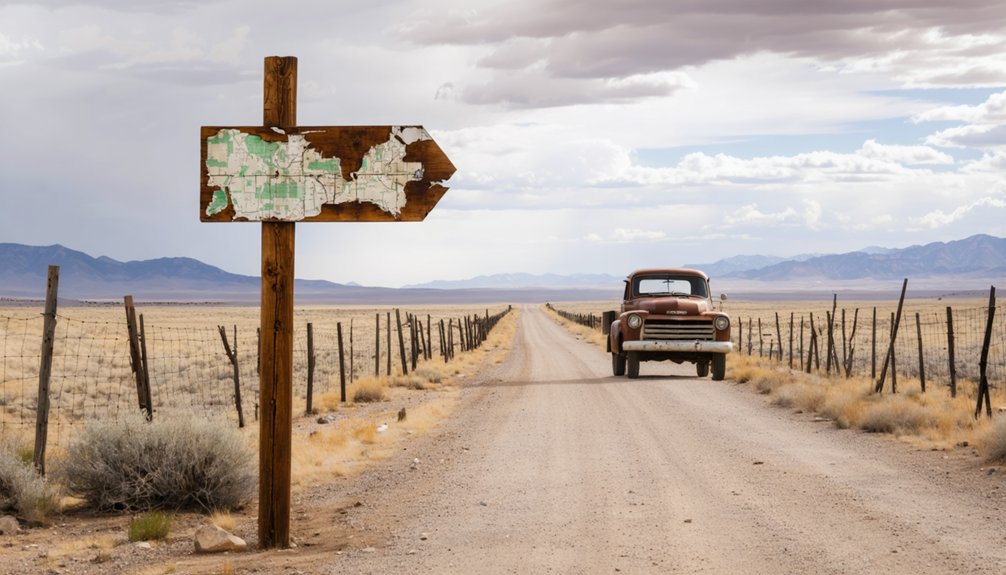
You’ll find that Vienna’s downfall came swiftly—a crippling 1885 lawsuit shuttered the profitable mines just as the town hit its stride. The subsequent years brought only scattered ore shipments and failed revival attempts, leaving Vienna a shell of wooden buildings clinging to the mountainside.
When forest fires swept through in the 1920s, they erased the last physical traces of a community already abandoned for decades. The journey requires traveling through Sawtooth City before reaching the remote site. Today, you can reach the site via a dirt road access near Vienna, Idaho, at coordinates 43.9667, -114.7167.
Mining Lawsuits Ended Production
When the Vienna Mine’s twenty-stamp mill fell silent in 1885, it marked the beginning of the end for a town that had flourished on silver’s promise. Legal disputes over mining claims shut down operations that had been churning out $40,000 to $50,000 monthly since 1883. The litigation strangled Vienna’s economic lifeline, halting production at a mine that had already yielded over $500,000 in silver.
The mill eventually resumed on a smaller scale until 1888, but the damage was done. Only intermittent ore shipments continued afterward, and the town’s population drifted away, chasing better prospects in districts where lawyers hadn’t replaced miners. Buying and selling claims became the real business in those days, overshadowing actual mining operations.
You’ll find this wasn’t unusual—the General Mining Act of 1872 sparked countless battles over claim ownership. The Coeur d’Alene River Basin became one of North America’s leading silver, lead and zinc-producing areas, with mining activities spanning over a century across the region.
Fire Consumed Remaining Structures
The ghost town that survived economic collapse couldn’t escape nature’s fury. During the 1920s, a massive forest fire swept through Vienna’s abandoned townsite, erasing over 200 hastily-built wooden structures from existence.
The infrastructure failures began with flammable construction materials—miners prioritized speed over safety at 8,200 feet elevation, creating a tinderbox community.
Today, you’ll find these remnants of destruction:
- Scorched rock foundations poking through dense forest undergrowth
- Scattered metal artifacts like rusted tin cans in shaded clearings
- Flat ground with subtle bumps marking former building locations
- Charred wood fragments hidden beneath alpine vegetation
The fire completed what abandonment started, transforming Vienna from ghost town to archaeological puzzle. Nothing substantial survived the flames—just whispers of a community that dared defy these unforgiving Sawtooth Mountains.
Where to Find Vienna in Idaho’s Sawtooth Mountains
Nestled in central Idaho’s Sawtooth Mountains, Vienna sits at the upper end of Smiley Creek drainage, where prospector Levi Smiley first discovered rich silver-bearing quartz in 1879. You’ll find this ghost town’s remains at coordinates 43.850474°N, 114.853548°W in Blaine County, perched on the ridge separating Beaver Creek from Smiley Creek. Vienna Peak rises to 10,226 feet, marking the southern terminus of the Sawtooth Range.
To reach Vienna, you’re looking at roughly 50 miles northwest from Hailey or 20 miles northeast from Atlanta. The site occupies Smiley’s Canyon, where abandoned mills and remnants of mining operations restoration efforts dot the landscape. You’ll discover Vienna near Alturas Lake‘s isolated southern benchmarks, eight miles from its historic rival Sawtooth City in neighboring Beaver Canyon.
What You’ll Actually See at the Ghost Town Site Today
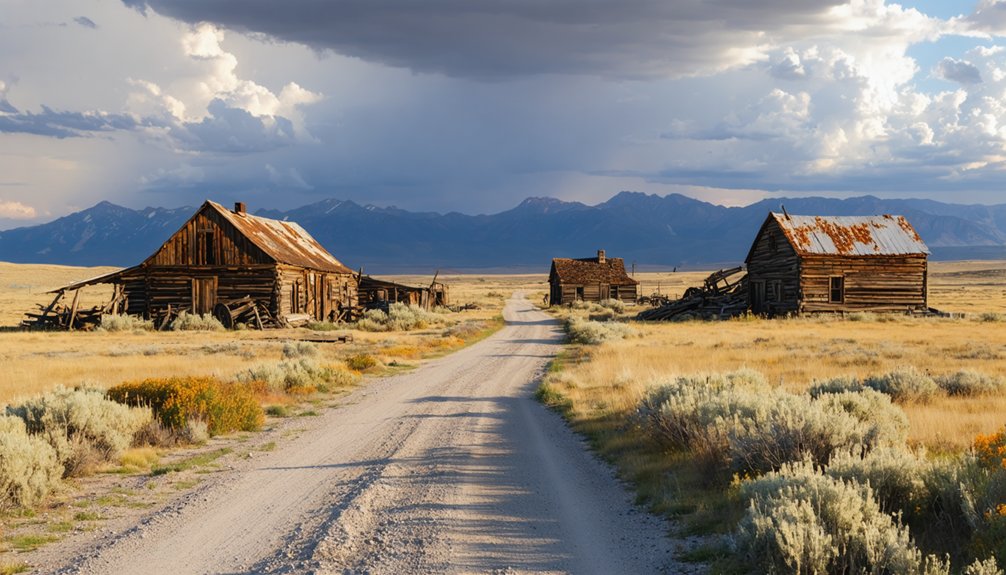
After climbing to 7,800 feet through rough mountain roads, you’ll find Vienna stripped nearly bare—a ghost town in the truest sense. Over 200 buildings vanished after 1900, leaving only whispers of what once thrived here. Former buildings visible today are reduced to rock foundations and sparse cabin ruins, while mining relics scattered across the landscape tell fragmented stories.
The history of ghost towns in Idaho history reveals the harsh realities faced by many communities as resources dwindled and opportunities faded. Each site carries a unique tale of ambition and hardship, reflecting the relentless pursuit of prosperity in the rugged terrain. As you explore these remnants, you’ll not only discover the physical remnants but also the echoes of the lives that once filled these now-silent streets.
What remains paints a haunting picture:
- Mine tailings and trash piles mark where silver extraction fueled this mountain settlement
- Intact cans and glass fragments litter the ground—tangible echoes of daily life
- Stone foundations outline where homes once stood against harsh winters
- A dirt road winds directly to accessible mine shafts
You’ll walk among these remnants while swatting mosquitoes near mountain springs, freedom found in exploring history’s abandoned margins.
How to Prepare Your Vehicle for the Mountain Journey
Before you point your vehicle toward Vienna’s high-altitude ruins, understanding that this journey demands more than a full gas tank will keep you from becoming another cautionary tale on Idaho’s unforgiving mountain roads.
Mountain preparation separates successful adventurers from rescue statistics—Vienna’s remote location doesn’t forgive poor planning or mechanical failure.
Your vehicle maintenance checklist starts with brake inspection, battery testing, and antifreeze verification—essentials that prevent cold-weather breakdowns. Check tire tread depth and pressure; mountain conditions punish underinflated rubber. Pack tire chains, a shovel, jumper cables, and a fully inflated spare.
Route planning considerations extend beyond GPS coordinates—share your departure time and destination with someone reliable. These gravel-and-dirt approaches require four-wheel drive capability.
Stock emergency supplies: blankets, water, first aid kit, and bright-colored flares. Keep your fuel tank above half-full; mountain grades devour gasoline faster than flatland highways.
Essential Gear and Supplies for High Elevation Exploration
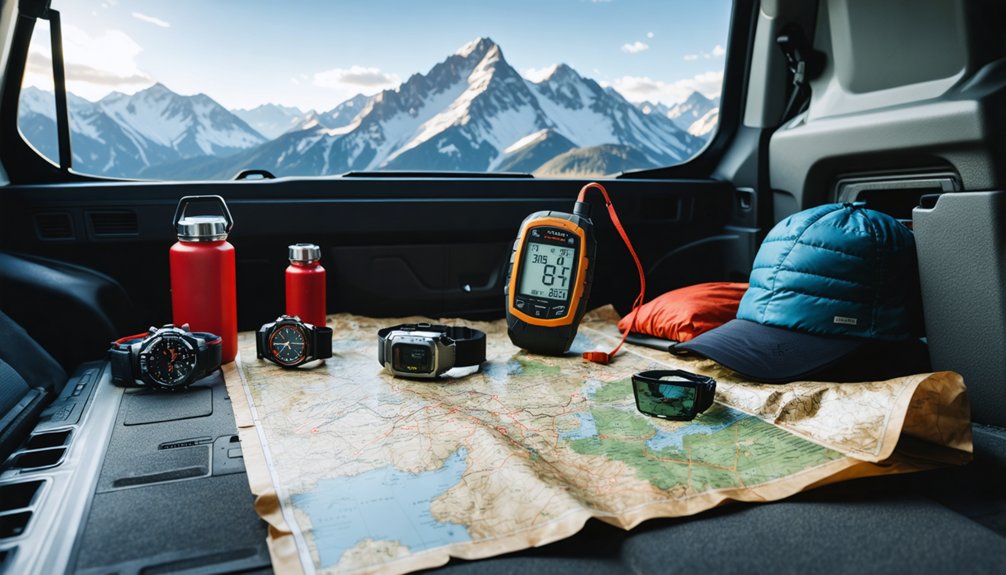
Vienna’s skeletal structures stand at over 8,000 feet, where morning temperatures plummet below freezing even in July and afternoon storms materialize without warning from seemingly cloudless skies. You’ll need layering techniques for cold weather that let you shed or add protection as conditions shift:
- Base layer: Lightweight synthetic long underwear wicks moisture while you climb weathered boardwalks
- Midweight insulation: Expedition-weight fleece or wool for extreme elevations when exploring collapsed mines
- Windproof shell: Waterproof breathable jacket shields against sudden squalls
- Down parka: 800+ fill power keeps you warm during extended photography sessions
Pack a warm wool hat, insulated gloves, sturdy boots, trekking poles for stability, headlamp with extra batteries, sunglasses, first-aid supplies, and water bottles with treatment tablets—freedom demands self-reliance.
Capturing History Through Photography and Research Resources
Peel back the layers of Vienna’s vanished history through your camera lens and archival detective work. You’ll find compelling photographic composition opportunities among scattered foundation stones, mine tailings, and equipment remnants at 7,800 feet—what’s left after systematic clearing and a 1920s forest fire erased this $500,000 silver producer.
Frame your shots to capture the contrast between mountain wilderness and industrial archaeology, where trash piles tell stories of daily life from 1879-1887.
Research accessibility runs deep: the University of Idaho’s digital collections, Idaho State Historical Society records, and Idaho Geological Survey publications offer mine maps, town sketches from 1884, and production data documenting Vienna’s peak years.
Compare historical postcards against your modern captures to witness time’s relentless reclamation of this once-thriving thousand-resident camp.
Frequently Asked Questions
What Months Offer the Best Weather for Visiting Vienna Ghost Town?
June through September deliver Vienna’s prime visiting window. You’ll enjoy ideal temperature ranges from 75°F to 86°F, minimal precipitation patterns, and dry dirt roads. Summer’s clear skies and extended daylight let you explore this high-elevation ghost town freely.
Are Camping Facilities Available Near the Vienna Townsite?
No campground availability exists at Vienna itself, but you’ll find nearby camping options through dispersed sites in Sawtooth National Forest. You can pitch your tent freely near the spring, embracing backcountry solitude among historic ruins.
Can I Legally Remove Artifacts or Take Souvenirs From the Site?
No, you can’t legally remove artifacts—like guardians protecting history’s treasures, preservation regulations stand firm. Taking souvenirs triggers serious legal consequences: hefty fines, potential jail time, and criminal charges. Federal law demands you leave Vienna’s remnants untouched for future wanderers.
How Long Does the Hike Take From Parking Area to Ruins?
You’ll need 55 minutes to reach the ruins from your parking spot at the Vienna Mine marker. The 2.5-mile packed trail’s terrain difficulty remains moderate, making this hiking duration manageable for most adventurers seeking historical exploration.
Are There Other Ghost Towns Nearby Worth Visiting Same Day?
Why settle for one ghost town? You’ll find Bayhorse, Bonanza, and Custer within 50-75 miles—each showcasing unique historical significance through preservation efforts. These silver-mining relics offer authentic Western freedom, easily combined into one unforgettable day trip.
References
- https://minespotter.com/vienna-idaho/
- https://www.youtube.com/watch?v=p3HTA8rSHqA
- https://www.lib.uidaho.edu/digital/postcards/items/nwpostcards12.html
- https://history.idaho.gov/wp-content/uploads/0207.pdf
- https://ghost-towns.close-to-me.com/states/idaho/vienna-id/
- https://www.idahogeology.org/pub/Staff_Reports/2009/SR_09-6.pdf
- https://westernmininghistory.com/mine-detail/10168508/
- https://npshistory.com/publications/crmo/hcs/chap7.htm
- http://modeshift.org/419/idahos-silver-valley-a-story-of-wealth-tragedy-and-transformation/
- https://www.idahogeology.org/pub/Pamphlets/P-21.pdf