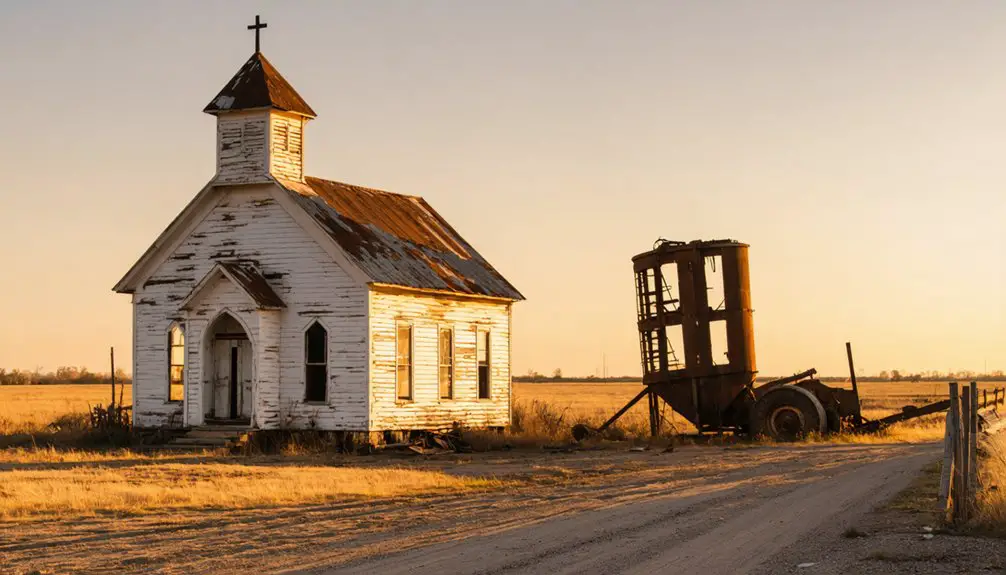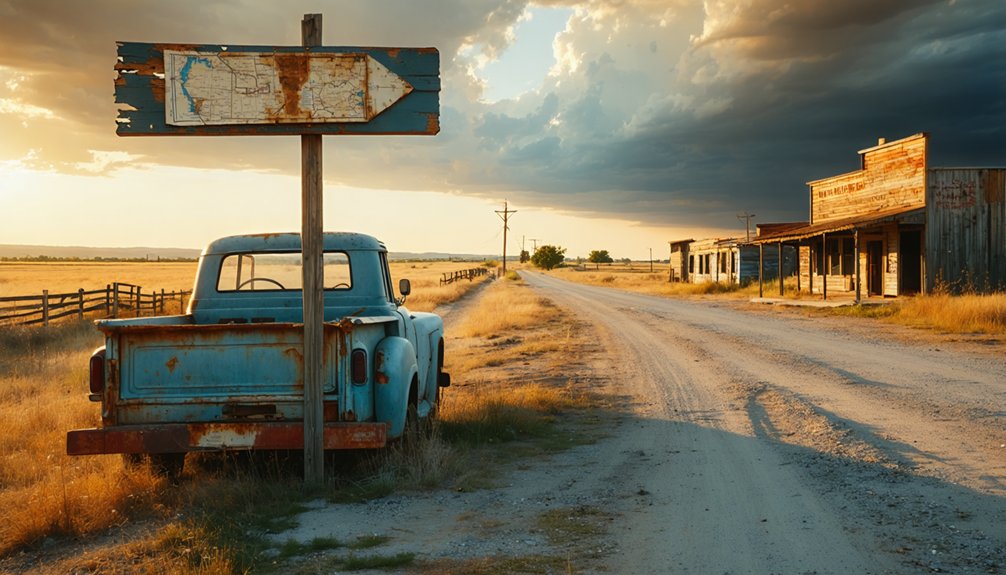
From Konawa’s downtown, you’ll drive northwest on N. 3500 Rd for two miles as asphalt gives way to gravel, leading to Violet Springs Cemetery—all that remains of Oklahoma’s wildest whiskey town. Pack sturdy boots, sunscreen, and extra water for exploring the single-acre burial ground where 25 saloon killings ended and Katherine Cross’s headstone chillingly reads “murdered by human wolves.” Spring and fall offer the best weather, though you’ll want to avoid May’s sudden downpours and check for permission before nighttime paranormal investigations at the phantom growling grave.
Key Takeaways
- From Konawa’s downtown, drive northwest on N. 3500 Rd for two miles; road transitions from asphalt to gravel.
- Visit during spring or fall for comfortable temperatures between 63-84°F, avoiding severe May thunderstorms and extreme weather.
- Explore Katherine Cross’s “human wolves” monument and cemetery containing 25 documented saloon killing victims from whiskey town era.
- Pack high-SPF sunscreen, sturdy boots, emergency supplies, and extra water for temperature swings and limited rural amenities.
- Obtain landowner permission for nighttime paranormal investigations at the “phantom growling grave” to avoid trespassing charges.
The Wild History of Oklahoma’s Most Notorious Whiskey Town
A dozen saloons lined the dusty streets of Violet Springs during its whiskey-soaked heyday, outnumbering legitimate businesses in this notorious Oklahoma Territory settlement. You’d find yourself at a crossroads where bootlegging operations thrived just half a mile from Indian Territory’s dry border.
Between 1895 and 1905, eight saloons served 600 thirsty souls who defied prohibition laws with reckless abandon.
The saloon culture here ran wild—three doctors stayed busy patching up rowdy patrons while outlaws like Belle Starr and the Doolin Gang made regular appearances. Notably, townsfolk organized Masonic lodges and fraternal orders but never built a church.
When Oklahoma achieved statehood in 1907, it entered as a dry state, killing Violet Springs’ entire economy overnight and transforming this whiskey haven into the ghost town you’ll explore today.
What Remains Today: Cemetery Markers and Frontier Stories
When you pull off the rural highway near Asher, you’ll spot two distinct cemeteries on opposite sides of the road—the larger Konawa City Cemetery and the smaller, weathered Violet Springs Cemetery marking where this whiskey town’s residents found their final rest.
You’ll navigate rough terrain past toppled headstones and tattered military flags, discovering markers spanning Oklahoma’s territorial era. The most haunting is Katherine Cross’s monument—though her original headstone’s missing, the base remains with its cryptic reference to death by “human wolves.” Her parents commissioned this distinctive marker after townspeople barely attended her 1917 funeral, their parental legacy concerns prompting symbolic epitaphs that wouldn’t let the community forget their eighteen-year-old daughter. The eastern edge once bordered Seminole Nation territory, making this cemetery a chronicle to frontier boundaries and untold stories.
Getting There: Directions and Nearby Landmarks
From Konawa’s small downtown center, you’ll head northwest on N. 3500 Rd. for roughly two miles until the pavement gives way to gravel and the Violet Springs Cemetery emerges on your left.
Road conditions shift from maintained asphalt to rural gravel, so adjust your speed accordingly. Parking accommodations are minimal—pull onto the shoulder respecting private property boundaries.
Nearby Reference Points:
- Sacred Heart Mission – Five miles northwest of Konawa, three miles north of Highway 39, offering historical context for your frontier exploration
- State Highway 39 – Runs between Asher and Konawa, providing your main arterial route into whiskey-trading country
- Territorial Boundary Marker – Less than half-mile away, marking where Oklahoma Territory met Seminole Nation
Contact landowners before visiting. Your freedom ends where trespassing begins.
Best Time to Visit and What to Bring
Since Violet Springs Cemetery sits exposed on Oklahoma’s open plains, timing your visit around the state’s temperamental weather patterns separates memorable exploration from miserable endurance. You’ll find spring and fall offer the sweet spot—comfortable 63-84°F temperatures without summer’s oppressive heat or winter’s biting cold.
These seasonal variations demand smart packing: lightweight layers handle 40-degree morning-to-afternoon swings, while waterproof gear shields you from sudden May downpours averaging 4.65 inches.
Your recommended gear should include high-SPF sunscreen (3,000 annual sunshine hours don’t forgive), sturdy boots for uneven terrain, and emergency supplies for remote exploration. Pack extra water during those 60+ days above 90°F, and don’t skip the wide-brimmed hat.
Spring’s severe thunderstorms and autumn’s convective rains mean checking forecasts isn’t optional—it’s survival.
Exploring the Cemetery and Historic Gravesites
The moment you step through the rusted gates of Violet Springs Cemetery, you’re walking into Oklahoma Territory’s bloodiest chapter—a single acre purchased for just $25 that became the final address for victims of 25 documented saloon killings.
Three Must-See Elements:
- Katherine Cross’s headstone (age 18)—inscribed “murdered by human wolves,” referencing a fatal abortion, not literal predators
- The phantom growling grave—where paranormal investigations consistently record unexplained sounds
- First drugstore foundation marking civilization’s fragile foothold
Local folklore warns you’ll hear growling near Katherine’s plot after dark. Obtain landowner permission before nighttime visits—trespassing charges kill the adventure fast. This Pottawatomie County burial ground sits opposite Konawa City Cemetery on N. 3500 Road, marking where Seminole Nation territory once began. Respect the graves while documenting your experience.
Other Ghost Towns to Add to Your Pottawatomie County Route
You’ll find Corner tucked away in Pottawatomie County’s landscape, a frontier settlement that vanished as residents scattered to larger towns with better opportunities.
Just down the road, Keokuk Falls offers equally sparse remains—another quiet memorial to communities that couldn’t outlast Oklahoma’s shifting economic tides.
Both sites reward curious explorers with that authentic ghost town solitude, though you’ll need to do some homework on exact locations since they’re far less documented than Sacred Heart or Econtuchka.
Corner’s Frontier History
Just west of Violet Springs, Corner embodied everything wild about Oklahoma Territory’s whiskey town era. Founded in 1891 by cattleman Perry, this settlement straddled the Seminole Nation boundary where frontier lawlessness ruled supreme.
With no jail or church, Corner’s 600 residents built their economy entirely on bootlegging to Indian Territory.
Corner’s Wild Reputation Featured:
- Eight saloons serving desperadoes, horse thieves, and outlaws moving contraband into Creek and Seminole Nations
- Three overworked doctors treating wounded men from gunfights and frontier violence
- A cemetery corner reserved until 1927 specifically for victims of violent deaths
Despite thriving community life—complete with fraternal lodges, cotton gins, and five stores—Corner died fast when Oklahoma achieved statehood in 1907 as a dry state.
Keokuk Falls Remains
Seven miles southeast of Prague, wooden sidewalks still bore dark stains from frontier gunfights when local historians photographed them decades ago—blood soaked so deep into the planks that weather couldn’t erase Corner’s violent legacy.
You’ll find Keokuk Falls hugging the North Canadian River‘s edge, where Moses Keokuk’s namesake town thrived as Oklahoma Territory’s wildest liquor hub until 1907 statehood killed the party.
Today, satellite mapping leads you to grist mill ruins identifiable through matching window placements in vintage photographs. Stone foundations mark former saloon locations where fortunes changed hands nightly. The falls themselves vanished when floods redirected the river’s course, but abandoned cemeteries and faded signage prove this ghost town once pulsed with dangerous energy.
Bring GPS coordinates—this freedom seeker’s paradise hides deliberately off modern maps.
Frequently Asked Questions
Are There Any Entrance Fees to Visit Violet Springs Cemetery?
No entrance fees stand between you and freedom—this forgotten sanctuary welcomes you without charge. You’ll discover self-guided walking tours through weathered headstones offering remarkable photographic opportunities. Pack water, wear sturdy boots, and let your curiosity roam wild among history’s whispers.
Is Overnight Camping Permitted Near the Violet Springs Ghost Town Site?
No official overnight camping exists at Violet Springs Ghost Town itself. You’ll find parking availability limited there, so scout nearby lodging options like BLM dispersed sites or local RV parks within driving distance for your freedom-loving adventure base.
Can I Access Historical Records or Maps of Original Town Buildings?
You’ll find historical archives documenting Violet Springs’ town architecture starting from 1892 at Oklahoma Historical Society. Records reveal five stores and eight saloons thrived here from 1895-1905, offering fascinating glimpses into this vanished frontier settlement’s layout.
Are Guided Tours Available for Violet Springs and Surrounding Ghost Towns?
No guided tour schedules exist for Violet Springs or surrounding ghost towns—you’ll explore independently. Visitor centers aren’t available either, so you’re free to roam at your own pace. Just respect private property and obtain necessary permits beforehand.
When planning your journey, consider adding some road trip destinations in Oklahoma that showcase the unique landscapes and attractions the state has to offer. From the stunning natural beauty of the Wichita Mountains to the vibrant art scene in Tulsa, there’s something for everyone. Be sure to check local resources for any special events or seasonal activities that might enhance your visit.
As you delve into the history of violet springs ghost town, you’ll uncover intriguing stories of the past, from the settlers who once called it home to the secrets hidden within its abandoned structures. Take the time to explore the remnants of old buildings, where each corner holds a piece of the town’s legacy. Whether you’re a history buff or simply looking for a unique adventure, this ghost town is sure to leave you with lasting memories and a deeper appreciation for Oklahoma’s rich heritage.
What Safety Precautions Should I Take When Exploring Abandoned Areas?
Don’t let adventure turn into disaster. Be aware of potential hazards like weak floors and falling debris. Wear appropriate protective gear—sturdy boots, gloves, respirator, and headlamp. Never explore alone; your buddy’s your lifeline if things go sideways.