You’ll find Vulture City about an hour northwest of Phoenix via US 60-93, where Arizona’s most productive gold mine once yielded over 340,000 ounces of precious metal. Plan your visit between October and June when guided tours run daily except Wednesdays from 9AM-5PM, with admission at $18 for adults. You’ll explore 18 meticulously restored 1800s structures including the Assay Office, blacksmith shop, and the infamous hanging tree where alleged ore thieves met their end. The complete story behind this legendary boomtown reveals fascinating details about frontier justice and mining history.
Key Takeaways
- From Phoenix, take Interstate 17 North to SR 74, winding past Lake Pleasant before connecting to US 60-93 near Wickenburg.
- Guided tours run October through June, 9AM-5PM daily except Wednesdays; admission costs $18 adults, $15 seniors, $10 children.
- Explore 18 restored 1800s structures including the Assay Office, blacksmith shop, cookhouse, and the infamous hanging tree.
- Special events feature haunted flashlight tours, Gold Days celebrations, and hands-on activities like gold panning and blacksmithing workshops.
- Stay overnight at Best Western Rancho Grande or Los Viajeros Inn; visit Wickenburg Chamber for maps and brochures.
Before you can explore the weathered remnants of Vulture City, you’ll need to navigate the 54-mile journey from Phoenix to Wickenburg—a scenic desert drive that takes just over an hour when traffic cooperates. Your fastest route follows Interstate 10 West to Loop 303 North, then merges onto US 60-93 West through the Sonoran landscape until you reach downtown Wickenburg.
If you’re seeking alternate driving routes, consider taking Interstate 17 North to SR 74 (Carefree Highway), which winds past Lake Pleasant’s shimmering waters before connecting to US 60-93. Unfortunately, public transportation options won’t grant you much freedom here—there’s no direct service, and combining Valley Metro’s line 571 bus with a taxi will consume nearly two hours and cost over $80.
Once you arrive in Wickenburg, you can explore local attractions like the Hassayampa River Preserve before continuing to Vulture City. Stop by the Wickenburg Chamber Visitor’s Center at 216 N. Frontier Street to pick up brochures, maps, and additional information about the area. For overnight stays, Best Western Rancho Grande and Los Viajeros Inn offer comfortable accommodations after your ghost town adventure.
The Discovery That Started It All: Henry Wickenburg’s 1863 Gold Strike
Once you arrive in Wickenburg, you’ll walk the same desert terrain where German immigrant Henry Wickenburg stumbled upon one of Arizona’s richest gold discoveries in 1863. His initial venture team—Isaac Van Bibber and Theodore Green—had followed King Woolsey’s advice to search the Harquahala Mountains, but they’d found nothing.
Their mineral exploration strategies shifted during the return journey along the Hassayampa River when they spotted a conspicuous quartz outcropping near a distinctive peak.
That November discovery would transform into the legendary Vulture Mine, ultimately yielding over 340,000 ounces of gold. Early testing revealed the site’s incredible potential, with estimates indicating 20 troy ounce per ton gold yield that made it one of the territory’s most valuable strikes. Wickenburg worked tirelessly to extract and sell the ore at $15 per ton, though the operation proved challenging in those early days. While his partners departed to secure financing, Wickenburg camped alone beside the Hassayampa, fifteen miles from the strike. You’re now following in the footsteps of a determined prospector who refused to abandon his claim.
Arizona’s Richest Gold Mine: Production Numbers and Economic Impact
As you walk through Vulture City’s crumbling stamp mill foundations, you’re standing at the heart of Arizona’s most productive gold mine—a operation that yielded 340,000 ounces of gold and 260,000 ounces of silver between 1863 and 1942. The numbers tell an extraordinary story: over $6.6 million in period-value bullion that translates to more than $200 million in today’s currency.
This wasn’t just a mine; it was an economic engine that sparked the founding of Wickenburg, drew 5,000 residents to this remote desert, and created ripple effects that helped birth Phoenix itself through the agricultural networks established to support the mining community. The mining process combined both surface and underground extraction methods to access the valuable ore deposits. The operation eventually came under the Vulture Mining Company after Benjamin Phelps purchased and reorganized the enterprise.
Historic Gold Production Totals
Between 1863 and 1942, the Vulture Mine extracted an extraordinary 340,000 ounces of gold from Arizona’s desert landscape, cementing its status as the state’s most productive gold operation in history. You’ll discover that three distinct production periods generated approximately $6.7 million in period values—equivalent to over $200 million today when combined with silver output.
The mine’s early phase (1867-1872) yielded $1.85 million in bullion, while monthly production figures peaked during the 1879-1888 expansion with $2 million extracted. Gold grades over time remained remarkably consistent through a vein measuring nearly 100 feet wide and 47 feet thick at depth. The operation also produced 260,000 ounces of silver alongside its legendary gold yields.
The final revival (1908-1917) produced $2.84 million before fault displacement disrupted the ore body, ultimately leading to wartime closure in 1942. During the 1930-1931 exploration phase, United Verde Extension Mining Co. sank a 500-foot deep shaft with 1,000 feet of lateral workings in an attempt to locate additional ore deposits.
Silver Mining Revenue Streams
While gold dominated the Vulture Mine’s legendary output, silver production added a substantial secondary revenue stream that you shouldn’t overlook when calculating the operation’s true economic impact. The mine yielded 260,000 ounces of silver throughout its lifetime, occurring naturally alongside gold in electrum, galena, and other mineral formations within the late Cretaceous quartz porphyry.
This milling process profitability became evident when the Vulture Mining Company built their all-encompassing facility by 1871, complete with warehouses and boarding houses to support 150 workers. Processing revenue impacts extended beyond initial extractions—reworking tailings proved surprisingly lucrative after high-grade deposits depleted. The Territory of Arizona seized the mine for back taxes in 1894, reflecting the ongoing financial challenges that plagued various ownership groups. Henry Wickenburg discovered the gold-bearing quartz ledge in 1863, establishing what would become Arizona’s most profitable mine.
Early litigation records document daily yields of $700, demonstrating how silver mineralization complemented the primary gold operations and sustained the town’s 5,000 residents through multiple boom-and-bust cycles.
Regional Economic Development Impact
From 1863 to 1942, the Vulture Mine’s 340,000 ounces of gold production—combined with 260,000 ounces of silver—generated economic ripples that transformed Arizona’s central desert from barren wilderness into a thriving commercial corridor. You’ll discover the ghost town’s economic impacts extended far beyond Vulture City’s 5,000 residents.
Henry Wickenburg’s strike directly founded the town bearing his name, while Jack Swilling’s grain route to Phoenix—today’s Grand Avenue—established agricultural supply chains that fed mining operations and sparked Phoenix’s growth. The mine’s $6.7 million historical revenue (exceeding $200 million today) fueled infrastructure development across the region.
Unlike most mining town revivals, Vulture City’s influence permanently reshaped Arizona’s settlement patterns, proving how one prospector’s 1863 discovery could architect an entire territory’s economic future.
Walking Through History: What to Expect on Your Two-Hour Tour
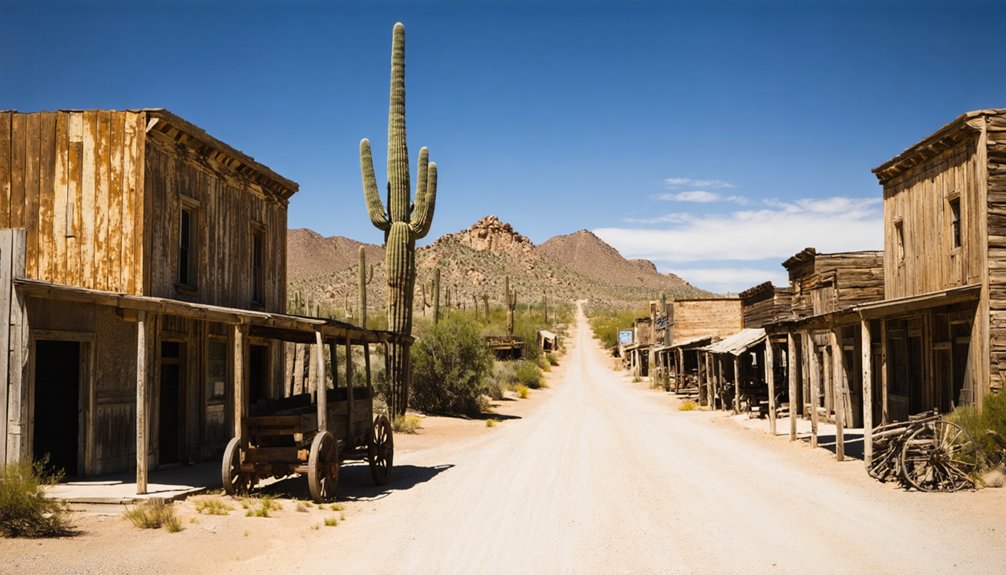
Your journey through Vulture City unfolds across 16 meticulously restored 1800s buildings, each one offering an authentic glimpse into the daily lives of Arizona’s gold rush pioneers. You’ll explore at your own pace during weekend guided tours from October to June, where interpretive signage quality enhances your understanding of this once-thriving mining community.
Inside, period furnishings authenticity transports you back—wood-burning stoves in the cookhouse, miners’ personal belongings, and photo documentation revealing the town’s transformation from abandonment to restoration. Your guide shares hands-on gold mining education while leading you past structures that witnessed 340,000 ounces of gold extraction. The two-hour experience accommodates all mobility levels, letting you step freely through history where Henry Wickenburg’s 1863 discovery sparked Arizona’s remarkable gold rush era.
Restored Structures and Historic Buildings You’ll Explore
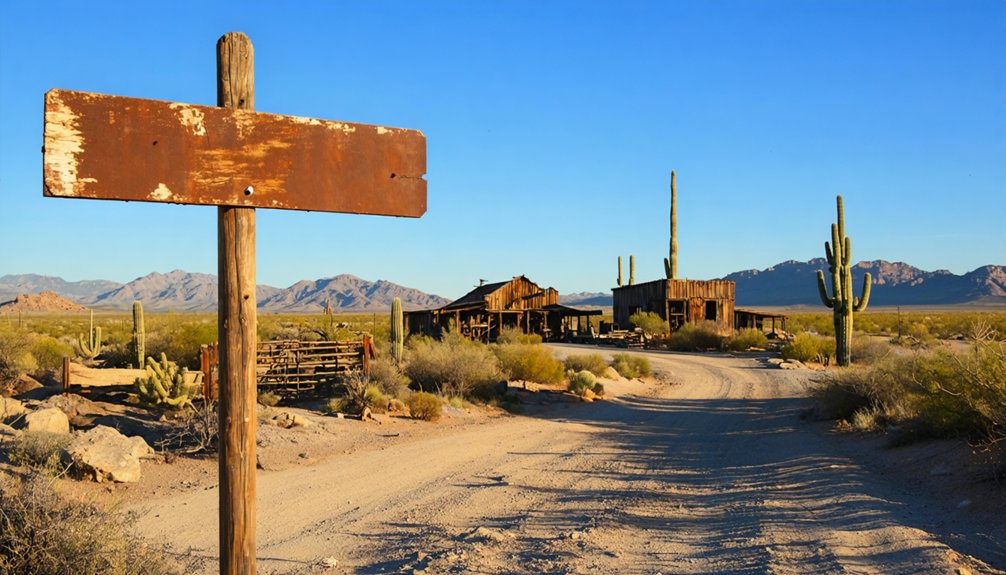
As you step onto Vulture City’s dusty streets, sixteen meticulously restored 1800s buildings stand before you like sentinels of Arizona’s gold rush past. You’ll wander freely through the Assay Office, where living quarters blend seamlessly with work facilities, showcasing authentic frontier furnishings recovered from the site itself.
The adobe-walled brothel reveals intimate details of frontier life through period interior design and mining artifacts. Inside the Blacksmith Shop, historians and tradespeople have preserved tools exactly where miners once forged them. The Cookhouse’s mess hall, rebuilt from historic maps, tells stories of communal meals shared after long shifts underground.
Each structure—meticulously stabilized during 2017’s restoration—offers an unfiltered glimpse into the gritty reality of 1800s mining life, letting you explore Arizona’s untamed history at your own pace.
The Hanging Tree and Tales of Frontier Justice
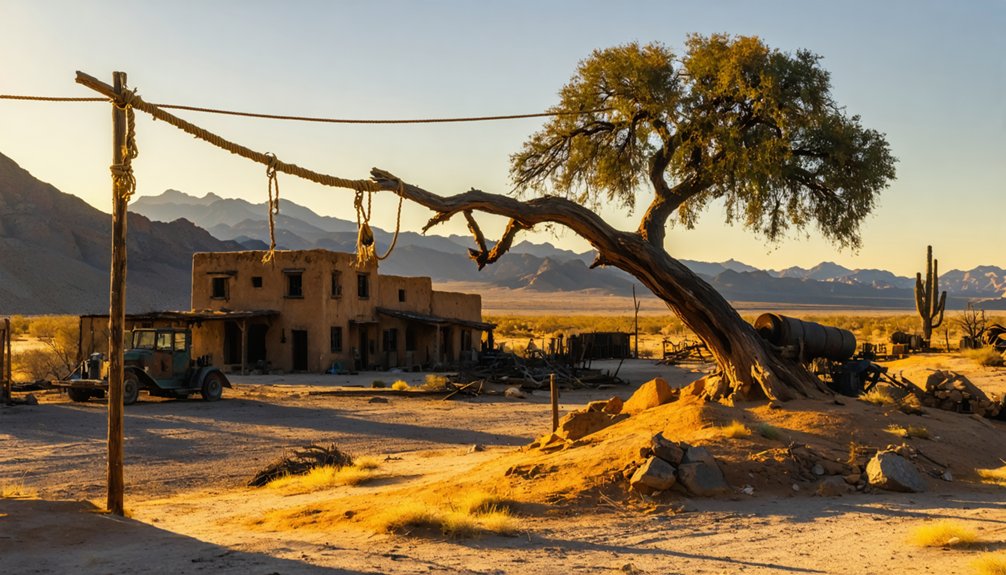
The gnarled ironwood tree standing beside Henry Wickenburg’s crumbled cabin holds Vulture City’s darkest legacy—a makeshift gallows where eighteen men allegedly met their end between the 1860s and 1900. You’ll find a rope noose still dangling from its branches, a chilling reminder of vigilante justice in this lawless mining camp.
Without formal law enforcement, miners dispensed their own brutal brand of frontier order. High graders caught stealing gold ore faced swift corporal punishments—death by hanging. Bodies dangled for hours before decomposing where they swung, eventually buried near the execution site.
While no official records verify these claimed hangings, you’ll feel the weight of these dark tales as you stand beneath the weathered branches, imagining the desperate men who died for pocketing someone else’s fortune.
Gold Days, Haunted Events, and Authentic Wild West Experiences
Between 1863 and 1942, Vulture Mine‘s shafts yielded 340,000 ounces of gold and 260,000 ounces of silver—a fortune worth $200 million by today’s standards that transformed this remote Arizona Territory outcrop into the state’s richest gold strike. You’ll walk among remnants of 5,000 residents who once populated this boomtown’s saloons, brothels, and boarding houses during its lawless heyday.
After the 1942 wartime closure, ghost town lore took root. Prospector scavenging and Depression-era rushes created eerie resurgence stories that still echo through weathered structures. You’ll sense the restless energy linked to founder Henry Wickenburg’s tragic suicide—a darkness that permeates the desert-worn buildings. The 2017 restoration preserved authentic Wild West details while maintaining the spectral atmosphere that draws modern adventurers seeking unfiltered frontier history.
The Rise, Fall, and Resurrection of a Mining Boomtown
Circling overhead in 1863, vultures led Henry Wickenburg to a quartz outcropping that would become Arizona’s most legendary gold strike. You’ll discover how the Vulture Mine transformed frontier lifestyles, growing from a 12-acre garden supporting 150 workers to a 5,000-resident boomtown complete with saloons, boarding houses, and brothels.
By the 1880s, it stood as Arizona’s richest gold mine, fueling Phoenix’s growth through irrigation canals and grain routes.
Political intrigue surfaced when the Territory of Arizona seized the property for back taxes in 1894. Wickenburg died penniless in 1905, while the mine produced over $30 million through intermittent operations until Roosevelt’s 1942 wartime closure. Today’s preservation efforts honor this ghost town’s resurrection, protecting Arizona’s most productive gold mine site.
Separating Myth From Reality: the True Story Behind the Legends
Vultures circled—or so the legend claims—but historical records tell a different story about Wickenburg’s 1863 discovery. You’ll find surviving legends at Vulture City that deserve scrutiny. The mine’s actual production numbers prove impressive enough without exaggerated accounts inflating revenue from $30 million to $200 million.
Reality Check: What Actually Happened
- The Discovery: Wickenburg likely followed scavenging birds—a common prospecting technique—not vultures dramatically circling gold
- The Hanging Tree: Eighteen executions occurred, though guilt wasn’t always proven in this lawless camp
- Henry’s Fortune: Despite discovering Arizona’s richest mine, Wickenburg died destitute after selling early
- Production Records: 340,000 ounces of gold confirmed the mine’s dominance without embellishment
These verified facts paint a compelling enough picture without Hollywood’s polish.
Practical Information for Planning Your Visit to Vulture City
Planning ahead makes all the difference when you’re mapping out your desert ghost town adventure. Vulture City welcomes explorers seasonally from October 2nd through May 17th, 9AM-5PM daily, except Wednesdays. You’ll find the remote site at 36610 355th Ave in Wickenburg—budget extra time for the winding desert roads that reward you with untouched Arizona wilderness.
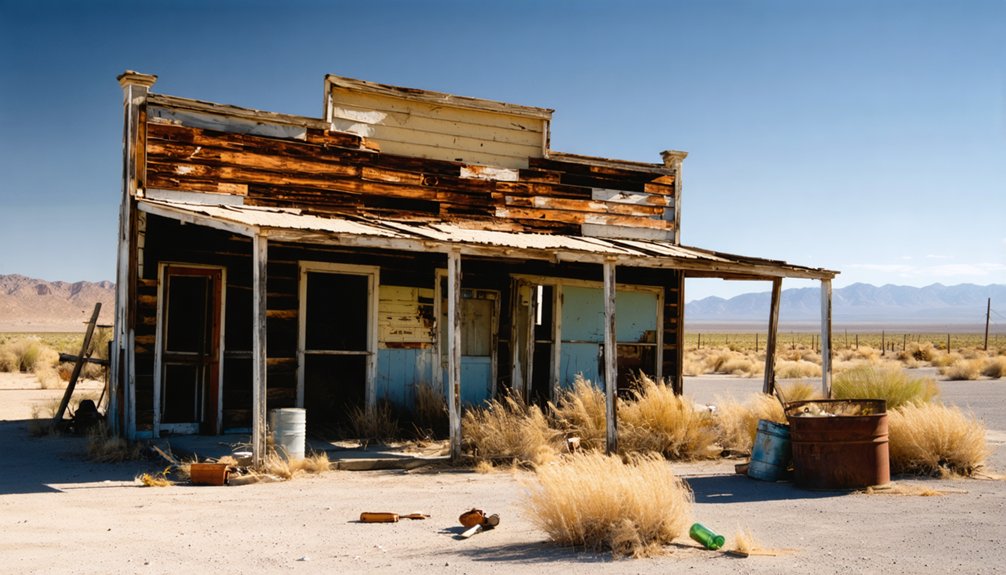
As you wander through the eerie landscape, you might find yourself captivated by the stories embedded in the walls of the dilapidated buildings. Exploring vulture city’s ghostly remnants reveals secrets of its storied past, each corner echoing the whispers of those who once thrived in this once-bustling settlement. Don’t forget your camera, as the haunting beauty of the desert contrasts stunningly with the ruins left behind.
Self-guided tours let you roam freely through 18 restored 1800s structures at your own pace, from the assay office to the notorious brothel. Adults pay $18, seniors and groups $15, kids $10.
Want something different? Special event access includes haunted flashlight tours after dark, Gold Days celebrations, and seasonal festivities like Christmas in the Desert. Try your hand at gold panning or blacksmithing workshops for authentic frontier experiences.
Frequently Asked Questions
What Are the Admission Prices and Operating Hours for Vulture City?
You’ll pay $15 for adults, $7 for kids 7-11, while under 6 enter free. Hours run 9 AM-3 PM weekdays, 9 AM-5 PM weekends, preserving this town’s historical significance and cultural preservation for your exploration.
Are Children Allowed on the Tours and Is It Family-Friendly?
Young adventurers will strike gold here! You’ll discover suitable activities like gold-panning and Old West shows welcoming all ages. On-site amenities include shaded picnic areas and food trucks, making your family’s ghost town exploration comfortable and memorable.
Can Visitors Bring Pets to Vulture City Ghost Town?
You’ll find Vulture City welcomes your four-legged companions with pet friendly amenities throughout the grounds. Just follow the leash requirements, keeping your dog secured while exploring the authentic 1800s buildings at your own adventurous pace.
Is Photography Permitted During the Guided Tours and Events?
Yes, photography’s fully permitted during guided tours and events without restrictions. Tour photography policies welcome all skill levels and equipment, while photography requirements are minimal—just bring your camera and explore freely through authentic 1800s buildings.
What Should Visitors Wear and Bring for the Desert Walking Tour?
Like a desert wanderer, you’ll need comfortable walking shoes, long sleeves, and proper sun protection—SPF 50+ sunscreen, wide-brim hat, and sunglasses. Pack a gallon of water per person to conquer this untamed terrain freely.
References
- https://www.visitarizona.com/directory/vulture-city-ghost-town
- https://vulturecityghosttown.com/history/
- https://vulturecityghosttown.com/blog/abandoned-america/
- https://westernmininghistory.com/towns/arizona/vulture-city/
- https://vulturecityghosttown.com/about-us/
- https://roadtrippers.com/magazine/vulture-city-ghost-town-restored/
- https://en.wikipedia.org/wiki/Vulture_City
- https://www.atlasobscura.com/places/vulture-city-ghost-town
- https://www.rome2rio.com/s/Phoenix/Wickenburg
- https://outwickenburgway.com/about-wickenburg/directions/