You’ll leave US-54’s pavement behind for ten miles of gravel roads winding past abandoned farmsteads to reach Waterloo on Smoot’s Creek. Look for the faded water tower marking this 1879 settlement where railroad dreams died when tracks bypassed the town for Murdock. Pack printed directions since cell service disappears in these low-traffic townships, and avoid visiting after rain—you risk getting stuck. The crumbling limestone schoolhouse, defiant 1924 Catholic church, and weathered grave markers dating to 1887 await your discovery, along with fascinating stories about what drove this community’s rise and ultimate abandonment.
Key Takeaways
- Navigate 10 miles of gravel roads from US-54; bring printed directions as cell service is unreliable in remote townships.
- Visit after dry weather to avoid getting stuck; seasonal rain or snow makes roads impassable on wind-swept plains.
- Explore the 1924 Catholic church, historic cemetery with markers from 1887, and limestone schoolhouse turned cattle corral.
- Combine your trip with nearby ghost towns: Lerado, Castleton (1952 film location), and Wilson’s 24 limestone buildings.
- Look for the faded water tower and grain elevator remnants marking Waterloo’s location on Smoot’s Creek.
The Rise and Fall of a Pioneer Settlement
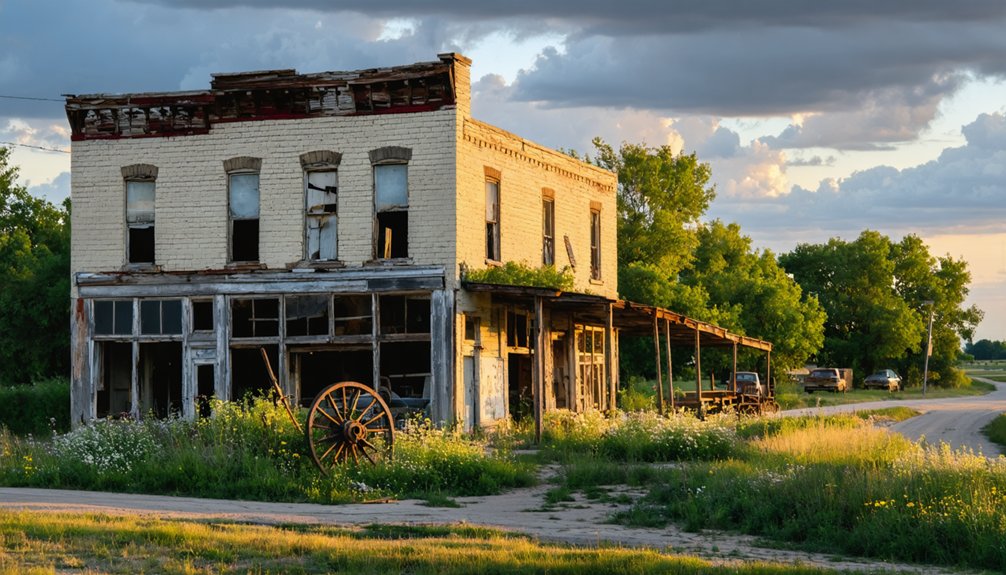
The wind-swept plains of Kingman County witnessed the birth of Waterloo in 1879, when pioneers filed the village plat on July 7th. You’ll discover how this way-station transformed into a bustling community, fueled by dreams of railroad prosperity that never materialized.
Railroad dreams drew settlers to Waterloo’s windswept prairie in 1879, but prosperity remained forever just beyond the horizon.
When the rail line bypassed Waterloo for Murdock five miles south, the town’s failed economic aspirations sealed its fate. By 1924, residents still invested in a modern brick schoolhouse, hauling materials by team from Murdock—testament to their stubborn determination.
Yet seasonal weather impacts proved merciless. Strong winds scoured the open plains after settlers plowed the protective prairie sod, driving families away. Without railroad connections, economic isolation strangled growth.
Today, you’ll find only remnants of that pioneer spirit scattered across abandoned foundations.
What Remains at the Waterloo Ghost Town Site
Standing amid the windswept grasslands today, you’ll find Waterloo’s skeletal remains tell stories of defiant hope and inevitable surrender. The limestone schoolhouse still guards its original ground—too heavy for settlers to move, now a hollowed cattle corral with crumbling limestone structures where children once learned. You’ll discover preserved grave markers west of town, the oldest dating to 1887, though many inferior stones have returned to dust.
The 1924 Catholic church defies abandonment, serving a handful of faithful with bricks hauled from Murdock by wagon. A former schoolhouse breathes as someone’s home. Hidden away, the Riggs Arboretum towers over everything—trees exceeding 100 feet, the West’s oldest arboretum, privately owned and off-limits. You can’t enter, but you’ll understand: some legacies choose their own keepers.
Getting There: Directions and Road Conditions
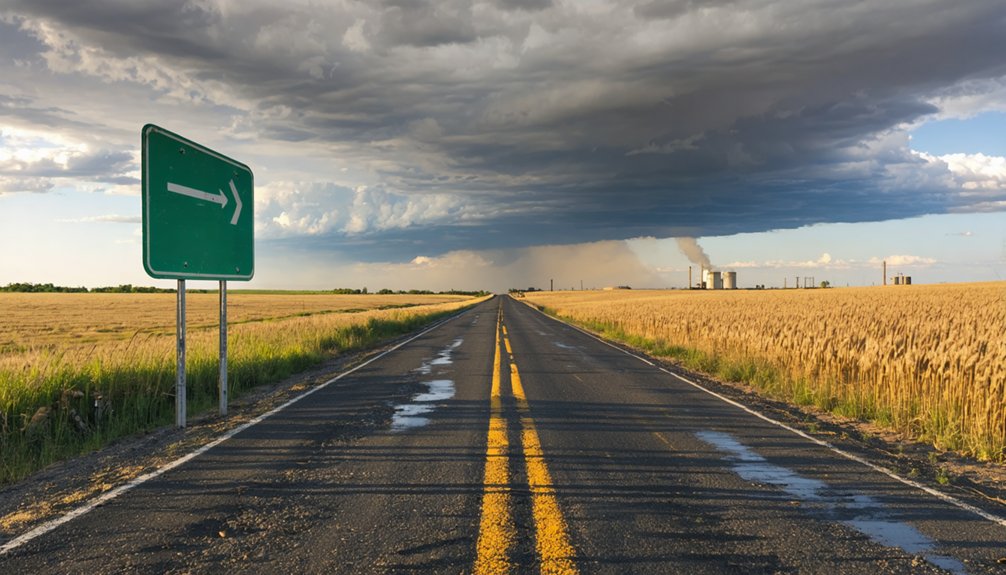
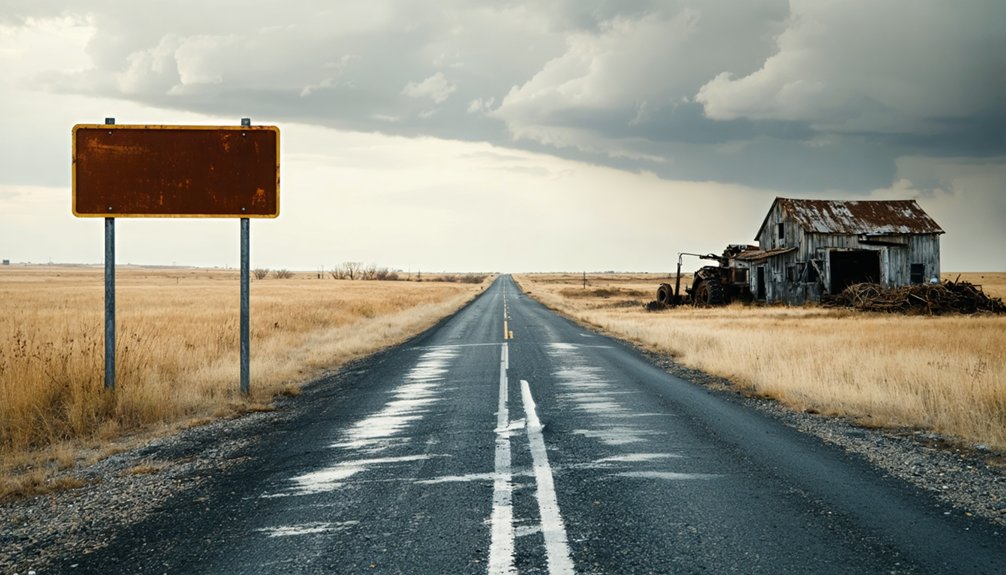
You’ll leave the paved comfort of US-54 behind, turning onto county roads that narrow into gravel tracks threading between abandoned farmsteads and wheat fields stretching to the horizon. Watch for the faded water tower or remnants of grain elevators—these skeletal landmarks often mark where Waterloo once thrived, though your GPS may stubbornly insist you’re in the middle of nowhere.
Pack printed directions as backup; cell service grows spotty as you venture deeper into these low-traffic townships where the only traffic you’ll encounter might be a combine harvester during planting season.
Since Waterloo sits ten miles northeast of Kingman in the remote stretches of Galesburg Township, you’ll need to embrace several miles of gravel roads to reach this ghost town perched on the eastern bank of Smoot’s Creek. Take it slow—five miles per hour lets you scan for ruts and road hazards without risking your suspension.
The rock roads see minimal maintenance, so you’re proceeding at your own risk out here. Seasonal accessibility becomes critical after rain or snow, when conditions deteriorate fast. Getting stuck means waiting hours for a tow truck with spotty cell signal.
I’ve watched thick dust layers coat my windshield on dry days, while strong winds whip across the open plains. Navigate carefully, watch for creek crossings, and you’ll find freedom in these forgotten corners where highways never reached.
Nearby Landmarks and Routes
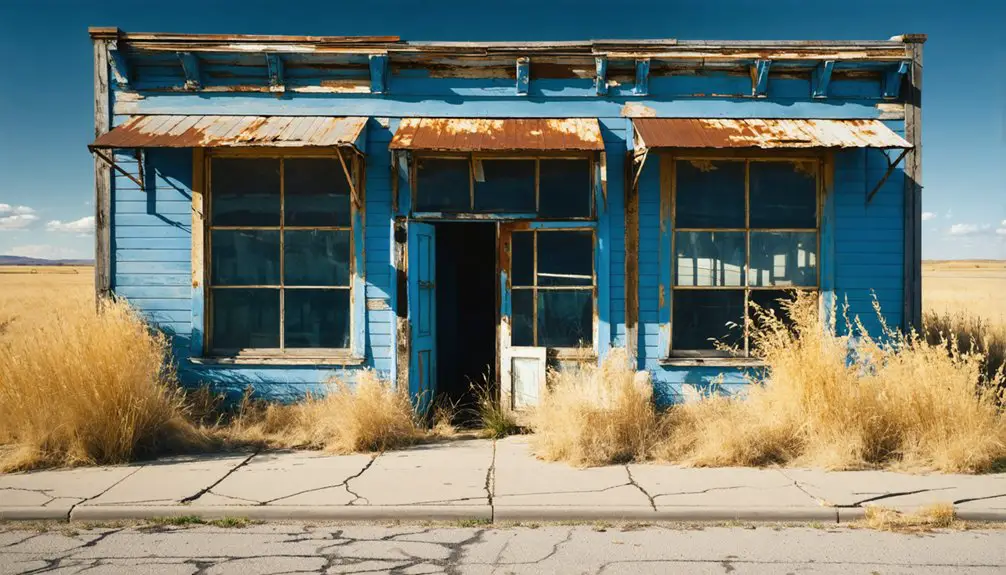
Beyond the rutted gravel approaches to Waterloo itself, a network of forgotten settlements dots Kingman County’s prairie landscape, each connected by windswept roads that tell Kansas’s settlement story in abandoned storefronts and empty lots.
Your route should include Lerado’s scenic approaches, where nature’s reclaimed the sidewalks, and Castleton—famous as a 1952 film location. Marshall’s demise lies visibly along those same railroad tracks that promised prosperity but delivered abandonment. These transportation evolution markers crisscross your path repeatedly, physical reminders of why some towns thrived while others died.
I’ve found Wilson’s 24 limestone buildings worth the detour, plus there’s an Atlas Ad Astra Missile Silo nearby. The abandoned infrastructure becomes your roadmap—follow those rail corridors where optimism once ran on steel wheels, now returned to prairie silence.
Historic Churches and Religious Heritage
You’ll discover Waterloo’s spiritual roots run deep through three denominations that once called this prairie settlement home—though today only St. Louis Catholic Church remains standing. The Catholics rebuilt their church twice after wind destroyed the first frame structure before its 1882 dedication, finally erecting the current $3,500 building in 1901 that still anchors the community.
Walk northeast to find the single cemetery where Presbyterians, Catholics, and a third denomination rest together, a quiet monument to pioneers who first gathered for worship in each other’s homes before raising proper church buildings.
Three Denominations, One Cemetery
The weathered gravestones in Waterloo’s cemeteries tell stories of a community once served by three distinct denominations—Presbyterian, Methodist, and Catholic—each contributing to the town’s spiritual fabric. You’ll find 336 memorial records in Waterloo Cemetery on the town’s northeastern edge, while Lebanon Cemetery holds 357 souls and Saint Louis Cemetery preserves 236 Catholic burials. Despite denomination membership trends that ultimately closed the Methodist church in 1929 and forced the Presbyterian building’s sale in 1959, these congregations shared more than faith—they shared final resting places.
Walk among the markers and you’ll discover shared cemetery management that transcended religious boundaries, reflecting frontier practicality where survival mattered more than denominational differences. These grounds remain accessible, offering tangible connections to Waterloo’s vanished congregations.
Catholic Church Rebuilt Twice
When ambitious Catholic settlers raised their first St. Louis Catholic Church in 1882, they couldn’t imagine wind would destroy it before dedication. But frontier determination runs deep—they rebuilt immediately, then constructed today’s $3,500 structure in 1901 under Fr. Alexis Centner’s direction.
You’ll appreciate the community rebuilding efforts evident throughout:
- 1924 two-story brick school hauled from Murdock by wagon, sand from Smoots Creek
- $300 family pledges (many gave more), clearing debts by completion
- $400 antique bell from Mackville enhancing architectural features
- Ground-built steeple crane-lifted into place by Chick Smarsh
The church stands remarkably unchanged since 1971, an enduring monument to settlers who wouldn’t let setbacks define them. They simply rebuilt better each time.
Presbyterian Services in Homes
While Catholics rebuilt their churches with stubborn resolve, Pleasant Valley Presbyterians took a different path—they worshiped in each other’s living rooms for fourteen years. Imagine gathering around a neighbor’s fireplace in 1878, singing hymns where supper dishes usually sat. This home based worship wasn’t laziness; it reflected the reality of pioneer life and small population size.
You’ll find this pattern throughout Kansas ghost towns—folks made do with what they had. The Presbyterians established their congregation on February 25, 1878, two years before Waterloo officially existed. They rotated between member homes, creating intimate services that brought genuine community together. Not until 1892 did they raise a permanent structure. That church stood until December 1959, when declining membership forced its sale—ending an eighty-one-year chapter of prairie faith.
The Railroad That Changed Everything
Victory and defeat hung in the balance as two Kansas towns faced off for their economic futures in the early 1880s. You’ll discover how railroad competitions between Waterloo and Murdock determined which settlement would thrive. When Murdock secured the depot in 1883, Waterloo’s dreams of nursery tree shipments and crop distribution vanished.
The 1883 railroad decision between Waterloo and Murdock sealed one town’s prosperity and condemned the other to abandonment.
By 1885, you’d have witnessed a community adapting to its railroad-less fate:
- Riggs nursery cultivated 12,000 trees with no efficient shipping method
- Local haulers created jobs transporting nursery stock by wagon
- Abundant crops rotted without rail access to markets
- New settlers bought land directly instead of homesteading
The railroad that never arrived changed everything—transforming what could’ve been a bustling trade hub into the ghost town you’ll explore today.
Riggs Arboretum: A Unique Attraction Among the Ruins
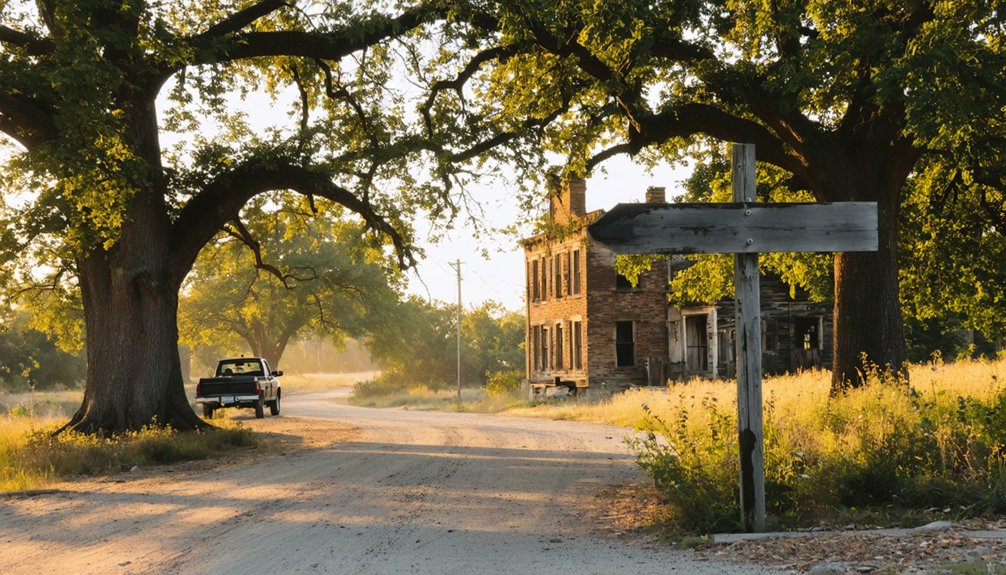
Among Waterloo’s crumbling foundations and abandoned streets, you’ll stumble upon an unexpected marvel—a thriving forest that shouldn’t exist on the Kansas plains. John Water Riggs created this secret sanctuary in the late 1800s, importing cedars of Lebanon, Australian exotics, and Nile lotus to prove rare species could survive here. His naturalistic landscape design transformed 35 acres into America’s smallest arboretum with the biggest story.
Today, descendants preserve what fire couldn’t destroy in 1930—towering bald cypress and sequoias that’ve weathered over a century. These historic preservation efforts maintain Kansas’s oldest, least-known arboretum west of the Mississippi. You won’t find a gift shop or admission fees here, just living proof that beauty persists when everything else crumbles. It’s pure freedom—nature reclaiming what civilization abandoned.
Barrett Cemetery and Final Resting Places
The worn headstones at Barrett Cemetery tell stories that Waterloo’s residents never could—this burial ground in nearby Frankfort became the final chapter for pioneers who watched their dreams of thriving prairie towns fade into Kansas soil. You’ll find 178 documented souls here, their genealogical records spanning from the 1850s through today.
Notable burials that capture the Free State spirit:
- Sarah Alderdice (1845–1883) – survived the turbulent settlement years
- Flora Bell Barcus (1868–1894) – died young in an unforgiving landscape
- G.H. Hollenberg – community founder who staked his claim
- Civil War-era settlers who chose freedom over compromise
FamilySearch maintains driving directions and searchable databases, letting you trace connections between these ghost town pioneers and your own wandering soul.
Photography Opportunities and Landmarks
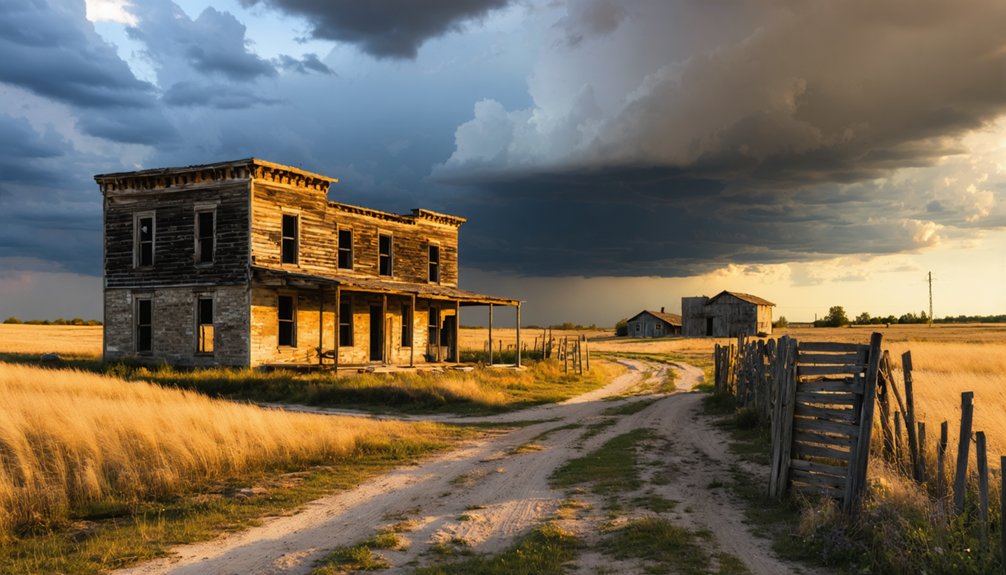
Beyond the cemetery gates, your camera finds new purpose among Waterloo’s living monuments—the towering specimens of Riggs Arboretum, where cedars of Lebanon cast shadows across Kansas prairie like they’ve bridged continents through sheer will.
The botanical collections reward patient exploration: sequoias reaching skyward, Palestinian olives adapting to heartland soil, magnolias defying conventional growing zones.
Smoot’s Creek provides your compositional anchor, especially during golden hour when water catches light between creek-bank vegetation. The converted schoolhouse and forester’s residence frame perfectly against rolling farmland—structures that’ve outlasted the town itself.
For aerial photography, launch near the ten-acre arboretum to capture how civilization and wilderness negotiate their boundaries. Drone footage reveals patterns invisible from ground level: foundation rectangles beneath prairie grass, the arboretum’s deliberate geometry interrupting natural chaos.
Nearby Ghost Towns Worth Exploring
Waterloo anchors a constellation of abandoned settlements within thirty miles, each telling variations of the same prairie tragedy—dreams built on railroad promises that never materialized.
You’ll discover regional variations in ghost town culture across these sites:
- Marshall (1870s): Residents literally picked up their buildings and moved them two miles south when tracks bypassed the town—entire structures relocated to chase prosperity.
- Lerado: Minimal structures remain, but the scenic drive through rolling prairie offers meditative solitude.
- Castleton: The most photogenic stop—preserved facades straight from a Western film set.
- Abbeyville: Houses Waterloo’s relocated Methodist Church (1929), a physical monument to consolidation.
Each location reveals different atmospheric quality across sites. You’ll find Marshall’s defiant resilience contrasts sharply with Lerado’s quiet surrender to time.
Frequently Asked Questions
Are There Any Facilities or Restrooms Available at the Waterloo Ghost Town Site?
No portable restrooms available and facilities limited at this abandoned site. You’ll find zero modern amenities—plan accordingly. Pack supplies and use Kingman’s services before venturing out. This authentic ghost town experience means embracing total self-reliance during your exploration.
What Is the Best Time of Year to Visit Waterloo Ghost Town?
Fall offers fabulous conditions for your freedom-seeking adventure. You’ll find ideal weather conditions with crisp 50s-70s temperatures, stunning foliage framing your exploration, and fewer crowds than peak tourist season spring—plus perfect light for capturing Waterloo’s haunting beauty.
Is Permission Required to Explore the Remaining Structures at Waterloo?
You’ll need permission since remaining structures likely fall under private property ownership. Respect local preservation efforts by contacting Kingman County Historical Society first. They’ll connect you with landowners who often welcome respectful visitors sharing their passion for history.
Can You Camp Overnight Near the Waterloo Ghost Town Location?
You can’t camp directly at Waterloo’s ghost town site, but you’ll find nearby camping options at Tuttle Creek State Park and C2T Ranch. These alternatives let you explore freely while respecting historical preservation efforts on private farmland.
Are There Guided Tours Available for Waterloo and Surrounding Ghost Towns?
No formal guided tours exist for Waterloo’s abandoned buildings, but you’re free to explore independently. Self-guided adventures let you discover local history at your own pace, wandering through weathered structures and forgotten streets without restrictions or schedules.